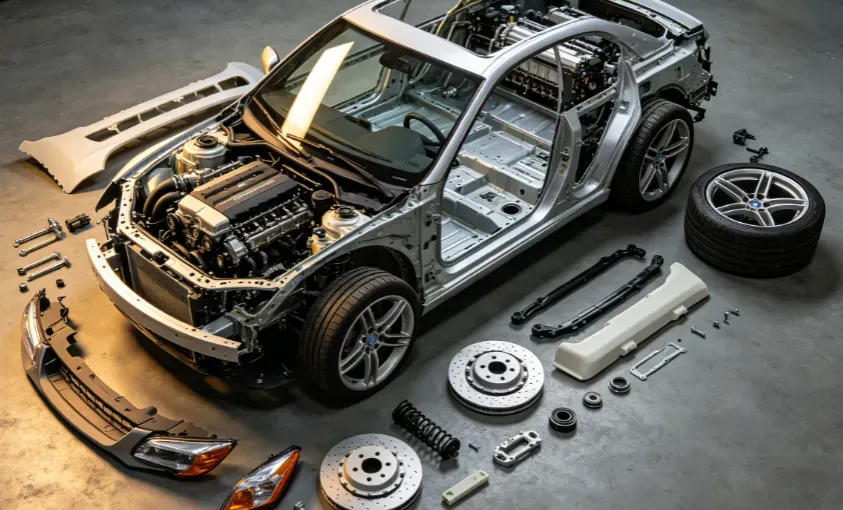
Canada imported over $8 billion worth of auto parts in 2025, with China ranking among the top three foreign suppliers. If you are looking into shipping auto parts from China to Canada — whether brake rotors, engine components, EV batteries, or aftermarket body panels — you have probably already noticed the gap between your supplier’s FOB price and what it actually costs to get those parts into your warehouse. That gap can swallow your margin if you do not understand the full picture: freight costs, import duties, the China Surtax, packaging requirements, and Canada’s 2026 customs compliance rules. This guide closes that gap. By the time you finish reading, you will know exactly which shipping method fits your parts, what you will pay at every step, how to package correctly so nothing arrives damaged, and how to avoid the mistakes that cost other importers thousands.
At Dantful.US, we have spent 15+ years as a FIATA and IATA-certified freight forwarder based in Shenzhen, specializing in China-to-Americas logistics — including dedicated Shipping from China to Canada and Shipping from China to USA services. We have shipped thousands of auto parts containers to Canada — and we have seen every mistake an importer can make. This guide shares what we have learned.
How Much Does It Cost to Ship Auto Parts from China to Canada?
The first question every importer asks is about cost. The honest answer: it depends on how you ship, how much you ship, and what your parts are made of. Below is a realistic cost snapshot based on mid-2026 market rates.
Quick Cost Snapshot by Shipping Method
| Shipping Method | Cost Range (USD) | Per-Unit Equivalent | Best For |
|---|---|---|---|
| Sea Freight — FCL 20ft | $2,500–$4,500 | ~$0.15–$0.30/kg | Bulk orders ≥15 CBM |
| Sea Freight — FCL 40ft | $3,500–$7,500 | ~$0.10–$0.20/kg | Large-volume importers |
| Sea Freight — LCL | $70–$150 per CBM | ~$0.45–$0.90/kg | 1–14 CBM mixed shipments |
| Air Freight (100–500 kg) | $5.80–$7.20/kg | — | Urgent, high-value parts |
| Air Freight (1,000+ kg) | $4.95–$5.50/kg | — | Volume air freight |
| Express Courier (DHL/FedEx/UPS) | $6–$10/kg | — | Samples, small parcels |
These are base freight rates only. Per-kilogram rates vary significantly by mode — for a complete shipping cost from China to Canada per kg comparison, see our detailed rate guide. The full landed cost includes nine additional layers that first-time importers routinely underestimate.
The Full Landed Cost: 9 Layers Beyond Freight
| Cost Layer | Estimated Cost | Notes |
|---|---|---|
| ① Ocean/Air Freight | See table above | |
| ② Origin Charges (China) | $150–$400 | Terminal handling, documentation, export customs filing |
| ③ Marine Cargo Insurance | 0.2%–0.5% of cargo value | A $50,000 container costs $100–$250 to insure — cheap protection |
| ④ Destination Port Charges (Canada) | CAD $350–$800 | Terminal handling, security fees at Vancouver/Montreal |
| ⑤ Drayage (Port → Warehouse) | CAD $200–$600 | Trucking from port to your final destination |
| ⑥ Customs Brokerage | CAD $50–$150 per entry | Licensed broker fee for CBSA entry filing |
| ⑦ Import Duty (MFN) | 0%–7% of CIF value | Most auto parts at 6%; see HS code table in Section 5 |
| ⑧ China Surtax (if applicable) | 25% of duty value | Steel and aluminum auto parts since October 2024 |
| ⑨ GST + Provincial Tax | 5%–15% of (CIF + Duty) | Varies by province — Ontario 13% HST, BC 5% GST only |
Real-World Landed Cost Example
Let us put real numbers on this. A Toronto-based importer ships 3 CBM (800 kg) of brake rotors and suspension arms from Shenzhen to Toronto via LCL sea freight. (For larger shipments, see our 20 ft Container Shipping Cost from China to Canada breakdown.) Cargo value: $15,000 USD.
| Cost Item | Amount |
|---|---|
| Ocean freight (LCL: $120 × 3 CBM) | $360 |
| Origin charges (China) | $250 |
| Destination port charges + drayage (CAD ~$500) | ~$370 |
| Customs brokerage (CAD ~$100) | ~$75 |
| Import duty (MFN 6% × $15,000) | $900 |
| GST (5% × $16,270) | ~$814 |
| Total Landed Cost | ~$17,769 |
That is +18.5% over the FOB price. If you are comparing supplier quotes on different Incoterms, see our FOB shipping from China to Canada guide for a full breakdown of what FOB includes — and what it does not. Now here is the kicker: if those steel brake rotors are subject to the China Surtax (25%), add another $3,750. Your landed cost jumps to ~$21,519 — a 43.5% increase over FOB. This is why checking your HS codes against the SOR/2024-187 schedule before placing a purchase order is not optional. For a detailed breakdown of how much is shipping from China to Canada across different container sizes and shipping modes, see our dedicated cost guide.
FCL vs LCL vs Air Freight: What Is the Best Way to Ship Auto Parts from China to Canada?
Choosing the right shipping method is the single biggest cost-control decision you will make. It affects not just your freight bill, but also your transit time, cargo safety, and per-unit landed cost. Here is how the three options stack up for auto parts specifically.
Head-to-Head Comparison: Cost, Speed & Safety
| Factor | FCL (Full Container Load) | LCL (Less than Container Load) | Air Freight |
|---|---|---|---|
| Cost Efficiency | ⭐⭐⭐⭐⭐ ~$0.10–$0.30/kg | ⭐⭐⭐ ~$0.45–$0.90/kg | ⭐⭐ $4.95–$7.20/kg |
| Transit Speed | 18–35 days port-to-port | 22–45 days (+7–12 extra for consolidation) | 3–8 days door-to-door |
| Cargo Safety | ⭐⭐⭐⭐⭐ Exclusive container, zero shared handling | ⭐⭐⭐ Mixed cargo — heavy parts may crush lighter shipments | ⭐⭐⭐⭐ Minimal time in transit |
| Min Practical Volume | ≥15 CBM (or ~10 CBM for a 20ft) | 1–14 CBM | Any weight |
| Container/Unit | 20GP (28 CBM), 40GP (58 CBM), 40HQ (68 CBM) | Charged per CBM | Charged per kg |
Transit Times from China to Canada
| Route | Sea FCL (Port-to-Port) | Sea LCL (Port-to-Port) | Sea Door-to-Door* | Air Door-to-Door |
|---|---|---|---|---|
| Shenzhen → Vancouver | 18–22 days | 25–30 days | 25–32 days | 5–7 days |
| Shanghai → Toronto | 28–35 days | 35–42 days | 35–45 days | 6–8 days |
| Ningbo → Montreal | 32–38 days | 38–45 days | 38–48 days | 7–9 days |
| Guangzhou → Calgary | 22–28 days | 28–35 days | 28–38 days | 6–8 days |
*Door-to-door includes factory pickup (1–3 days) + export customs (1–2 days) + import clearance (1–5 days) + last-mile drayage (1–3 days). For a complete timeline breakdown by route, see How long does sea shipping take from China to Canada.
Real-world timeline — PO issued to goods at your Toronto warehouse: Factory production (15–30 days) → inland trucking to Shanghai port (2–3 days) → ocean transit (28–35 days) → CBSA customs clearance (2–5 days) → final trucking (2–3 days) = 49 to 76 days total. Plan accordingly.
Four Factors That Make or Break Your Timeline
- LCL consolidation: Adds 7–12 days. Your cargo waits at origin until enough shipments fill a shared container, then waits again for deconsolidation at the destination CFS (Container Freight Station).
- Port congestion: Vancouver Deltaport can backlog 3–7 days during peak season. Prince Rupert — approximately 500 nautical miles closer to Asia — averages faster turnaround and shorter rail connections to inland Canada.
- Customs clearance speed: A properly filed PARS (Pre-Arrival Review System) declaration gets release within hours. A document review adds 2–5 days. A physical examination adds 5–14 days.
- Seasonal crunch: Chinese New Year (January–February) and pre-Christmas peak (August–October) add 1–3 weeks. Book 3–4 weeks ahead during these windows.
Which Method for Which Auto Parts?
- Heavy steel parts (brake rotors, engine blocks, suspension arms, axles) → FCL strongly recommended. At $0.10–$0.20/kg, FCL is unbeatable for high-density cargo. The exclusive container eliminates the risk of heavy parts damaging other shipments — or being damaged themselves. For a detailed comparison of container options and rates, see our Sea Freight from China to Canada guide.
- Lightweight plastic parts (bumpers, grilles, interior trim, headlights) → LCL viable. Per-CBM pricing stays manageable for low-weight cargo. Specify top-layer stowage to avoid crushing. Learn more about LCL Shipping from China to Canada and when shared containers make sense for your shipment size.
- Electronic parts (ECUs, sensors, infotainment modules) → Air freight recommended. High value-to-weight ratio justifies the air premium. These components are sensitive to the humidity and temperature swings of a 30-day ocean crossing. For rate benchmarks, see our Air freight from China to Canada page.
- EV batteries → Sea freight with DG (Dangerous Goods) declaration. Air freight severely restricts lithium batteries above 100 Wh. All lithium batteries require UN 38.3 test certification and Class 9 DG paperwork regardless of mode.
- Oversized body parts (bumpers, exhaust systems, body panels) → FCL or breakbulk. These parts waste space in LCL — you pay per cubic meter, and a hollow bumper box takes up volume you get charged for.
Key Ports & Routes
China departure: Shenzhen (Yantian/Shekou), Shanghai (Yangshan), Ningbo, Guangzhou (Nansha), Qingdao.
Canada arrival: Vancouver (Deltaport) handles the highest volume. Prince Rupert is approximately 500 nautical miles closer to Asia — saving roughly 60 hours at sea — and offers faster rail connections to Edmonton, Calgary, and Toronto. Montreal and Halifax serve eastern Canada via the Panama Canal route (40–55 days). For a comprehensive map of all major Shipping Routes from China to Canada, see our dedicated route guide.
Door to Door Shipping Auto Parts from China to Canada: The Step-by-Step Process
For importers who want a single point of contact rather than coordinating four or five different vendors, door-to-door shipping — especially under DDP (Delivered Duty Paid) terms — is the standard choice. For a complete walkthrough of this process, see our How to Ship from China to Canada: Step-by-Step guide. Here is exactly how the process works.
The 8-Step Door-to-Door Journey
Step 1 — Factory Pickup (China): Your freight forwarder arranges trucking from the supplier’s factory to the export warehouse or port. If you use multiple suppliers, consolidate all cargo at one warehouse before container loading. (1–3 days)
Step 2 — Export Documentation & China Customs Clearance: The forwarder prepares the commercial invoice, packing list, and export customs declaration. China export customs reviews and releases the shipment. (1–2 days)
Step 3 — Origin Handling & Container Loading: Cargo is warehoused, palletized, and loaded into the container. For LCL shipments, cargo moves to a CFS (Container Freight Station) for consolidation with other shipments bound for Canada.
Step 4 — Main Carriage (International Transport): The container boards a vessel at Yantian, Yangshan, or another major port. Ocean transit runs 18–35 days depending on destination. Air freight takes 3–8 days. Track your shipment via vessel AIS or your forwarder’s online portal.
Step 5 — Arrival at Canadian Port/Airport: The container is discharged at Vancouver, Prince Rupert, Montreal, or Halifax. For air freight, cargo arrives at Toronto Pearson (YYZ) or Vancouver International (YVR).
Step 6 — Canada Import Customs Clearance (CBSA): Your customs broker files the PARS pre-arrival declaration. CBSA assesses duties and taxes. This is where CARM (CBSA Assessment and Revenue Management) registration and your RPP (Release Prior to Payment) bond become mandatory — without them, CBSA will not release your goods.
Step 7 — Destination Handling: For FCL, the container goes directly to your warehouse via drayage truck. For LCL, the shipment must first be deconsolidated at the destination CFS, then trucked separately.
Step 8 — Last Mile Delivery: Final trucking to your warehouse, dealership, distribution center, or Amazon FBA facility. (1–3 days)
DDP vs DDU: Which One Should You Choose?
| DDP (Delivered Duty Paid) | DDU (Delivered Duty Unpaid) | |
|---|---|---|
| Who pays duties? | Forwarder pays all duties and taxes upfront — included in your all-in quote | You pay CBSA directly at time of entry |
| CARM requirements | Forwarder coordinates with your CARM account | You manage CARM, RPP bond, and payment yourself |
| Best for | First-time importers, SMEs, Amazon sellers | Large importers with in-house customs teams |
| Cost predictability | ✅ All-in quote, no surprises | ⚠️ Final cost depends on CBSA assessment |
Dantful.US provides true door-to-door DDP service to Canada — one dedicated account manager handles your entire shipment from your supplier’s factory in Guangzhou to your warehouse in Toronto, including all duties and taxes paid upfront.
HS Codes, Customs Clearance & Import Duties on Auto Parts from China to Canada
Customs clearance is where most auto parts importers encounter their first expensive surprise. The difference between a shipment clearing in hours versus being held for weeks often comes down to two things: correct HS (Harmonized System) code classification and detailed commercial invoices.
Auto Parts HS Code Quick Reference
| HS Code | Part Category | MFN Duty | China Surtax (25%)? | SIMA Risk? |
|---|---|---|---|---|
| 8708.30 | Brakes (pads, rotors, calipers, drums) | 6% | Yes — if steel | Possible |
| 8708.40 | Gearboxes & transmissions | 6% | Possible — if steel housing | Low |
| 8708.50 | Drive axles with differential | 6% | Yes — steel axles | Possible |
| 8708.80 | Suspension (shocks, struts, control arms, springs) | 6% | Yes — steel springs/arms | Possible |
| 8708.91 | Radiators | 6% | Possible — if aluminum | Low |
| 8708.92 | Exhaust pipes, silencers, catalytic converters | 6% | Yes — steel exhaust | Possible |
| 8708.93 | Clutches & parts | 6% | Possible | Low |
| 8708.94 | Steering wheels, columns, boxes | 6% | Possible | Low |
| 8708.99 | Other parts (sensors, body trim, brackets) | 0%–6% | Depends on material | Depends on product |
| 4011.10 | Tires (passenger vehicles) | 7% | No | Low |
| 8507.60 | EV lithium-ion batteries | 0%–7% | No | Low |
| 7318.15 | Steel fasteners (bolts, nuts, screws) | 0%–8% | Yes (25%) | Yes — up to 150%+! |
Deadly Trap #1 — The China Surtax (25%)
Since October 2024, under SOR/2024-187, a 25% surtax applies to Chinese-origin steel and aluminum products — and that includes auto parts made primarily of these materials. This surtax stacks on top of the standard MFN (Most-Favored-Nation) duty rate. It is not a replacement.
Real example: $10,000 CAD worth of steel brake rotors (HS 8708.30) → $600 MFN duty (6%) + $2,500 China Surtax (25%) = $3,100 in duties before GST.
Action: Check every HS code against the SOR/2024-187 Schedule before placing your purchase order. A licensed customs broker can do this in minutes.
Deadly Trap #2 — SIMA Anti-Dumping Duties (up to 150%+)
CBSA maintains active SIMA (Special Import Measures Act) measures on Chinese steel fasteners, aluminum extrusions, and certain fabricated steel products. Anti-dumping duties can exceed 150% — potentially more than the goods themselves are worth.
The real risk area for auto parts importers: steel bolts and nuts (HS 7318.15), steel brackets, and structural steel components. Always check the CBSA SIMA active measures list for every new SKU before ordering from China. If you are unsure, request an advance tariff ruling from CBSA under memorandum D11-11-3 — it is binding and eliminates uncertainty.
The 4-Step CBSA Customs Clearance Process
- Pre-Arrival Filing (PARS): Your customs broker submits the B3 entry with commercial invoice, packing list, Bill of Lading (B/L), and Certificate of Origin while the shipment is still in transit. Do not wait until the container arrives.
- CBSA Risk Assessment: CBSA assigns one of three outcomes — Released (fastest, most shipments), Document Review (2–5 day delay), or Physical Examination (5–14 day delay).
- Duty & Tax Payment: Duty = MFN rate × CIF value (in CAD). GST = 5% × (CIF + Duty). Payment is processed through the CARM portal.
- Release: Goods are cleared for drayage to final destination.
One critical note: “Auto parts” as a line-item description on a commercial invoice is a red flag that triggers CBSA document review almost automatically. Compare these two descriptions:
- ❌ “Auto parts — $5,000”
- ✅ “Steel brake rotor, passenger vehicle, HS 8708.30, $25/unit × 200 pcs”
The first gets held. The second gets released.
Canada Import Regulations for Auto Parts: CARM, Surtax & Compliance
Canadian import regulations changed significantly in 2024–2025, and 2026 is the year full compliance becomes the norm. Here is what every auto parts importer must have in place before their first container sails.
CARM Compliance — 3 Mandatory Steps
CARM (CBSA Assessment and Revenue Management) is now mandatory for all commercial importers. Without it, there is no customs clearance — period.
- Register on the CARM Client Portal at carm.cbsa-asfc.gc.ca.
- Obtain your BN15 — the 15-digit Import/Export Account number from the CRA (Canada Revenue Agency).
- Post your RPP (Release Prior to Payment) bond. Under CARM, importers must secure their own financial guarantee. You can no longer rely on your customs broker’s bond.
Registration takes 5–10 business days. Start this process before your first shipment sails — not when your container is already sitting at Deltaport.
Transport Canada Safety Compliance (CMVSS)
Safety-critical auto parts sold in Canada must comply with CMVSS (Canadian Motor Vehicle Safety Standards). This applies to:
- Brake systems — CMVSS 105/135
- Lighting equipment — CMVSS 108
- Tires — CMVSS 109/119/139
- Steering components, seat belts, and glazing (windshields)
Non-compliant safety parts can be seized by CBSA or ordered re-exported at your expense. Always request CMVSS compliance documentation from your Chinese supplier before ordering safety-related components.
EV Parts — Extra Rules Apply
Lithium-ion EV batteries are classified as Class 9 Dangerous Goods. For detailed requirements on shipping batteries from China to Canada, including UN 38.3 certification and packaging standards, see our dedicated dangerous goods guide. Requirements include:
- UN 38.3 test certification (mandatory for all lithium batteries)
- DG declaration for both sea and air freight
- Air freight watt-hour limits: typically ≤100 Wh per battery without special approval
- Sea freight is the standard and recommended route for EV battery shipments
EV motors, controllers, and charging modules generally fall under standard Chapter 8708 or 8501/8504 and ship as non-DG cargo.
Other Compliance Essentials
- ISPM-15: All solid wood packaging (pallets, crates, dunnage) must be heat-treated to 56°C core temperature for 30 minutes and bear the official IPPC stamp. Non-compliant wood = the entire shipment refused at port. No exceptions.
- Used auto parts: Face additional CBSA scrutiny. May require cleaning certificates and environmental compliance documentation. Duty treatment may differ from new parts.
- Counterfeit parts: CBSA actively seizes counterfeit branded auto parts. Verify your Chinese supplier’s legitimacy before ordering branded components.
- Provincial tax differences: Ontario (HST 13%), British Columbia (GST 5% only), Quebec (GST 5% + QST 9.975%), Alberta (GST 5% only). Your effective tax rate varies by up to 10% depending on your import province.
How to Package & Protect Auto Parts for Safe International Shipping from China
This is the topic no competitor covers — and it is the one that costs importers the most when ignored. Ocean containers spend 30+ days at sea with extreme humidity and temperature swings. Bare steel rusts. Unsecured heavy parts shift. Poorly crated body panels crack. One damaged pallet can wipe out the profit on an entire container.
Rust Prevention — VCI Is Mandatory for Steel Parts
VCI (Vapor Corrosion Inhibitor) is the industry standard for protecting ferrous metals during ocean transit. VCI molecules form an invisible protective layer on metal surfaces that prevents rust for 12–24 months.
- Wrap individual steel parts in VCI paper or VCI poly bags
- Wrap entire pallets in VCI stretch film
- Add desiccant packs inside sealed packaging to absorb residual moisture
- For raw or unfinished steel surfaces, apply anti-rust oil as a secondary barrier
The single most common packaging mistake we see: bare steel brake rotors loaded into a container with zero corrosion protection. They show visible rust before the container reaches Vancouver.
Packaging by Auto Parts Type
| Part Type | Packaging Method | Critical Rule |
|---|---|---|
| Brake rotors, drums | VCI paper wrap → VCI film pallet wrap → reinforced pallets (≥1,500 kg capacity) | Extreme weight — never stack pallets |
| Body panels (bumpers, fenders, hoods) | Custom corrugated crates with foam bracing; ship vertically | Never flat-stack bumper crates |
| Engine blocks, transmissions | Bolt to solid wood base or welded steel frame → VCI wrap → tarp cover | Forklift access from all four sides |
| ECUs, sensors, electronics | Anti-static bubble wrap → double-wall carton → desiccant | Air freight whenever possible |
| Tires | Stack horizontally on pallets; minimal additional packaging | Store at destination in climate-controlled space |
| Small parts (bearings, gaskets, fasteners) | Double-wall cartons ≤25 kg each → palletized → shrink-wrapped | Label every carton: contents + HS code + quantity |
ISPM-15 Wood Packaging — Mandatory
All solid wood used in packaging (pallets, crates, dunnage, blocking) must comply with ISPM-15: heat-treated to 56°C core temperature for a minimum of 30 minutes, and stamped with the official IPPC mark (country code + treatment code + facility registration number). Non-compliant wood packaging means CBSA rejects the entire shipment — no exceptions, no appeals.
Five Container Loading Rules
- Heaviest parts on the floor layer; lighter cargo on top.
- Dunnage air bags fill every gap between cargo and container walls — zero movement equals zero damage.
- Ratchet straps secured to container lashing rings for any load exceeding 500 kg.
- Photograph the loaded container before sealing the doors — essential evidence for insurance claims.
- Leave a narrow center aisle if possible — CBSA inspectors appreciate inspection access, and it may reduce examination time.
Shipping Engine Parts, Brake Parts, EV Parts & Body Parts: What Is Different for Each?
Not all auto parts are the same — and treating them as if they were is a fast track to damaged cargo, customs holds, and unexpected costs. While this guide focuses on the Canadian market, the logistics principles for auto parts apply broadly. Here is how the five most commonly imported auto parts categories differ in HS classification, shipping method, packaging, and compliance requirements.
Engine Parts — HS 8409 / 8708
Typical parts: Pistons, cylinder heads, crankshafts, camshafts, engine blocks, gaskets, timing belts, turbochargers.
HS note: Complete engines fall under Chapter 8407/8408 (not 8708). Individual engine components — pistons, gaskets, valves — generally fall under 8409 or 8708.99. Verify each part’s subheading before filing.
Shipping: FCL recommended for bulk. A single cast-iron engine block can weigh 150+ kg — FCL per-kg cost is unbeatable at this density. Air freight only for small, urgent components like turbocharger cartridges or specialized gasket sets.
Packaging: All machined cast-iron surfaces must have VCI protection plus anti-rust oil. Cylinder bores and bearing journals need additional grease coating and plastic caps. Engine blocks must be bolted to a solid wood or steel base — never shipped loose.
Compliance: Engines generally do not require CMVSS certification, but emissions-related components (EGR valves, catalytic converters) may face Environment Canada scrutiny.
Brake Parts — HS 8708.30
Typical parts: Brake pads, brake rotors/discs, brake calipers, brake drums, brake hoses, ABS sensors.
HS note: All under 8708.30 — 6% MFN duty. Steel rotors and drums face the 25% China Surtax. Certain steel brake components may also face SIMA anti-dumping scrutiny.
Shipping: FCL strongly recommended for rotors and drums due to extreme weight (a single rotor weighs 8–15 kg). Air freight for small-batch high-performance pads and ABS sensors.
Packaging: This is where VCI is non-negotiable. Raw cast-iron rotors rust faster than almost any other auto part. Each rotor individually VCI-wrapped, then palletized with VCI film over-wrap. Calipers should have brake fluid ports plugged and sealed.
Compliance: Brake pads and rotors are CMVSS 105/135 safety-critical parts. Ensure your Chinese supplier provides compliance documentation before ordering. Aftermarket performance pads should meet FMVSS-equivalent standards accepted by Transport Canada.
EV Parts — HS 8507 / 8708
Typical parts: Lithium-ion battery packs, battery modules, electric drive motors, onboard chargers, DC-DC converters, battery management systems (BMS).
HS note: Batteries → 8507.60; motors → 8501; controllers/chargers → 8504; structural EV parts → 8708.99. EV parts HS classification is still evolving — work with a customs broker who has specific EV experience.
Shipping: Batteries → sea freight with Class 9 Dangerous Goods declaration. Air freight is severely restricted for lithium batteries. Motors and chargers → standard cargo, sea or air.
Packaging: EV batteries require UN-certified packaging (UN 3480 for lithium-ion batteries). Fire-retardant pallets, short-circuit protection on all terminals, DG hazard labels on all four sides of outer packaging.
Compliance: UN 38.3 test report is mandatory for all lithium batteries — without it, CBSA will detain the shipment. EV charging equipment may also need CSA or UL certification for sale in Canada.
Body Parts — HS 8708.10 / 8708.29
Typical parts: Bumpers, fenders, hoods, doors, grilles, headlights, taillights, mirrors, windshields.
HS note: Bumpers → 8708.10; other body parts → 8708.29; lighting → 8512 (separate from Chapter 8708); safety glass → 7007. Generally 6% MFN duty with low Surtax/SIMA risk (non-steel materials).
Shipping: LCL can work but watch the CBM calculation — a bumper or fender is light but takes up enormous volume. You pay per cubic meter, not per kilogram. For mixed body part orders, FCL with optimized stacking is frequently cheaper than LCL once you do the math.
Packaging: Body panels must ship vertically in custom crates with foam contour bracing. Headlights and taillights need double-wall cartons with molded foam inserts. Windshields require dedicated glass crates with tilt and shock indicators.
Compliance: Headlights and taillights must meet CMVSS 108 (lighting). Windshields must meet CMVSS 205 (glazing). Aftermarket replacement body parts generally do not require CMVSS certification unless they affect crash safety performance.
Aftermarket & Performance Parts — Mixed HS Chapters
Typical parts: Cold air intakes, performance exhaust systems, coilover suspension kits, turbo kits, ECU tuners, aftermarket wheels.
HS note: Varies widely — performance exhaust → 8708.92; coilovers → 8708.80; aftermarket wheels → 8708.70; ECU tuners → 8708.99 or 9032. Every SKU needs individual HS verification.
Shipping: High value-to-weight ratio for performance parts means air freight often makes economic sense despite higher per-kg rates. For bulk aftermarket orders (e.g., a pallet of coilover kits), LCL sea freight is the standard route.
Compliance risk: Aftermarket performance parts face additional scrutiny. Emissions defeat devices, non-compliant lighting, and uncertified wheels can be seized at the border. Some performance ECUs may violate Canadian emissions regulations. Verify compliance before shipping — not after.
How to Choose a Freight Forwarder for Auto Parts from China to Canada (And Avoid Costly Mistakes)
A Toronto auto parts distributor once switched to a cheaper freight forwarder to save $400 on a container. The result: their brake rotors arrived rusted because the forwarder never mentioned VCI packaging. Their commercial invoice simply read “auto parts” — triggering an 18-day CBSA document review. And the “cheaper” quote excluded $1,200 in destination charges. Total loss: over $4,500. The wrong forwarder costs far more than the right one. Choosing a specialized Freight Forwarder from China to Canada who understands both the logistics and the product category makes all the difference.
Six Questions to Ask Before Choosing a Freight Forwarder
- “Have you shipped auto parts to Canada before?” A generic forwarder will not flag SIMA risks, recommend VCI packaging, or catch HS code errors. Ask for specific examples of auto parts shipments they have handled.
- “Are you FIATA/IATA certified?” Professional certifications signal legitimacy. Dantful.US holds both — FIATA for freight forwarding and IATA for air cargo.
- “Do you offer door-to-door DDP to Canada?” DDP eliminates surprise destination charges, CARM complexity, and the need to coordinate separate vendors. One all-in quote, one point of contact.
- “Do you have direct carrier contracts?” Forwarders with direct ocean and air contracts get better rates and guaranteed space during peak season. Those without are buying space on the spot market at higher, less predictable prices.
- “Will I have a dedicated account manager?” Auto parts shipments involve multiple HS codes, variable regulations, and specific packaging needs. You need one person who knows your business history — not a rotating support ticket queue.
- “Is this an all-in quote or base rate only?” A $2,500 container quote that excludes THC, security fees, documentation, drayage, and customs brokerage is not a $2,500 quote. Demand a line-item landed cost breakdown.
Five Costly Mistakes Auto Parts Importers Make
| Mistake | What It Costs | How to Avoid It |
|---|---|---|
| Vague invoices (“auto parts, $5,000”) | 2–4 week CBSA hold + $500–$2,000 port storage | Every line: specific name + material + HS code + unit value + quantity |
| No rust protection | Entire shipment rejected or insurance claim denied | VCI packaging for all ferrous metal parts |
| Wrong HS code | AMPS penalties: $150 first offense, escalating | Verify against Canadian Customs Tariff; request advance ruling |
| Not checking SIMA before ordering | 34%–150%+ retroactive anti-dumping duties | Check CBSA SIMA list for each HS code before issuing PO |
| Ignoring CARM until shipment arrives | Container held at port — zero chance of release | Register on CARM Client Portal 2–3 weeks before first shipment |
Dantful.US checks every box: 15+ years of freight forwarding experience, FIATA and IATA certified, direct carrier contracts with competitive rates, dedicated account managers who understand auto parts, and door-to-door DDP service to every major Canadian market.
FAQs
How much does it cost to ship auto parts from China to Canada per kg?
Sea freight FCL: approximately $0.10–$0.30 per kg. Sea freight LCL: approximately $0.45–$0.90 per kg. Air freight: $4.95–$7.20 per kg. Express courier: $6–$10 per kg. These are base freight rates only — the full landed cost (freight + duties + taxes + handling fees) typically adds 18–45% above your FOB purchase price depending on the shipping method and whether the China Surtax applies.
How long does it take to ship auto parts from China to Canada by sea?
Sea freight port-to-port: 18–35 days to Vancouver, 28–38 days to Montreal. Door-to-door, including factory pickup, export clearance, ocean transit, CBSA customs clearance, and final delivery: 25–50 days depending on the destination city. LCL adds 7–12 extra days for consolidation and deconsolidation at both ends.
What is the cheapest way to ship auto parts from China to Canada?
For shipments of 15 CBM or more: FCL sea freight — as low as $0.10/kg. For 1–14 CBM: LCL sea freight at $70–$150/CBM. A cost-saving strategy used by many of our clients: combine purchase orders from two or three Chinese suppliers at one consolidation warehouse to fill a 20ft container — you get FCL-level pricing on orders that would otherwise ship LCL.
What documents do I need to import auto parts from China to Canada?
Five essentials: (1) detailed Commercial Invoice with per-item HS codes, (2) Packing List, (3) Bill of Lading (sea) or Airway Bill (air), (4) Certificate of Origin, and (5) CARM Client Portal registration with BN15 and RPP bond. Safety-critical parts (brakes, lighting, tires) additionally require Transport Canada CMVSS compliance documentation. EV batteries require UN 38.3 test certification.
Do I need a customs broker to import auto parts from China?
Not legally mandatory — you can self-clear — but strongly recommended. Auto parts involve complex HS code classification, China Surtax applicability checks, and SIMA anti-dumping risk screening. A licensed Canadian customs broker navigates these daily and prevents expensive errors. Most DDP freight forwarders, including Dantful.US, include licensed customs brokerage as part of their door-to-door service.
Are there extra taxes on auto parts imported from China compared to other countries?
Yes. Since October 2024, a 25% China Surtax (SOR/2024-187) applies to Chinese-origin steel and aluminum auto parts — stacked on top of the standard 6% MFN duty. Certain steel products, including fasteners and brackets, also face SIMA anti-dumping duties of up to 150%+. Always check your specific HS codes against active CBSA measures before placing any purchase order with a Chinese supplier.
Can I ship EV batteries and electric vehicle parts from China to Canada?
Yes, with additional requirements. Lithium-ion EV batteries are Class 9 Dangerous Goods and require: UN 38.3 test certification, Dangerous Goods declaration for both sea and air freight, UN-certified packaging (UN 3480), and compliance with watt-hour restrictions for air freight (typically ≤100 Wh without special approval). Sea freight is the standard and recommended route for EV battery shipments. Motors, controllers, and chargers ship as standard non-DG cargo.
Get A Free Shipping Quote