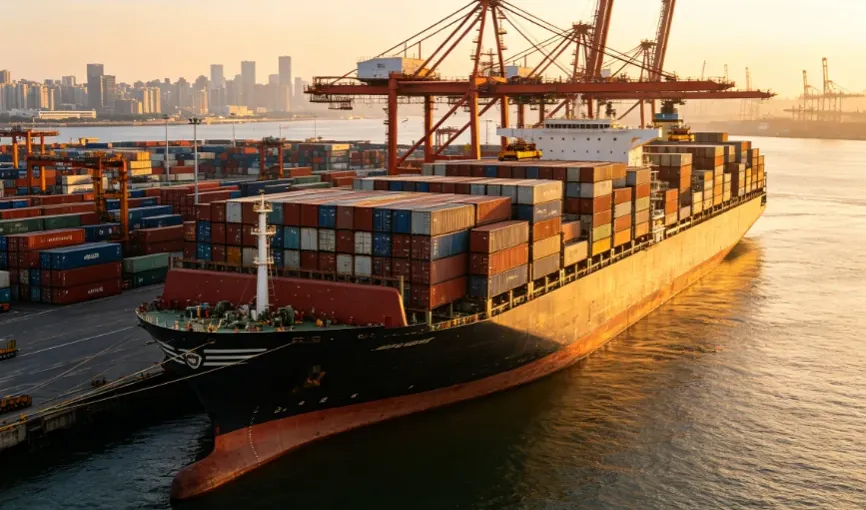
Shanghai has been the world’s busiest container port for 16 straight years, closing 2025 with 55.06 million TEU — and the deep-water Yangshan terminals alone handled 28.7 million of them. That capacity is what makes the Peru lane worth re-reading in 2026: since Chancay opened on Peru’s central coast in November 2024, weekly mainline services from Shanghai reach Peru’s new gateway in roughly 23–28 days instead of the 32–40 days Callao cargo often spends at sea.
This guide covers shipping from Shanghai to Peru as it actually works in October 2026 — which Shanghai yard your container loads at, what FCL and LCL cost to Chancay and Callao, how PVG air cargo compares once chargeable weight is applied, and the SUNAT duty-and-IGV stack waiting at the other end. For the country-level overview first, start with our shipping from China to Peru hub.
Shipping from Shanghai to Peru in 2026: A Yangshan Port Guide for Your Booking
Shanghai is not one port but a cluster, and only two of its areas matter for Peru cargo:
| Shanghai yard | Where it sits | What it means for a Peru booking |
|---|---|---|
| Yangshan (Phases I–IV) | Shengsi islands, reached by the 32.5 km Donghai Bridge | 15 m+ draft, so the 20,000 TEU mainline ships that carry West Coast South America cargo berth directly. Phase IV is fully automated and works around the clock |
| Waigaoqiao (Phases I–IV) | Pudong, at the Yangtze mouth | Closer to Jiangsu and Zhejiang suppliers; mostly feeds Yangshan by barge, and takes a handful of direct calls |
| Luojing / Wusongkou | Yangtze north bank | Domestic and bulk business — not where your Peru box loads |
Three operational details decide whether your booking sails on time:
- Most export boxes reach Yangshan by barge, not by truck. Containers are gated in at mainland depots and shuttled across on scheduled barge services, which is cheaper than a Donghai Bridge truck run but puts the container yard cut-off earlier in the week.
- Cut-offs are unforgiving: usually 24–48 hours before ETD. VGM has to be filed separately and the export declaration is lodged with Shanghai Customs before gate-in. Miss it in October and the box rolls a week, because capacity out of China tightens into the year-end peak.
- Chemicals and dangerous goods from Jiangsu and Zhejiang need extra lead time. MSDS review and carrier approval take days, and only part of the fleet accepts DG boxes. Machinery, auto parts and chemical cargo from the Yangtze River Delta is exactly what Peru’s industrial importers buy, so build a week of slack into the plan.
Shipping Cost from Shanghai to Peru: October 2026 FCL and LCL Rates
These are realistic all-in ocean quotes for October 2026 — base freight, BAF, Shanghai origin THC and documentation — excluding Peruvian import taxes and destination charges:
| Shanghai/Yangshan → Peru | 20ft FCL (20GP) | 40ft FCL (40GP) | 40ft HQ (40HC) |
|---|---|---|---|
| Direct mainline to Chancay | $2,300–$3,100 | $3,400–$4,800 | $3,600–$5,000 |
| Direct mainline to Callao | $2,400–$3,200 | $3,500–$5,000 | $3,700–$5,200 |
| Transshipment via Busan or Panama | $2,200–$3,000 | $3,300–$4,700 | $3,500–$4,900 |
| On-carriage by feeder to Paita, Matarani or Ilo | +$150–$400 | +$200–$450 | +$200–$450 |
Rates move on fuel, currency and space, so use the numbers as a sanity check rather than an offer. If you want to model a full quote line by line, our freight cost calculator does the arithmetic on mode, weight and volume in one screen.
LCL from Shanghai to Peru is the right call below roughly 12–15 CBM:
| Volume | LCL at $70–$125 per CBM | What to add |
|---|---|---|
| 1 CBM | $70–$125 | Minimum charge applies |
| 3 CBM | $210–$375 | $30–$60 CFS consolidation at the Shanghai warehouse |
| 5 CBM | $350–$625 | Typical first-order size for a Peruvian SME importer |
| 10 CBM | $700–$1,250 | Price a 20ft before you book |
| 15 CBM | $1,050–$1,875 | FCL usually wins once destination fees are counted |
On the destination side, budget $250–$450 per container for terminal handling and port charges at Callao or Chancay, plus deconsolidation and delivery for LCL, and ask how much free time you get — storage at a congested gateway accrues faster than most importers expect. Our sea freight from China to Peru guide tracks how the carrier mix and rate levels have moved through 2026.
October 2026 reality check: capacity out of Shanghai tightens from October through December as year-end retail stock is pulled forward, and peak-season surcharges of 10–20% land with about two weeks’ notice. If your cargo has to be in Lima before Christmas, book three to four weeks ahead and confirm the rate validity date in writing.
20ft vs 40ft Container Cost from Shanghai to Peru: Which Box to Book
| Box | Usable volume | Best fit for Peru cargo | Cost per CBM at the low end |
|---|---|---|---|
| 20ft (20GP) | ~25–28 CBM | Heavy industrial cargo: machinery, steel fittings, tiles, auto parts | ~$82–$128 |
| 40ft (40GP) | ~58–60 CBM | Mixed SKUs, mid-size programs, retail replenishment | ~$57–$83 |
| 40ft HQ (40HC) | ~68 CBM | Light bulky goods: furniture, plastics, packaging, apparel | ~$53–$76 |
| 45ft HQ | ~75 CBM (limited strings) | Very light volume, where the carrier offers it | Quote only |
The 40ft looks cheaper per cubic metre, but Peru’s import mix decides the question for you. Machinery and metal goods usually run into the payload ceiling first — a 20ft carries roughly 28 tonnes of payload against 26–28 tonnes on a 40ft — so a heavy 40ft can be weight-out while still half empty. Textiles, plastics and furniture go the other way: light, bulky cargo should always be quoted in a 40HQ. If your order sits between 15 and 25 CBM, ask for both an LCL and a 20ft price in the same quote so you can compare landed cost, not freight cost.
Shanghai to Peru Transit Time: 23–28 Days Direct to Chancay vs 32–40 via Callao
| Routing | Port-to-port | Door-to-door incl. clearance and Lima delivery |
|---|---|---|
| Shanghai (Yangshan) → Chancay, direct mainline | 23–28 days | 27–33 days |
| Shanghai → Callao, direct mainline | 28–34 days | 32–39 days |
| Shanghai → Callao via Busan or Panama relay | 32–40 days | 36–45 days |
| Shanghai → Paita / Matarani by feeder | 34–44 days | 38–50 days |
| LCL consolidation (Shanghai CFS → Callao/Chancay) | 30–42 days | 34–46 days |
| Air freight PVG → Lima (LIM), airport to airport | 3–6 days | 6–10 days |
| Express courier, door to door | — | 4–8 days |
Two things stretch these windows on the Peru side. First, Callao congests during the agro-export season from November to March, when fruit and vegetable exporters compete for berths and yard space with your container. Second, SUNAT’s risk channel decides your clearance time: a green channel releases in a day, while an orange or red channel adds physical inspection and 3–7 days. Filing the DAM before the vessel arrives — standard practice for an experienced broker — is the single most effective way to keep a Shanghai shipment on schedule. Chancay, which is 80 km north of Lima and roughly a 2–3 hour drayage, has been noticeably smoother than Callao for import cargo since it opened.
Air Freight from Shanghai to Peru: PVG Rates and Chargeable Weight
Shanghai Pudong (PVG) is the busiest cargo airport in the world by tonnage, and Peru-bound air freight rides the widebody belly capacity on the transpacific passenger and freighter network into Jorge Chávez International Airport (LIM) in Lima.
| Weight tier, PVG → LIM | Rate per kg | Airport to airport | Best for |
|---|---|---|---|
| 45–100 kg | $7.00–$9.00 | 3–6 days | Samples, spare parts, urgent restocks |
| 100–300 kg | $5.50–$7.50 | 3–6 days | E-commerce replenishment, medical devices |
| 300–500 kg | $5.00–$7.00 | 4–7 days | Launch stock, high-value electronics |
| Courier parcel under 45 kg, door to door | $12–$20 | 4–8 days | Documents, trade samples |
Air freight is priced on chargeable weight — the greater of actual weight and volumetric weight, where volumetric weight is length × width × height in centimetres divided by 6,000. Light cartons therefore bill far above what the scale says:
| Carton | Actual weight | Volumetric weight (÷ 6,000) | Billed weight |
|---|---|---|---|
| 60 × 50 × 40 cm | 12 kg | 20 kg | 20 kg |
| 120 × 80 × 100 cm | 95 kg | 160 kg | 160 kg |
| 100 × 100 × 110 cm | 70 kg | 183.3 kg | 183.3 kg |
Run your own carton dimensions through our volumetric weight calculator before you ask for an air rate; packing the same goods into denser cartons is often the cheapest rate reduction available.
| Sea freight (FCL or LCL) | Air freight (PVG → LIM) | |
|---|---|---|
| Door-to-door transit | 27–46 days | 6–10 days |
| Typical cost per kg | $0.10–$0.30 | $5.00–$9.00 |
| Best for | Bulk, heavy, low value density | Urgent cargo, high value density |
| Minimum charge | 1 CBM (LCL) | 45 kg, or a courier parcel |
| Working capital tied up | 4–6 weeks | days |
Air makes sense for a first trial order, a launch that cannot miss a retail date, spare parts that stop a production line, and goods whose value density justifies the premium. Once a product line is proven, move it to LCL and then to FCL — that is the normal progression on this lane.
How to Ship from Shanghai to Peru: Six Steps from the Yangtze Delta to Lima
- Send the forwarder the supplier address and the HS code. The city decides the yard, and the HS chapter decides whether your Peruvian broker needs an import licence or a sanitary permit before the cargo lands.
- Book three to four weeks out and confirm the yard. Ask explicitly whether the box loads at Yangshan or Waigaoqiao, and when the container yard cut-off closes.
- Gate in, declare, file VGM. Your forwarder lodges the export declaration with Shanghai Customs, arranges the barge or truck move to the terminal, and files VGM separately.
- File the DAM with SUNAT before arrival. Your Peruvian customs broker submits the Declaración Aduanera de Mercancías in advance so the container can be cleared the day it berths.
- Pay duty and IGV, then release. With the certificate of origin in the file, duty is usually 0% and IGV is 18% of the CIF value plus duty.
- Deliver from Chancay or Callao. Chancay is 80 km from Lima (2–3 hours by truck), Callao is 15 km (about an hour), and both can be handled door to door.
One clarification worth making early: door to door is a service, not a term. DDP and DAP are the Incoterms you use to quote it — under DDP your forwarder includes Peruvian duty and IGV in a fixed price, while under DAP you pay them separately on arrival. Ask which one your quote uses. For the service side of the lane, our freight forwarder from China to Peru guide lists the checks that separate a real forwarder from a rate broker.
Peru Import Duty and IGV on Cargo from Shanghai: The 0% FTA Rate Explained
Peru’s import charges come in two layers, and only one of them is negotiable.
Ad valorem duty is where the China–Peru free trade agreement, in force since 2010, does its work: most industrial tariff lines enter at 0% when a valid certificate of origin travels with the shipment. Without that certificate Peru applies its MFN rate — around 0–11% for most industrial goods, higher for textiles, footwear and some agricultural lines.
IGV is not negotiable. Peru charges 18% (16% IGV plus 2% IPM) on the CIF value plus duty, whether you claim the FTA or not. If you are an IGV-registered business in Peru, that import IGV becomes a fiscal credit against your sales IGV, so the cash-flow hit is smaller than the headline number.
Here is the same machinery shipment priced both ways:
| Cost line | With FTA certificate of origin | Without the certificate (6% ad valorem) |
|---|---|---|
| FOB Shanghai | $12,000.00 | $12,000.00 |
| Ocean freight + insurance to Callao | $2,460.00 | $2,460.00 |
| CIF value | $14,460.00 | $14,460.00 |
| Ad valorem duty | $0.00 | $867.60 |
| IGV 18% (16% + 2% IPM) | $2,602.80 | $2,758.97 |
| SUNAT, broker and terminal fees | $380.00 | $380.00 |
| Inland delivery in Lima | $120.00 | $120.00 |
| Landed total | $17,562.80 | $18,586.57 |
The certificate of origin is worth $1,023.77 on this single shipment, and the IGV alone adds 21.7% to the FOB value. That is why the origin document is the first thing a competent broker asks for — and why a quote that looks cheap but assumes duty-free treatment without checking the origin paperwork is not a quote you can plan around. Importers who intend to hold or re-process stock in Peru should also ask about the special economic zone regime around Chancay, which offers tax treatment for logistics and value-added operations inside the zone.
Shanghai vs Ningbo vs Shenzhen for Peru Cargo: Which Origin Port Wins in 2026
| Origin port | Cargo it suits | Transit to Peru | 20GP October 2026 |
|---|---|---|---|
| Shanghai (Yangshan / Waigaoqiao) | Machinery, auto parts, chemicals, textiles from Jiangsu, Zhejiang and Shanghai | 23–28 days to Chancay, 28–34 to Callao | $2,300–$3,200 |
| Ningbo (Beilun / Chuanshan) | Consumer goods, plastics, hardware, housewares | 24–30 days | $2,250–$3,100 |
| Shenzhen (Yantian / Shekou) | Electronics, high-value consumer tech | 26–33 days | $1,850–$3,600 |
Shanghai wins when your suppliers sit in the Yangtze River Delta, when you need chemical or DG bookings, or when the direct Chancay strings matter more than a few dollars of freight. Ningbo is usually the cheaper load port for container-loads of consumer goods, and Shenzhen stays the default for electronics and anything whose value density favours air. Comparing those two lanes is worth ten minutes: our shipping from Ningbo to Peru and Shenzhen to Peru guides run the same numbers, and the Shanghai to Uruguay article shows how the Yangshan cut-off behaves on a different South American lane.
Frequently Asked Questions
How much does it cost to ship from Shanghai to Peru in 2026?
In October 2026 a 20ft container from Shanghai/Yangshan to Chancay runs $2,300–$3,100 and to Callao $2,400–$3,200, while a 40ft container runs $3,400–$4,800 and $3,500–$5,000. LCL is $70–$125 per CBM and air freight from PVG is $5.50–$9.00 per kg depending on weight tier. Peruvian duty and 18% IGV come on top.
How long does shipping from Shanghai to Peru take?
Sea freight takes 23–28 days from Shanghai to Chancay on the direct mainline strings and 28–34 days to Callao, or 32–40 days on relay routings via Busan or Panama. LCL adds 3–5 days of consolidation, and door-to-door service adds 3–6 days for SUNAT clearance and delivery. Air freight from PVG takes 3–6 days airport to airport and 6–10 days door to door.
Should I load my container at Yangshan or Waigaoqiao?
You rarely get the choice — the carrier string, the vessel draft and the cut-off decide. Yangshan has the 15 m draft that takes the deep-water mainline ships carrying Peru cargo, while Waigaoqiao is closer to Jiangsu and Zhejiang suppliers and mainly feeds Yangshan by barge. Send your forwarder the supplier address and let them pick the yard that still meets the cut-off.
What import duty and taxes does Peru charge on goods from Shanghai?
Under the China–Peru FTA, in force since 2010, most industrial goods enter at 0% ad valorem duty with a valid certificate of origin. Without it, Peru applies the MFN rate of roughly 0–11% to most industrial lines. IGV of 18% (16% IGV plus 2% IPM) is charged on CIF plus duty either way.
Is LCL or FCL cheaper from Shanghai to Peru?
Under roughly 12–15 CBM, LCL at $70–$125 per CBM nearly always wins. Between 15 and 25 CBM ask for both quotes, because LCL deconsolidation and destination handling at Callao or Chancay eat into the apparent saving, and above about 25 CBM a 20ft container wins outright.
What documents do I need to import from Shanghai into Peru?
Commercial invoice, packing list, bill of lading or air waybill, the certificate of origin for FTA treatment, and an insurance certificate if you insure the cargo. Your Peruvian broker files the DAM with SUNAT, usually before the vessel arrives, and SUNAT then assigns a green, orange or red inspection channel.
Book Shanghai to Peru Shipping with a Forwarder Who Knows Chancay
The Shanghai–Peru lane changed when Chancay opened, and the operators who understand it are the ones who can tell you whether your box should sail direct to Chancay at 23 days or via Callao at a lower rate. Send us the supplier address, the HS code, the volume and the date you need the goods in Lima, and we will come back with an all-in quote for FCL, LCL or air — including the SUNAT duty and IGV position on your specific HS code.
Get a free Shanghai to Peru quote — 15+ years on the China–Americas lane, FIATA certified and NVOCC licensed.