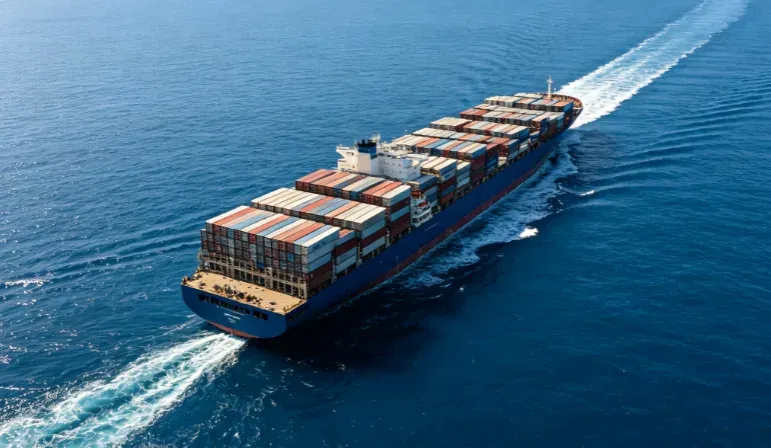
Shanghai has been the world’s busiest container port for 16 straight years, closing 2025 with 55.06 million TEU — and the Yangshan deep-water complex alone handled 28.7 million of them, up 10.4% year on year. Uruguay, meanwhile, is a country of 3.4 million people where China is the largest single source of imports. Put those two facts together and you get a lane that looks small on paper but runs on some of the world’s largest ships.
This guide covers shipping from Shanghai to Uruguay as it actually works in September 2026: which Shanghai yard your box loads from, what the freight really costs, how long the River Plate leg takes, how air cargo out of Pudong compares, and the DNA/IVA tax stack waiting at Montevideo. For the country-level overview first, start with our shipping from China to Uruguay hub.
Shanghai Port Guide for Uruguay Cargo: Yangshan, Waigaoqiao and the Cut-Off That Bites
Shanghai is not one port but a cluster, and for Uruguay cargo only two of its areas matter:
| Area | Where it sits | What it means for a Montevideo booking |
|---|---|---|
| Yangshan (Phases I–IV) | Shengsi islands, reached by the 32.5 km Donghai Bridge | Handles the deep-water mainline strings; 15 m+ draft so 20,000 TEU ships berth directly. Phase IV is fully automated and works 24/7 |
| Waigaoqiao (Phases I–IV) | Pudong, at the Yangtze mouth | Closer to Jiangsu and Zhejiang factories; acts as the barge hub that feeds Yangshan, and takes some direct calls |
| Luojing | North bank of the Yangtze | Bulk and domestic business — not where your Uruguay container loads |
Two operational details decide whether your booking leaves on time:
- Your container usually arrives at Yangshan by barge, not by truck. Most export boxes are gated in on the mainland and shuttled across on scheduled barge services, which is cheaper than a Donghai Bridge truck run but adds a cut-off earlier in the week. If your supplier finishes production on a Friday, say so before the booking is placed.
- Cut-offs at Yangshan are unforgiving. Container yard cut-off typically closes 24–48 hours before the vessel’s estimated departure, VGM must be filed separately, and the export declaration is done with Shanghai Customs before gate-in. Miss it and the box rolls a week — expensive in September, because the sailings around China’s National Day holiday (October 1–7) fill up first.
Chemical and dangerous-goods shippers from Jiangsu and Zhejiang should add a week: MSDS review, carrier approval and the limited number of vessels that accept DG boxes all slow the booking down. A forwarder with staff in Shanghai handles this as routine; a rate-only broker usually discovers the problem at the port gate.
Shipping Cost from Shanghai to Uruguay: September 2026 FCL and LCL Rates
These are realistic all-in ocean quotes for September 2026 — base freight, BAF/CAF, Shanghai origin THC and documentation — excluding Uruguayan import taxes and destination charges:
| Shanghai/Yangshan → Montevideo | 20ft FCL (20GP) | 40ft FCL (40GP) | 40ft HQ (40HC) |
|---|---|---|---|
| Mainline call (direct or last River Plate port) | $2,350–$4,200 | $2,950–$5,450 | $3,150–$5,700 |
| Relay via Singapore / Port Klang | $2,300–$4,100 | $2,900–$5,300 | $3,100–$5,550 |
| Via Buenos Aires (feeder or truck across the Plata) | on request, typically +$150–$350 | +$200–$400 | +$200–$400 |
September 2026 reality check: South America peak season runs August–October and carries a 10–20% premium, and Golden Week (October 1–7) removes a chunk of early-October capacity. If you need a container to sail before the holiday, book three to four weeks ahead — and confirm the rate validity date on the quote, because PSS notices land with about two weeks’ notice on this trade.
LCL from Shanghai to Montevideo is the right call below roughly 15 CBM:
| Volume | Typical rate | Notes |
|---|---|---|
| 1 CBM | $105–$180 | Minimum charge applies |
| 5 CBM | $525–$900 | Common first-order size for a small importer |
| 10 CBM | $1,050–$1,800 | Above ~15 CBM, price an FCL instead |
Add a $30–$60 consolidation charge at the Shanghai CFS, plus Montevideo deconsolidation and delivery. On the destination side, budget $250–$450 per container for Uruguayan port and terminal charges, and ask what free time you get — demurrage at a small port with limited yard space accrues faster than most importers expect. Our how much is shipping from China to Uruguay guide breaks every charge line down, and the 20ft and 40ft container cost article compares routings box by box.
20ft vs 40ft Container Cost from Shanghai to Uruguay: Picking the Box for Montevideo Cargo
| Box | Usable volume | Best fit | Cost per CBM at the low end |
|---|---|---|---|
| 20ft (20GP) | ~25–28 CBM | Heavy cargo: machinery, tiles, chemicals, auto parts | ~$84–$168 |
| 40ft (40GP) | ~58–60 CBM | Regular mid-size programs, mixed SKUs | ~$49–$94 |
| 40ft HQ (40HC) | ~68 CBM | Light, bulky goods: furniture, plastics, packaging | ~$46–$84 |
| 45ft HQ | ~75 CBM (limited strings) | Very light volume, where the carrier offers it | quote only |
A 40ft looks cheaper per CBM in every table, but on the Uruguay lane the box that saves money is often two 20ft containers: Uruguay is a small market, so arriving stock in two waves cuts your exposure to demurrage, lets you release the first box while the second is still at sea, and avoids the awkward weight distribution that a heavy 40ft can create on Uruguayan road trucking. If your cargo is dense and your cash flow is tight, price both options before you book. Weight cargo also runs into the payload ceiling first: a 20ft carries roughly 28 tonnes of payload and a 40ft around 26–28 tonnes, so a container of tiles, cement or steel can be weight-out while still half empty.
Sea Freight Transit Time from Shanghai to Uruguay: Direct Call, Cape Route or Buenos Aires Relay
| Routing | Port-to-port | Door-to-door | Notes |
|---|---|---|---|
| Yangshan → Montevideo, mainline call | 32–40 days | 36–46 days | Fastest option; availability varies by string and week |
| Relay via Singapore / Port Klang | 34–44 days | 38–50 days | Common in high season when direct space is full |
| Via Buenos Aires, then feeder or truck | 36–48 days | 40–54 days | Frequent for LCL groupage |
| Via Santos / Paranaguá | 38–50 days | 42–56 days | The Brazil-first rotation |
| LCL consolidation add-on | +3–7 days | +3–7 days | Waiting for a full groupage at the CFS |
One thing to understand before you compare quotes: on services from Asia to the East Coast of South America, “direct” rarely means non-stop. Most strings route south through the Malacca Strait and around the Cape of Good Hope, then call Santos, Paranaguá and Buenos Aires before Montevideo — so Montevideo is often the last River Plate call, and cargo discharged there waits behind three ports of work. A quote with a two-day-longer sailing time can still deliver earlier if it calls Montevideo first. Ask your forwarder for the port rotation, not just the transit figure.
After berthing at the Terminal Cuenca del Plata or Montecon, add 2–4 working days for DNA clearance and trucking to a Montevideo warehouse or inland to Salto, Paysandú or Punta del Este.
Air Freight from Shanghai (PVG) to Uruguay: Rates, Transit Time and Chargeable Weight
Shanghai Pudong (PVG) is China’s largest air cargo gateway, and there is no non-stop freighter to Montevideo — cargo connects through São Paulo (GRU), Buenos Aires (EZE) or Miami (MIA) before landing at Carrasco International (MVD).
| Service from PVG | Rate (September 2026) | Door-to-door transit |
|---|---|---|
| Consolidated air, 100–300 kg | $6.2–$8.8 per kg | 5–10 days |
| Consolidated air, 300–500 kg | $5.2–$8.2 per kg | 5–10 days |
| Blocked space, 500–1,000 kg | $4.7–$7.7 per kg | 5–9 days |
| Blocked space, 1,000 kg+ | $4.4–$7.2 per kg | 5–9 days |
| Express courier (DHL/FedEx/UPS) | $9–$15 per kg | 3–6 days |
Most shipments carry a $50–$150 minimum charge, and airlines bill the greater of actual and volumetric weight — length × width × height ÷ 6000 in centimetres. A carton measuring 60 × 50 × 40 cm is 120,000 ÷ 6000 = 20 kg chargeable, even if it weighs 14 kg. For dense industrial parts out of the Yangtze River Delta that is rarely an issue; for packaging, plastic housings or upholstery it can double your bill.
| Factor | Air freight (PVG → MVD) | Sea freight (Yangshan → Montevideo) |
|---|---|---|
| Door-to-door transit | 5–10 days | 36–46 days |
| Typical cost | $4.4–$8.8 per kg | $105–$180 per CBM (LCL) |
| Minimum charge | $50–$150 | ~$150–$250 (LCL handling) |
| Best for | Samples, production-critical spares, high-value electronics | Restocks, machinery, chemicals, anything over ~15 CBM |
Air makes sense on this lane for a first trial order, a spare part that is stopping a line in Montevideo, or electronics where the interest on tied-up inventory exceeds the air premium. Detail matters: the full air freight from China to Uruguay guide covers the routing options and customs treatment. Once volume passes about 15 CBM, sea freight wins on cost every time.
Shanghai vs Ningbo vs Shenzhen: Which Origin Port Ships to Uruguay for Less
| Gateway | 20ft to Montevideo | 40ft to Montevideo | Strongest for |
|---|---|---|---|
| Shanghai (Yangshan) | $2,350–$4,200 | $2,950–$5,450 | Machinery, chemicals, solar and electrical equipment, textiles from the Yangtze Delta |
| Ningbo | $2,300–$4,150 | $2,900–$5,400 | Consumer goods, plastics, furniture, hardware |
| Shenzhen / Yantian | $2,400–$4,500 | $3,000–$5,700 | Electronics, telecom gear, LED lighting from the Pearl River Delta |
| Qingdao | $2,550–$4,600 | $3,300–$5,900 | Tyres, steel products, northern supply base |
On the same vessel string the four gateways quote within roughly $100–$200 of each other, so the origin port is almost never the real saving. What moves the number is inland trucking: sending a Foshan supplier’s cargo to Shanghai instead of loading it at Yantian adds $700–$1,100 per 40ft, and a Wenzhou or Yiwu supplier trucking to Ningbo is usually cheaper than routing through Shanghai. Pick the port by where your goods are made, then let the forwarder optimise the string. If your cargo is currently booked out of Shenzhen, our shipping from Shenzhen to Uruguay comparison is the reference point.
Uruguay Customs Clearance for Shanghai Cargo: DNA, DUA, 22% IVA and the Free Port
Uruguayan customs is administered by the Dirección Nacional de Aduanas (DNA), and every commercial import is declared through the VUCE single window as a DUA by a licensed customs broker — the despachante de aduana — who is mandatory. The importer must hold an active RUT registered with the DGI. Clearance at Montevideo is usually fast: 2–4 working days for a clean, correctly classified container.
What your Shanghai shipment pays in 2026:
- Import duty — the Mercosur Common External Tariff, 0–35% of CIF. Uruguay’s recent unilateral reductions brought the average CET to about 7.1%; most machinery sits at 0–14%, electronics 14–16%, and textiles, footwear and some consumer goods at the top of the scale.
- IVA — 22% on the CIF value plus duty (11% reduced rate for certain food and medicines).
- Small extras — a customs control fee of about 0.06% of CIF, Uruguayan port and terminal charges, and the despachante fee of roughly $80–$150 per declaration.
- Compliance documents for technical goods — electrical products need a conformity certificate (LATU testing is the usual route), and any chemical shipment needs its MSDS on file before the DUA is filed.
- No China–Uruguay FTA. Negotiations have been discussed for years without an agreement in force. There is no preferential duty on this lane, so ignore guides promising FTA savings.
Worked example — a 9 CBM LCL shipment of machinery parts:
| Line | Amount |
|---|---|
| FOB Shanghai | $8,800 |
| LCL freight 9 CBM at ~$130 + origin charges | $1,550 |
| Marine insurance | $100 |
| CIF value (duty base) | $10,450 |
| Import duty at 12% | $1,254 |
| IVA 22% on $11,704 | $2,575 |
| Landed cost in Montevideo | $14,279 (+62% over FOB) |
Then decide the customs territory. Goods held in the Montevideo free port area or in a free zone — Zonamerica, Zona Franca de Montevideo, Nueva Palmira — are exempt from duties and IVA while they stay inside, which is why Uruguay works as a regional distribution platform for Brazil, Argentina and Paraguay. Taxes are triggered only when goods enter Uruguayan customs territory for local sale, so the free port defers rather than deletes the bill for domestic sales. Nueva Palmira is a river terminal for transit and project cargo, not a routine container destination.
Documents and Booking Checklist for Shipping from Shanghai to Uruguay
| Document | Why it matters on the Shanghai lane |
|---|---|
| Commercial invoice + packing list | Drives the DUA valuation; NCM codes must match the invoice description |
| Bill of lading or air waybill | Consignee details must match the importer’s RUT record |
| Certificate of origin | Required by DNA for tariff determination even without an FTA |
| NCM / HS classification | Sets the duty rate and flags whether MIC permits or LATU testing apply |
| MSDS (chemicals) | Needed for carrier approval in Shanghai and again at DNA |
| Conformity certificate (electrical) | LATU/UTE compliance before release of electrical goods |
| Insurance certificate | Marine cover at ~0.1–0.3% of value; the River Plate feeder legs are where claims happen |
| VGM declaration | Filed separately from the yard cut-off; a missing VGM blocks loading |
Book 3–4 weeks ahead through September, confirm the sailing rotation rather than just the transit time, and appoint the despachante before the vessel sails so the DUA is drafted while the box is still at sea. A forwarder with Shanghai staff can usually name the broker and the vessel rotation in the same email as the rate — that is the difference between a partner and a rate reseller.
Frequently Asked Questions
How much does it cost to ship from Shanghai to Uruguay in 2026?
In September 2026 a 20ft container from Shanghai/Yangshan to Montevideo runs $2,350–$4,200 and a 40ft container $2,950–$5,450, excluding Uruguayan import taxes. LCL is $105–$180 per CBM and air freight from PVG is $4.4–$8.8 per kg depending on the weight tier.
How long does shipping from Shanghai to Montevideo take?
Sea freight takes 32–40 days when the string calls Montevideo directly and 36–50 days when the box relays via Singapore, Buenos Aires or Santos. Add 2–4 days for DNA clearance and delivery. Air freight from PVG takes 5–10 days door-to-door.
Is it better to load my container at Yangshan or Waigaoqiao?
You rarely get to choose — the carrier string and the cut-off decide. Yangshan takes the deep-water mainline services to South America; Waigaoqiao sits closer to Jiangsu and Zhejiang factories and feeds Yangshan by barge. Give your forwarder the supplier address and let them pick the yard.
What import taxes does Uruguay charge on goods from Shanghai?
The Mercosur CET of 0–35% of CIF (average around 7.1% today), then 22% IVA on CIF plus duty. A $10,450 CIF machinery shipment at 12% duty pays $1,254 duty and $2,575 IVA — roughly 37% on top of CIF. No China–Uruguay FTA is in force.
Can I use Montevideo free port or a free zone to avoid IVA?
Yes for re-export and regional redistribution: cargo in the free port area or in Zonamerica, Zona Franca de Montevideo or Nueva Palmira pays no duty or IVA while inside. For goods sold inside Uruguay the taxes simply apply on withdrawal.
Is air or sea freight better from Shanghai to Uruguay?
Sea wins above ~15 CBM — LCL from $105 per CBM or a 20ft from $2,350 at the low end. Air freight from PVG suits samples, urgent spares and high-value electronics at $4.4–$8.8 per kg with 5–10 day door-to-door transits.
Get a Shanghai to Uruguay Shipping Quote in 24 Hours
The Shanghai–Uruguay lane rewards preparation: Yangshan’s barge and cut-off calendar, the Golden Week squeeze, Montevideo’s port rotation and the 22% IVA stack are all predictable once you know them. Send us the supplier address, the cargo dimensions and the NCM code, and we will come back with a rate that names the yard, the string and the rotation — sea or air, port-to-port or door-to-door.
Contact Dantful.US for a free, itemised Shanghai–Montevideo quote within 24 hours.