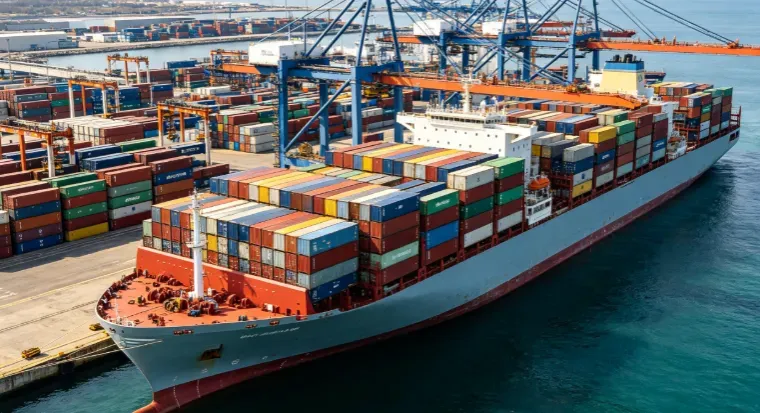
Uruguay is the only South American country whose capital is also its deep-sea gateway. Montevideo sits on the Río de la Plata, handles about one million TEU a year, and doubles as the transshipment hub for landlocked Paraguay and parts of Bolivia. China has been Uruguay’s largest trading partner for over a decade — beef, wool and cellulose head east, while electronics, machinery, auto parts and textiles worth roughly US$2 billion a year come back in containers. If you are importing any of it, the first number you need is the container price.
So, what does a 20ft or 40ft container cost from China to Uruguay in 2026? In Q3 2026, budget $2,600–$5,000 for a 20ft container and $3,200–$6,200 for a 40ft container all-in to Montevideo (excluding Uruguayan import taxes). Whether you get the low or high end of that range depends on one decision most guides never explain: direct service or transshipment. Based on 15 years of forwarding experience at Dantful.US International Logistics, here is the full 20ft vs 40ft cost picture. For a complete overview of your options, start with our shipping from China to Uruguay guide.
20ft vs 40ft Container Cost from China to Uruguay at a Glance
| Container | Typical Q3 2026 Rate | Usable Volume | Best For |
|---|---|---|---|
| 20ft FCL (20GP) | $2,600–$5,000 | ~25–28 CBM | 15–28 CBM, heavy cargo, first orders |
| 40ft FCL (40GP) | $3,200–$6,200 | ~58–60 CBM | 28–58 CBM, regular imports |
| 40ft HQ (40HC) | $3,400–$6,500 | ~68 CBM | Voluminous light cargo (furniture, plastics) |
| LCL (shared container) | $120–$280 per CBM | Under ~15 CBM | Trial orders, small shipments |
Q3 2026 reality check: South Atlantic rates have softened from the 2024–2025 peak, but transshipment routings via Buenos Aires or Santos still carry a $300–$700 premium per container versus a direct call, and peak-season surcharges (September–November) push FCL prices toward the top of these ranges. Booking 3–4 weeks ahead locks in standard pricing.
Direct or Transshipment? The Route Decision That Sets Your Price
This is the single biggest variable in the 20ft vs 40ft cost math for Uruguay — and almost every generic rate table skips it. Several carriers (MSC, COSCO, CMA CGM, ONE and others) run Asia–East Coast South America services that call Montevideo directly. Others discharge at Buenos Aires, Santos or Rio Grande and move your box to Uruguay by feeder, barge or truck. The direct call costs more in headline freight but eliminates a whole leg of handling:
| Routing | How It Works | Q3 2026 20ft | Q3 2026 40ft | Transit |
|---|---|---|---|---|
| Direct Shanghai/Ningbo/Shenzhen → Montevideo | Suez or Cape route, one vessel to TCP or Montecon terminal | $2,600–$4,200 | $3,200–$5,400 | 30–40 days |
| Via Buenos Aires | Discharge BUE, feeder/truck across the Plata | $2,800–$4,700 | $3,400–$6,000 | 35–48 days |
| Via Santos/Rio Grande | Discharge Brazil, short feeder to Montevideo | $2,900–$5,000 | $3,500–$6,200 | 36–50 days |
| Via Panama (Balboa) | Pacific leg, then transshipment to the Atlantic side | $3,000–$5,000 | $3,600–$6,200 | 40–52 days |
When transshipment wins: if your supplier is in a port without a direct Montevideo call, or when the direct service is fully booked in peak season. When direct wins: predictable arrival dates, one customs process, and typically 10–20% lower all-in cost. Ask your forwarder to quote both tracks — many will only show you the route they have space on. For a deeper look at how these service scopes differ, see our door-to-door vs port-to-port shipping pros and cons article.
20ft or 40ft: Which Container Size Fits Your Cargo?
The price gap between a 20ft and a 40ft is only about 20–30%, while the volume difference is more than double. That is why the 40ft is almost always the better cost-per-CBM deal once your cargo passes ~15 CBM.
| Specification | 20ft Container | 40ft Container | 40ft HQ |
|---|---|---|---|
| Internal dimensions (L×W×H) | 5.90 × 2.35 × 2.39 m | 12.03 × 2.35 × 2.39 m | 12.03 × 2.35 × 2.69 m |
| Usable volume | ~25–28 CBM | ~58–60 CBM | ~68 CBM |
| Max payload | ~28,200 kg | ~26,500 kg | ~26,300 kg |
| Cost per CBM (Q3 2026) | ~$100–$180/CBM | ~$55–$105/CBM | ~$50–$96/CBM |
Choose a 20ft when your cargo is heavy for its size — machinery, tiles, steel products, auto parts — or when your volume sits between 15 and 28 CBM. Choose a 40ft or 40ft HQ for bulky light goods such as furniture, mattresses and e-commerce stock. Two 20ft containers cost roughly 50–60% more than one 40ft with similar capacity, so any regular importer above ~28 CBM should standardize on 40ft equipment.
FCL Rates from China to Montevideo by Origin Port
Rates below are realistic all-in Q3 2026 ranges for direct or near-direct routings to Montevideo (excluding Uruguayan import taxes). Northern Chinese ports pay a structural premium because of the extra sailing distance:
| Origin Port | 20ft FCL | 40ft FCL | 40ft HQ |
|---|---|---|---|
| Shanghai | $2,600–$4,200 | $3,200–$5,400 | $3,400–$5,700 |
| Shenzhen / Yantian | $2,650–$4,300 | $3,250–$5,500 | $3,450–$5,800 |
| Ningbo | $2,700–$4,350 | $3,300–$5,600 | $3,500–$5,900 |
| Hong Kong | $2,600–$4,150 | $3,150–$5,300 | $3,350–$5,600 |
| Guangzhou / Nansha | $2,700–$4,300 | $3,300–$5,500 | $3,500–$5,800 |
| Qingdao | $2,900–$4,800 | $3,500–$6,100 | $3,700–$6,400 |
| Tianjin / Dalian | $3,000–$5,000 | $3,600–$6,200 | $3,800–$6,500 |
What is inside an FCL quote? Ocean freight, BAF/CAF fuel surcharges, origin THC and documentation, and destination terminal handling at Montevideo. Duties and IVA are collected separately by Uruguayan customs. For a line-by-line breakdown of how forwarding quotes are assembled, see our sea freight forwarder from China guide.
Montevideo Port and Uruguay’s Free Zone Strategy
Your container will discharge at one of Montevideo’s two main container terminals — TCP (Terminal Cuenca del Plata) or Montecon — on the Río de la Plata. The port’s ~14-metre channel handles modern deep-sea vessels, which is why direct Asia services call here. Two Uruguay-specific tricks can change your 20ft/40ft cost picture:
- Nueva Palmira (on the Uruguay River) is the transshipment point for barge traffic to Paraguay; if your final buyer is actually in Asunción or Ciudad del Este, a through quote via Nueva Palmira is often cheaper than shipping to Montevideo and trucking back.
- Free zones such as Zonamerica (next to Carrasco airport), Colonia and Nueva Palmira let you import, store and deconsolidate without paying IVA or duties — taxes are triggered only when goods leave the zone into Uruguayan customs territory. Importers who distribute over time or re-export to the region routinely cut their tax bill by months.
Air Freight Alternative: Rates and When It Beats the Container
When a 20ft or 40ft quote feels too slow — or the cargo is too small and urgent — air freight is the alternative. Most China–Uruguay air cargo connects through São Paulo (GRU), Buenos Aires (EZE) or Miami (MIA) before landing at Carrasco International Airport (MVD):
| Weight Tier | Q3 2026 Rate (USD/kg) | Transit |
|---|---|---|
| 45–100 kg | $6.0–$9.5 | 5–9 days |
| 100–300 kg | $5.5–$9.0 | 5–8 days |
| 300–500 kg | $5.0–$8.5 | 4–8 days |
| 500+ kg | $4.8–$8.0 | 4–8 days |
| Express courier (DHL/FedEx/UPS) | $10–$18 | 3–6 days |
Volumetric weight rule: air freight is billed on chargeable weight — actual weight vs length × width × height ÷ 6000 (cm), whichever is higher. A 100 kg carton measuring 1.0 × 1.0 × 1.0 m is charged as 167 kg, so bulky light cargo is far cheaper by sea.
Air vs Sea: The Real Trade-Off
| Factor | 20ft/40ft Sea Freight | Air Freight |
|---|---|---|
| Transit time | 30–50 days | 4–9 days |
| Cost per kg (typical) | $0.3–$0.6 (containerized) | $4.8–$9.5 |
| Cost per CBM (typical) | $100–$180 (20ft) | $2,400–$4,800 |
| Minimum charge | Container basis | ~$150–$250 per shipment |
| Best for | Bulk, heavy, non-urgent | High-value, urgent, perishable, spare parts |
Use air when the goods are worth more than the freight or a delay costs more than the premium — electronics, medical devices, production-line spare parts, samples. For everything else, a 20ft or 40ft container wins on cost per unit by 5–10 times. The consolidation mechanics on South American lanes are covered in our LCL shipping from China to Brazil guide — the same logic applies to Uruguay.
Uruguay Import Taxes: Budgeting the Landed Cost
The freight quote is only half the picture. Uruguay’s customs (Dirección Nacional de Aduanas, DNA, filing through the VUCE electronic single window) levies taxes on the CIF value (cost + insurance + freight) of your container:
- Import duties (arancel): per the Mercosur Common External Tariff (TEC), 0–20% of CIF — most consumer goods sit at 12–18%, electronics around 14–20%, and capital goods and machinery often 0–14%
- IVA (value-added tax): 22% — one of the highest standard rates in South America; charged on CIF + duty (a reduced 10% rate applies to some basic goods)
- IMESI: an internal excise on vehicles, alcohol, tobacco and fuels, charged in addition to duty and IVA for those categories
- Customs fees: small fixed charges plus a licensed customs broker (“despachante”) fee of roughly US$100–250
- No preferential FTA yet: the China–Uruguay FTA has been under negotiation since 2023 but is not in force in 2026, so standard TEC duties apply — unlike Chile or Ecuador, which already trade with China duty-free on most lines
Worked Example: Landed Cost of a 20ft Container
| Item | Value (USD) |
|---|---|
| Freight (Shanghai → Montevideo, 20ft, direct) | $3,400 |
| Cargo value (electronics) | $25,000 |
| CIF value | $28,400 |
| Duty (16% of CIF) | $4,544 |
| IVA (22% of CIF + duty = $32,944) | $7,248 |
| Total taxes payable | ≈ $11,792 |
| Full landed cost | ≈ $39,792 |
Clearance typically takes 2–4 working days for a clean shipment with correct HS codes and the commercial invoice, packing list and bill of lading. Compare this with the FTA-shortcut available on the Pacific side — our shipping containers from China to Brazil guide explains how the region’s largest market handles the same math.
Transit Times for 20ft & 40ft Containers
| Route | Typical Transit | Notes |
|---|---|---|
| Shanghai → Montevideo (direct) | 30–38 days | Weekly-ish sailings; most reliable option |
| Shenzhen / Ningbo → Montevideo (direct) | 31–40 days | Strong carrier coverage |
| Via Buenos Aires (feeder/truck) | 35–48 days | Add border logistics across the Plata |
| Via Santos / Rio Grande (feeder) | 36–50 days | Check feeder schedules before booking |
| LCL (any routing) | +5–10 days | Waiting for consolidation at origin hub |
| Air freight (via GRU/EZE/MIA) | 4–9 days | Then ~1 day trucking to your warehouse |
Remember that transit time ≠ delivery time: add 2–4 days for arrival, customs clearance and trucking to your warehouse.
How to Get the Lowest Container Rate to Uruguay
- Ask for the direct-service quote first — transshipment is a fallback, not a default; it adds $300–$700 per box
- Move up to 40ft once you pass ~28 CBM — per-CBM cost drops roughly in half
- Use Shanghai, Shenzhen or Hong Kong as origin — northern ports add $300–$800 per container
- Book off-peak — avoid September–November and the pre-Lunar New Year rush
- Classify HS codes correctly — a correct classification can cut duty by several points; a wrong one triggers penalties and delays
- Consider a free zone — Zonamerica or Nueva Palmira entry defers IVA and duties until goods actually enter the market; compare our 20ft & 40ft container cost from China to Paraguay guide for how the same structure serves the region’s landlocked importers
Frequently Asked Questions
Q: How much does a 20ft container cost from China to Uruguay in 2026?
A: Expect $2,600–$5,000 all-in to Montevideo (Q3 2026) depending on origin port and routing; transshipment via Buenos Aires or Santos adds $300–$700. Add Uruguayan import duties (0–20% of CIF) and 22% IVA for the full landed cost.
Q: How much does a 40ft container cost from China to Uruguay?
A: A 40ft FCL runs $3,200–$6,200 (40ft HQ $3,400–$6,500). The 40ft costs only 20–30% more than a 20ft while carrying more than double the volume, so it is the better deal above ~28 CBM.
Q: Why are Uruguay container rates cheaper than Paraguay’s?
A: Uruguay has its own deep-sea port. Paraguay is landlocked, so its containers add a river-barge or truck leg (roughly a 10–25% premium) after the ocean voyage. Montevideo is actually the main transshipment hub for Paraguay’s boxes.
Q: How long does it take to ship a container from China to Uruguay?
A: Direct services take 30–40 days; transshipment routings 35–50 days; LCL adds 5–10 days. Air freight takes 4–9 days.
Q: What taxes do I pay on a container imported from China to Uruguay?
A: Import duties under the Mercosur TEC (0–20%, most goods 12–18%) plus 22% IVA on CIF + duty, IMESI for vehicles/alcohol/tobacco/fuels, and small customs and broker fees. The China–Uruguay FTA is still under negotiation, so no preferential rate applies yet.
Q: Should I ship 20ft, 40ft or air freight from China to Uruguay?
A: Under ~15 CBM use LCL; 15–28 CBM or heavy cargo use a 20ft; above 28 CBM use a 40ft or 40ft HQ; and use air only for urgent, high-value or perishable goods — it costs 5–10 times more per unit than sea. For a broader cost baseline, our how much it costs to ship from China to Uruguay guide covers every mode in one place.
Ship Your Container to Uruguay with Rates You Can Trust
Uruguay’s container trade runs on precise numbers: the direct-vs-transshipment decision, Mercosur duties, 22% IVA and the free-zone option all have to line up before you book. With realistic Q3 2026 rates and a forwarder who knows the Montevideo terminals, your first 20ft or 40ft shipment can be budgeted to the dollar.
Ready to ship? Contact Dantful.US for a free, itemized 20ft/40ft quote — we handle everything from Chinese port pickup to delivery in Montevideo, with direct-service options and free-zone routing advice included.