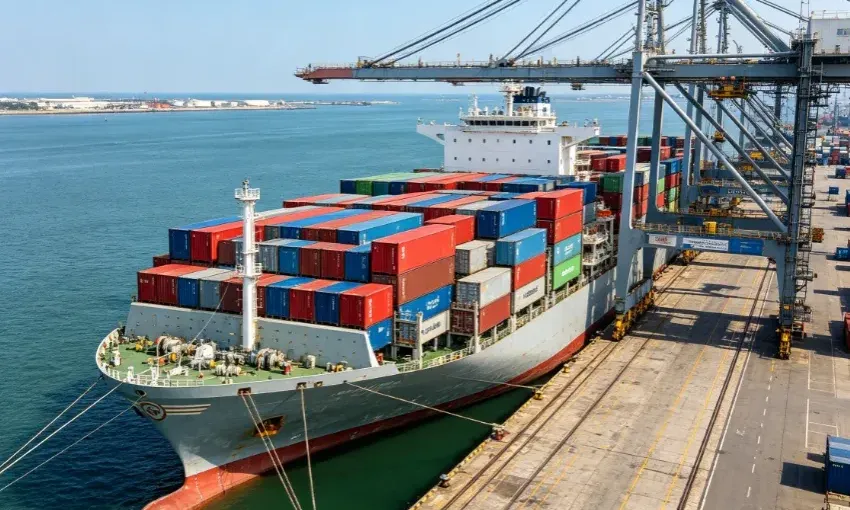
Argentina is the South American lane where every forwarder quotes a different number — “30 days”, “45 days”, “about two months” — and all of them can be right. The ocean leg is only one gear in the clock. On this lane there is a second gear that Chile, Peru and Ecuador do not have: a weekly East Coast South America (ECSA) schedule in which Buenos Aires is usually the last call after four or five Brazilian ports, and an import file that has to clear ARCA through a broker before any truck moves.
This guide separates the gears. It gives Q3 2026 transit times from China to Argentina by mode and by origin port, walks one 40ft container from a Ningbo factory to a Córdoba warehouse day by day, and shows how to count backwards from your delivery date so a 45-day lane does not become a 60-day surprise. If you are still choosing your service level, start with our shipping from China to Argentina overview, then come back here for the calendar.
China supplies Argentina with roughly US$1.5–1.6 billion of goods every month — machinery, electronics, auto parts, chemicals, textiles and consumer goods — and it is the country’s second-largest supplier after Brazil. Two waybill types move almost all of it: FCL and LCL on the water, and consolidated air into Ezeiza.
How Long Does It Take to Ship from China to Argentina? The Q3 2026 Answer by Mode
| Shipping mode | Port to port / airport to airport | Door to door | Realistic use |
|---|---|---|---|
| Sea FCL, direct ECSA call | 33–43 days | 45–52 days | Full containers, 15 CBM and up |
| Sea FCL via Santos relay | 40–52 days | 52–62 days | When no direct space exists |
| Sea LCL (groupage) | 38–50 days | 50–62 days | Trial orders, under ~15 CBM |
| Air freight, consolidated | 5–9 days | 6–10 days | Urgent restocks, high-value cargo |
| Express courier | 3–5 days | 3–6 days | Samples, spare parts, documents |
Read the middle column, not the first one. The number that matters is door to door, and on this lane the difference between a good and a bad month is 15 days.
Sea Freight Transit Time from China to Argentina: Direct Call, Santos Relay or Montevideo Overspill
Asia–East Coast South America services do not cross the Panama Canal. They run south through the Malacca Strait and around the Cape of Good Hope, then work the Brazilian coast — Santos, Paranaguá, Itajaí, Rio Grande — before entering the River Plate at Montevideo and Buenos Aires. Three practical consequences follow:
- The ocean leg is long because of geography, not slow ships. A 10,000+ nautical mile run at 18 knots simply takes 30–40 days.
- Buenos Aires is late in the rotation. Your container arrives on the date the vessel reaches its last Brazilian call, minus or plus a day or two — so a delay in Santos is a delay for you.
- Direct versus relay changes the answer by 7–12 days. A direct Buenos Aires call gives 33–43 days; a booking that relays at Santos onto a feeder gives 40–52 days. Both are quoted as “sea freight to Buenos Aires”, and that gap is the single most common reason two importers get different transit promises for the same cargo.
Transit Time from China to Argentina by Origin Port
| Origin port | Transit to Buenos Aires (port to port) | Sailings | Notes |
|---|---|---|---|
| Shenzhen / Yantian | 34–44 days | Weekly | Southern China electronics and consumer goods |
| Guangzhou / Nansha | 34–44 days | Weekly | Feeder-synced groupage from Huangpu |
| Ningbo / Beilun | 33–43 days | Weekly | Deepest ECSA coverage of the Yangtze delta |
| Shanghai | 33–42 days | Weekly+ | Fastest leg, highest competition |
| Qingdao | 38–47 days | Weekly | Northern cargo, longer first leg |
| Tianjin / Xingang | 40–48 days | Fortnightly | Thin South America coverage |
Two adjustments matter more than the table. First, the cut-off rhythm: ECSA vessels are weekly, so missing a gate-in by one day costs seven. Second, destination port: Buenos Aires and Dock Sud (Exolgan) have the most carrier competition, while Rosario, Zarate and La Plata quotes run 5–15% higher on thinner schedules. Our Shanghai and Ningbo lane guides break those rate structures down; the cost breakdown covers what each charge line does to your landed cost.
Is Shipping from China to Argentina Faster via Montevideo?
Yes — sometimes, and for a specific reason. Montevideo sits on the same River Plate rotation as Buenos Aires but handles a fraction of the volume, so berth windows are easier and river pilots are not queued. Argentine importers use it as an overspill: discharge in Uruguay, move the container 230 km by road into Buenos Aires province, clear the Argentine entry separately.
It makes sense when the River Plate terminals are congested, when your cargo is going to the western provinces anyway, or when a vessel is skipping its Buenos Aires call. It does not make sense as a cost play — you pay an extra set of handling, storage and transit-documentation charges, and the Mercosur transit filing has to be set up before the vessel arrives. Treat it as a schedule tool, not a discount.
Door to Door Shipping Time from China to Argentina: A 40ft Timeline from Ningbo to Córdoba
Here is one real shipment — 58 CBM of auto parts, a 40HQ from Ningbo/Beilun to a plant outside Córdoba, 700 km from the port. The “typical” column is what we plan; the “when it slips” column is what actually happens about one time in four.
| Day | What happens | When it slips |
|---|---|---|
| 0 | Booking confirmed; NCM codes agreed; supplier books the truck | Booking waits for a payment confirmation |
| 1–4 | Factory loading, trucking to Beilun, export declaration filed | Supplier misses the load date |
| 5–6 | Gate-in, VGM and shipping instructions, vessel cut-off cleared | One day late = next week’s vessel |
| 7 | Vessel sails | Rolled for space: +7 days |
| 8–39 | Ocean leg to Montevideo and Buenos Aires (32 days) | Relay at Santos instead of direct: +7–12 days |
| 40–41 | Arrival, discharge, terminal stacking at Dock Sud | Berth queue: +1–4 days |
| 42–46 | Despachante files through VUCEA; ARCA releases on green channel | Orange or red channel: +3–10 days |
| 46–47 | Container picked up, trucked 700 km on Ruta 9 to Córdoba | Truck capacity in harvest season: +1–2 days |
| 47–49 | Unstuffed at the plant, container returned inside free time | Detention if you hold the box |
Plan on 47 days for this pair of ports, and quote 45–58 days as the honest door-to-door band for sea freight into Argentina. Air on the same route is 6–10 days; the trade-off is roughly ten times the freight cost per kilo, which is why door to door shipping quoted on a sea basis is usually the right answer for anything above a few hundred kilos.
Air Freight Transit Time from China to Argentina: 4–8 Days to Ezeiza and the Chargeable Weight Rule
Ezeiza (EZE) is Argentina’s only widebody cargo gateway, and capacity to South America is thinner than to Europe or North America — so air on this lane is a capacity game, not a distance game. Peak retail weeks can push a booking out by three days on their own.
| Service | Rate (Q3 2026) | Airport to airport | Door to door |
|---|---|---|---|
| Consolidated (100–300 kg) | $5.5–$9.5/kg | 5–9 days | 6–10 days |
| Priority / blocked space (300+ kg) | $5.2–$9.0/kg | 4–7 days | 5–8 days |
| Express courier | $10–$15/kg | 3–5 days | 3–6 days |
Most shipments route through a Middle East, European or African hub onto a South America freighter — the fastest itineraries are genuinely faster, but they depend on the hub connection, not the China leg.
Before you compare quotes, understand how the airline charges you: chargeable weight is the greater of actual weight and volumetric weight, where volumetric weight is length × width × height in centimetres divided by 6,000. A carton of assembled plastic shelving weighing 22 kg but measuring 120 × 80 × 70 cm bills as 112 kg. Run your own numbers through our Volumetric Weight Calculator before you accept a per-kilo rate — on this lane, repacking density is often worth more than negotiating the rate.
Customs Clearance Time in Argentina: What ARCA Adds to Your Transit Time
The import regime changed more in 2024–2025 than in the previous decade, and it changed in importers’ favour. The SIRA licence system was abolished in December 2024, the SEDI declaration followed in February 2025, and the PAIS surcharge on imports disappeared with it. Customs is now administered by ARCA through the VUCEA single window, with a licensed despachante de aduana filing on your behalf — self-clearance is not an option.
What that means for the clock:
- Green channel: documentary verification only, released in 2–5 business days. This is the normal case for a clean file.
- Orange channel: additional document review and possibly a partial inspection, +3–7 days.
- Red channel: physical inspection of the container, +5–10 days, and the container sits at the terminal while it happens.
Channel assignment is driven by the NCM code, the declared value, the supplier history and your own importer record. Two things you control: classify the NCM code correctly (a wrong code is the most common cause of a red channel) and file before arrival — the declaration can be lodged while the vessel is still in the South Atlantic, so the release happens on day one or two after discharge instead of day five.
One separate clock worth knowing about: Argentina’s import-payment rules still set settlement windows for goods and capital goods, and the FX leg is administered in parallel with customs. Cargo can be cleared and still be waiting on payment documentation, which is why an experienced forwarder coordinates the bank, the broker and the terminal together. The full tax stack — Mercosur CET duties of 0–35%, IVA at 21%, the statistical fee and the refundable advance withholdings — is in our Argentina cost guide.
LCL Shipping Time to Argentina: Why Groupage Adds 5–12 Days
LCL to Buenos Aires is a good deal under about 15 CBM, but never plan it against the FCL calendar. Four segments make it slower:
- Origin consolidation. The co-loader needs enough cargo to fill the box. Cut-offs are weekly, so your goods can wait 3–7 days before they even leave the warehouse in Yiwu, Foshan or Ningbo.
- The main leg is the same vessel — this is where LCL and FCL are equal.
- CFS stripping at destination. Loose cargo is de-stuffed at a Buenos Aires consolidation depot, not at the quay, adding 2–4 days after discharge.
- Consolidated clearance. The consolidator’s broker handles the paperwork, so you are in a queue rather than first in line.
Realistic planning band: 50–62 days door to door, versus 45–58 for FCL. Above 15 CBM the FCL case is decisive on both cost and time; our LCL consolidation guide covers the same mechanics on the region’s largest lane.
When to Book a China to Argentina Shipment: Counting Back from Your Delivery Date
Work backwards, not forwards. Take the date the goods must be in your warehouse and subtract:
| Subtract | Milestone | Why |
|---|---|---|
| 45–58 days | Vessel sail date | Sea door-to-door band for BA and the interior |
| 7 days | Booking and cargo-ready date | Factory loading, trucking, export clearance |
| 5 days | SI/VGM and shipping instruction cut-off | Weekly services do not wait |
| 3 days | Gate-in at the Chinese terminal | One late day = one lost week |
| 7-day buffer | Contingency | Relay, berth queue or inspection |
Then check the calendar. Golden Week (1–7 October 2026) closes factories and slows port operations across China: bookings for pre-Golden-Week sailings need to gate in around 20–23 September or they wait until mid-October. Chinese New Year does the same in the first quarter, and Argentina’s own January summer shutdown slows brokers, terminals and trucking at the other end. August to October is peak season in both directions, with surcharges and tighter space.
The Cost of a Late China to Argentina Shipment: Demurrage, Storage and Tied-Up Capital
Buenos Aires terminals give container cargo only 5–7 free days of storage. Once that lapses, the terminal’s storage and demurrage tariff is charged per container per day, and on this lane a lapsed 40ft costs more per day than the trucking leg to Córdoba — ask your forwarder for the terminal tariff in writing rather than a verbal estimate.
The invisible cost is bigger. A $40,000 consignment tied up for an extra 14 days at a 12% annual cost of capital is $184 in financing alone, before lost sales, rescheduled inland trucks and, in the worst case, air freight for part of the order to keep a production line running. A week of avoidable delay on this lane routinely costs more than the spread between the cheapest and the most expensive ocean quote.
Two habits pay for themselves: file the ARCA declaration before arrival, and model your all-in landed cost — freight, duties, IVA, terminal charges and inland delivery — before you commit to a supplier date. Our Freight Cost Calculator gives you the freight side in a minute, and a forwarder who handles this lane weekly, like the team behind our sea freight forwarder from China service, will tell you which of your segments is the risky one.
Frequently Asked Questions About Shipping Time from China to Argentina
How long does it take to ship from China to Argentina by sea?
Direct services reach Buenos Aires in 33–43 days port to port in Q3 2026. Door to door, plan 45–58 days: add 2–5 days of ARCA clearance and 1–4 days of trucking, and count 2–4 days more for Córdoba, Rosario or Mendoza.
How long does air freight from China to Argentina take?
5–9 days airport to airport to Ezeiza, 6–10 days door to door, and 3–6 days with an express courier. Remember that air cargo bills on chargeable weight — centimetres cubed, divided by 6,000 — so bulky cartons pay more than they weigh.
How long does customs clearance take in Argentina?
A green-channel release through VUCEA takes 2–5 business days. An orange channel adds 3–7 days and a red channel 5–10 days. Since SIRA was abolished in December 2024 the bottleneck is your NCM classification and importer record, not a licence queue.
Is shipping from China to Argentina faster via Montevideo?
When the River Plate terminals are congested, discharging in Montevideo and trucking the 230 km into Buenos Aires can save 3–7 days. It costs more in handling and transit paperwork, so use it as a schedule fix rather than a rate fix.
Why is my China to Argentina shipment taking 60 days?
Usually because of a Santos relay instead of a direct call (+7–12 days), a rolled booking (+7 days), an orange or red channel (+3–10 days), or an incomplete file (+5–15 days), not because the vessel was slow. Audit those four segments before blaming the ocean leg.
How far ahead should I book?
Three weeks minimum, four to five in peak season and around Golden Week. Count back from your delivery date, and keep a 7-day buffer for the segments you do not control.
Plan a China to Argentina Shipment Around Real Dates
Tell us the cargo, the Chinese origin city and the date your goods must be in Buenos Aires, Córdoba or Mendoza, and we will give you a transit plan with the cut-off dates, the clearance channel you should expect and a rate you can hold against it. We run this lane every week and we file in Argentina through local brokers.
Get a China to Argentina transit time quote — 15 years of forwarding, one forwarder accountable from the factory gate to your warehouse door.