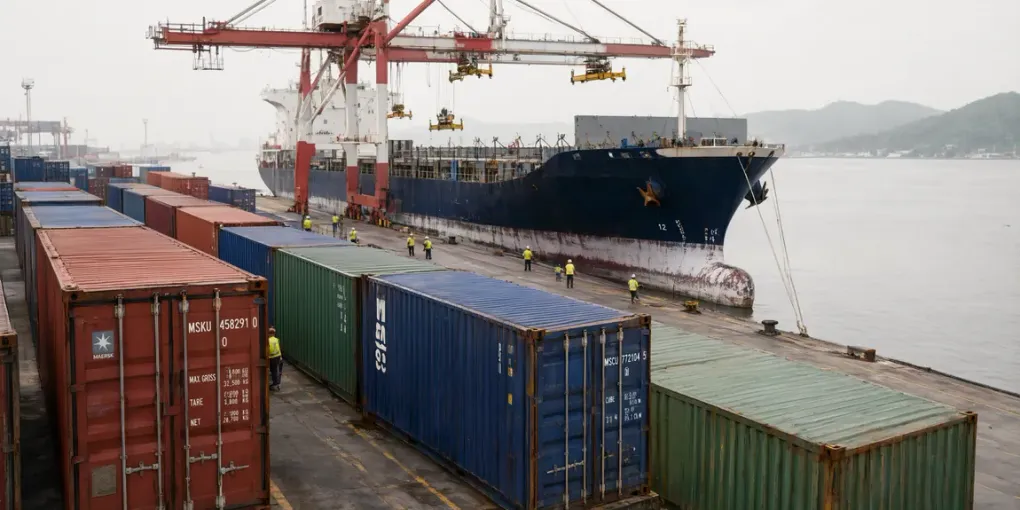
Two 40ft high cubes leave Ningbo the same week for Cartagena. One carries flat-pack furniture at roughly 180 kg per CBM; the other carries ceramic tiles at closer to 1,400 kg per CBM. Same vessel, same ocean freight, same terminal, same customs line. But the tile box weighs out at 26 tonnes with a third of its interior still empty, needs a heavier chassis on the climb to Bogotá, and costs three times more per kilogram to move than the furniture box did.
That is the part of container shipping from China to Colombia that rate tables do not show. Choosing a container is a physical decision before it is a price decision — internal dimensions, payload, how the box is stuffed, how much free time the terminal gives you, and whether DIAN releases it before demurrage starts. This guide works through all of it with November 2026 numbers, using the two Colombian coasts as they actually operate: Cartagena and Barranquilla on the Caribbean side, Buenaventura on the Pacific.
For the country-level picture of routes, modes and duty rates, start with our shipping from China to Colombia hub, and for the ocean-side view of the same lane our sea freight from China to Colombia guide covers sailing schedules in more depth.
Container Shipping Cost from China to Colombia: November 2026 FCL Rates by Box Size
The figures below are port to port, in US dollars, excluding origin and destination charges. They reflect November 2026 market conditions in the post-peak shoulder, when carriers have already pushed their September–November general rate increases through and space is easier to find.
| Origin (China) | 20GP → Buenaventura | 40GP → Buenaventura | 40HQ → Buenaventura |
|---|---|---|---|
| Shanghai | $1,950 – $2,750 | $2,700 – $3,850 | $2,850 – $3,950 |
| Ningbo | $1,900 – $2,800 | $2,650 – $3,900 | $2,800 – $4,000 |
| Shenzhen (Yantian) | $1,900 – $2,700 | $2,600 – $3,750 | $2,750 – $3,850 |
| Qingdao | $2,050 – $2,900 | $2,800 – $3,950 | $2,950 – $4,100 |
| Origin (China) | 20GP → Cartagena | 40GP → Cartagena | 40HQ → Cartagena |
|---|---|---|---|
| Shanghai | $2,000 – $2,850 | $2,750 – $3,900 | $2,900 – $4,050 |
| Ningbo | $1,950 – $2,800 | $2,700 – $3,950 | $2,850 – $4,100 |
| Shenzhen (Yantian) | $1,950 – $2,800 | $2,700 – $3,950 | $2,850 – $4,000 |
| Qingdao | $2,100 – $2,950 | $2,850 – $4,000 | $3,000 – $4,150 |
Three things drive the differences more than the origin port does:
Coast, not city. Cartagena carries the Caribbean premium because it is the transshipment hub of the whole Colombian coast; Buenaventura is usually a little cheaper on the base rate but recovers that through slower terminal turnaround and more expensive inland trucking to Bogotá.
Box size, on a per-unit basis. A 20GP at $2,100 divided by roughly 30 usable CBM is about $64 per CBM. A 40HQ at $3,200 divided by roughly 65 usable CBM is about $42 per CBM. The big box is a third cheaper per unit of space — which is why almost every light, bulky import from China to Colombia moves in a 40HQ, and why 40HQ equipment is the first thing to disappear when the lane tightens.
Equipment, not just rate. High cubes to Buenaventura are a thinner pool than to Cartagena. In a tight week you may be offered a 40GP at a 40HQ price and told it is the same thing; it is not — you lose 8.6 CBM of height, roughly 20% of your usable space on light cargo.
If your decision is specifically between two box sizes and you want the rate-by-rate comparison, our 20ft and 40ft container cost from China to Colombia breakdown goes deeper on that single question. For a first estimate of what the whole shipment will run before you request quotes, the Freight Cost Calculator gives you a starting price by container type and destination region.
20ft vs 40ft vs 40HQ Container to Colombia: Internal Dimensions, Payload and the Road-Weight Trap
| Type | Internal length × width × height | Nominal CBM | Tare weight | Max payload | Max gross |
|---|---|---|---|---|---|
| 20GP | 5.90 × 2.35 × 2.39 m | 33.2 | ~2,300 kg | ~28,180 kg | 30,480 kg |
| 40GP | 12.03 × 2.35 × 2.39 m | 67.7 | ~3,750 kg | ~26,730 kg | 30,480 kg |
| 40HQ | 12.03 × 2.35 × 2.69 m | 76.3 | ~3,900 kg | ~26,580 kg | 30,480 kg |
| 45HQ | 13.55 × 2.35 × 2.69 m | 86.0 | ~4,800 kg | ~27,700 kg | 32,500 kg |
The 45HQ exists in theory and rarely in practice on this lane: few carriers position them for Colombia, and several terminals handle them reluctantly. Treat it as an option to ask about, not one to plan around.
The column that decides most Colombian shipments is the payload, and the constraint that bites is not the container — it is the road. Colombia enforces axle-load limits on its highway network, and the corridor from Buenaventura up to Bogotá climbs through the Western Cordillera, with the Loboguerrero section as the steep, slow, weight-sensitive part. A 40HQ loaded to its 26,580 kg payload is a 30,480 kg gross box before the chassis is counted. That is legal on a properly configured multi-axle trailer and not always practical on the climb, which is why experienced importers of dense cargo routinely split into two 20ft boxes: each one carries 1,400 kg more cargo inside a box that is 1,600 kg lighter, and each one sits on a shorter, cheaper, more manoeuvrable chassis.
Bogotá also sits at 2,640 m. Altitude costs you engine power on the climb, and a heavy box that would take 12 hours from Buenaventura to Cali can take 18–22 hours to Bogotá. That is a trucking cost and a scheduling cost, not an ocean cost — and it is quoted per container, not per tonne, which is another reason heavy cargo prefers 20ft.
A working rule for this lane:
- Denser than 500 kg per CBM (tiles, steel, cement, machinery, chemicals in drums): 20ft, even though the rate per CBM looks worse.
- 250–500 kg per CBM (appliances, auto parts, hardware, packaged food): 40GP.
- Lighter than 250 kg per CBM (furniture, toys, apparel, plastic goods, packaging): 40HQ, and ask for a 45HQ only if the schedule allows.
How Many Pallets Fit in a 20ft or 40ft Container to Colombia: Stuffing Math and the 85% Rule
Nominal CBM is a marketing number. What you can actually load is 85–90% of it, because cartons do not tessellate perfectly, pallets waste the gap above them, and the door end always ends up half-empty.
| Container | Nominal CBM | Realistic load | Standard pallets 1.2 × 1.0 m | Euro pallets 1.2 × 0.8 m |
|---|---|---|---|---|
| 20GP | 33.2 | 28 – 30 CBM | 10 | 11 |
| 40GP | 67.7 | 58 – 62 CBM | 20 – 21 | 23 – 24 |
| 40HQ | 76.3 | 65 – 68 CBM | 20 – 21 (40 double-stacked) | 23 – 24 (46 double-stacked) |
Double-stacking is the lever most importers miss. Two tiers of pallets fit inside a 40HQ only when the loaded pallet height stays at or below about 1.10 m — 2.20 m of stacked cargo inside a 2.69 m interior leaves just enough room to load and unload without a fight. Above 1.10 m you are paying for a high cube and using it like a standard box.
The weight check has to run at the same time as the volume check, and this is where the pallet count usually fails:
- 21 standard pallets at 1,200 kg each = 25,200 kg. That fits a 40HQ payload with 1,380 kg to spare — and then fails the Bogotá road run.
- The same 25,200 kg in two 20ft boxes is 12,600 kg per box, comfortably legal on the climb, at roughly the same total cargo weight and a slightly higher ocean cost.
- 21 pallets at 400 kg each = 8,400 kg, which cubes out a 40HQ long before it weighs out. That is the shipment a high cube was designed for.
If you are shipping cartons rather than pallets, calculate the stack height from the carton dimensions plus 10 mm of dunnage per layer, not from the container height divided by the carton height. The last layer never fits the way the arithmetic says it will.
Container Shipping Transit Time from China to Colombia: Services, Transshipment and Real Door Dates
| Route | At-sea transit | Typical routing |
|---|---|---|
| Shenzhen (Yantian) → Buenaventura | 28 – 38 days | Direct WCSA string or relay at Balboa |
| Shanghai → Buenaventura | 30 – 40 days | Direct WCSA or via Balboa |
| Ningbo → Buenaventura | 31 – 41 days | Via Balboa on most strings |
| Shanghai → Cartagena | 32 – 45 days | Panama Canal transit, Cartagena hub call |
| Ningbo → Cartagena | 33 – 44 days | Panama Canal, sometimes relay at Manzanillo |
| Shenzhen → Cartagena | 32 – 44 days | Transshipment at Balboa or Cartagena |
| Qingdao → Cartagena | 35 – 46 days | Longest north-China rotation |
| Any origin → Barranquilla | +3 – 6 days | Magdalena river transit after a coastal relay |
Two structural facts explain most of the variance. First, Cartagena is not just a destination — it is a relay point, so your box may sit there for a few days waiting for a feeder even though the vessel arrived on schedule. Second, Pacific services to Buenaventura are fewer and less interchangeable than Caribbean services, so a missed connection costs more days on that coast. The same dynamic governs the Pacific lane further south, which is why our container shipping from China to Chile guide shows similar gaps between direct and relay routings.
Door dates, which is what your customer actually asks about:
- Shanghai to Buenaventura terminal: 30–40 days at sea, 2–5 days DIAN clearance, 1–2 days to Cali, 2–3 days to Bogotá.
- Shanghai to Cartagena terminal: 32–45 days at sea, 2–5 days clearance, 1–2 days to Medellín, 3–4 days to Bogotá.
- End to end, port to warehouse: 36–48 days to Bogotá via Buenaventura, 38–50 days via Cartagena.
Add a week if your cargo is selected for a physical inspection, and add the LCL consolidation wait (4–7 days) if you are not shipping a full box.
FCL vs LCL Container Shipping to Colombia: Where the 15 CBM Break-Even Sits
If you cannot fill a container, your choice is not “smaller container” — it is a shared one. LCL is billed per revenue ton, which is the greater of cubic metres and weight in tonnes (1 CBM = 1,000 kg), so a light, bulky shipment pays for volume rather than mass. Our Volumetric Weight Calculator converts carton dimensions into that chargeable figure in seconds, and it is worth running before you accept an LCL quote that looks cheap per CBM.
| FCL (20GP) | LCL | |
|---|---|---|
| Billing unit | Per container | Per CBM or per 1,000 kg, whichever is greater |
| Indicative cost | $1,900 – $2,800 port to port | $70 – $125 per CBM |
| Fixed destination charges | Terminal and THC per box | CFS handling, deconsolidation, documentation per shipment |
| Typical transit | 30 – 40 days | 34 – 47 days (adds consolidation and deconsolidation) |
| Damage and contamination risk | Lowest — your cargo only | Higher — shares a box with other shippers |
| DIAN clearance | One declaration, one inspection risk | Consolidated house bill, deconsolidated before clearance |
The break-even on this lane sits at 13–15 CBM, or around 12 tonnes of dense cargo. Below 10 CBM, LCL almost always wins. Between 10 and 15 CBM, get both quotes and compare door-to-door totals rather than per-CBM rates, because LCL destination charges are largely fixed and quietly double the effective rate on a 6 CBM shipment. Above 15 CBM, a 20GP is cheaper and clears faster — and in Colombia the clearance speed difference is real, because DIAN inspections on consolidated cargo take longer than on a single-house bill of lading.
Destination Charges for a Container in Colombia: THC, Demurrage and Detention at Cartagena and Buenaventura
This is the block that turns a $3,200 ocean rate into a $4,700 invoice, and it is quoted in almost no online rate table. The figures below are indicative for 2026 and must be confirmed against the terminal named on your arrival notice.
| Charge | 20ft | 40ft | Notes |
|---|---|---|---|
| Terminal handling (THC) | $150 – $230 | $230 – $330 | Cartagena (SPRC or Contecar) and Buenaventura (TCBUEN, Grupo Portuario, Aguas Vivas) each publish their own tariff |
| Documentation fee | $60 – $120 | $60 – $120 | Per bill of lading, not per container |
| Terminal / wharfage and security | $40 – $80 | $55 – $100 | Includes ISPS-type security charges |
| Weighing and VGM handling | $15 – $35 | $15 – $35 | Some terminals bundle it into THC |
| Customs broker (agencia de aduanas) | $150 – $350 | $180 – $400 | Per declaration |
| Inland trucking, Buenaventura → Bogotá | $500 – $800 | $700 – $1,100 | Heavy boxes on the climb price higher |
| Inland trucking, Cartagena → Bogotá | $650 – $950 | $900 – $1,400 | Longer distance, better road |
Then there are the two clock-based charges that catch first-time importers, and they are not the same thing:
Demurrage is charged by the terminal while your container sits inside the port after discharge. Free time at Cartagena is commonly 5 days, at Buenaventura 3–5 days, counted from discharge. After that, expect roughly $40–$90 per day for a 20ft and $60–$120 per day for a 40ft, though the published terminal tariff governs.
Detention is charged by the carrier while the container is outside the port and not yet returned empty. Carrier free days on this lane are usually 7–10 from gate-out; after that the daily rate is similar to demurrage but billed by a different party, so you can be paying both at once if the box leaves the terminal late and comes back later still. Empty return in Cartagena and Buenaventura requires a booking slot — turning up unannounced is how a one-day delay becomes a four-day detention bill.
The practical defence is sequencing: have your DI drafted before the vessel berths, have the BL released (telex release is faster than original documents on this lane), and have the truck booked for the day the levante is issued. Importers who clear within free time typically pay $450–$900 in destination charges; those who do not often pay double.
Customs Clearance for a Container Shipping to Colombia: DIAN Declaration, Levante and 19% IVA
The container does not become yours when it is discharged. It becomes yours when DIAN issues the levante — the release that authorises the terminal to hand the box over. The sequence under Colombia’s customs regime (Decreto 1165 de 2019) runs like this:
- Arrival notice from the carrier or agent, with the terminal, free time and the BL status.
- Bill of lading release. Original BL surrendered, or a telex release confirmed. Without this the terminal will not release and the demurrage clock keeps running.
- Import declaration (DI) filed in DIAN’s MUISCA system by your agencia de aduanas, with the HS code, customs value, freight, insurance and the applicable arancel.
- Inspection, if DIAN selects the shipment — documentary, physical, or both. Physical inspection moves the box to an inspection zone and adds 2–5 days.
- Levante issued, duties and IVA paid, truck admitted to the terminal.
- Retiro — the box leaves, and detention starts counting against your free days.
Documents your broker will ask for: commercial invoice, packing list, bill of lading, the certificate of origin if any preference is claimed, insurance certificate, and the VGM record. The consignee must hold an active RUT with the importer role; a foreign buyer without a Colombian entity either imports under DDP terms with the forwarder as importer of record, or uses a zona franca.
The tax maths, using a 40HQ from Ningbo to Cartagena in November 2026:
| Line | Calculation | Amount |
|---|---|---|
| Goods (FOB China) | 22,000 kg of hardware and housewares | $22,000 |
| Ocean freight | 40HQ, Ningbo → Cartagena | $3,200 |
| Insurance | 0.4% of CIF | $600 |
| CIF value | Goods + freight + insurance | $25,800 |
| Arancel | 10% MFN rate on CIF | $2,580 |
| IVA base | CIF + arancel | $28,380 |
| IVA | 19% of the base | $5,392 |
| Destination charges | THC, doc, broker | $700 |
| Inland trucking | Cartagena → Bogotá | $1,100 |
| Total landed | $35,572 |
That is 62% above the factory-gate value, and two-thirds of the gap is tax. Colombia has no free trade agreement with China, so Chinese-origin goods pay the standard MFN rate — 0%, 5%, 10% or 15% depending on the HS code — plus the 19% IVA charged on the duty-inclusive base. Anti-dumping duties apply to specific product lines, notably textiles, footwear and some steel products, and they are worth checking by HS code before you book, not after.
The one relief worth knowing: if you are VAT-registered in Colombia and importing for resale, the IVA you pay at import is generally creditable against the IVA you collect on sales. It is a cash-flow cost, not a permanent one — which is exactly why DDP pricing and your own import licence produce very different economics on the same box. For help structuring that, our freight forwarder from China to Colombia guide covers the service models.
Container Loading, VGM and Sealing: The Five Checks That Prevent a Claim
Most container claims on this lane are not carrier negligence. They are loading decisions made in a Chinese warehouse in twenty minutes.
- Verified gross mass (VGM). SOLAS requires a declared VGM before the box is loaded. The number has to come from a weighbridge or a certified calculation, not from adding up packing lists. A mis-declared VGM gets the box rolled and can void your insurance.
- Weight distribution. Heavy cargo goes over the axles and toward the door end of the floor structure that supports it, never concentrated at one end. A 20ft box loaded 70% at the door end will fail an axle check on the climb and can distort the floor.
- Dunnage and bracing. Airbags or timber between pallets, lashing to the floor rings for machinery. A box that arrives with cargo shifted 40 cm forward usually has a load plan that ignored braking forces.
- Moisture control. A steel box crossing the Pacific and then sitting in Cartagena humidity condenses water on the ceiling. Desiccant bags and a container liner cost $40–$120 and prevent the mould claim that costs $4,000.
- Seal and photographic record. Seal number recorded on the BL, photographed on the closed doors at the supplier, and again at destination before opening. This single habit settles most shortfall disputes in your favour.
Frequently Asked Questions
How much does container shipping from China to Colombia cost in November 2026?
Port-to-port ocean freight runs about $1,900–$2,800 for a 20GP, $2,600–$3,900 for a 40GP and $2,700–$4,000 for a 40HQ from Shanghai, Ningbo or Shenzhen to Buenaventura or Cartagena. Origin charges add roughly $350–$600 per box, destination charges $450–$900, and inland trucking $700–$1,400 to Bogotá or Medellín. A 40HQ delivered to a Bogotá warehouse typically lands at $4,800–$6,300 before duties.
How many CBM and pallets fit in a 20ft and a 40ft container?
A 20ft general purpose container holds 33.2 CBM nominal and about 28–30 CBM of real cargo, which is 10 standard 1.2 × 1.0 m pallets or 11 Euro pallets. A 40ft holds 67.7 CBM nominal and 58–62 CBM of real cargo, or 20–21 standard pallets. A 40ft high cube holds 76.3 CBM nominal and 65–68 CBM of cargo, and can double-stack 40 pallets when pallet height stays at or below about 1.10 m.
Is a 20ft or a 40ft container cheaper to ship to Colombia?
Per CBM the 40ft is always cheaper: at November 2026 rates a 20GP to Buenaventura costs about $64 per usable CBM while a 40HQ costs about $42. Per kilogram the 20ft wins, because it carries 28,180 kg inside a 2,300 kg tare against 26,580 kg inside a 3,900 kg tare. If your cargo is denser than roughly 500 kg per CBM, or has to climb the Buenaventura–Bogotá corridor at full weight, ship two 20ft boxes instead of one 40ft.
How long does container shipping from China to Colombia take?
Port to port, plan on 28–38 days from Shenzhen to Buenaventura, 30–40 days from Shanghai to Buenaventura, and 32–45 days from Shanghai or Ningbo to Cartagena. Barranquilla runs 3–6 days longer because of the Magdalena river transit. Add 2–5 days for DIAN clearance and 1–4 days for inland trucking, so a realistic Shanghai-to-Bogotá door date is 36–48 days.
How much free time do I get at Cartagena before demurrage starts?
Cartagena terminals commonly grant 5 free days for FCL import containers and Buenaventura 3–5, counted from discharge rather than from your booking date. After that, demurrage runs roughly $40–$90 per day for a 20ft and $60–$120 per day for a 40ft, and detention on the box outside the terminal is billed separately once the carrier free days, usually 7–10, expire. Confirm the tariff with the terminal on your arrival notice before the vessel berths.
Do I need a customs broker to clear a container in Colombia?
Yes in practice. The import declaration must be filed in DIAN MUISCA by a licensed agencia de aduanas, and the consignee needs an active RUT with the importer role. The broker files the DI, calculates the arancel and 19% IVA, handles inspection if DIAN selects the shipment, and obtains the levante that lets the terminal release the box.
Get a Container Shipping Quote from China to Colombia
Container decisions compound: the wrong box costs you space on the light cargo and freight on the dense cargo, and a late declaration costs you demurrage on every day the terminal holds the box. Tell us the cargo, the CBM, the weight and the destination city, and we will come back with a quote that separates ocean freight, origin charges, destination charges and trucking — so you can compare two quotes on the same basis.
Contact our team with your shipment details and we will confirm equipment availability to Cartagena and Buenaventura for your sailing window.