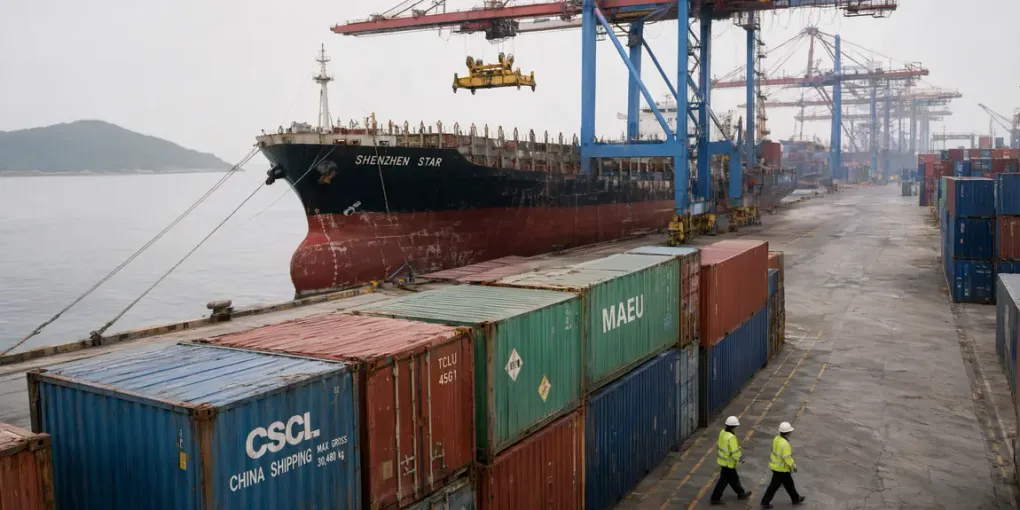
Two in five Shenzhen electronics shipments that miss their sailing do not miss it because of freight rates. They miss it because the battery paperwork was issued after the container was already at the gate. That is what this lane punishes: shipping from Shenzhen to Ecuador is a rate question for about ten minutes and a compliance and routing question for the rest of the week.
Shenzhen is the sourcing base where the cargo is dense in value and awkward in regulation — power banks, e-bikes, LED drivers, Bluetooth speakers, phone spares, and the lithium cells inside all of them. Ecuador is a dollarised market with a 15% IVA, a 0.5% FODINFA levy, a 5% currency-outflow tax, and a free trade agreement that removes most of the duty if the certificate of origin is right. Between the two sits Yantian, the deepest container gateway in South China, and a Guayas river channel that decides whether your box berths on arrival or waits for water. Country-level context lives in our shipping from China to Ecuador hub; this guide covers the Shenzhen end.
Shipping from Shenzhen to Ecuador in November 2026: Yantian vs Shekou vs Hong Kong Ports
Shenzhen is not one port. Four loading points serve the same factories, and the choice is made by which district your suppliers sit in, not by which terminal quotes cheaper.
| Loading point | Distance from | Direct Ecuador calls | Drayage per 40ft | When it wins |
|---|---|---|---|---|
| Yantian (Hutchison, 20 deep-water berths, 14.2–17.6 m alongside) | 35–55 km east of Futian; 20–35 km from Dongguan | Weekly South America strings; Maersk’s AC2 rotation calls Yantian and includes Guayaquil | $180–$420 from Longgang/Bantian, $260–$520 from Dongguan | Default for eastern Shenzhen, Longgang, Pingshan and Dongguan electronics |
| Shekou / Chiwan (China Merchants) | 10–25 km from Nanshan, Bao’an and Futian | Mostly feeder and intra-Asia; Ecuador cargo relays at Yantian, Nansha or Busan | $90–$240 | Western Shenzhen, Bao’an and Nanshan suppliers with small lots |
| Da Chan Bay (western sister terminal) | 5–20 km from Bao’an | Selected mainline calls, space tight in Q4 | $80–$220 | Oversize or awkward cargo that cannot take a long east-bound haul |
| Hong Kong (Kwai Tsing) | 40–60 km; 2–4 hours trucking with a sealed in-bond manifest | Better carrier spread, similar transit | $300–$600 plus border handling | Only when the HKG rate undercuts Yantian by more than the trucking bill |
Yantian’s numbers are why it dominates south China exports: 20 deep-water berths, 87 quay cranes, a 17.6 m waterway, and a rotation that lets a 400-metre vessel discharge and reload in a single call. For Ecuador that matters less than you would expect, because no carrier runs Shenzhen–Ecuador as a pure shuttle — the box is relayed through Busan, Manzanillo or Balboa, and the relay port, not the load port, sets your arrival date.
Shekou is the right answer more often than rate sheets suggest. If your three suppliers are in Bao’an and Nanshan, trucking to Yantian adds $180–$280 and half a day per container; Shekou or Da Chan Bay absorbs that, then feeds the box to Yantian or Nansha for the ocean leg. You lose one to two days and save more than the day is worth on small volumes.
Hong Kong looks cheaper on paper about once a quarter. When it does, the gap has to beat $300–$600 of cross-border trucking plus a customs seal and a separate export declaration — and it rarely does for a single 40HQ.
How to Ship from Shenzhen to Ecuador: Six Steps from Huaqiangbei to Guayaquil
- Map suppliers to a district, not a city. Huaqiangbei for components and phone parts, Bantian and Longgang for consumer electronics and marketplace sellers, Bao’an for LED and power supplies, Nanshan for higher-value hardware, Dongguan across the river for accessories and tooling.
- Consolidate in a Shenzhen CFS. Three to eight suppliers feed one warehouse in Pinghu, Buji or Bao’an, where cartons are counted, photographed and marked before stuffing. This is the step that catches a short shipment while the supplier can still fix it.
- Screen the cargo for dangerous goods. Anything with a cell inside gets a UN38.3 summary and an MSDS before booking, not after. A power bank declared as “electronics” is the most common cause of a rolled booking out of Yantian.
- Book on the right string. Ask for the relay port, not just the transit number: Busan-relay and Manzanillo-relay services behave differently when a vessel is blanked.
- Gate in and file. Yantian works a 3–4 day gate-in window, VGM before the terminal cut-off, one export declaration covering the consolidated lot, plus the 13% Chinese export VAT rebate paperwork.
- Clear and deliver in Ecuador. The DAI is pre-filed in ECUAPASS while the ship is at sea, the aforo channel decides whether an inspection adds 2–4 days, and the truck to Quito or Cuenca is booked before discharge.
Shipping Cost from Shenzhen to Ecuador: November 2026 FCL, LCL and Air Rates
Five lines decide the invoice and only one of them is ocean freight. Here is the November 2026 picture, port to port:
| Loading point | 20GP | 40GP | 40HQ | Note |
|---|---|---|---|---|
| Yantian → Posorja / Guayaquil | $1,550–$2,600 | $2,300–$4,050 | $2,350–$4,150 | Weekly strings, deepest draft, most space |
| Shekou → Guayaquil (via Yantian/Nansha) | $1,580–$2,660 | $2,340–$4,120 | $2,400–$4,220 | Adds 1–2 days and a feeder fee |
| Hong Kong → Guayaquil | $1,520–$2,560 | $2,260–$4,000 | $2,310–$4,090 | Add $300–$600 cross-border trucking |
| LCL, Shenzhen CFS → Guayaquil | — | — | — | $70–$145 per CBM, $90–$140 minimum |
| SZX / HKG air → GYE or UIO | — | — | — | $3.4–$6.4 per kg by weight break |
The four lines that get missed:
- Origin charges — THC, documentation, export declaration, VGM and CFS handling, $320–$620 per container.
- Drayage inside the delta — $90–$520 depending on district and terminal.
- Ecuadorian destination charges — $250–$450 per container at Posorja or Guayaquil, plus $50–$70 per bill of lading.
- Brokerage and inland trucking — $150–$320 for the DAI, then $450–$900 to move a 40ft from the coast to Quito, Cuenca or Ambato.
Small electronics lots distort this arithmetic badly, because LCL is priced on revenue tonnes, not on cartons. A 6 CBM shipment of phone accessories weighing 1.8 tonnes bills as 6 CBM at $70–$145, or $420–$870 — often less than the $320–$620 of origin charges alone on an FCL. Run the numbers through our Freight Cost Calculator before you assume a container is cheaper; below roughly 15 CBM it usually is not.
Shenzhen to Ecuador Transit Time: Yantian Strings, the Busan Relay and Guayaquil’s Tidal Window
No carrier sails Shenzhen–Ecuador non-stop, so the quoted 27 days is a port-to-port number that becomes 40 door to door.
| Route | Port to port | What sets the date |
|---|---|---|
| Yantian → Posorja (DP World, 15.5 m draft) | 27–33 days | Deep water, no tidal restriction, weekly strings |
| Yantian → Guayaquil (Contecon, TPG, Fertisa) | 30–36 days | ~40 nm upriver behind a 9.7–11 m channel |
| Shekou → Guayaquil | 31–37 days | Feeder to Yantian or Nansha, then mainline |
| Hong Kong → Guayaquil | 29–35 days | Same strings, different load port |
| Yantian → Esmeraldas | 34–40 days | Feeder from the mainline, few Asia calls |
| Yantian → Puerto Bolívar (Machala) | 33–39 days | Banana belt; reefers and project cargo |
| SZX/HKG → GYE (air) | 3–6 days door to door | 2–4 flight days plus clearance |
Two clocks run underneath. The first is the Yantian cut-off, 3–4 days before sailing, tightening in the autumn build-out when a single blanked sailing rolls a week of bookings. The second is the river clock: Guayaquil’s terminals sit about 40 nautical miles up the Guayas, so deep-draft vessels wait for water and berth queues form. Posorja, 60 km downriver with 15.5 m of natural draft, deletes that wait — same carrier, same sailing, two to four days earlier at the Ecuadorian end.
| Stage | Time |
|---|---|
| Supplier pickup and CFS consolidation in Shenzhen | 3–6 days |
| Gate-in, export declaration, VGM, sailing | 1–3 days |
| Ocean leg to Posorja or Guayaquil | 27–36 days |
| Discharge and terminal handling | 1–3 days |
| SENAE clearance in ECUAPASS | 2–5 working days |
| Duty, IVA and ISD settlement | Same day to 2 days |
| Inland delivery to Quito, Cuenca, Ambato | 1–2 days |
20ft vs 40ft Container from Shenzhen to Ecuador: What Electronics Cargo Actually Fills
Shenzhen cargo is light in relation to its value, which inverts the usual container logic. A 20GP carries about 33 CBM and 28 tonnes of payload; a 40HQ carries 76 CBM and roughly 26 tonnes. If your goods run at 200–300 kg per CBM, you will fill the 76 CBM of a 40HQ at 15–23 tonnes — under the payload, so the box is volume-limited and the 40HQ is the correct purchase.
| Cargo type | Typical kg/CBM | Container that fits | Why |
|---|---|---|---|
| LED panels, fixtures, drivers | 180–260 | 40HQ above 30 CBM | Light, bulky, needs cube |
| Laptops, tablets, networking gear | 250–350 | 40HQ | Value-dense, cube-hungry |
| Phone accessories, cables, cases | 220–320 | 20GP under 20 CBM, 40HQ above | Density sits between |
| Power banks, battery packs | 400–600 | 20GP or LCL | Dense and regulated; weight and DG both bite |
| E-bikes, scooters, complete units | 130–180 | 40HQ, floor-loaded | Very light, very bulky |
Pallet arithmetic settles the palletised case: a 20GP takes 10 Euro pallets (1200 × 800 mm) in a single tier, a 40HQ takes 20–21. If your supplier ships 18 pallets, the 40HQ is decided before the rate is even quoted.
A worked comparison: 46 CBM of LED lighting at 200 kg per CBM, 9.2 tonnes. A 40HQ at $2,350–$4,150 works out to $51–$90 per CBM. The same cargo as LCL bills 46 CBM at $70–$145, or $3,220–$6,670, plus a CFS fee at both ends and a longer handling chain — the container wins on cost and on damage risk. Reverse the decision below 15 CBM, where LCL’s $90–$140 minimum and a single consolidated clearance beat a container’s fixed origin charges. Box selection, weights and terminal charges are covered in more depth in our container shipping from China to Ecuador guide.
Air Freight from Shenzhen to Ecuador: SZX vs Hong Kong Rates and Chargeable Weight
Air is a working option on this lane because Shenzhen exports the exact cargo that cannot wait five weeks: new product launches, marketplace replenishment, spare parts, samples that decide a repeat order. Rates in November 2026:
| Service | Weight break | Rate per kg | Door-to-door time |
|---|---|---|---|
| Consolidated air (SZX or HKG) | 45–100 kg | $5.4–$7.8 | 7–10 days |
| Consolidated air | 100–300 kg | $4.2–$6.0 | 6–9 days |
| Consolidated air | 300 kg + | $3.4–$5.2 | 5–8 days |
| Express courier (DHL/FedEx/UPS) | Any | $9–$15 | 3–6 days |
Shenzhen Bao’an (SZX) has no non-stop freighter service to Ecuador, so every consolidated kilo leaves on a connection — Hong Kong first for carrier choice, or Guangzhou and Shanghai for space — and lands at Guayaquil’s José Joaquín de Olmedo (GYE) at sea level. Quito’s Mariscal Sucre (UIO) sits at roughly 2,840 m, where widebody freighters lift less payload, so rates into UIO run $0.4–$1.0 per kg above GYE and most sierra cargo is trucked up from the coast instead.
Two mechanics decide what you actually pay. The first is chargeable weight: air bills the greater of actual weight and L×W×H÷6000 in centimetres. A 300 kg shipment occupying 2.1 CBM bills at 350 kg, because 2.1 million cm³ ÷ 6000 = 350. Shenzhen’s light export categories — foam-packed speakers, LED panels, phone cases in retail packaging — are exactly the cargo that trips the rule, and repacking to 70% pallet fill can cut the air bill by a fifth. Our Volumetric Weight Calculator does the same division in your browser.
The second is battery class. Standalone lithium cells (UN3480) cannot fly on passenger aircraft, must sit at 30% state of charge or below, and need carrier approval before the booking exists. Many Shenzhen consolidators therefore route power banks by sea and fly only the devices with cells installed (UN3481). Check which category your carton falls into before comparing air rates — the cheapest quote on the board is often the one that quietly cannot be flown.
| Sea FCL | Air freight | Express | |
|---|---|---|---|
| Door-to-door | 37–49 days | 5–10 days | 3–6 days |
| Cost for 300 kg / 2.1 CBM | ~$1,850–$3,000 | ~$1,190–$1,820 | ~$2,700–$4,500 |
| Best for | 15 CBM and up, no deadline | Urgent, high value, under ~3 CBM | Samples, documents, spares |
| Minimum charge | One container or LCL floor | ~$120–$180 per shipment | Per parcel |
Documents for Shipping Lithium Batteries from Shenzhen to Ecuador: UN38.3, MSDS and the Class 9 Booking
This is where Shenzhen cargo separates itself from cargo from anywhere else in China. Ecuador’s SENAE and the airlines both treat a battery as dangerous goods, and the paperwork chain runs in one direction only: tests first, then the declaration, then the booking.
| Document | What it proves | Who issues it |
|---|---|---|
| UN38.3 test summary | The cell passed the eight transport tests (altitude, thermal, vibration, shock, short circuit, impact, overcharge, forced discharge) | The cell manufacturer’s accredited lab |
| MSDS / SDS | Chemical and hazard profile, class, packing group | Cell or battery maker |
| Shipper’s Declaration for Dangerous Goods (DGD) | The shipment is correctly classified, packed, marked and labelled | The forwarder, on your instruction |
| Class 9 label and lithium battery mark | Handlers can identify the hazard | Packer |
| Packing instruction reference | PI 965 (standalone cells/batteries), 966 (with equipment), 967 (in equipment) for air; IMDG class 9 for sea | Forwarder |
| Carrier approval / DG acceptance | The line has agreed to load it | Carrier, in writing |
| MSDS-based import file for SENAE | Ecuadorian customs can classify the goods | Broker |
The rule that catches exporters is that MSDS is not a substitute for UN38.3. A customs broker can accept an MSDS; an airline cannot, and neither will a mainline carrier at Yantian accept a booking for UN3480 without a test summary naming the exact cell. If your supplier buys generic cells and rebrands packs, the summary usually does not name your product — which is why so much Shenzhen battery cargo ends up rolled, re-packed, or split into sea and air lots at the last minute.
Practical sequencing: request the UN38.3 summary and MSDS at the purchase order stage, confirm the packing instruction with the forwarder before booking, and keep standalone batteries out of air consolidations entirely unless the carrier has approved them in writing.
Ecuador Import Duty on Shenzhen Cargo: 15% IVA, FODINFA, ISD and the FTA Certificate
Ecuador is dollarised, so there is no exchange-rate guesswork, only a tax stack that is entirely predictable if the certificate of origin is correct.
| Charge | Base | Rate |
|---|---|---|
| Ad valorem duty | CIF | 0% on most industrial and consumer lines under the China–Ecuador FTA (in force since May 2024), otherwise the tariff line rate |
| FODINFA | CIF | 0.5% |
| IVA | CIF + duty + FODINFA | 15% |
| ISD | Amount remitted abroad | 5% |
| SENAE and terminal charges | Per declaration and container | $250–$450 |
A 40HQ of LED lighting and small electronics, FOB Shenzhen $22,000:
| Item | Amount |
|---|---|
| FOB Shenzhen | $22,000 |
| Origin charges | $480 |
| Ocean freight, Yantian → Posorja | $2,350 |
| Marine insurance | $110 |
| CIF value | $24,460 |
| Duty at 0% under the FTA | $0 |
| FODINFA at 0.5% | $122 |
| IVA at 15% on $24,582 | $3,687 |
| ISD at 5% on the $22,000 remittance | $1,100 |
| Destination charges and broker | $620 |
| Inland Posorja → Quito | $760 |
| Landed total | $30,750 |
That is 40% above the factory price and the ocean freight is under a tenth of it. Remove the certificate of origin and duty returns at 15% of CIF, $3,669, which also pushes IVA up by $551: the missing document costs $4,219, more than the container costs to move. Note where the tax lands — IVA on the duty-inclusive base, ISD on the supplier payment — and note that an IVA-registered importer recovers the 15% against sales VAT, which is why a DDP quote can quietly cost 15% of CIF. Door to door is a service; DDP and DAP are the Incoterms used to price it, and the difference is who pays this stack. Our door to door from China to Ecuador guide lays out both structures.
E-commerce Shipping from Shenzhen to Ecuador: The 4x4 Courier Regime and Consolidated Parcels
Shenzhen sells to Ecuador in two shapes: containers and parcels. Parcels run on a different legal track, and getting the track wrong is more expensive than getting the freight rate wrong.
Under SENAE’s courier regime, commonly called 4x4, a personal shipment travels as Category B when it weighs up to 4 kg and is valued at up to $400 FOB, capped at roughly $1,600 a year per person. Inside those limits the parcel moves on a simplified declaration without the full DAI, which is why the casillero model — a consolidator address in Shenzhen or Hong Kong, repacking, then a per-kilo rate into Guayaquil or Quito — dominates small-lot trade.
| Parcel channel | Billable basis | Rate | Transit |
|---|---|---|---|
| Consolidated air parcel | Per kg, 0.5 kg minimum | $7–$14 per kg | 8–14 days |
| Express courier door to door | Per kg + fuel + remote fee | $12–$22 per kg | 4–7 days |
| Sea consolidation (LCL parcel) | Per CBM, 0.5 CBM minimum | $90–$180 per CBM | 32–42 days |
| Formal entry above the regime limits | DAI + duty + IVA + ISD | Full tax stack | 35–50 days |
For sellers, the break-even is blunt. Below $400 FOB and 4 kg, the courier regime is faster and cheaper than any formal clearance. Above it, every parcel is a formal import, and consolidating parcels into a single DAI — one importer of record, one declaration, one clearance fee — is the only way to keep the per-unit cost sane. Ecuadorian last-mile delivery runs through Servientrega, Laar or Urbano, and the receiver’s cédula and RUC decide whether the parcel clears as a personal or commercial import.
Marketplace sellers should also plan for the return leg: a battery-containing product rejected at the destination cannot be flown back economically, so landed cost models for Shenzhen electronics should carry a 2–4% warranty and write-off allowance rather than an assumption of returns.
Frequently Asked Questions
How much does it cost to ship from Shenzhen to Ecuador in November 2026?
Port to port out of Yantian, a 20GP runs $1,550–$2,600, a 40GP $2,300–$4,050 and a 40HQ $2,350–$4,150, before $320–$620 of origin charges and $250–$450 of destination charges. LCL bills $70–$145 per CBM and consolidated air freight $3.4–$6.4 per kg.
How long does sea freight from Shenzhen to Ecuador take?
Yantian to Posorja is 27–33 days port to port and Yantian to the Guayaquil river terminals 30–36 days, because vessels wait on a tidal window in a channel of roughly 9.7–11 metres. With 3–6 days before sailing, 2–5 working days for clearance and 1–2 days inland, door to door is 37–49 days.
Can I ship lithium batteries from Shenzhen to Ecuador?
Yes, as dangerous goods. Standalone cells and packs (UN3480) need a UN38.3 test summary, an MSDS, a Class 9 declaration and written carrier approval; by air they follow IATA packing instruction 965 and fly at 30% state of charge or less. Batteries inside equipment (UN3481) are simpler but still need the UN38.3 summary on file.
Is Yantian or Shekou cheaper for Ecuador cargo?
Yantian, by $30–$90 per container, and it carries the weekly South America strings while Shekou feeds them. Shekou still wins for Bao’an, Nanshan and western Shenzhen suppliers, where $120–$260 of saved drayage per 40ft outweighs the freight difference.
What tax do I pay when a Shenzhen container arrives in Ecuador?
Duty at the tariff line rate — 0% on most lines with a valid FTA certificate of origin — plus 0.5% FODINFA on CIF, 15% IVA on CIF plus duty plus FODINFA, and 5% ISD on the supplier payment. On a $22,000 FOB container that is about $4,910 with the certificate and $9,129 without it.
Get a Shenzhen to Ecuador Shipping Quote in 24 Hours
Send us your supplier districts, the carton dimensions and total weight, whether any carton contains a cell, the HS code you expect to declare, and the Ecuadorian delivery address. We will come back with a quote that names the loading point, the sailing and cut-off, the Posorja or Guayaquil nomination, whether the FTA preference applies to your tariff line, and whether door to door should be priced DDP or DAP. Start at contact Dantful.US, or read the how much shipping from China to Ecuador cost guide, the sea freight from China to Ecuador routing guide, and the freight forwarder from China to Ecuador service page for the same lane.