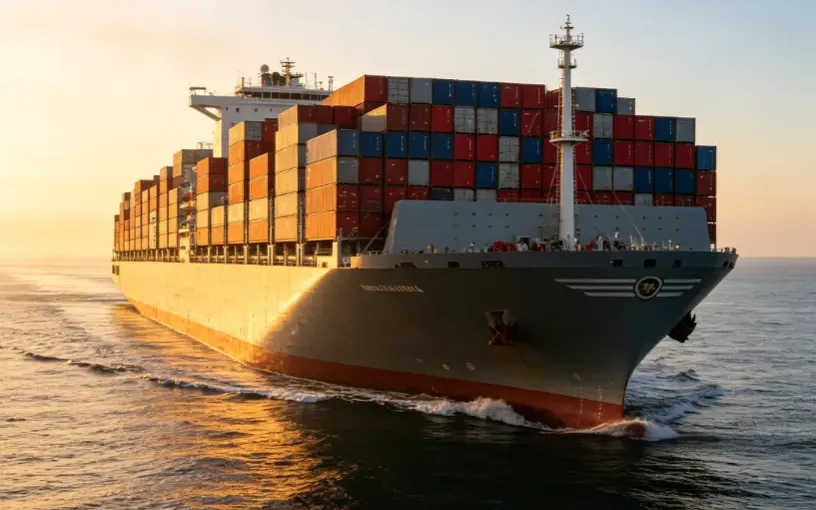
For two weeks every spring and autumn, Guangzhou becomes the busiest trading floor on earth. The Canton Fair brings tens of thousands of buyers to the Pearl River Delta, and among the most consistent regulars are Argentine importers — who for years have used the fair to source exactly what the factories of Guangdong make: LED lighting from Zhongshan, home appliances from Shunde, furniture and ceramics from Foshan, hardware and auto parts from the delta’s industrial towns. China is Argentina’s second-largest trading partner, and a large share of that trade flows through Guangzhou’s two container gateways: the deep-water port of Nansha and the riverside terminals of Huangpu.
This guide covers shipping from Guangzhou to Argentina in 2026 with the specifics that actually change your quote: September 2026 FCL and LCL rates, real transit times to Buenos Aires and Dock Sud, the air option from Guangzhou Baiyun (CAN), how Nansha and Huangpu split the work, and what ARCA collects at the Argentine border in the post-SIRA era. For the country-level picture, start with our shipping from China to Argentina overview.
The Guangzhou Loading Map: Nansha, Huangpu and the Trucking Math
Guangzhou is not one dock but two very different loading points, and choosing between them is the first decision that moves your costs:
| Terminal | What it is | Role on the Argentina lane |
|---|---|---|
| Nansha | Deep-water port at the mouth of the Pearl River (Phases I–IV) | Mainline FCL: Asia–East Coast South America strings call here; container gated 3–7 days before sailing |
| Huangpu / Xinsha | Riverside terminals upriver toward downtown Guangzhou | LCL consolidation hub: groupage networks for Foshan, Zhongshan, Shunde and Jiangmen cargo |
| Shekou / Yantian (nearby) | Shenzhen’s ports, ~60–90 minutes by truck | Overflow mainline capacity when Nansha space is tight; same ECSA strings |
The trucking math is where Guangzhou wins or loses. Your supplier’s factory, not the port’s reputation, decides the cheapest gateway:
- Foshan (furniture, ceramics, sanitary ware) — 60–90 minutes to Nansha; this is why Foshan furniture fills so many Nansha boxes
- Zhongshan (lighting, small appliances) — about 60–75 minutes to Nansha
- Shunde (home appliances: Midea country) — 45–60 minutes to Nansha
- Dongguan (furniture, electronics, toys) — 60–90 minutes to Nansha, or similar to Yantian
- Downtown Guangzhou (garments, hardware, auto parts) — 30–60 minutes to Huangpu; 60–90 minutes to Nansha
Rule of thumb: full containers load at Nansha; LCL consolidates at Huangpu; and if your supplier sits in Shenzhen proper, quote Shekou/Yantian too — the base ocean rate is nearly the same and you save a domestic truck leg. For a deeper look at what a forwarding partner does with these terminals, see our sea freight forwarder from China guide.
Sea Freight Rates from Guangzhou to Argentina (September 2026)
Argentina sits at the far end of the Asia–South America lane, and September is peak season on it. The ranges below are realistic all-in ocean freight quotes for September 2026 — ocean freight, BAF/CAF, origin THC and documentation at Nansha, and destination charges at the Argentine port — excluding Argentine import taxes:
| Guangzhou/Nansha → | 20ft FCL | 40ft FCL | 40ft HQ |
|---|---|---|---|
| Buenos Aires | $2,400–$4,500 | $3,000–$6,100 | $3,200–$6,300 |
| Dock Sud | $2,500–$4,600 | $3,100–$6,200 | $3,300–$6,400 |
| Rosario (Paraná River) | $2,800–$5,000 | $3,400–$6,600 | $3,600–$6,800 |
September 2026 reality check: August–October is peak season on the South America East Coast lane, carrying a 10–20% premium over spring levels, and space tightens further from mid-September as importers rush cargo out before China’s National Day holiday (October 1–7). Book 3–4 weeks ahead if you want a guaranteed sailing.
Rates to the River Plate typically run 15–25% above west-coast South America destinations because the voyage is longer and direct strings are fewer. Buenos Aires and Dock Sud price almost identically; Rosario adds roughly $300–$400 per container for the Paraná River leg. Argentine import duties and IVA are collected separately by ARCA — see the border section below.
LCL Consolidation: Huangpu Groupage for Smaller Orders
If your shipment is under ~15 CBM, LCL from Guangzhou is the standard answer — and it is genuinely cheaper from the PRD than from most Chinese regions because the volume of groupage to South America is huge:
| Volume | Typical rate (September 2026) | Notes |
|---|---|---|
| 1 CBM | $110–$240 | Minimum charge applies |
| 5 CBM | $550–$1,200 | Typical Foshan/Zhongshan mixed order |
| 10 CBM | $1,050–$2,300 | Compare FCL above ~15 CBM |
Add a $30–$60 consolidation fee at origin and deconsolidation charges in Buenos Aires. The mechanics are the same as on the region’s benchmark lane — our LCL shipping from China to Brazil guide walks through consolidation step by step. One Guangzhou-specific advantage: consolidators run weekly cut-offs at Huangpu timed to the mainline vessels at Nansha, so a Foshan supplier’s goods picked up on Tuesday can be on a Friday-sailing vessel without warehousing at your expense.
Air Freight from Guangzhou to Argentina (CAN–EZE)
For urgent or high-value cargo, Guangzhou Baiyun International Airport (CAN) is one of China’s three largest air-cargo hubs, with regular capacity to Buenos Aires Ezeiza (EZE) — usually via a connection in São Paulo, Miami, or Madrid, since no PRD carrier flies the River Plate nonstop:
| Service | Rate (September 2026) | Door-to-door transit |
|---|---|---|
| Consolidated air (100–300 kg) | $5.8–$9.8 per kg | 6–10 days |
| Priority / blocked space (300+ kg) | $5.5–$9.0 per kg | 5–9 days |
| Express courier (parcels, samples) | $11–$16 per kg | 4–7 days |
A $50–$150 minimum charge applies to most air shipments.
Volumetric weight is where air quotes go wrong: airlines bill on the greater of actual and volumetric weight — length × width × height ÷ 6000 (cm). A Zhongshan lighting carton that weighs 12 kg but measures 60 × 40 × 40 cm bills at 16 kg volumetric (60×40×40÷6000). Light, bulky goods from the delta’s furniture and lighting factories are exactly the cargo that gets caught; pack dense and ask your forwarder for the chargeable weight before you book.
Air vs Sea from Guangzhou: Which One for Your Cargo?
| Factor | Air (CAN → EZE) | Sea (Nansha → Buenos Aires) |
|---|---|---|
| Door-to-door transit | 6–10 days | 40–60 days |
| Typical cost | $5.5–$9.8 per kg | $0.35–$0.80 per kg-equivalent (FCL) |
| LCL-equivalent cost | — | $110–$240 per CBM |
| Minimum practical charge | $50–$150 | ~$200–$400 (LCL handling) |
| Best for | Downtime parts, samples, high-value, urgent | Volume restocks, heavy or bulky cargo, routine supply |
| Inventory capital tied up | Days | 6–9 weeks |
The arithmetic is simple: air earns its premium when time is the constraint — a machine part that stops a Córdoba line, a first order too small for LCL, or a seasonal collection that missed the boat. For routine restocks, sea freight from Nansha stays dramatically cheaper. For the DDP alternative on this lane, our door-to-door vs port-to-port shipping pros and cons guide helps you compare service levels.
Transit Times: Nansha to the River Plate
| Routing | Typical transit | Notes |
|---|---|---|
| Nansha → Buenos Aires (direct string) | 34–44 days | Asia–East Coast South America mainline services calling the River Plate |
| Via Santos transshipment | 41–53 days | The largest ECSA ships relay at Santos, not the River Plate |
| LCL add-on (consolidation) | +3–7 days | Groupage waiting time at Huangpu |
| Air CAN → EZE | 6–10 days | Door-to-door, including clearance |
Where the schedule actually slips:
- River Plate draft: the ~10-meter channel limits Buenos Aires to mid-size vessels, so the biggest Asia–ECSA ships relay at Santos and feed the River Plate — expect 41–53 days when your box takes that path
- Berth windows: Buenos Aires and Dock Sud run tight berthing schedules in peak season; a missed window costs 2–4 days
- Clearance: ARCA release typically takes 2–5 working days for clean cargo; your despachante de aduana files through VUCEA before the vessel arrives so clearance starts at berth
- Inland leg: add 1–3 days of trucking to Córdoba, Rosario or Mendoza after customs release
- Season: winter fog on the River Plate (May–August) and Argentine long weekends both ripple into schedules
What Your Guangzhou Shipment Pays at the Argentine Border (2026)
Argentina’s import system changed more in 2024–2025 than in the previous decade: SIRA licenses were abolished in December 2024, the SEDI statistical declaration was scrapped in February 2025, and the PAIS tax on imports disappeared with it. Customs is run by ARCA through the VUCEA single window, where registered importers file automatically. For most goods there is no prior license; a short list of sensitive categories (some textiles, footwear, steel) still requires a non-automatic license.
The 2026 tax stack on a Guangzhou shipment:
| Tax | Rate | Base | Notes |
|---|---|---|---|
| Import duty (arancel) | 0–35% | CIF value | MERCOSUR common external tariff; most consumer goods 12–20%, capital goods often 0–14% |
| IVA | 21% | CIF + duty | 10.5% for some capital goods |
| IVA advance withholding | ~20% | CIF + duty | Refundable/creditable against the importer’s IVA position |
| Income tax advance | ~6% | CIF value | Refundable/creditable for registered importers |
| PAIS tax | 0% since Dec 2024 | — | Eliminated |
| China FTA | None | — | No preferential agreement — full MFN duties apply |
Cash-flow note for importers: the advance withholdings (~20% IVA + ~6% income on the CIF base) hit your cash at clearance and are recovered later against your tax position — budget for the full stack even though part comes back. For a complete worked FCL example with the identical ARCA math, see our shipping from Shanghai to Argentina guide; for the full line-by-line cost picture, our how much does shipping from China to Argentina cost guide.
Worked Example: Zhongshan LED Lighting, LCL to Dock Sud
Concrete numbers beat abstractions. Take a typical first order: a Zhongshan lighting exporter ships 8 CBM of LED luminaires (about 1,100 cartons, FOB value $6,400) LCL to Dock Sud:
| Line | Amount | Notes |
|---|---|---|
| LCL freight (8 CBM × $180) | $1,440 | Mid-range September 2026 rate |
| Consolidation fee (Huangpu) | $50 | Covers groupage, customs filing, one B/L |
| Ocean insurance (~0.6% of FOB) | $40 | Optional but recommended |
| CIF value | $7,930 | The base ARCA taxes on |
| Import duty at ~13% (typical consumer-goods band) | $1,031 | Check your exact NCM with a broker |
| IVA at 21% on (CIF + duty) | $1,882 | $8,961 × 21% |
| Total import taxes | $2,913 | Paid at clearance; duty + IVA |
| Advance withholdings (refundable) | ~$1,586 + $476 | ~20% IVA and ~6% income on the CIF base |
Freight plus taxes comes to roughly $4,400 on top of the $6,400 FOB value — a ~69% landed-cost uplift that many first-time importers underestimate, and why we always quote delivered (DDP) or at least CIF so the tax base is explicit before you commit. Split across 1,100 cartons, the import taxes alone add about $2.65 per carton.
Guangzhou vs Shenzhen vs Hong Kong: Which PRD Gateway?
All three gateways serve the same ECSA strings at near-identical base rates, so the choice is cargo and supplier geography:
| Factor | Guangzhou (Nansha/Huangpu) | Shenzhen (Shekou/Yantian) | Hong Kong |
|---|---|---|---|
| Strongest cargo | Lighting, furniture, ceramics, appliances, hardware, garments | Electronics, high-tech, e-commerce, auto parts | Consolidation, high-value, banking-sensitive cargo |
| Hinterland trucking | 30–90 min (Foshan, Zhongshan, Shunde, Dongguan west) | 30–60 min (Shenzhen, Dongguan east) | Cross-border trucking from all PRD |
| LCL strength | Very strong (Huangpu groupage) | Strong | Traditional consolidation giant, now pricier |
| Typical cost level | Base | Base | 10–20% above mainland for most lanes |
| Best when | Your supplier is in the western delta | Your supplier is in Shenzhen/eastern delta | You need HK consolidation, LC banking or mixed-Asia sourcing |
The honest rule: choose the gateway closest to your supplier, then let a forwarder shop the other two — Nansha, Shekou and Yantian sit within two hours of each other by truck, and carrier alliances price them differently week to week.
Frequently Asked Questions
Q: How much does it cost to ship from Guangzhou to Argentina in 2026?
A: A 20ft container runs $2,400–$4,500 and a 40ft container $3,000–$6,100 from Guangzhou/Nansha to Buenos Aires in September 2026, excluding Argentine import taxes. LCL is $110–$240 per CBM and air freight from CAN $5.8–$9.8 per kg.
Q: How long does shipping from Guangzhou to Argentina take?
A: Direct services reach Buenos Aires in 34–44 days; transshipment via Santos runs 41–53 days. Add 2–5 days for ARCA clearance and inland delivery. Air freight takes 6–10 days door-to-door.
Q: What is the difference between Nansha and Huangpu for Argentina cargo?
A: Nansha is the deep-water port where mainline FCL vessels call; Huangpu is the riverside LCL consolidation hub. Full containers go through Nansha; mixed small orders consolidate at Huangpu before feeder or mainline loading.
Q: Is Guangzhou or Shenzhen cheaper for Argentina?
A: Base ocean rates are near-identical. Guangzhou wins for Foshan/Zhongshan/Shunde suppliers (shorter trucking, dense LCL groupage); Shenzhen wins for Shenzhen/eastern Dongguan electronics suppliers. Get quotes from both before booking.
Q: Which Argentine port should I use?
A: Buenos Aires and Dock Sud handle ~90% of containerized imports and are the default; Rosario suits the Paraná corridor. Most importers clear in Buenos Aires and truck inland to Córdoba, Rosario or Mendoza.
Q: Do I need an import license in 2026?
A: No, for most goods. SIRA was abolished in December 2024 and SEDI in February 2025; importers register automatically through VUCEA. A short list of sensitive products still needs a non-automatic license — confirm your NCM with a broker before you ship.
Get a Guangzhou–Argentina Quote
Shipping from Guangzhou to Argentina pairs the Pearl River Delta’s deepest export base with an Argentine import regime that finally stopped rationing licenses. With a realistic September 2026 budget that includes ARCA’s full tax stack, the right terminal choice — Nansha for FCL, Huangpu for LCL — and a forwarder who knows both, your first container from the Canton Fair’s backyard can arrive on schedule.
Ready to book? Contact Dantful.US for a free, itemized Guangzhou–Argentina quote — FCL, LCL, air from Baiyun, or door-to-door DDP.