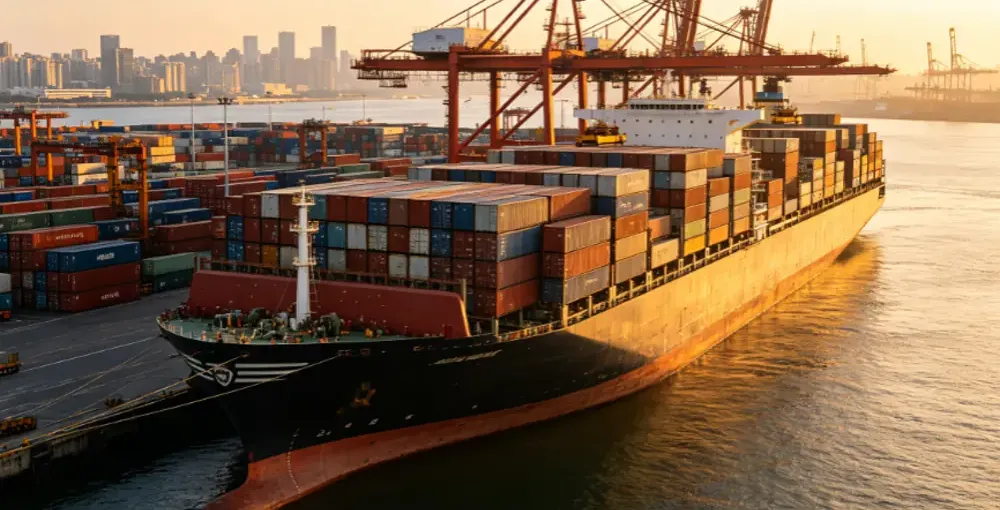
Every tonne of sea freight from China to Bolivia finishes its ocean voyage in a different country. Bolivia has never had a seaport: the nearest deep-water quay sits at Arica in Chile, roughly 450 km and one 4,000 m Andean pass away from La Paz, and the alternative gateways are Iquique, Ilo, Matarani, Callao and — for eastern cargo — Santos in Brazil.
That single fact shapes everything an importer has to plan. A China–Bolivia sea shipment is not one contract but two: an ocean carrier moving your container to a foreign port, and a road carrier moving it inland under a Bolivian customs transit regime. The water leg is usually the cheap part; the gateways, the surcharges and the transit paperwork are where quotes diverge by thousands of dollars.
This guide works the sea side of the move — routes, Q3 2026 rates, transit, the FCL/LCL decision and the Aduana Nacional (ANB) paperwork that releases the box. For the road, air and door-to-door alternatives around it, start from our shipping from China to Bolivia overview.
Sea Freight Routes from China to Bolivia: Where the Ocean Leg Ends
On the water your container travels an ordinary Asia–South America West Coast rotation. What makes the lane unusual is the discharge port: it decides your inland freight bill, your transit, and how long your cargo sits in bond before the ANB releases it.
Arica and Iquique (Chile)
Arica is the classic gateway. Under the 1904 treaty Bolivian cargo enjoys free-port treatment there, the port operator runs a dedicated Bolivian cargo terminal with bonded storage, and the road climbs to the Altiplano through Tambo Quemado — about 450 km to La Paz and El Alto. Iquique, further south, reaches Oruro, Cochabamba and Santa Cruz through Pisiga; schedules there are thinner, so rate swings are wider and 40HQ equipment tighter.
Ilo and Matarani (Peru)
Peru’s Ilo concessions, extended by the 2010 complementary protocol, give Bolivian cargo dedicated storage and free-zone space on Peruvian soil, with trucks crossing at Desaguadero — a shorter drive to La Paz than the Chilean road, and the reason several Altiplano importers split volume between Arica and Ilo. Matarani is the southern alternative when Ilo is booked out.
Callao (Peru)
Callao is the deepest and busiest of the Pacific options: the most frequent sailings from Asia, the largest vessels and the best 40HQ availability. The trade-off is the road leg, the longest of the Pacific gateways at 4–6 days to Santa Cruz. For heavy, low-value cargo where the ocean rate dominates, Callao often still wins.
Santos and the Paraguay–Paraná Waterway (Brazil)
Bolivia also draws ocean cargo through the Atlantic side: Santos and Paranaguá, then rail via Corumbá or barge up the Paraguay–Paraná waterway to Puerto Suárez / Puerto Quijarro, and on to Santa Cruz. Transit is longer and schedules less predictable, but for cargo with a Brazilian supply chain it avoids the Andes crossings entirely.
Which Gateway Fits Your Cargo and Your City
| Destination | First-choice gateway | Why |
|---|---|---|
| La Paz / El Alto | Arica | Shortest road leg (~450 km) and free-port storage in bond |
| Oruro, Potosí | Arica or Iquique | Pisiga crossing; compare both ocean rates |
| Cochabamba | Arica or Matarani | Balanced road distance, weekly sailings both ways |
| Santa Cruz | Callao, or Santos for east-bound cargo | Lowest ocean rate of the Pacific options; Brazilian route avoids the Altiplano |
| Tarija, far south | Ask for Antofagasta quotes | Southern Chilean port competes with the Arica road |
The cheap lesson here: never accept a China–Bolivia sea quote that names only the Chinese load port. Ask which gateway the rate discharges at, and whether the inland leg is quoted — a $400 saving on the ocean rate can disappear behind $900 of extra trucking.
Ocean Freight Rates from China to Bolivia: Q3 2026 FCL and LCL Costs
Bolivia sea rates are quoted port-to-gateway, not port-to-Bolivia, so every serious quote carries two freight lines. These are realistic Q3 2026 market ranges, consistent with our how much is shipping from China to Bolivia cost guide; the ocean figures include the base freight, BAF fuel charge and origin THC.
| Ocean leg (origin → gateway) | 20ft FCL | 40ft FCL | 40ft HQ |
|---|---|---|---|
| Shanghai → Arica | $1,400–$2,500 | $2,000–$3,300 | $2,100–$3,500 |
| Ningbo → Iquique | $1,450–$2,600 | $2,050–$3,400 | $2,150–$3,600 |
| Shenzhen / Yantian → Arica | $1,300–$2,400 | $1,900–$3,200 | $2,000–$3,400 |
| Guangzhou / Nansha → Ilo | $1,400–$2,550 | $2,000–$3,350 | $2,100–$3,500 |
| Qingdao → Callao | $1,700–$2,900 | $2,400–$3,900 | $2,600–$4,100 |
Then the land leg, which is billed per container — and, unlike the ocean rate, does not fall when volumes soften:
| Truck leg (gateway → city) | 20ft FCL | 40ft / 40HQ | Road transit |
|---|---|---|---|
| Arica → La Paz / El Alto | $1,000–$1,800 | $1,300–$2,300 | 1–2 days |
| Arica → Oruro | $1,100–$2,000 | $1,400–$2,500 | 1–2 days |
| Arica → Cochabamba | $1,500–$2,500 | $2,000–$3,200 | 2–3 days |
| Arica → Santa Cruz | $2,000–$3,200 | $2,600–$4,200 | 3–5 days |
| Ilo / Matarani → La Paz (Desaguadero) | $1,100–$2,000 | $1,400–$2,500 | 2–3 days |
| Callao → Santa Cruz | $1,600–$2,800 | $2,000–$3,600 | 4–6 days |
Add the two lines and the all-in sea freight most Bolivian importers actually pay lands at $2,500–$4,800 for a 20ft and $3,100–$6,000 for a 40ft or 40HQ to a Bolivian terminal, before duties and IVA. Duties, IVA and the broker are quoted separately — see the customs section below.
For volumes under a container, LCL (groupage) is priced per cubic metre: $150–$300 per CBM on the Bolivia lane in Q3 2026, with a minimum of 1 CBM and the overland leg billed per CBM in the same shared flow. The consolidation mechanics are identical to the region’s biggest groupage lane, which we break down step by step in our LCL shipping from China to Brazil guide.
What Is Inside a China–Bolivia Sea Freight Quote
Two quotes for the same cargo can differ by 40% without either being dishonest — one simply excludes the lines the other includes. On this lane, these are the components worth naming:
- BAF / CAF (bunker adjustment) — fuel-linked, already inside the ocean figures above on most carriers, but occasionally quoted separately.
- Peak-season surcharge (PSS) and GRI — capacity-driven adders, sharpest from September through November on the West Coast South America trade.
- Origin THC and export documentation — terminal handling at the Chinese port plus the export customs filing.
- Destination THC, wharfage and gate charges — paid at the gateway; these are the fees that make two gateways differ even when the ocean rate matches.
- Equipment imbalance and overweight surcharges — 40HQ boxes can carry a repositioning premium into Chilean and Peruvian ports, and a 40ft loaded near its limit costs more over the Andes than the tariff suggests.
- Transit, border and gateway charges — MIC/DTA processing at the exterior customs agency, border-crossing fees, and storage or detention of $100–$200 per container per day once free time expires. Documents should never lag the vessel.
The Aduana Nacional itself publishes useful cost yardsticks for what a normal Bolivian import looks like as a share of cargo value — a rare, impartial benchmark to test a quote against:
| ANB reference (share of FOB value) | Typical range |
|---|---|
| International maritime freight | 3–6% |
| International road freight (gateway → Bolivia) | 1.23–2.10% |
| Port expenses at the gateway | ~0.51% |
| Cargo insurance | 0.37–2% |
If a forwarder’s ocean line for a $30,000 FOB shipment lands above 6% of FOB outside peak weeks, it is worth a second quote. To sanity-check your own numbers before you request pricing, the Freight Cost Calculator turns cargo dimensions, weight and destination into an indicative starting rate.
Seasonality alert: China–South America capacity tightens from August to December, and PSS filings on this trade can add 15–30% to the ocean rate. Booking 3–4 weeks ahead with a rate-validity window is the cheapest insurance on the Bolivia lane — and remember that Lunar New Year in February pulls a second wave of congestion, this time on the Chinese export side.
How Long Does Sea Freight from China to Bolivia Take?
Ocean transit on this lane is long because most services transship once — usually at Busan, Hong Kong or Singapore — before the West Coast South America leg. Weekly sailings are standard from Shanghai, Ningbo, Shenzhen and Qingdao.
| Route | Ocean transit | + overland | Port-to-door total |
|---|---|---|---|
| Shanghai → Arica → La Paz | 26–32 days | 2–3 days | 30–38 days |
| Shenzhen / Yantian → Iquique → Santa Cruz | 28–34 days | 3–5 days | 33–40 days |
| Ningbo → Callao → La Paz | 27–33 days | 3–5 days | 32–40 days |
| Guangzhou → Callao → Santa Cruz | 28–34 days | 3–4 days | 33–40 days |
| Qingdao → Arica → Cochabamba | 32–38 days | 3–5 days | 36–45 days |
Add the ANB clearance window of 2–5 working days and the practical planning figures are 35–45 days for FCL door-to-door and 40–50 days for LCL, counted from the day your supplier releases the goods. Three things stretch those numbers: transshipment that misses a connection (add 5–10 days), LCL consolidation (add 5–10 days), and the Altiplano rainy season from December to March, when Tambo Quemado and Desaguadero can back up with truck queues. Our companion how long does it take to ship from China to Bolivia guide maps every mode on the lane, including air.
One scheduling rule beats all the rest: the fastest vessel is useless if the transit declaration is filed late. Cargo that arrives at Arica before the MIC/DTA is ready waits in bond and starts the detention clock.
FCL or LCL: Choosing Sea Freight Options from China to Bolivia
This is a pure arithmetic decision, and on a landlocked lane the arithmetic changes slightly because the overland leg is priced per container for FCL but per CBM for LCL.
| FCL (20ft / 40ft) | LCL (groupage) | |
|---|---|---|
| Billing basis | Per container | Per CBM or per revenue ton (1 CBM = 1,000 kg) |
| Practical fit | From ~15 CBM upward | Under ~15 CBM |
| Transit | 35–45 days door-to-door | 40–50 days door-to-door |
| Handling | Sealed box, one handling cycle | Consolidation, break-bulk at the gateway, more touches |
| Best for | Dense cargo, fragile goods, repeat shipments | Trials, spare parts, mixed supplier orders |
A worked example makes the breakpoint obvious. Take furniture-grade cartons of 60 × 40 × 40 cm → 0.096 CBM each, 200 cartons = 19.2 CBM: LCL at $150–$300 per CBM bills $2,880–$5,760, while a 20ft moves the same 19.2 CBM all-in at $2,500–$4,800 and arrives about a week sooner. Below roughly 10 CBM the picture flips and LCL is the sensible buy.
Density is the second variable. LCL quotes compare volume against weight at a 1:1,000 ratio, so a carton of steel fixings that weighs 30 kg in 0.024 CBM is billed on 30 kg of revenue weight, not on its tiny volume — dense cargo reaches the FCL breakpoint far earlier than the CBM count suggests. Run your packing list through the Volumetric Weight Calculator before you compare LCL and FCL quotes, and ask your forwarder to show the chargeable weight behind the LCL price.
Sea Freight Customs Clearance in Bolivia: ANB, MIC/DTA and the DUI Paperwork
Bolivian sea freight does not clear where it lands. It moves under a transit regime to an interior customs office and is imported there. Understanding those two stages is what keeps a shipment out of storage.
Step 1 — The Transit Regime Starts at the Exterior Customs Agency
The Aduana Nacional de Bolivia operates exterior customs agencies in Chile and Peru. There, the international road carrier files the MIC/DTA (Manifiesto Internacional de Carga / Declaración de Tránsito Aduanero) electronically through the ANB’s SUMA platform. The system checks the manifest for consistency, may select it for documentary review under selective criteria, and the window officer then seals and stamps the copies. Only once the transit is authorised can the truck move Bolivian-bound cargo legally toward an interior destination customs office such as Tambo Quemado, Desaguadero or a city office.
Step 2 — The DUI, the Taxes and the Levante
On arrival, the bonded depot or free-zone concessionaire issues the Parte de Recepción — the document that actually starts the import procedure. Your broker (Agencia Despachante de Aduana) or your own team then files the DUI (Declaración Única de Importación) in SIDUNEA++, pays the taxes within three business days at Banco Unión, and waits for the system to assign a control channel: green (release directly), yellow (documentary check) or red (physical inspection). Release — the levante — follows within two days of a clean channel result. Clean, well-documented containers clear in 2–5 working days; a value or classification mismatch can turn that into weeks.
What is paid, on the CIF frontier value (goods + international freight + insurance):
- Gravamen Arancelario (GA): per Bolivia’s 2026 import tariff schedule, commonly 5–20% on consumer and industrial goods, with rates up to 40% on protected items
- IVA a la importación: 14.94% of (CIF frontier + GA + other charges) — the import version of Bolivia’s 13% VAT, grossed up so the tax is inside the base
- Verificación: 1% of the FOB value
- Plus the Agencia Despachante fee and the bonded warehouse tariff, which scale with CIF value and weight
Documents the ANB Expects on a Sea Shipment
Commercial invoice with the FOB value broken out and literal goods descriptions; the transport document — the maritime manifest for the ocean leg and the MIC/DTA for the road leg; the packing list; a Declaración Andina de Valor whenever the FOB value exceeds USD 5,000; the Parte de Recepción; the cargo insurance policy; and the port expense sheet from the gateway. A certificate of origin is required only to claim a tariff preference — and Bolivia has no free-trade agreement with China, so Chinese goods pay the standard schedule.
Worked example — 20ft of textiles, Shanghai → Arica → La Paz (1,000 units, Q3 2026):
| Item | Value (USD) |
|---|---|
| Cargo FOB value | $12,000 |
| Ocean freight to Arica (20ft) | $1,900 |
| Marine insurance (0.6% of FOB) | $72 |
| CIF frontier value at Arica | $13,972 |
| Gravamen Arancelario (10%) | $1,397 |
| Port expenses at gateway (0.51% of FOB) | $61 |
| IVA a la importación (14.94% of $15,430) | $2,305 |
| Verificación (1% of FOB) | $120 |
| Broker and bonded warehouse | $270 |
| Inland trucking Arica → La Paz | $1,500 |
| Landed total | ≈ $19,565 |
| Uplift over FOB | ≈ +63% |
| Landed cost per unit | ≈ $19.56 |
The freight lines are only about $3,400 of that $19,565 — the taxes and fees are larger. Budget them before you commit to a purchase order, not after the vessel sails.
Booking Sea Freight to Bolivia: Cut-Off, VGM and the Weekly Sailing Rhythm
- Get an itemized quote — ocean leg, gateway charges, transit filing, truck leg, duties and IVA shown separately. If they are bundled into one number, you cannot optimise the gateway.
- Book 3–4 weeks ahead and confirm 40HQ equipment availability for your sailing week, not at the last minute.
- Watch two Chinese-side deadlines: the cargo cut-off for your port of loading, and the VGM (verified gross mass) submission, which is mandatory before loading and a common cause of rolled bookings.
- Clear export — your forwarder handles the Chinese export declaration, loading and the bill of lading. Check whether the B/L is consigned to order or to your Bolivian consignee, because the transit filing needs the right consignee data.
- Sail and connect — one transshipment is normal; ask which hub and how tight the connection is before you promise a date internally.
- Pre-file the MIC/DTA before the vessel berths. This is the highest-leverage task in the whole process: it lets the truck load the day the container is available instead of accruing gateway storage.
- Truck and clear — cross at Tambo Quemado, Desaguadero or Pisiga, file the DUI, pay the taxes, collect the levante, and deliver to La Paz, El Alto, Cochabamba or Santa Cruz.
Plan the sequence backwards from your delivery date and the 35–45 day window stops feeling unpredictable. If you would rather hand the ocean booking, the transit regime and the ANB clearance to one partner with liability across both legs, our door-to-door vs port-to-port comparison explains what changes — and what does not — when the sea quote becomes an all-in door quote.
Frequently Asked Questions
How much does sea freight from China to Bolivia cost in Q3 2026?
The ocean leg runs $1,400–$2,500 for a 20ft and $2,000–$3,500 for a 40ft to Arica, Iquique or Callao, plus $1,000–$2,800 per container of trucking into Bolivia. All-in to a Bolivian terminal, that is $2,500–$4,800 for a 20ft and $3,100–$6,000 for a 40ft or 40HQ. LCL is billed per CBM at $150–$300.
How long does sea freight from China to Bolivia take?
Ocean transit to the gateway port takes 26–38 days depending on the Chinese origin and service, then 2–5 days of trucking to La Paz, Cochabamba or Santa Cruz, plus 2–5 working days of ANB clearance. Plan on 35–45 days door-to-door for FCL and 40–50 days for LCL.
Does sea freight to Bolivia need a Bolivian port?
No. Bolivia is landlocked, so every sea shipment discharges in a neighbouring country and finishes the journey by road: Arica or Iquique in Chile, Ilo, Matarani or Callao in Peru, or Santos in Brazil feeding the Paraguay–Paraná waterway and rail to Santa Cruz.
Which documents does the ANB require for a sea shipment to Bolivia?
The commercial invoice with the FOB value broken out, the bill of lading or maritime manifest, the MIC/DTA road manifest, the packing list, a Declaración Andina de Valor when the FOB value exceeds USD 5,000, the Parte de Recepción from the bonded depot, the insurance policy and the port expense sheet. A certificate of origin matters only for preferential tariffs, and China has no FTA with Bolivia.
Is FCL or LCL cheaper for sea freight to Bolivia?
Below roughly 15 CBM, LCL at $150–$300 per CBM usually wins; above that a 20ft at $2,500–$4,800 all-in is cheaper and arrives 5–10 days sooner. LCL is billed per CBM or per revenue ton, so cargo heavier than 1,000 kg per CBM pays by weight and reaches the FCL breakpoint much earlier.
What import taxes apply to sea freight arriving in Bolivia?
The ANB charges the Gravamen Arancelario on the CIF frontier value under the 2026 tariff schedule — commonly 5–20% on consumer and industrial goods — plus IVA a la importación of 14.94% on CIF plus duty and port expenses, and a 1% verification fee on the FOB value, with broker and warehouse charges on top.
Get a Q3 2026 Sea Freight Quote for China–Bolivia Cargo
Send us your cargo details — origin city in China, volume or container type, destination in Bolivia and the goods you are importing — and we will come back with a quote that prices both legs and the gateway charges separately, so you can see exactly what the sea freight costs and what the Andes adds. Fifteen years on the China–Americas trade, with gateway partners in Arica, Iquique, Ilo, Matarani and Callao.
Request your China–Bolivia sea freight quote — or tell us your target date and we will work the booking backwards from it.