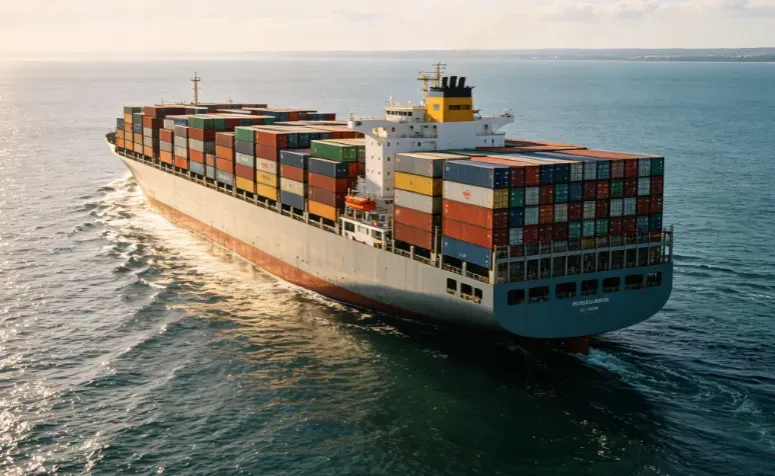
How long does it take to ship from China to Bolivia? The honest answer in 2026: 30–45 days by sea, 5–9 days by air, and 3–6 days by express courier — and the reason for that wide spread is Bolivia itself. Bolivia is landlocked, so a sea shipment does not end at a Bolivian port: your container discharges at Arica or Iquique in Chile, or Callao in Peru, then travels overland by truck across the Andes to La Paz, Santa Cruz or Cochabamba. That final land leg is part of every sea freight transit time you see quoted — and it is exactly where many importers lose days they did not plan for.
This guide gives you real 2026 transit times for every shipping method from China to Bolivia, route-by-route breakdowns through the main transshipment gateways, the factors that cause delays, and a simple way to calculate your own door-to-door timeline — based on 15 years of hands-on freight forwarding experience at Dantful.US International Logistics. For a full overview of your options, start with our shipping from China to Bolivia guide.
Shipping Times from China to Bolivia at a Glance
| Shipping Method | Total Door-to-Door Time | Port-to-Port / Flight Time | Best For |
|---|---|---|---|
| Express courier (DHL/FedEx-type) | 3–6 days | 2–4 days | Documents, samples, urgent parcels |
| Air freight | 5–9 days | 3–5 days flight time | High-value, time-sensitive cargo |
| Sea freight LCL | 35–50 days | 30–40 days incl. transshipment | Small shipments under 15 CBM |
| Sea freight FCL | 32–45 days | 28–38 days incl. transshipment | Full containers, bulk cargo |
| Sea + land door-to-door | 40–55 days | Includes clearance + overland to inland cities | Complete service to your door |
These are realistic 2026 figures for the most common routes from Shanghai, Shenzhen and Ningbo. The exact number depends on your origin port, the transshipment gateway, and whether your final destination is Santa Cruz (closer to the border) or La Paz (higher in the Andes).
Why Shipping Times to Bolivia Are Different
Bolivia is one of only two landlocked countries in South America, so there is no such thing as a direct China–Bolivia sea route. Every ocean shipment works like this:
- Your container sails from a Chinese port to a regional hub (usually transshipping once, via Busan, Hong Kong or Singapore)
- It discharges at a neighbor-country port: Arica or Iquique (Chile), Callao or Matarani (Peru) — Arica is the classic gateway, with Bolivia enjoying free-port rights there under a 1904 treaty
- The container clears transit/import procedures and is trucked overland to Bolivia — 2–5 days to Santa Cruz or La Paz depending on the port
That overland leg adds both days and cost compared with coastal destinations. For a deeper comparison of service scopes, see our door-to-door vs. port-to-port shipping breakdown.
Sea Freight Transit Times from China to Bolivia (Route by Route)
| Route | Ocean Transit | Overland to Destination | Total Port-to-Door |
|---|---|---|---|
| Shanghai → Arica (Chile) → La Paz | 26–32 days | 2–3 days | 30–38 days |
| Shanghai → Arica → Santa Cruz | 26–32 days | 3–4 days | 32–38 days |
| Shenzhen/Yantian → Iquique → Santa Cruz | 28–34 days | 3–5 days | 33–40 days |
| Ningbo → Callao (Peru) → La Paz | 27–33 days | 3–5 days | 32–40 days |
| Qingdao → Arica → Cochabamba | 32–38 days | 3–5 days | 36–45 days |
| Guangzhou → Callao → Santa Cruz | 28–34 days | 3–4 days | 33–40 days |
Most China–Bolivia services transship at Busan, Hong Kong or Singapore for the Asia leg and connect at the Chilean or Peruvian port for the final leg. LCL (consolidated) shipments add 5–10 days because your cargo waits for a full container at the consolidation hub. In practice, plan on 35–45 days for FCL and 40–50 days for LCL from the day your supplier releases the goods.
Air Freight Transit Times from China to Bolivia
Air freight is the fastest reliable option and the only realistic choice when you need goods in Bolivia within two weeks. There are no direct cargo flights between China and Bolivia, so shipments connect via Miami, Amsterdam, Madrid, Istanbul or Lima before arriving at:
- El Alto International Airport (LPB) — serves La Paz; at ~4,000 m altitude, high-altitude conditions limit aircraft payload, which can affect both space availability and price
- Viru Viru International Airport (VVI) — Santa Cruz, Bolivia’s largest cargo gateway and the preferred entry for most air freight
| Route | Flight Time | Typical Total Door-to-Door |
|---|---|---|
| Shanghai (PVG) → Santa Cruz (VVI) | 3–5 days | 5–8 days |
| Guangzhou (CAN) → Santa Cruz (VVI) | 3–5 days | 5–8 days |
| Hong Kong (HKG) → La Paz (LPB) | 3–6 days | 6–9 days |
| Shenzhen (SZX) → Santa Cruz (VVI) | 3–5 days | 5–8 days |
Air Freight Rates & Volumetric Weight
Air freight from China to Bolivia runs approximately $5.5–$11 per kg in 2026 depending on the departure airport, weight band and season (rates for shipments over 1,000 kg sit at the low end). Charges are always calculated on the greater of gross weight or volumetric weight:
Volumetric weight (kg) = length × width × height (cm) ÷ 6000
Example: a carton of 80 × 60 × 50 cm weighing 30 kg → volumetric weight = 80 × 60 × 50 ÷ 6000 = 40 kg. You pay for 40 kg, not 30 kg. This matters enormously for bulky, light goods — keep packaging tight or air freight will quietly double your bill.
Air Freight vs Sea Freight from China to Bolivia
| Factor | Sea Freight (FCL/LCL) | Air Freight |
|---|---|---|
| Total door-to-door time | 32–55 days | 5–9 days |
| Typical cost per kg | $1.0–$3.0/kg (container equivalent) | $5.5–$11/kg |
| Minimum charge | ~$120–$250 (LCL minimum) | ~$150–$300 (minimum air waybill) |
| Best for | Bulk, heavy, non-urgent cargo | Urgent, high-value, perishable or light cargo |
| Restrictions | Fewer — most goods shippable | Batteries, liquids and aerosols restricted |
| Risk during transit | Higher handling exposure | Lower damage risk, faster cash flow |
Choose sea freight for containers, heavy machinery, furniture or anything over 1–2 CBM where cost per unit matters more than speed. Choose air freight when you are restocking fast-selling items, shipping spare parts or samples, or when your supplier has missed the sailing window. Many importers split the difference: sea for the bulk inventory, air for urgent replenishment.
Express Courier Shipping Times to Bolivia
For documents, samples and small parcels, international couriers (DHL, FedEx, UPS-style services) deliver to Bolivia in 3–6 days door to door. Customs clearance is handled by the courier, and tracking is end-to-end. Rates are high — roughly $12–$25 per kg depending on the service tier — so express only makes sense for small, urgent or high-value items. It is also the most reliable option for time-critical shipments like spare machine parts that keep a production line running.
What Delays Shipments to Bolivia?
Knowing where time gets lost is half the battle. The most common delay factors on the China–Bolivia lane:
- Transshipment connections — missing the weekly feeder at Arica or Callao can add 5–10 days; book with a forwarder who checks connection times, not just the main ocean leg
- Overland bottlenecks — the Arica–La Paz and Iquique–Santa Cruz truck routes can slow in the rainy season (December–March) and around holiday closures
- Customs documentation — Bolivia’s customs (Aduana Nacional) is strict about commercial invoices, packing lists, HS codes and, for many goods, prior authorization; one incorrect document can mean days of delay
- Peak season — September to January is peak export season on this lane; space tightens and both sea and air times stretch
- High-altitude air cargo — at El Alto (LPB), payload restrictions can push your shipment to the next flight; Santa Cruz (VVI) is the safer choice for urgent air freight
- Inland destination — delivery to remote areas beyond La Paz, Santa Cruz and Cochabamba adds 1–3 days of trucking
For a step-by-step look at how a full-service provider handles these risks, see our sea freight forwarder from China guide.
How to Calculate Your Own Door-to-Door Timeline
A simple formula gives a realistic estimate for any shipment:
Total time = production lead time + China pickup (1–2 days) + main carriage + transshipment buffer (2–5 days) + customs clearance (2–5 days) + inland delivery (1–4 days)
Example by sea (FCL): 3 days pickup + 30 days ocean & transshipment + 3 days clearance at Arica + 3 days overland to La Paz = 39 days. Example by air: 2 days pickup + 4 days flight & connections + 2 days clearance + 1 day delivery = 9 days. Build in a 3–5 day safety buffer and you will never over-promise a delivery date again. For a sense of how neighboring markets compare, our guide on how long it takes to ship from China to Brazil covers the same logic for South America’s largest economy.
Customs Clearance & Import Taxes in Bolivia
Bolivian customs is administered by the Aduana Nacional de Bolivia (ANB). Importers must be registered (NIT tax ID), and shipments are cleared electronically against the commercial invoice, packing list, bill of lading or air waybill, and certificate of origin. Expect 2–5 working days for a clean shipment; food, agricultural and pharmaceutical products additionally require SENASAG (Servicio Nacional de Sanidad Agropecuaria e Inocuidad Alimentaria) authorization.
What will you pay?
- Import duties (Gravamen Arancelario): typically 10–20% of the CIF value (cost + insurance + freight), depending on the HS code — capital goods and machinery often attract lower rates
- IVA (value-added tax): 13% — applied on CIF + duties
- Customs service fees and storage — small fixed charges, but demurrage at the Chilean or Peruvian gateway port can be costly if clearance drags
There is no free-trade agreement between China and Bolivia, so Chinese goods pay the standard tariff schedule. Because the landlocked route involves two customs processes (transit through Chile/Peru plus Bolivian import), many importers prefer a door-to-door service where the forwarder handles both sides. Chile’s ports — the natural gateway for Bolivia — are covered in depth in our sea freight from China to Chile guide.
Frequently Asked Questions
Q: How long does sea freight take from China to Bolivia?
A: 32–45 days port-to-door for FCL (28–38 days ocean incl. transshipment, plus 2–5 days overland from Arica, Iquique or Callao). LCL takes longer — typically 40–50 days — because of consolidation waiting time.
Q: How long does air freight take from China to Bolivia?
A: 5–9 days door to door, with 3–5 days of actual flight and connection time. Cargo to Santa Cruz (Viru Viru) is usually faster than to La Paz (El Alto) because of the high-altitude payload restrictions at El Alto.
Q: What is the fastest way to ship from China to Bolivia?
A: Express courier (3–6 days) for small parcels, and air freight (5–9 days) for larger urgent shipments. For anything non-urgent, sea freight via Chile or Peru is dramatically cheaper.
Q: Which port does cargo for Bolivia actually go to?
A: Sea cargo discharges mainly at Arica or Iquique in Chile and Callao or Matarani in Peru, then continues by truck to Bolivian cities. Arica is the classic gateway with Bolivian free-port rights.
Q: Why did my shipment from China to Bolivia take longer than quoted?
A: The usual culprits: missed transshipment connections at the hub port, customs document errors, rainy-season delays on the Andean truck routes, and peak-season congestion (September–January). A forwarder who monitors connections and pre-checks documents prevents most of these.
Q: How can I get my goods from China to Bolivia faster?
A: Choose air freight or express for urgent cargo, use Santa Cruz (VVI) as the air entry point, ensure complete documents (HS codes, invoices, prior authorizations) before departure, and book 2–4 weeks ahead in peak season.
Plan Your China–Bolivia Shipment with Confidence
Shipping to a landlocked country adds complexity, but the China–Bolivia lane is well-trodden: with realistic transit expectations, the right mode for each shipment, and a forwarder who knows the Arica and Callao gateways, your goods will arrive on schedule and on budget — whether by sea in 40 days or by air in a week.
Ready to ship? Contact Dantful.US for a free, itemized quote with accurate transit times for your specific route.