Port of Long Beach
Port Overview
The Port of Long Beach is one of the busiest container gateways in North America and a cornerstone of trans-Pacific trade. Located in Southern California’s San Pedro Bay, the port handled a record 9.88 million TEUs in 2025 and consistently ranks among the top US ports for containerized imports from Asia. For importers managing shipping from China to USA, Long Beach offers the shortest sailing distances from major Chinese ports, the most advanced terminal infrastructure on the West Coast, and direct on-dock rail connections that move cargo inland in days. For official schedules, tariffs, and operational updates, visit the Port of Long Beach official website.
Why the Port of Long Beach Matters for China Importers
- Record Volume: Nearly 9.9 million TEUs in 2025, with five of six terminals handling over 1 million TEUs each — two exceeding 2 million.
- Asia Connectivity: Over 140 shipping lanes to 217 ports worldwide, with the heaviest concentration on China and East Asia. All three major carrier alliances operate multiple weekly services.
- America’s Green Port: The pioneering Green Port Policy mandates shore power, zero-emission equipment, and the Clean Trucks Program — making Long Beach the environmental standard-bearer for US ports.
- Fully Automated Terminal: LBCT at Middle Harbor is the most technologically advanced container terminal in the Western Hemisphere, with fully automated electric transport and remote-controlled ship-to-shore operations.
- Foreign Trade Zone: FTZ No. 226 enables duty deferral, reduction on processed goods, and elimination on re-exports.
Key Facts at a Glance
| Metric | Value |
|---|---|
| Annual Container Volume | ~9.88 million TEUs (2025 record) |
| Total Area | 3,200 acres (land and water) |
| Waterfront | 25 miles |
| Container Terminals | 6 major terminals |
| Berth Depth | Up to 76 feet (LBCT) |
| Rail Connectivity | Pacific Harbor Line → BNSF & Union Pacific |
| Foreign Trade Zone | FTZ No. 226 |
| Key China Trade Lanes | Shanghai, Ningbo, Shenzhen, Qingdao, Xiamen |
Port Location
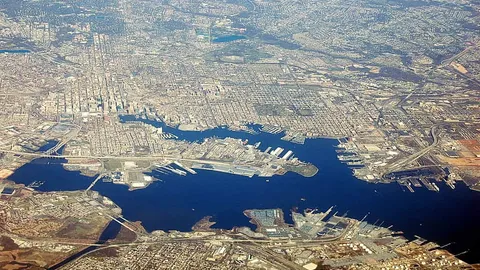
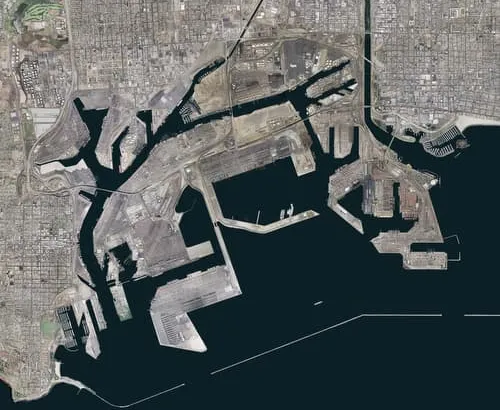
The Port of Long Beach occupies 3,200 acres along 25 miles of waterfront in San Pedro Bay, approximately 20 miles south of downtown Los Angeles. Together with the adjacent Port of Los Angeles, it forms the San Pedro Bay port complex — the largest container port complex in the Western Hemisphere, handling roughly 40% of all US containerized imports.
Service Region
- Immediate market: Southern California’s 23 million consumers — plus the broader California economy, the world’s fifth-largest — are reachable within hours by truck.
- National reach: The Pacific Harbor Line (PHL) , a 115-mile short-line railroad, connects all six terminals directly to BNSF and Union Pacific transcontinental networks. Over 30% of Long Beach imports move out of state by rail, reaching Chicago in 5–7 rail days.
- E-commerce hub: The Inland Empire (Riverside and San Bernardino counties), just 60 miles east, houses over 600 million square feet of warehouse space anchored by Amazon, Walmart, and Target distribution networks.
- US-Mexico corridor: Proximity to Otay Mesa and Calexico border crossings positions Long Beach as a strategic entry point for goods destined for Mexico.
Port Terminals
The Port of Long Beach operates six container terminals under a landlord model — the City owns the land and infrastructure while private operators lease and manage terminal operations.
Major Container Terminals
-
Long Beach Container Terminal (LBCT) — Pier E / Middle Harbor: The most advanced terminal on the US West Coast. This $1.3 billion, fully automated facility features 14 ship-to-shore cranes with dual-hoist tandem-lift capability, automated electric stacking cranes, and OCR-based gate processing averaging under two minutes per truck. With a 4,200-foot wharf, 76-foot channel depth, and capacity exceeding 3.5 million TEUs annually, its on-dock rail handles over 10,000 containers per week across 8 working tracks. Primary carrier: OOCL (40-year lease).
-
Total Terminals International (TTI) — Pier T: A 384-acre facility with 16 ship-to-shore cranes, 28 yard cranes, and 12 on-dock rail tracks. Annual capacity: 2.9 million TEUs, handling vessels up to 19,000 TEU. Operated by TIL Group (MSC-affiliated).
-
International Transportation Service (ITS) — Pier G: A 277-acre terminal undergoing a $365 million expansion (completion 2028) that will extend the quay to 3,500 feet and boost capacity by up to 50%. Equipped with five electric cranes and the port’s first on-dock rail installation.
-
Pacific Container Terminal (PCT) — Pier J: A 256-acre SSA Marine facility with 14 gantry cranes, 5,902 feet of berthing across five berths (48–50 feet depth), and on-dock rail with 114-railcar capacity. Serves COSCO, CMA CGM, and Ocean Alliance carriers.
-
SSA Marine Terminals — Pier A & Pier C: Two additional SSA-operated facilities handling Matson’s expedited China–Long Beach express service and specialized breakbulk operations.
All six terminals feature on-dock or near-dock rail access via the Pacific Harbor Line, enabling vessel-to-railcar transfers that bypass truck drayage. The port is investing $1.8 billion in the Pier B On-Dock Rail Support Facility (completion 2032), which will quadruple intermodal rail capacity to over 4 million TEUs annually and cut ship-to-train transfer times to under 24 hours.
Shipping Routes to This Port
The Port of Long Beach is served by near-daily sailings from China’s top container ports across all three major carrier alliances — 2M, Ocean Alliance, and THE Alliance — ensuring maximum scheduling flexibility for importers.
From Shenzhen (Yantian / Shekou)
Yantian is typically the last South China port of call before vessels cross the Pacific. Multiple weekly PSW sailings connect Yantian and Shekou directly to Long Beach via COSCO, OOCL, Evergreen, and CMA CGM. Yantian’s deep-water berths accommodate the largest trans-Pacific vessels, ensuring consistent capacity even during peak season.
From Shanghai
Shanghai is the single largest origin port for Long Beach-bound cargo, with daily sailings across all major carrier alliances. As the world’s busiest container port, Shanghai offers maximum schedule frequency — importers can nearly always find vessel space within 2–3 days of cargo readiness.
From Ningbo
Ningbo-Zhoushan is a primary PSW departure hub often paired with Shanghai on the same rotation. Weekly sailings available through all three alliances, with strong capacity from COSCO and Evergreen. Its proximity to Zhejiang and Jiangsu manufacturing clusters makes it the natural gateway for a significant share of China’s consumer goods exports.
From Qingdao
Qingdao is typically the first or second North China port call on PSW loops. While frequency is slightly lower than Shanghai and Ningbo, competitive rates are available — especially for cargo from Shandong, Hebei, and Tianjin manufacturing regions.
From Xiamen and Secondary Ports
Xiamen, Dalian, and other secondary Chinese ports connect to Long Beach via feeder services to Shanghai or Ningbo, or through less frequent direct PSW calls. Transshipment via Hong Kong or Busan provides additional options for ports without direct service.
Transit Time from China to Long Beach
Long Beach offers some of the shortest Pacific crossing times available to US importers:
| Origin Port | Transit Time to Long Beach | Sailing Frequency |
|---|---|---|
| Shanghai | 12–15 days | Daily |
| Ningbo | 13–15 days | Daily |
| Shenzhen (Yantian) | 13–16 days | Daily |
| Qingdao | 14–17 days | 4–5 per week |
| Xiamen | 15–18 days | 2–3 per week |
Actual transit times vary by carrier service tier, seasonal weather, and port conditions. Express services can trim 1–3 days off standard schedules. For LCL (Less-than-Container-Load) , add 3–5 days for consolidation and deconsolidation. Port congestion is a material risk during peak season (August–October) and labor negotiations — importers should build buffer time into supply chain planning. For a complete comparison, see our guide on how long sea shipping takes from China to USA.
Shipping Cost from China to Long Beach
Ocean freight rates from China to Long Beach are shaped by market dynamics, carrier pricing, and port-side charges. Understanding these cost drivers helps importers budget accurately and identify savings.
Factors Affecting Freight Rates
- Seasonality: Peak season (August–October) rates can increase 30–60%. Chinese New Year (January/February) creates a pre-holiday rush followed by a post-holiday rate dip — often the most cost-effective booking window.
- Container type and size: 40’ standard containers offer the best per-unit economics. High-cube, 20’, and specialized equipment (reefer, open-top, flat-rack) command premiums. See our guide on containers shipping from China to USA for detailed specifications.
- Service level: Standard trans-Pacific service vs. expedited or priority-loading options differ substantially. Premium services guarantee equipment availability and vessel space during peak season.
- Port fees: Long Beach charges wharfage (cargo value/weight based), dockage (vessel berthing), and the PierPass Traffic Mitigation Fee for daytime cargo. Budget $200–$400 per container depending on timing, terminal, and cargo type.
How to Lower Your Shipping Costs
| Strategy | Potential Impact |
|---|---|
| Ship FCL instead of LCL | 30–50% lower per-unit freight cost |
| Book during off-peak (March–July) | 20–40% rate reduction |
| Use off-peak PierPass hours | Lower gate fees per container |
| Pre-clear customs documentation | Avoid demurrage at $200–$400/day |
| Consolidate with a China-based forwarder | Access to volume-negotiated carrier rates |
| Use on-dock rail to inland destinations | Eliminate drayage, reduce door-to-door transit cost |
Partnering with a China-based freight forwarder like DANTFUL gives importers access to competitive carrier contracts, consolidated rates, and expert guidance on navigating Long Beach terminal procedures and fees.
Warehousing Services
The greater LA / Long Beach area is the largest US warehousing market, anchored by the Inland Empire’s 600+ million square feet of industrial real estate.
Bonded Warehousing & FTZ
The Port of Long Beach operates Foreign Trade Zone (FTZ) No. 226, enabling importers to store goods without immediate duty payment. Duties are deferred until goods leave the FTZ, or eliminated if re-exported — valuable for seasonal inventory, quality inspections, and value-added processing (labeling, kitting, repackaging) before final distribution.
Overseas Warehousing & 3PL
The Inland Empire offers comprehensive third-party logistics services for China-to-US importers:
- Container deconsolidation and transloading from 40’ ocean containers into 53’ domestic trailers
- Amazon FBA preparation and direct-to-fulfillment-center delivery
- Pick-and-pack e-commerce fulfillment with same-day order processing
- Cross-docking and e-commerce returns processing
Warehousing & Distribution Strategy
For importers, warehousing near Long Beach delivers key advantages: faster container turnaround avoids per-diem charges, transloading from 40’ ocean containers into 53’ domestic trailers cuts inland trucking costs by up to 20%, and same-day delivery is available across Southern California.
DANTFUL partners with vetted warehouses across the Long Beach / LA metro area, offering end-to-end logistics including inventory management, FBA prep, labeling, kitting, and last-mile delivery coordination.
Frequently Asked Questions
Q: Which port is better for China imports — Long Beach or Los Angeles?
A: Both are adjacent and part of the same San Pedro Bay gateway. Long Beach leads in automation (LBCT is the West Coast’s most advanced terminal); Los Angeles handles slightly more TEU volume. In practice, the choice depends on which terminal your carrier calls. DANTFUL can advise based on your preferred carrier and cargo destination.
Q: How long does customs clearance take at the Port of Long Beach?
A: With properly pre-filed documentation through CBP’s Automated Commercial Environment (ACE) , customs release typically takes 1–3 business days. C-TPAT certified importers benefit from significantly lower physical examination rates.
Q: What is the cheapest way to ship from China to Long Beach?
A: FCL (Full Container Load) ocean freight during off-peak season (March–July) is most cost-effective. For shipments under 15 cubic meters, LCL may be more economical despite higher per-unit rates.
Q: Does the Port of Long Beach have enough capacity for future growth?
A: Yes. The port’s $3.2 billion, ten-year capital program — the largest of any US port — targets 20 million TEUs in annual capacity by 2050. Current annual capacity is approximately 13.5 million TEUs, with major projects including the $1.8 billion Pier B On-Dock Rail Support Facility (completion 2032) and ongoing terminal expansions at ITS and Pier S.