Port of Baltimore
Port Overview
Overview of the Port of Baltimore
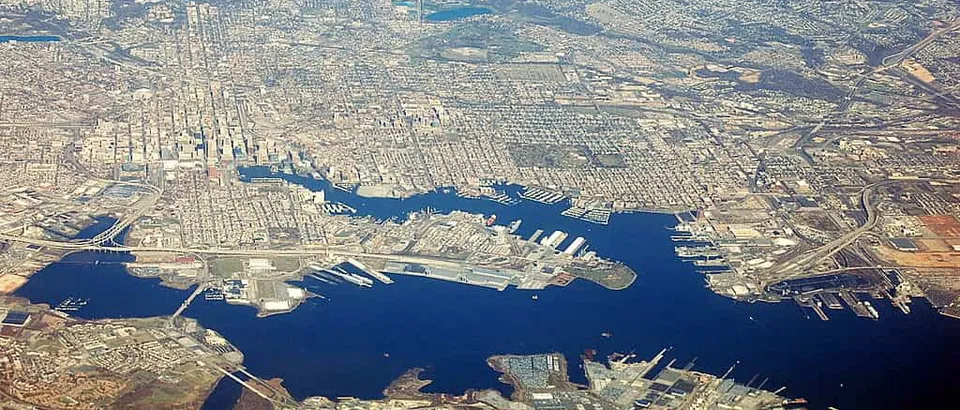
The Port of Baltimore is the fourth-largest US East Coast port by cargo value and the nation’s undisputed leader in roll-on/roll-off (RoRo) cargo handling. Located in Baltimore, Maryland, at the head of the Chesapeake Bay, it provides deep-water access to the Atlantic Ocean and serves as a critical gateway for goods shipping from China to USA, including containers, automobiles, heavy machinery, and bulk commodities.
In 2023, the port handled a record 1.26 million TEUs, with approximately 97% of container traffic moving through the Seagirt Marine Terminal. Its strategic Mid-Atlantic location positions it within overnight trucking distance of roughly one-third of the US population — including major markets like Washington DC, Philadelphia, New York, and the entire Northeast manufacturing corridor. For importers evaluating freight shipping from China to USA, Baltimore offers a compelling alternative to congested northern East Coast ports. For official terminal schedules and operational updates, visit the Maryland Port Administration website.
Why the Port of Baltimore Matters for China Importers
- #1 US RoRo Port: Handles more automobiles, light trucks, tractors, and heavy construction machinery than any other American port. For vehicle and equipment importers, Baltimore is unmatched in specialized handling infrastructure.
- Deep-Water Access: 50-foot channels and berths accommodate Ultra Large Container Vessels (ULCVs) up to 14,000 TEU capacity, ensuring direct all-water service from Asia without lightering or transshipment.
- Growing Container Capacity: Seagirt Marine Terminal’s $430.5 million capital program is expanding throughput from 1.5 million TEU to 2.1 million TEU, with the Berth I/II Modernization Project breaking ground in 2027.
- Double-Stack Rail: The Howard Street Tunnel expansion opened in September 2025, enabling double-stack intermodal rail service via CSX and Norfolk Southern to the Midwest.
- Foreign Trade Zone #74: One of the largest US FTZs, covering nearly 1,000 acres across seven Maryland counties with duty deferral, reduction, and streamlined customs procedures.
Key Facts at a Glance
| Metric | Value |
|---|---|
| Annual Container Volume | ~1.26 million TEUs (2023 record) |
| RoRo Cargo Rank | #1 in the United States |
| Channel Depth | 50 feet (15.2 meters) |
| Container Terminals | Seagirt Marine Terminal (primary) |
| Total Marine Terminals | 5 major terminals (Seagirt, Dundalk, Fairfield, South Locust Point, North Locust Point) |
| Rail Connectivity | CSX & Norfolk Southern (double-stack enabled since Sept 2025) |
| Foreign Trade Zone | FTZ #74 |
| Key China Trade Lanes | Shanghai, Ningbo, Shenzhen, Qingdao |
| Cargo Types | Containers, automobiles, RoRo, machinery, forest products, bulk (coal, salt, sugar, gypsum) |
Port Location
The Port of Baltimore occupies a strategic position on the Patapsco River, approximately 12 nautical miles from the Chesapeake Bay and roughly 150 nautical miles from the Atlantic Ocean. Its Mid-Atlantic location avoids the extreme congestion of northern East Coast gateways while delivering faster inland transit to key population and manufacturing centers.
Service Region
The Port of Baltimore’s distribution reach covers a significant portion of the US consumer market:
- Immediate market: Baltimore-Washington metropolitan area — home to over 9.8 million consumers and one of the wealthiest US regions by median household income.
- Overnight trucking radius: One-third of the US population is accessible within a single day’s drive, spanning the entire Northeast Corridor from Boston to Richmond, plus Pittsburgh, Cleveland, and Detroit manufacturing hubs.
- Midwest reach: Double-stack rail service via CSX and Norfolk Southern reaches Chicago in 2–3 rail days, connecting Baltimore imports to the nation’s largest intermodal hub.
- Southeast distribution: Direct I-95 corridor access enables efficient trucking to North Carolina, South Carolina, and Georgia markets.
- E-commerce fulfillment: Proximity to the I-95 logistics corridor, including major Amazon, Walmart, and Target distribution centers in Pennsylvania and Virginia, makes Baltimore a prime entry point for e-commerce and retail inventory.
Port Terminals
The Port of Baltimore operates five major terminals, each with specialized cargo handling capabilities. The diversified terminal structure enables the port to handle containers, RoRo, breakbulk, and bulk cargo simultaneously without cross-terminal congestion.
Major Terminals
-
Seagirt Marine Terminal: The port’s primary container-handling facility, operated by Ports America Chesapeake under a long-term concession. Features 4 berths (Berths III and IV at 50-foot depth for ULCVs), super post-Panamax gantry cranes, and on-dock rail. Handles approximately 97% of Baltimore’s container traffic. The terminal is actively expanding — new rubber-tired gantry (RTG) cranes were added in late 2024, and a $430.5 million capital plan targets 2.1 million TEU capacity. Berths III and IV alone handle 90% of vessel calls in 2025.
-
Dundalk Marine Terminal: The port’s largest and most versatile general cargo facility, with 13 berths and direct rail access. Handles automobiles, RoRo cargo, forest products, steel, project cargo, and breakbulk on a single campus. Dundalk is the center of Baltimore’s #1 RoRo operation, processing hundreds of thousands of vehicles annually for brands including Mazda, Mercedes-Benz, and John Deere.
-
Fairfield Marine Terminal: Specializes in bulk and breakbulk cargo handling, including coal, salt, sugar, and gypsum. Equipped with heavy-lift cranes for project cargo and oversized equipment.
-
South Locust Point & North Locust Point: Handle additional RoRo, cruise, and general cargo operations supporting the port’s diversified cargo portfolio.
Shipping Routes to This Port
Baltimore is served by all-water services from China’s major container ports via the Panama Canal. Multiple carrier alliances maintain weekly sailings, ensuring scheduling flexibility for importers shipping from manufacturing hubs across China.
From Shanghai
Shanghai is the single largest origin port for Baltimore-bound cargo, with multiple weekly sailings via the Ocean Alliance and THE Alliance through the Panama Canal. As the world’s busiest container port, Shanghai provides maximum scheduling flexibility — importers can typically secure vessel space within 2–3 days of cargo readiness.
From Ningbo
Ningbo-Zhoushan is a major departure hub on US East Coast service strings, often paired with Shanghai on the same vessel rotation. Weekly sailings are available through COSCO, Evergreen, and other alliance carriers.
From Shenzhen (Yantian / Shekou)
Yantian serves as the last South China port of call on many US East Coast loops, making it an efficient departure point for Pearl River Delta cargo. Panama Canal transit is available from all three major alliances.
From Qingdao and Secondary Ports
Qingdao is served via the same Panama Canal loops that call Shanghai and Ningbo. Cargo from northern Chinese ports (Tianjin, Dalian, Xiamen) can route through Shanghai or Ningbo as feeder connections. For smaller ports without direct Baltimore service, transshipment via Busan or Hong Kong provides additional options.
Transit Time from China to the Port of Baltimore
All-water transit from China to Baltimore via the Panama Canal is predictable and well-established. The following table shows typical port-to-port transit times from major Chinese origin ports:
| Origin Port | Transit Time to Baltimore | Sailing Frequency |
|---|---|---|
| Shanghai | 28–35 days | Multiple per week |
| Ningbo | 30–36 days | Weekly |
| Shenzhen (Yantian) | 30–38 days | Weekly |
| Qingdao | 32–38 days | Weekly |
| Xiamen | 33–40 days | Bi-weekly |
Actual transit times vary by carrier service tier, Panama Canal transit window availability, and seasonal weather patterns in the North Atlantic. For LCL (Less-than-Container-Load) shipments, add 3–5 days for consolidation at origin and deconsolidation at destination.
Importers should note that the Panama Canal operates on a reservation system, and during dry-season capacity restrictions, vessels without pre-booked transit slots may face 1–3 day delays.
For a complete comparison of transit times across all US entry points, see our guide on how long sea shipping takes from China to USA.
Shipping Cost from China to Baltimore
Ocean freight rates from China to Baltimore are influenced by market dynamics, seasonal demand, and port-side charges unique to the US East Coast. Understanding these cost factors helps importers budget accurately and identify savings opportunities.
Factors Affecting Freight Rates
- East Coast premium: All-water services to Baltimore via the Panama Canal carry a premium over West Coast routes. The East Coast rate differential typically ranges $700–$1,200 per FEU due to longer voyage distance and Panama Canal transit fees.
- Seasonality: Peak season (August–October) rates can surge 30–60% as retailers build holiday inventory. Conversely, the post-Chinese New Year period (February–March) and early summer (May–July) often offer the most favorable rates for budget-conscious importers.
- Container type and size: 40’ standard containers offer the best per-unit economics. 40’ high-cube and 20’ containers command different rate structures, while specialized equipment (reefer, open-top, flat-rack) carries significant premiums. For detailed specifications and cost comparisons by equipment type, see our guide on containers shipping from China to USA.
- Panama Canal fees: Vessel transit tolls are embedded in ocean freight rates and vary by vessel size and cargo volume. Recent canal water management surcharges add approximately $50–$150 per container during low-water periods.
- Port fees: Baltimore charges wharfage (cargo-based), dockage (vessel berthing), and terminal handling fees. Budget $200–$400 per container for port-side charges depending on cargo type and volume.
How to Lower Your Shipping Costs
| Strategy | Potential Impact |
|---|---|
| Ship FCL instead of LCL | 30–50% lower per-unit freight cost |
| Book during off-peak (February–July) | 20–40% rate reduction |
| Pre-clear customs documentation | Avoid demurrage and storage charges |
| Use double-stack rail for inland destinations | Eliminate drayage, reduce door-to-door cost |
| Consolidate with a China-based forwarder | Access to volume-negotiated carrier contracts |
| Consider FTZ storage for seasonal inventory | Defer duties, improve cash flow |
Warehousing Services
The Baltimore-Washington corridor is a major logistics and distribution hub, anchored by the Port of Baltimore’s cargo throughput and extensive interstate highway connections.
Bonded Warehousing & FTZ
Foreign Trade Zone (FTZ) #74, administered by the Baltimore Development Corporation, covers nearly 1,000 acres across seven Maryland counties and offers importers key advantages:
- Duty deferral: Pay customs duties only when goods leave the FTZ for US consumption — no time limit on storage.
- Duty reduction or elimination: Elect the lower duty rate between foreign inputs or finished products. Duties are eliminated on re-exported, scrapped, or destroyed goods.
- Streamlined customs: “Direct delivery” and “weekly entry” procedures reduce Merchandise Processing Fees and administrative overhead.
- Inventory tax exemption: Imported goods held in the FTZ are exempt from Maryland state and local inventory taxes.
Overseas Warehousing & 3PL
Baltimore’s logistics infrastructure supports a range of 3PL services for China-to-US importers, including container deconsolidation and transloading, Amazon FBA preparation and direct-to-FC delivery, pick-and-pack e-commerce fulfillment, cross-docking, and returns processing.
Warehousing & Distribution Strategy
For importers shipping from China, warehousing near the Port of Baltimore delivers measurable advantages:
- Avoid per-diem/demurrage charges: Faster container turnaround from nearby warehouses reduces daily equipment rental fees.
- Lower inland freight costs: Transloading into domestic 53’ trailers reduces inland trucking costs by up to 20%.
- Speed to market: Next-day ground delivery to Washington DC, Philadelphia, and New York; 2–3 day rail to Chicago.
- I-95 corridor access: Direct highway access to the entire Eastern Seaboard from Boston to Miami.
DANTFUL partners with vetted warehousing and 3PL providers across the Baltimore-Washington metro area, offering end-to-end logistics including inventory management, FBA prep, labeling, kitting, and last-mile delivery.
Frequently Asked Questions
Q: Is Baltimore or New York/New Jersey better for China imports?
A: Both are major East Coast gateways with distinct advantages. Baltimore excels for RoRo, automobiles, and specialized cargo while experiencing less congestion than New York/New Jersey. For pure containerized imports, New York/New Jersey handles roughly five times the TEU volume. The best choice depends on your cargo type, inland destination, and carrier preference.
Q: How long does customs clearance take at the Port of Baltimore?
A: With properly pre-filed documentation through CBP’s Automated Commercial Environment (ACE), customs release typically takes 1–3 business days. Baltimore’s US Customs and Border Protection team is known for efficient processing of both containerized and RoRo cargo. C-TPAT certified importers benefit from significantly lower physical examination rates, reducing average clearance time and the risk of delays.
Q: What is the cheapest way to ship from China to Baltimore?
A: The most cost-effective method is FCL (Full Container Load) ocean freight during off-peak season (February–July), leveraging volume-negotiated carrier rates through a China-based freight forwarder. For shipments under 15 cubic meters, LCL may be more economical despite higher per-unit rates. Importers managing seasonal inventory cycles can also benefit from FTZ #74’s duty deferral to improve cash flow.
Q: What types of cargo does Baltimore handle best?
A: Baltimore’s standout capability is RoRo cargo — automobiles, tractors, construction machinery, trucks, and heavy equipment. The port is also efficient with containerized consumer goods, forest products, steel, and bulk commodities. If your shipment involves vehicles or oversized machinery, Baltimore is the strongest East Coast choice.
Q: How did the Francis Scott Key Bridge collapse affect port operations?
A: The March 2024 bridge collapse blocked deep-draft vessel access for 74 days. The Fort McHenry Federal Channel was restored to full depth in June 2024, and port operations have returned to normal capacity. All terminals are fully operational with normal vessel schedules. A replacement bridge is expected to open in 2030.