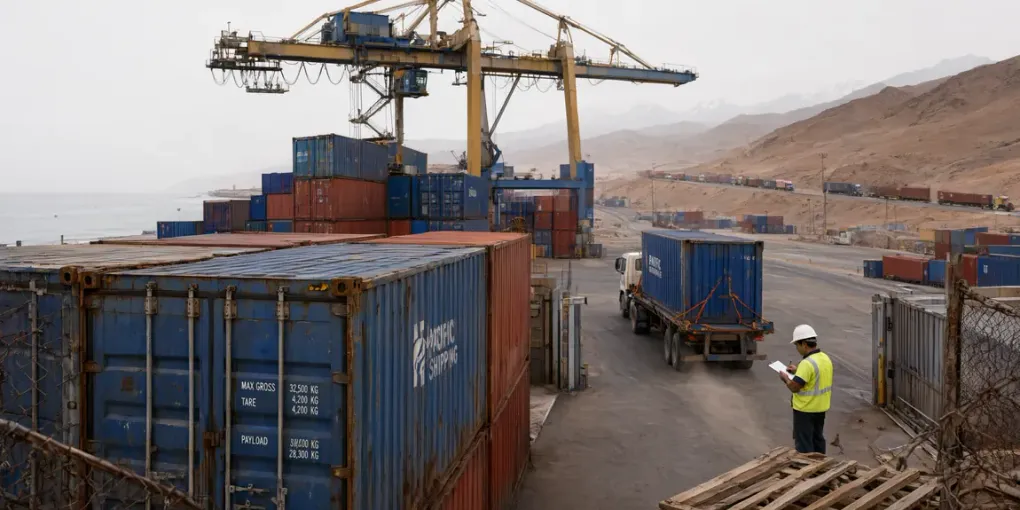
No ship has ever discharged a container in Bolivia. The nearest deep-water quay is Arica, in Chile, roughly 450 km and one 4,000 m Andean pass away from El Alto — which means a freight forwarder from China to Bolivia is not really selling ocean space. It is selling a handover: booking a box on an Asia–South America West Coast string, then making sure the transit document that lets a Chilean or Peruvian truck move that box inland is filed before the vessel berths, not after.
That distinction is why two quotes for the same 40HQ to Santa Cruz can differ by $2,300 and neither is dishonest. The ocean freight is almost identical across every legitimate NVOCC on this lane. What changes is the gateway, who pays the bonded storage while the box waits, and whether the transit filing (MIC/DTA) was lodged early enough that a truck was standing by on the day of discharge. Below are November 2026 numbers for the whole chain, the gateway economics a forwarder should be able to explain line by line, and the paperwork sequence that decides whether your cargo clears in four days or four weeks. For the country-level view of gateways, modes and services, start with our shipping from China to Bolivia hub.
What a Freight Forwarder from China to Bolivia Actually Owns: Three Customs Territories, One Booking
Four different parties have to act in sequence before your cargo reaches a warehouse in El Alto, and only one of them is the company you hired.
| Party | What it legally does on this lane | What it cannot do |
|---|---|---|
| Ocean carrier (MSC, Maersk, CMA CGM, COSCO, Hapag-Lloyd, ONE) | Sails the box, issues the master bill of lading, charges THC at the gateway | Book a truck into Bolivia, file transit, classify your goods |
| NVOCC / consolidator | Buys space in bulk, issues its own house bill, stuffs LCL cargo at a Chinese CFS | Appear on a Bolivian import declaration |
| Freight forwarder | Books space, collects from the supplier, files the Chinese export declaration, coordinates the transit filing, contracts the truck, quotes one door price | File the DUI, clear goods without a licensed despachante, act as importer of record |
| Agencia Despachante de Aduana | Files the DUI with the Aduana Nacional, pays duty and IVA, obtains the levante | Book ocean freight or negotiate rates |
| International road carrier | Files the MIC/DTA at the exterior customs agency in Arica, Iquique or Ilo, seals and moves the box | Release the cargo without the ANB transit authorisation |
Two consequences follow, and both cost money when ignored.
First, the forwarder you hire is only as good as the two partners it uses at the far end: the road carrier that files the transit and the despachante that files the import declaration. A forwarder that cannot name both — and cannot tell you which exterior customs office the filing goes through — is reselling, and your container becomes someone else’s problem the moment the vessel sails from Ningbo.
Second, the forwarder sets the CIF frontier value declared on the bill of lading and the insurance certificate, and that is the base the ANB taxes. An artificially low freight line does not just shave $300 off the quote; it lowers the duty and IVA base, which is exactly why the ANB adjusts value when a declared freight looks implausible against the route. A quote that is suspiciously cheap on the ocean line is a quote that will be reopened at the border.
Freight Forwarder Cost from China to Bolivia: November 2026 Fees with the Altiplano Truck Line Exposed
On most lanes the ocean freight dominates. Here it does not. Because the sea leg ends in a third country, the inland truck is frequently the second-largest line and sometimes the largest after duty.
| Door-to-door service, November 2026 | Gateway and final city | All-in per shipment |
|---|---|---|
| 20ft (20GP), Shanghai or Ningbo | Arica → La Paz or El Alto | $2,800–$5,000 |
| 40ft (40GP), Shanghai or Ningbo | Ilo → Cochabamba | $4,300–$7,000 |
| 40ft High Cube (40HQ), Yantian | Iquique → Santa Cruz | $4,600–$7,600 |
| LCL, 6 CBM | Arica → La Paz | $1,550–$3,000 |
| Air freight, 100–300 kg | Lima or Santa Cruz → door | $5.8–$9.7 per kg |
| Air freight, 300+ kg | Lima or Santa Cruz → door | $5.2–$8.4 per kg |
| Express courier, under 30 kg | Airport to door | $9–$15 per kg |
The five lines a China–Bolivia quote must name
| Line | Who charges it | November 2026 range | The trap |
|---|---|---|---|
| Ocean freight + BAF/CAF | Carrier via forwarder | $1,400–$2,400 (20ft), $2,000–$3,400 (40HQ) to Arica or Iquique | Peak-season surcharge of $250–$600 per box added after booking |
| Gateway charges | Terminal and shipping line agent at Arica, Iquique or Ilo | $180–$320 (20ft), $260–$450 (40ft) | Quoted collect, so it lands on your despachante instead |
| Transit filing and bonded handling | Road carrier and free-port warehouse | $90–$200 per container, plus storage after free time | Free time of 5–10 days is short when a truck is not pre-booked |
| Inland truck to the Altiplano | Bolivian or Chilean road carrier | $1,000–$1,800 to La Paz, $2,000–$3,200 to Santa Cruz | Priced per container, not per CBM, so LCL pays per cubic metre instead |
| Forwarder service and documents | Your forwarder | $150–$350 per container, $40–$90 per LCL shipment | Re-billed as a separate bill of lading release fee |
A forwarder that offers one all-in number for China to Bolivia has either bundled the truck at a rate it has not confirmed, or excluded the gateway charges in the small print. Ask for the five lines separately and ask which of them is fixed for the sailing date. For a fast estimate on your own volumes, the Freight Cost Calculator runs the same bands this article uses; for the container-level detail, our how much shipping from China to Bolivia guide breaks down 20ft against 40ft.
Sea Freight from China to Bolivia: How Your Forwarder Prices the Arica, Iquique and Ilo Gateways
Gateway choice moves the door price more than any rate negotiation, because it changes the road distance, the border crossing, the customs office that handles the transit and the availability of 40HQ equipment.
| Gateway | Country and regime | Border crossing | Road to main markets | Why importers use it |
|---|---|---|---|---|
| Arica | Chile, free-port treatment for Bolivian cargo under the 1904 treaty | Tambo Quemado | ~450 km to La Paz and El Alto | Dedicated Bolivian cargo terminal and bonded storage; deepest sailing frequency |
| Iquique | Chile, duty-free zone with bonded transit | Pisiga | ~400 km to Oruro, ~1,000 km to Santa Cruz | Better for Oruro, Cochabamba and eastern cargo; thinner schedules, tighter equipment |
| Ilo | Peru, concessions extended by the 2010 protocol | Desaguadero | ~300 km to La Paz | Shortest drive to La Paz; free-zone space on Peruvian soil |
| Matarani | Peru, standard transit | Desaguadero | Longer than Ilo | The fallback when Ilo is booked out |
| Callao | Peru, standard transit | Desaguadero | ~1,300 km to La Paz | Used when Lima services are cheaper than the direct southbound calls |
| Santos | Brazil, waterway and rail | Puerto Suárez corridor | Santa Cruz and the eastern lowlands | The only sensible option for heavy cargo bound for Santa Cruz |
Arica is the default for Altiplano importers for a reason that has nothing to do with rates. Bolivian cargo there sits in a dedicated terminal with bonded storage, which lets a forwarder spread gateway handling and duty across a few days instead of paying demurrage the moment the box is discharged. Iquique wins when the destination is Santa Cruz or Cochabamba and the sailing you need happens to call there — but 40HQ equipment is tighter and rate swings are wider, so a 40HQ via Iquique can cost more than a 40HQ via Arica even though the ocean distance is similar.
The forwarder decision that matters here is whether the gateway is chosen for your destination city or for the carrier schedule the forwarder happens to have space on. For routing detail, sailing rhythm and the FCL-versus-LCL split, see our sea freight from China to Bolivia guide.
How Long Does It Take to Ship from China to Bolivia with a Forwarder: The 35–45 Day Build-Up
Forwarders quote the number the carrier gives them — sailing time. Importers live with the number that includes the Andean road, and the two differ by one to two weeks.
| Leg | 20ft via Arica to La Paz | 40HQ via Iquique to Santa Cruz | LCL via Arica to La Paz |
|---|---|---|---|
| Chinese port to gateway (at sea) | 26–32 days | 28–36 days | 26–34 days |
| Discharge, gateway handling, transit authorisation | 1–2 days | 1–3 days | 3–6 days (deconsolidation) |
| Road leg and border crossing | 1–2 days | 3–5 days | 3–5 days |
| ANB clearance and levante | 2–5 working days | 2–5 working days | 3–6 working days |
| Door to door | 32–41 days | 35–49 days | 40–52 days |
The two weeks that quotes hide are almost always the same two weeks: gateway dwell while a truck is arranged, and the ANB control channel. Pre-filing the MIC/DTA before the vessel berths removes the first. Nothing removes the second except clean documents — a value or classification query sends a container from a 2-day release to a 2-week review.
When your forwarder should quote air instead
Nothing flies direct from China to Bolivia, so air cargo transships through Lima, Miami, São Paulo or Madrid and lands at Viru Viru in Santa Cruz or El Alto in La Paz. That routing explains the 5–9 day door-to-door figure: the flight time is a fraction of it. El Alto sits at roughly 4,060 m, which restricts takeoff payload on hot days, so dense or heavy air cargo is often landed at Santa Cruz and trucked up the mountain instead.
Air is priced on chargeable weight, not actual weight: the carrier compares the gross weight with the volumetric weight at 1:6000 (length × width × height in centimetres, divided by 6000) and bills the higher of the two. A carton of plastic housewares that weighs 8 kg but measures 60 × 50 × 45 cm bills at 22.5 kg, turning a $6.20 rate into a $139 charge. Run your carton dimensions through the Volumetric Weight Calculator before you let a supplier pack air cargo loosely. Full transit tables by origin are in our how long does it take to ship from China to Bolivia article.
Customs Clearance from China to Bolivia: MIC/DTA, the DUI and What Your Forwarder Files
Bolivian cargo does not clear where it lands. It moves under a transit regime to an interior customs office and is imported there, and the forwarder sits on only one half of that sequence.
Step one — the transit document. The Aduana Nacional de Bolivia operates exterior customs agencies in Chile and Peru. There, the international road carrier files the MIC/DTA (Manifiesto Internacional de Carga / Declaración de Tránsito Aduanero) electronically through the ANB SUMA platform. The system checks the manifest against the bill of lading data, may select it for documentary review, and the window officer seals and stamps the copies. Only then can the truck move Bolivian-bound cargo legally toward Tambo Quemado, Pisiga, Desaguadero or an interior city office. The forwarder does not file this document — but a forwarder that has done the lane before makes sure the consignee data on the house bill matches what the road carrier will declare, which is the difference between a one-day transit authorisation and a rejection.
Step two — the import declaration. On arrival, the bonded depot or free-zone concessionaire issues the Parte de Recepción, which starts the import procedure. Your Agencia Despachante de Aduana then files the DUI (Declaración Única de Importación) in SIDUNEA++, you pay the taxes within three business days at Banco Unión, and the system assigns a control channel: green for release, yellow for documentary review, red for physical inspection. The levante follows within about two days of a clean result.
Documents the ANB will want, and which a competent forwarder collects before the vessel sails:
- Commercial invoice with the FOB value broken out and literal goods descriptions
- Bill of lading or maritime manifest, plus the MIC/DTA for the road leg
- Packing list with carton dimensions and weights
- Declaración Andina de Valor whenever the FOB value exceeds USD 5,000
- Parte de Recepción from the bonded depot
- Cargo insurance policy matching the declared CIF value
- Port expense sheet from the gateway
- Product registrations where the classification demands them — SENASAG for food and agricultural inputs, MSDS and UN38.3 for batteries
- Your NIT and the despachante mandate
A certificate of origin belongs in the file but earns nothing: there is no free trade agreement between China and Bolivia.
Import Duty and Taxes from China to Bolivia: Gravamen Arancelario, 14.94% IVA and the 1% Verificación
Bolivia taxes imports on the CIF frontier value — goods plus international freight plus insurance, valued at the point of entry, not at your warehouse.
| Charge | Base | November 2026 rate |
|---|---|---|
| Gravamen Arancelario (GA) | CIF frontier | 5–20% on most consumer and industrial goods, up to 40% on protected items |
| IVA a la importación | CIF + GA + port expenses | 14.94% |
| Verificación | FOB value | 1% |
| Port expenses | FOB value | About 0.5% |
| Despachante and bonded warehouse | Per declaration and per CBM or tonne | $250–$600 per container |
One correction worth carrying into every negotiation: the import VAT is 14.94%, not 13%. The 13% figure is Bolivia’s domestic VAT rate; the import version is grossed up so the tax sits inside its own base. A forwarder or a competitor quoting 13% is quoting the wrong tax, and on a $30,000 CIF value that error is roughly $580.
Worked example: a 40HQ of machinery, FOB $28,000, Shenzhen → Iquique → Santa Cruz
| Line | Amount |
|---|---|
| FOB goods, Shenzhen | $28,000 |
| Ocean freight, 40HQ to Iquique | $2,900 |
| Marine insurance (0.6%) | $168 |
| CIF frontier value | $31,068 |
| Gravamen Arancelario at 10% | $3,107 |
| Port expenses at Iquique | $143 |
| IVA a la importación at 14.94% on $34,318 | $5,127 |
| Verificación at 1% of FOB | $280 |
| Despachante and bonded warehouse | $520 |
| Inland truck, Iquique → Santa Cruz | $2,600 |
| Total cost at destination | $42,845 |
| Uplift over FOB | +53% |
| Landed cost per unit at 400 units | $107.11 |
The three lines an importer can actually influence are the gateway (the truck leg), the GA through correct classification, and the IVA through the DDP-versus-DAP decision below. Everything else is arithmetic you should be able to check before the purchase order, not after the container is on the water.
Door to Door vs DDP Shipping from China to Bolivia: Who Pays the Duty at Tambo Quemado
Door to door is a service scope — collection at the supplier in China through to your address in Bolivia. DDP and DAP are the Incoterms used to price it, and they answer one question: who pays the Bolivian duty and IVA. They are not the same thing, and on this lane the mechanism matters more than the label.
- DAP (Delivered at Place) — the forwarder delivers to your door and you are the importer of record. Your NIT appears on the DUI, you pay GA, IVA and the verificación, and because you are registered you claim the import IVA as a credit against your own sales tax. This is the cheaper structure above roughly one container a month.
- DDP (Delivered Duty Paid) — the forwarder quotes one fixed price with Bolivian taxes inside. Correctly executed, that usually means the forwarder imports in its own name on its own NIT and issues you a local invoice with 13% IVA on the marked-up price.
That second mechanism is where first-time importers lose money quietly. When the forwarder imports in its own name you are not the importer of record: you cannot claim the 14.94% import IVA paid at the border, you pay 13% IVA again on the forwarder invoice, and you lose visibility on the declared CIF value — which matters if the ANB later questions the classification. A DDP quote where your NIT appears on the DUI and the forwarder merely advances the taxes is a different product; ask which of the two you are being offered, in writing.
For a first trial order under 15 CBM, DDP through a consolidator is usually still the right call: the price is predictable and the customs risk sits with someone who files these declarations weekly. The mechanics of both are set out in our door to door shipping from China to Bolivia guide.
How to Choose a Freight Forwarder from China to Bolivia: Nine Checks for a Landlocked Lane
This is a lane where the cheapest quote and the cheapest shipment are rarely the same number, because the failure modes happen in a country you did not ship to.
- Ask for the Chinese licence. A Ministry of Commerce filing, an NVOCC registration if it issues its own bills of lading, and a FIATA membership are the three signals worth checking.
- Get the Chilean or Peruvian agent named, and the Bolivian despachante named. Which exterior customs office handles the transit, which bonded depot stores the box, which despachante files the DUI. A forwarder that answers vaguely is brokering your cargo onward.
- Demand the five cost lines separately — ocean, gateway charges, transit filing and storage, truck leg, forwarder fee. An all-in number without a schedule hides the two lines that actually vary.
- Ask who files the MIC/DTA and on which day. The correct answer is the road carrier, at the exterior customs agency, before the vessel berths. An answer of “we handle everything at destination” means nobody has planned the truck.
- Confirm the gateway equipment before you book. 40HQ availability at Iquique is not the same as at Arica, and a rolled booking costs more than the rate difference.
- Ask what free time you get and who pays after it. Gateway free time is 5–10 days. If the forwarder will not name the number in writing, assume the storage is yours.
- Check the insurance structure. All-risk cover at 110% of CIF, certificate in your name, costs roughly 0.4–0.7% of the value on this route. “Our own cover” is carrier liability, which pays a fraction of the loss.
- Test the customs knowledge before you pay. Send one classification question and one question about the Declaración Andina de Valor threshold. A forwarder that cannot answer either will not rescue you at Tambo Quemado.
- Watch for the four red flags — a price 25–30% under market with gateway charges excluded, a bill of lading issued by a company whose name is not on the quote, a request to wire the full amount to a personal account, and no written confirmation of the Incoterm. Our guide to avoiding freight forwarder scams documents the patterns, and our shipping agent selection guide covers what a good agent should be able to prove on paper.
Frequently Asked Questions About Freight Forwarders from China to Bolivia
How much does a freight forwarder from China to Bolivia cost in November 2026?
Door to door, $2,800–$5,000 for a 20ft to La Paz via Arica, $4,600–$7,600 for a 40HQ to Santa Cruz via Iquique, and $1,550–$3,000 for 6 CBM of LCL. The ocean leg is only 35–45% of the total: gateway charges, the MIC/DTA filing, the Altiplano truck and the forwarder service fee are separate lines.
Can my freight forwarder clear customs in Bolivia for me?
No. The DUI can only be filed by an Agencia Despachante de Aduana licensed by the Aduana Nacional de Bolivia, and the transit document is filed by the international road carrier at the exterior customs agency. Your forwarder books, coordinates and contracts the truck, but it cannot replace the despachante.
How long does shipping from China to Bolivia take with a freight forwarder?
26–36 days at sea to Arica or Iquique, then 1–5 days of road and border crossing and 2–5 working days of ANB clearance. Realistic door to door is 35–45 days FCL and 40–52 days LCL; air is 5–9 days because nothing flies direct.
Which Bolivian port does cargo from China arrive at?
None — Bolivia has no seaport. Cargo discharges at Arica or Iquique in Chile or Ilo, Matarani and Callao in Peru, then moves by road through Tambo Quemado, Pisiga or Desaguadero. Eastern cargo can come up the Paraguay–Paraná waterway via Santos.
What taxes does Bolivia charge on goods imported from China?
The Gravamen Arancelario of 5–20% on the CIF frontier value (up to 40% on protected items), IVA a la importación of 14.94% on CIF plus duty plus port expenses, and a 1% verificación on FOB. There is no China–Bolivia free trade agreement, so a certificate of origin earns no preference.
Is door to door shipping from China to Bolivia DDP or DAP?
Either. Door to door is the service; DDP and DAP are the quote terms. Under DAP your NIT is on the DUI and you claim the import IVA credit. Under DDP the forwarder imports in its own name and invoices you locally with 13% IVA, which is simpler but gives up the credit.
Get a Freight Forwarder Quote from China to Bolivia
Send us the supplier address, the carton count and dimensions, the destination city and the FOB value, and we will come back within one business day with a quote that names all five lines — ocean freight, gateway charges, transit filing and storage, the truck leg to your city and our fee — plus the sailing date, the gateway we recommend for your destination and whether DDP or DAP fits your volume. We work with named road carriers and despachantes at Arica, Iquique and Ilo, and we will tell you plainly when a different gateway is cheaper than the one your supplier suggested. Contact our team to start.