Port of Santos
Port Overview
Overview of Santos
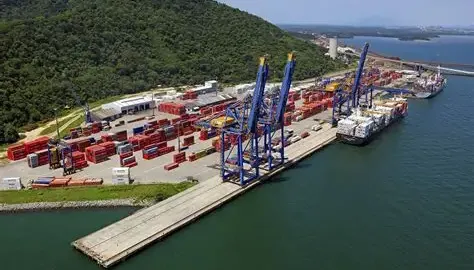
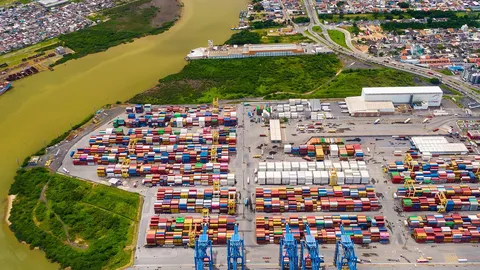
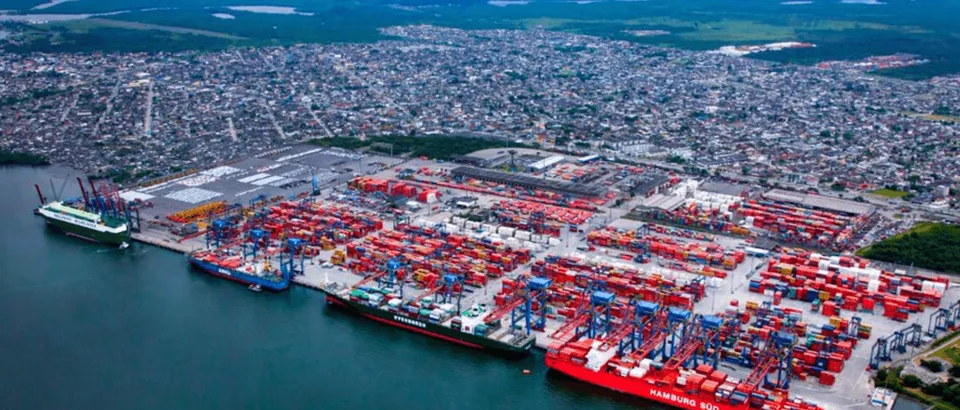
The Port of Santos (Porto de Santos) is the largest port in Latin America and Brazil’s primary trade gateway. Located in São Paulo state, it handles over 4.3 million TEUs annually — roughly 40% of Brazil’s containerized trade — and processes over 130 million tons of cargo each year. For importers managing shipping from China to Brazil, Santos is the primary entry point, serving the industrial heartland of São Paulo state and connecting to every major economic region.
Why the Port of Santos Matters for China Importers
- Latin America’s Largest Port: Over 4.3 million TEUs handled annually — more than double any other Brazilian container port. Ranks among the top 40 container ports globally.
- Gateway to Brazil’s Economic Core: Located just 80 km from São Paulo, the largest city in the Southern Hemisphere, with a metropolitan population exceeding 22 million.
- Extensive Carrier Coverage: All major carrier alliances — 2M, Ocean Alliance, and THE Alliance — operate regular services from Chinese ports multiple times per week.
- Continuous Modernization: Ongoing dredging programs maintain channel depths of 15 meters, with plans to reach 17 meters, enabling the port to accommodate New Panamax vessels.
- Private Investment: Recent terminal lease auctions have driven investment in automation and intermodal connectivity.
Key Facts at a Glance
| Metric | Value |
|---|---|
| Annual Container Volume | ~4.3 million TEUs |
| Total Cargo Tonnage | ~130 million tons annually |
| Channel Depth | 15 meters (deepening to 17m) |
| Container Terminals | 4 major terminals |
| Rail Connectivity | Rumo Logística → São Paulo & interior |
| Key China Trade Lanes | Shanghai, Ningbo, Shenzhen, Qingdao |
Port Location
The Port of Santos occupies both banks of the Santos Estuary in São Paulo state, spanning the cities of Santos (right bank) and Guarujá (left bank). It lies approximately 80 km southeast of São Paulo city, connected by the Rodovia Anchieta (SP-150) and Rodovia dos Imigrantes (SP-160) — Brazil’s most critical freight corridor.
Service Region
Santos serves as the primary import-export gateway for Brazil’s most economically productive regions:
- São Paulo Metropolitan Region: Latin America’s largest industrial and consumer market, home to 22 million people and roughly 30% of Brazil’s GDP. Goods clearing Santos can reach São Paulo distribution centers within 2–3 hours by truck.
- Greater ABC & Interior Paulista: The industrial belt of Santo André, São Bernardo, and São Caetano (Brazil’s automotive heartland), plus interior manufacturing hubs in Campinas, Sorocaba, and Jundiaí — all within a 3–5 hour truck radius.
- Minas Gerais & Center-West: Rail and highway corridors connect Santos to Belo Horizonte (mining, steel, manufacturing) and the agricultural export powerhouse of Goiás and Mato Grosso.
- Southern Brazil: Coastal shipping extends Santos’s reach to Paranaguá, Itajaí, and Rio Grande do Sul, though direct China services to these ports are less frequent.
Port Terminals
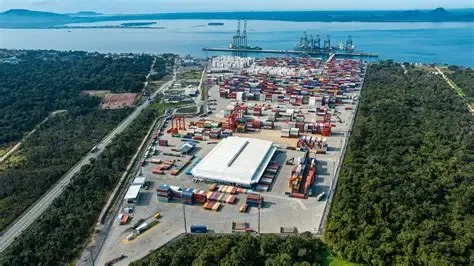
The Port of Santos operates four major container terminals across both banks of the estuary, plus specialized terminals for bulk, vehicles, liquid bulk, and breakbulk:
Major Container Terminals
-
Santos Brasil (Tecon Santos): The largest container terminal in South America, located on the right bank (Santos side). Spanning 600,000 m² with a 1,510-meter quay, it features 8 super post-Panamax gantry cranes and an annual capacity exceeding 2 million TEUs. Primary hub for Maersk, MSC, and 2M Alliance vessels, with on-terminal rail access via Rumo Logística.
-
BTP (Brasil Terminal Portuário): A 490,000 m² joint venture between CMA CGM and Terminal Investment Limited (MSC group). With 1,108 meters of quay, 8 gantry cranes, and a capacity of 1.5 million TEUs, BTP is the primary call for Ocean Alliance carriers including COSCO, CMA CGM, and Evergreen.
-
Ecoporto Santos: A 130,000 m² multi-purpose terminal handling containers, breakbulk, and project cargo. Serves as flexible overflow capacity during peak season.
-
DP World Santos: Located on the left bank (Guarujá side), this terminal handles containers, project cargo, and RoRo with on-dock rail, serving as the preferred call for THE Alliance services.
All major terminals feature on-dock or near-dock rail access, enabling direct vessel-to-wagon transfers that accelerate cargo movement to São Paulo’s distribution hubs.
Shipping Routes to This Port
Santos is served by regular sailings from China’s top container ports via the Cape of Good Hope route. All major carrier alliances maintain dedicated South America East Coast service strings from Asia.
From Shenzhen (Yantian / Shekou)
Yantian International Container Terminal is typically the last South China port of call on Asia-to-ECSA (East Coast South America) service strings. Multiple weekly sailings are available from Maersk, MSC, COSCO, CMA CGM, and Evergreen. As the dominant export hub for consumer electronics and automotive components, Shenzhen accounts for a substantial share of China-to-Santos container volume.
From Shanghai
Shanghai — the world’s busiest container port — is the largest single origin for Santos-bound cargo. Weekly sailings across all three carrier alliances ensure vessel space is typically available within 2–3 days of cargo readiness. Shanghai’s Yangtze River Delta position also captures cargo from Jiangsu and Zhejiang provinces.
From Ningbo
Ningbo-Zhoushan is frequently paired with Shanghai on the same vessel rotation, providing consistent weekly capacity from the Yangtze River Delta. A major export hub for machinery, industrial equipment, and textiles, Ningbo offers competitive rates across all carrier alliance service strings.
From Qingdao and Other Ports
Qingdao is called on ECSA service loops alongside Shanghai or Ningbo, serving northern Chinese manufacturing hubs including Shandong, Hebei, and Tianjin. Secondary ports including Xiamen, Dalian, and Fuzhou connect to Santos via feeder services through Shanghai, Ningbo, or transshipment hubs such as Singapore or Port Klang, adding 3–7 days to total transit time.
Transit Time from China to Santos
Ocean transit from China to Santos is among the longest regular container trade routes due to the Cape of Good Hope routing. Below are typical port-to-port transit times:
| Origin Port | Transit Time to Santos | Sailing Frequency |
|---|---|---|
| Shanghai | 35–42 days | 3–5 per week |
| Ningbo | 36–42 days | 3–5 per week |
| Shenzhen (Yantian) | 34–40 days | 3–5 per week |
| Qingdao | 37–44 days | 2–3 per week |
| Xiamen | 38–45 days | 1–2 per week |
Express and priority services can trim 2–4 days off standard schedules. For LCL (Less-than-Container-Load) shipments, add 5–7 days for consolidation at origin and deconsolidation at destination. Santos has historically experienced congestion during Brazil’s peak import season (August–November, ahead of Black Friday and year-end retail), when berth waiting times can extend 2–5 days. Importers should work with a freight forwarder who monitors real-time Santos port conditions.
Shipping Cost from China to Santos
Ocean freight rates from China to Santos are shaped by global market dynamics, Brazil-specific port charges, and domestic logistics costs.
Factors Affecting Freight Rates
- Seasonality: Brazil’s peak import season (August–November) can push rates 30–50% higher as retailers build inventory for Black Friday and Christmas. Post-Chinese New Year (February–April) offers the most favorable rates.
- Container type and size: 40’ standard containers (FEUs) offer the best per-unit economics for the Santos lane. High-cube, 20’, and specialized equipment (reefer, open-top, flat-rack) command significant premiums — relevant for Brazil’s food and pharmaceutical imports.
- Route and transshipment: Direct services cost more but deliver faster. Transshipment via Singapore or Port Klang can offer lower base rates at the expense of 5–10 additional transit days.
- Port charges: Budget approximately $300–$500 per container for Santos THC, wharfage, and document fees. The Santos Port Authority (SPA) publishes current tariff schedules. Additional charges include the ISPS surcharge and SSP (berth usage fee).
How to Lower Your Shipping Costs
| Strategy | Potential Impact |
|---|---|
| Ship FCL instead of LCL | 30–50% lower per-unit freight cost |
| Book during off-peak (February–July) | 20–40% rate reduction |
| Pre-clear Brazilian customs documentation | Avoid demurrage charges |
| Use Rumo rail for inland destinations | Lower per-unit cost vs. long-haul trucking |
| Consolidate with a China-based forwarder | Access to volume-negotiated rates |
| Plan for off-peak gate hours | Reduced terminal fees |
Partnering with a China-based freight forwarder like DANTFUL gives importers access to competitive carrier contracts, consolidated rates, and expert guidance on Santos terminal procedures and Brazilian customs clearance through a single point of contact.
Warehousing Services
The Santos-São Paulo logistics corridor is Brazil’s most developed warehousing market with a comprehensive ecosystem of bonded and general storage facilities:
Bonded Warehousing (Entreposto Aduaneiro)
Brazil’s Entreposto Aduaneiro (bonded warehouse) regime under Receita Federal allows importers to store goods without immediate payment of import duties, IPI, and ICMS:
- Duty and tax deferral: Import taxes are only due when goods leave the bonded facility for domestic consumption — up to 1 year for general cargo, extendable to 3 years.
- Value-added processing: Bonded facilities support labeling, kitting, repackaging, and quality inspections before customs entry — valuable for multi-SKU shipments requiring Brazilian-market adaptation.
- Mercosur re-export: Goods re-exported to other Mercosur countries (Argentina, Paraguay, Uruguay) avoid Brazilian duties entirely.
Overseas Warehousing & 3PL Services
The Greater São Paulo region — particularly logistics hubs in Barueri, Cajamar, and Guarulhos — hosts Brazil’s most extensive 3PL network, offering container deconsolidation, Amazon Brazil and Mercado Livre FBA prep, pick-and-pack fulfillment, cross-docking, and reverse logistics.
Warehousing & Distribution Strategy
Positioning inventory near the Santos-São Paulo corridor delivers measurable advantages:
- Avoid per-diem charges: Faster container turnaround reduces daily detention fees, which can reach $200–$350 per day after the 7–10 working day free-time window.
- Lower inland freight costs: Deconsolidating at the port region avoids sending full containers to distant, higher-cost warehouse markets.
- Speed to market: Same-day delivery to São Paulo metro, next-day to Campinas, and 2–3 day delivery to Rio de Janeiro from Santos-area facilities.
DANTFUL partners with vetted 3PL providers across the Santos-São Paulo corridor, offering end-to-end solutions including customs brokerage, bonded storage, FBA prep, and last-mile delivery.
Frequently Asked Questions
Q: How does Santos compare to other Brazilian ports for China imports?
A: Santos handles roughly 40% of Brazil’s container trade — more than double its nearest competitor, Paranaguá. Its unmatched carrier density, sailing frequency from China, and proximity to São Paulo make it the default choice for most China-to-Brazil importers.
Q: How long does customs clearance take at the Port of Santos?
A: With properly pre-filed documentation through Receita Federal’s Siscomex system, customs clearance typically takes 1–3 business days. Importers enrolled in Brazil’s OEA (Operador Econômico Autorizado) program benefit from reduced inspection rates and priority clearance. Brazil’s complex tax structure means working with an experienced customs broker is essential.
Q: What is the cheapest way to ship from China to Santos?
A: FCL ocean freight during off-peak season (February–July) through a China-based forwarder offers the lowest per-unit cost. For shipments under 15 CBM, LCL consolidation may be more economical despite higher per-unit rates. Given the 35–45 day transit, consolidating smaller shipments into FCL through a forwarder’s consolidation service can strike an optimal balance between cost and transit time.
Q: What cargo types does Santos handle best?
A: Santos excels with containerized goods — electronics, machinery, auto parts, textiles, chemicals, and consumer merchandise. Its dedicated container terminals mean container freight does not compete with bulk agricultural exports (soy, coffee, sugar) for berth space.
Q: Does the channel depth limit vessel size at Santos?
A: The current 15-meter channel depth accommodates vessels up to approximately 12,500 TEU capacity. The planned deepening to 17 meters will enable New Panamax and larger vessels to call fully laden. For ultra-large container vessels (18,000+ TEU), partial loading or lightering is currently required during low-tide windows.