Port of Itajaí
Port Overview
Overview of Itajaí Port
The Port of Itajaí (Porto de Itajaí) anchors Brazil’s second-largest container port complex and serves as the primary maritime gateway for southern Brazil. Situated on the Itajaí-Açu River in Santa Catarina state, the Itajaí-Navegantes Port Complex handled over 1.4 million TEUs in 2025, making it the country’s most important container gateway south of Santos. For importers managing shipping from China to Brazil, Itajaí offers a strategic alternative to the busier Santos port, with faster inland transit to southern Brazil’s manufacturing and consumer markets.
Why the Port of Itajaí Matters for China Importers
- Brazil’s #2 Container Complex: Approximately 1.44 million TEUs handled in 2025 — second only to Santos — with direct weekly calls from all major carrier alliances.
- Reefer & Cold Chain Leader: Over 3,800 reefer plugs and Iceport — Brazil’s only fully automated cold storage facility adjacent to a container terminal — make this the undisputed hub for temperature-controlled imports.
- Major Reinvestment: JBS Terminais took over the public terminal in October 2024, investing over BRL 250 million in new cranes, expanded yard space, and technology. The public terminal alone saw throughput surge 736% in 2025.
- Southern Brazil’s Industrial Gateway: Santa Catarina is one of Brazil’s most industrialized states per capita, and the port also serves northern Rio Grande do Sul and Paraná’s manufacturing zones.
- CMA CGM SEAS 3 Service: Weekly direct calls from Shanghai, Shekou, and Hong Kong to Itajaí, offering the fastest transit times from central China.
Key Facts at a Glance
| Metric | Value |
|---|---|
| Port Complex Annual TEU Volume | ~1.44 million TEUs (2025) |
| Public Terminal Quay Length | 1,030 meters (4 berths) |
| Channel Depth | 14 meters (Portonave targeting 17m) |
| Reefer Plugs | 3,800+ across the complex |
| Key Terminals | JBS Terminais (public), Portonave (private) |
| Key China Trade Lanes | Shanghai, Ningbo, Shenzhen, Qingdao |
Port Location
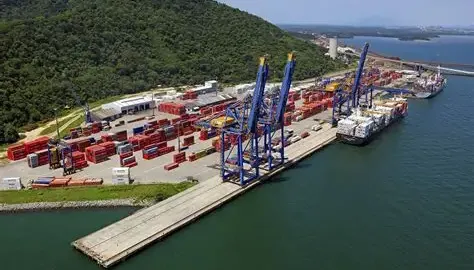
The Itajaí-Navegantes port complex straddles the Itajaí-Açu River near its Atlantic mouth in Santa Catarina state, southern Brazil. The public port occupies the right (south) bank in Itajaí municipality, while Portonave — the complex’s largest private terminal — sits on the left bank in Navegantes. The entrance is about 1 nautical mile from the river mouth, providing sheltered berthing with quick open-sea access.
Service Region
Itajaí is the primary import-export gateway for southern Brazil’s most dynamic economies:
- Santa Catarina State: Brazil’s most industrialized state per capita, anchored by food processing (JBS, BRF, Seara), textiles, ceramics, and metal-mechanic industries. Key cities Blumenau, Joinville, and Jaraguá do Sul are within a 1–3 hour truck radius.
- Paraná & Curitiba Corridor: Northern Paraná and the Curitiba metro area are efficiently served, often with shorter inland transit than via Paranaguá.
- Rio Grande do Sul: The northeastern manufacturing and agricultural zones — including the Serra Gaúcha region — are served via BR-101 with overnight trucking to major distribution centers.
The BR-470 and BR-101 highways form the port’s primary freight corridors, with BR-470 directly linking the port to western Santa Catarina’s poultry and pork processing belt.
Port Terminals
The Itajaí complex operates across both banks of the Itajaí-Açu River, with container handling divided between the public terminal and the private Portonave facility.
Container Terminals
-
JBS Terminais (Public Terminal): The logistics arm of the world’s largest protein processor took over operations in October 2024 and invested over BRL 250 million to revitalize the terminal. The facility features a 1,030-meter quay with 4 berths, a 14-meter draft, 1,750 reefer plugs, and annual handling capacity of up to 558,000 TEUs. A US$42 million expansion added two mobile harbor cranes and expanded storage area by 12.5%. The terminal serves 7 shipping lines with 8 weekly calls, including direct services from China via CMA CGM and COSCO.
-
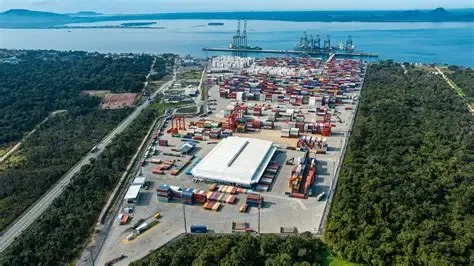
Portonave (Private Terminal — Navegantes): The largest private container terminal in southern Brazil, located directly opposite the public port. Spanning 400,000 m² with a 900-meter quay (3 berths), Portonave is equipped with 6 gantry cranes, 18 electric RTGs, and 2,130 reefer plugs — with a static capacity of 30,000 TEUs. Owned by Terminal Investment Limited (MSC Group), it serves 14 shipping lines. A R$1 billion modernization program is deepening the access channel to 17 meters to accommodate ultra-large container vessels.
Specialized Facilities
- Iceport (Portonave): Brazil’s only fully automated cold storage facility adjacent to a container terminal, with capacity for 16,000 pallet positions — a critical asset for temperature-controlled pharmaceutical, food, and chemical imports from China.
- Breakbulk & General Cargo: Multiple berths handle project cargo, steel, vehicles, and forest products, ensuring container traffic does not compete with other cargo types for berth space.
Shipping Routes to This Port
Itajaí is served by regular sailings from China’s major container ports, primarily via the Cape of Good Hope route. CMA CGM’s SEAS 3 service provides the most notable direct connection.
From Shenzhen (Yantian / Shekou)
Shenzhen features on CMA CGM’s SEAS 3 rotation (Shekou call) and is served through direct COSCO and MSC services. Shenzhen’s export profile of electronics, automotive parts, and consumer goods aligns with Santa Catarina’s industrial import demand.
From Shanghai
Shanghai is the key loading port for Itajaí-bound cargo. CMA CGM’s SEAS 3 calls Shanghai directly with transit times of approximately 33 days. Multiple competing carriers — COSCO, MSC, and Maersk — offer weekly sailings, sustaining competitive pricing.
From Ningbo
Ningbo-Zhoushan pairs with Shanghai on Asia–South America East Coast service strings, providing consistent weekly connections. MSC and COSCO routes typically include Ningbo, with transshipment via Shanghai or direct services available by season.
From Qingdao and Other Ports
Qingdao, Xiamen, and Tianjin connect predominantly through transshipment at Shanghai, Ningbo, or Singapore, adding 3–7 days to total transit. These feeder connections provide reliable, cost-effective access to southern Brazil for northern Chinese manufacturing hubs.
Transit Time from China to Itajaí
Ocean transit from China to Itajaí ranges from 33 to 46 days depending on the origin port and whether the service calls directly or via a coastal Brazilian hub.
| Origin Port | Transit Time to Itajaí | Service Structure |
|---|---|---|
| Shanghai | 33–38 days | Direct (CMA CGM SEAS 3) & other carriers |
| Ningbo | 34–40 days | Direct or via Shanghai |
| Shenzhen (Yantian/Shekou) | 33–39 days | Direct (SEAS 3 Shekou) & transship |
| Qingdao | 37–45 days | Via Shanghai/Ningbo or Singapore |
| Xiamen | 38–46 days | Coastal feeder → mainline |
For LCL (Less-than-Container-Load) shipments, add 5–7 days for consolidation and deconsolidation. Santa Catarina’s peak reefer export season (November–March) can create terminal congestion and temporary equipment shortages affecting import container turnaround.
Shipping Cost from China to Itajaí
Ocean freight rates to Itajaí are shaped by global dynamics, the port’s dual-terminal competitive environment, and southern Brazil’s inland freight economics.
Factors Affecting Freight Rates
- Terminal Competition: Two competing container terminals less than 2 km apart create a uniquely competitive environment absent at most Brazilian gateways.
- Seasonality: Southern Brazil’s reefer-driven trade keeps vessel utilization high during Q4–Q1, with rates running 20–35% above off-peak (April–September).
- Route and transshipment: Direct calls via SEAS 3 or comparable services carry a modest premium for faster transit. Transshipment via Santos or Singapore can save $200–$400 per container at the cost of 5–7 additional days.
- Port charges: Terminal handling fees range from $250–$450 per container, plus ISPS surcharge and port administration fees.
- Inland freight advantage: For Santa Catarina and northern Rio Grande do Sul destinations, inland trucking from Itajaí is typically 20–40% cheaper than from Santos, often offsetting any ocean freight difference.
How to Lower Your Shipping Costs
| Strategy | Potential Impact |
|---|---|
| Ship FCL instead of LCL | 30–50% lower per-unit freight cost |
| Book during off-peak (April–September) | 20–35% rate reduction |
| Leverage dual-terminal competition | Wider carrier choice, better rates |
| Pre-clear Brazilian customs documentation | Avoid demurrage charges |
| Route inland via Itajaí (not Santos) for southern Brazil deliveries | 20–40% lower trucking cost |
| Consolidate with a China-based forwarder | Access to volume-negotiated rates |
Partnering with a China-based freight forwarder like DANTFUL gives importers access to competitive carrier contracts across both Itajaí terminals, consolidated rates, and guidance on Brazilian customs clearance and southern Brazil’s inland distribution.
Warehousing Services
Southern Brazil’s logistics corridor — centered on the Itajaí–Joinville–Curitiba axis — offers a mature warehousing ecosystem with strong cold chain capabilities.
Bonded Warehousing (Entreposto Aduaneiro)
The Entreposto Aduaneiro regime allows importers to store goods without immediate payment of import duties, IPI, and ICMS for up to 1 year (extendable to 3). Itajaí-based bonded storage is particularly valuable for two reasons: the port’s reefer infrastructure supports bonded cold storage for temperature-sensitive imports, and proximity to Mercosur borders supports re-export strategies to Argentina, Paraguay, and Uruguay without triggering Brazilian duties.
Overseas Warehousing & 3PL Services
The Itajaí River Valley and Joinville region host a growing 3PL network specializing in container deconsolidation, cross-docking, and fulfillment for e-commerce and industrial supply chains. Iceport’s 16,000-pallet cold storage facility remains the flagship logistics asset. Standard ambient facilities span the BR-101 corridor from Itajaí to Curitiba, supporting pick-and-pack, retail distribution, and just-in-time manufacturing supply.
Warehousing & Distribution Strategy
Positioning inventory near the Itajaí complex delivers clear advantages:
- Lower inland freight: Avoids the 600–800 km trucking leg from Santos, saving $400–$800 per container for regional destinations.
- Avoid per-diem charges: Faster turnaround at less congested terminals reduces detention fees ($200–$350/day after the 7–10 day free-time window).
- Speed to market: Same-day delivery to Blumenau and Joinville, next-day to Curitiba, and 2-day delivery to Porto Alegre — versus 3–5 days from Santos.
- Cold chain integrity: Direct access to Iceport enables seamless temperature-controlled supply chains for pharmaceutical ingredients, specialty chemicals, and food additives from China.
DANTFUL partners with vetted 3PL providers across the Itajaí–Curitiba corridor, offering customs brokerage, bonded storage, cold chain warehousing, and last-mile delivery throughout southern Brazil.
Frequently Asked Questions
Q: How does Itajaí compare to Santos for China imports destined to southern Brazil?
A: For cargo destined to Santa Catarina, Rio Grande do Sul, or southern Paraná, Itajaí often delivers a lower total landed cost. Inland trucking from Itajaí is 20–40% cheaper and 2–4 days faster than from Santos. Itajaí also offers less terminal congestion and more available reefer infrastructure. Santos remains the default for São Paulo and Center-West destinations.
Q: Is the Port of Itajaí fully operational after the terminal transition?
A: Yes. Since JBS Terminais took over in October 2024, the port has undergone rapid recovery. In 2025, the public terminal handled 366,089 TEUs — a 736% increase over 2024 — while the full complex moved 1.44 million TEUs. JBS has invested over BRL 250 million in cranes, yard expansion, and technology. The terminal now serves 7 shipping lines with 8 weekly calls.
Q: How long does customs clearance take at the Port of Itajaí?
A: With pre-filed documentation through Receita Federal’s Siscomex system, clearance typically takes 1–3 business days. OEA (Operador Econômico Autorizado) certified importers benefit from reduced inspection rates and priority processing. Local customs brokerage services are well-established and specialized in China-origin cargo types.
Q: What are the reefer and cold chain capabilities at Itajaí?
A: The Itajaí-Navegantes complex is Brazil’s premier reefer port. With 3,800+ reefer plugs across both terminals and Iceport’s 16,000-pallet automated cold storage adjacent to Portonave, Itajaí offers cold chain capabilities unmatched in South America. For China-sourced pharmaceutical ingredients, specialty chemicals, food additives, and frozen goods, the port provides a fully integrated cold chain from vessel to inland distribution.
Q: What is the cheapest way to ship from China to Itajaí?
A: FCL ocean freight during off-peak (April–September) through a China-based forwarder offers the lowest per-unit cost. Two competing terminals within 2 km give importers a carrier-choice advantage for competitive rates. For shipments under 15 CBM, LCL consolidation may be more practical despite higher per-unit rates. Given the 33–45 day transit, consolidating smaller shipments into FCL through a forwarder’s consolidation service delivers the optimal cost-speed balance.