Port of Salvador
Port Overview
Overview of Salvador
The Port of Salvador (Porto de Salvador) is the main maritime hub for Brazil’s Northeast and the closest major Brazilian port to Asia. Located in Bahia state’s capital, it handles over 350,000 TEUs annually and serves as a strategic alternative to the heavily congested southern ports for importers managing shipping from China to Brazil.
Why the Port of Salvador Matters for China Importers
- Shortest China-to-Brazil Route: Salvador is approximately 1,200 nautical miles closer to Shanghai than Santos, translating to 5–8 days faster transit and lower bunker-related surcharges.
- Less Congestion: With significantly shorter berth waiting times compared to Santos and Paranaguá, Salvador offers more predictable discharge schedules — a critical advantage during Brazil’s August–November peak season.
- Gateway to the Northeast: Serving a region with over 56 million consumers and rapidly growing industrial activity, Salvador is the natural entry point for cargo destined to Bahia, Pernambuco, Ceará, and Sergipe.
- Modern Container Terminal: Wilson Sons’ Tecon Salvador features continuous investment in equipment and digital systems, maintaining handling efficiency on par with Brazil’s top terminals.
Key Facts at a Glance
| Metric | Value |
|---|---|
| Annual Container Volume | ~350,000 TEUs |
| Total Cargo Tonnage | ~5 million tons annually |
| Channel Depth | 15 meters |
| Container Terminals | 1 major terminal (Tecon Salvador) |
| Road Connectivity | BR-324 → Bahia interior & Northeast |
| Key China Trade Lanes | Shanghai, Ningbo, Shenzhen, Qingdao |
Port Location
The Port of Salvador occupies a natural deep-water harbor on the Bay of All Saints (Baía de Todos os Santos), the largest bay in Brazil and the second largest in the world. The port is situated in Salvador’s Lower City (Cidade Baixa), approximately 5 km from the historic city center.
Service Region
Salvador is the primary import-export gateway for Brazil’s Northeast, covering:
- Bahia State: Brazil’s fourth most populous state and a major industrial and agricultural producer, with strong manufacturing sectors in petrochemicals (Camaçari Petrochemical Complex), automotive (Ford and suppliers), food processing, and agribusiness.
- Pernambuco & Ceará: Coastal states to the north, home to industrial hubs in Recife, Fortaleza, and the Suape Port-Industrial Complex. Goods clearing Salvador can reach Recife within 12 hours by road.
- Sergipe & Alagoas: Smaller but growing markets to the north, accessible via BR-101, with developing industrial and consumer goods sectors.
- Western Bahia (MATOPIBA): One of Brazil’s fastest-expanding agricultural frontiers, producing soy, cotton, and corn for both domestic consumption and export.
The port is connected by BR-324 to Feira de Santana (Bahia’s second-largest city) and the interior, and by BR-101 along the northeastern coast.
Port Terminals
The Port of Salvador operates through two primary port complexes:
Container Terminal
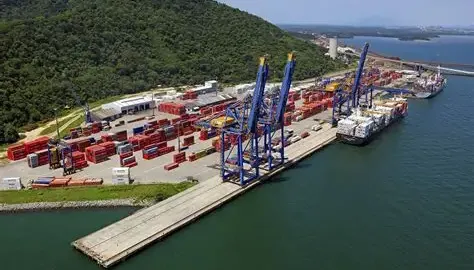
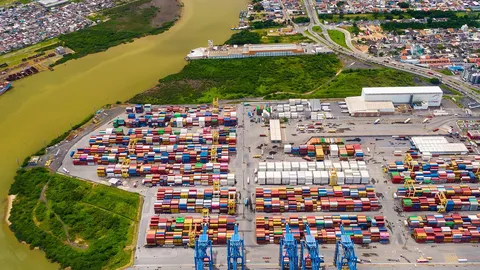
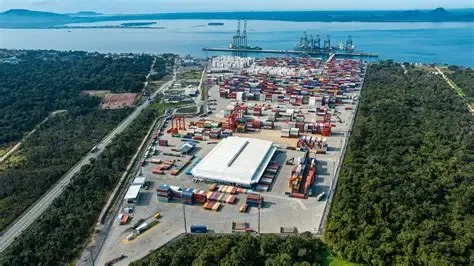
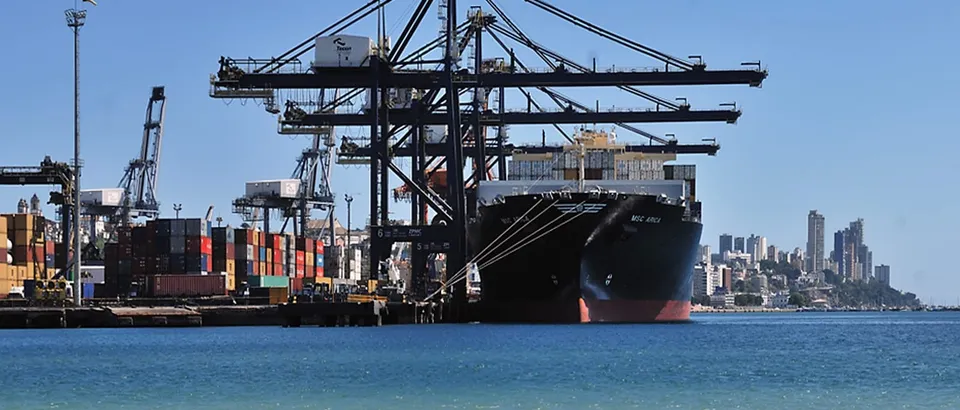
- Tecon Salvador (Wilson Sons): The sole container terminal at the Port of Salvador, operated by Wilson Sons Brasil — one of Brazil’s largest port and maritime logistics operators. The terminal spans approximately 60,000 m² with a 500-meter quay, featuring 4 post-Panamax and super post-Panamax gantry cranes. Annual capacity exceeds 400,000 TEUs. Tecon Salvador handles containerized imports of electronics, machinery, textiles, auto parts, and consumer goods from China and Asia, while loading exports of fruits, chemicals, coffee, and agricultural products. The terminal features on-dock rail access and digital gate systems for streamlined truck processing.
Bulk & Specialized Terminals
- Terminal Marítimo de Madre de Deus (Transpetro): Located across the bay, this facility handles liquid bulk, primarily petroleum products and chemicals. Important for the Camaçari Petrochemical Complex supply chain.
- Aratu Port Complex: An adjacent industrial port handling solid bulk (fertilizers, minerals, grains), breakbulk, and project cargo. The complex serves Bahia’s mining, chemical, and agricultural industries.
Shipping Routes to This Port
Salvador is served by regular sailings from China’s major container ports via the Cape of Good Hope route. While service frequency is lower than Santos, transit times are shorter due to the port’s northeastern position.
From Shenzhen (Yantian / Shekou)
As the dominant export hub for consumer electronics and components, Shenzhen is well-served on the Asia-to-Northeast Brazil service strings. Multiple carriers including COSCO, MSC, and Wilson Sons’ partner lines offer sailings with competitive transit times — Salvador is typically the first Brazilian call after rounding the Cape of Good Hope.
From Shanghai
Shanghai offers the most consistent service to Salvador across the carrier landscape. As the world’s busiest container port, Shanghai’s Yangtze River Delta position captures cargo from Jiangsu, Zhejiang, and beyond. Weekly sailings provide reliable vessel space and competitive rates.
From Ningbo
Ningbo-Zhoushan is frequently paired with Shanghai on the same vessel rotation, providing steady weekly capacity. Ningbo’s strength in machinery, industrial equipment, and textiles aligns well with the import needs of Bahia’s industrial sector.
From Qingdao and Other Ports
Qingdao serves northern Chinese manufacturing hubs (Shandong, Hebei) and connects to Salvador via direct calls or transshipment through Shanghai. Secondary ports such as Xiamen, Dalian, and Fuzhou connect via feeder to Shanghai or Ningbo, typically adding 3–5 days to total transit time.
Transit Time from China to Salvador
Salvador’s position as the closest major Brazilian port to Asia gives it a measurable transit advantage over southern ports:
| Origin Port | Transit Time to Salvador | Sailing Frequency |
|---|---|---|
| Shanghai | 30–36 days | 2–3 per week |
| Ningbo | 31–37 days | 2–3 per week |
| Shenzhen (Yantian) | 29–35 days | 2–3 per week |
| Qingdao | 33–39 days | 1–2 per week |
| Xiamen | 35–41 days | 1 per week |
For LCL (Less-than-Container-Load) shipments, add 5–7 days for consolidation at origin and deconsolidation at destination. Salvador’s lower congestion means berth waiting times are typically under 24 hours, compared to 2–5 days at Santos during peak season.
Shipping Cost from China to Salvador
Ocean freight rates from China to Salvador follow the same global market dynamics as the broader Brazil trade lane, with some Salvador-specific considerations:
Factors Affecting Freight Rates
- Lower bunker costs: Salvador’s shorter sailing distance from China translates to proportionally lower fuel surcharges compared to southern Brazilian ports — a consistent cost advantage on every shipment.
- Service frequency: Fewer weekly sailings than Santos means booking flexibility can be tighter during peak season, potentially driving spot rate premiums when demand surges.
- Port charges: Salvador’s THC and terminal handling charges are generally competitive with other Brazilian ports. Budget approximately $250–$450 per container for terminal handling, wharfage, and documentation fees.
- Container type: 40’ standard containers (FEUs) offer the best per-unit economics. High-cube, 20’, and specialized equipment (reefer, open-top) carry premiums.
How to Lower Your Shipping Costs
| Strategy | Potential Impact |
|---|---|
| Ship FCL instead of LCL | 30–50% lower per-unit freight cost |
| Book during off-peak (February–July) | 20–40% rate reduction |
| Pre-clear Brazilian customs documentation | Avoid demurrage charges |
| Consolidate with a China-based forwarder | Access to volume-negotiated rates |
| Use Salvador instead of Santos for Northeast destinations | Save on inland trucking costs |
| Leverage bond transit (Trânsito Aduaneiro) | Defer inland-state ICMS until final destination |
Partnering with a China-based freight forwarder like DANTFUL gives importers access to competitive carrier contracts, consolidated rates, and expert guidance on Salvador terminal procedures and Brazilian customs clearance.
Warehousing Services
The Salvador metropolitan area offers a growing warehousing ecosystem to support Northeast Brazil’s expanding import economy:
Bonded Warehousing (Entreposto Aduaneiro)
Brazil’s bonded warehouse regime under Receita Federal supervision allows importers to store goods at Salvador without immediate payment of import duties, IPI, and ICMS. Duties are deferred until goods leave the facility for domestic consumption — up to 1 year, extendable to 3 years. Bonded facilities in Salvador support labeling, repackaging, and quality inspection before final customs entry.
Distribution & Logistics Hubs
Key logistics zones in the Salvador area include:
- Simões Filho: An industrial suburb 30 km from the port along BR-324, home to multiple logistics parks and distribution centers serving the Bahia market.
- Camaçari: 40 km from Salvador, this industrial hub combines the petrochemical complex with logistics facilities supporting both domestic and international supply chains.
- Feira de Santana: Located at the BR-324/BR-101 intersection, this city 100 km inland is Bahia’s primary logistics crossroads, serving the interior and MATOPIBA agricultural frontier.
Warehousing Strategy for Northeast Brazil
Positioning inventory in the Salvador region delivers distinct advantages:
- Lower inland freight: Unlike southern Brazil where goods may travel 1,000+ km inland, Salvador-served markets are typically within 500 km of the port.
- Faster market reach: Same-day to Salvador metro, next-day to Aracaju, and 2–3 day delivery to Recife and Fortaleza.
- Port diversification: Using Salvador as a secondary import gateway reduces reliance on Santos and builds supply chain resilience.
Frequently Asked Questions
Q: How does Salvador compare to Santos for China imports?
A: Salvador offers 5–8 days faster transit from China and significantly lower congestion, but with fewer weekly sailings and limited direct services. For importers with cargo destined to Northeast, Central-West, or Northern Brazil, Salvador’s transit time advantage and lower inland trucking costs often outweigh the trade-off in sailing frequency. Santos remains the optimal choice for cargo destined to São Paulo, Rio de Janeiro, and Southern Brazil.
Q: How long does customs clearance take at the Port of Salvador?
A: With properly pre-filed documentation through Receita Federal’s Siscomex system, customs clearance at Salvador typically takes 1–3 business days. Salvador’s lower cargo volume compared to Santos often means faster processing and fewer inspection backlogs. Importers enrolled in the OEA (Operador Econômico Autorizado) program benefit from expedited clearance.
Q: What is the cheapest way to ship from China to Salvador?
A: FCL ocean freight during the off-peak season (February–July) through a China-based forwarder offers the lowest per-unit cost. For shipments under 15 CBM, LCL consolidation may be more economical despite higher per-unit rates. Salvador’s inherently shorter distance from China provides a baked-in cost advantage on every container.
Q: What cargo types is Salvador best suited for?
A: Salvador handles containerized goods well — electronics, machinery, auto parts, textiles, and consumer merchandise. The port is also strong in reefer container exports (fruits) and liquid/chemical bulk through the Madre de Deus terminal. For large-scale project cargo, the adjacent Aratu complex provides specialized handling capabilities.
Q: Can Salvador serve as my only Brazil import port?
A: It depends on your distribution footprint. For importers with customers concentrated in the Northeast, North, or Central-West regions, Salvador can absolutely serve as the primary or sole entry point. For nationwide distribution, many importers use dual-port strategy: Salvador for northern markets and Santos or Paranaguá for southern markets, splitting container volumes accordingly.