Port of Navegantes
Port Overview
Overview of Navegantes
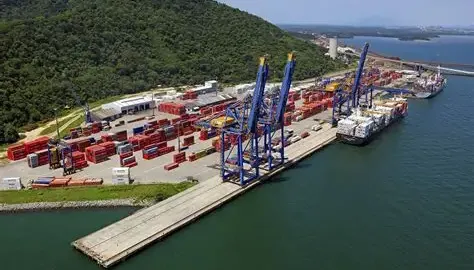
The Port of Navegantes, operated by Portonave S/A, is Brazil’s first private container terminal and one of the country’s most productive ports. Located in Santa Catarina, it handled 1.1 million TEUs in 2025, ranking as Brazil’s third-largest container port behind Santos and Paranaguá, making it a strategic gateway for importers managing shipping from China to Brazil. Portonave is owned by Terminal Investments Limited (TiL), the terminal arm of the MSC Group, ensuring strong global shipping connectivity.
Why the Port of Navegantes Matters for China Importers
- Brazil’s Most Productive Terminal: Portonave consistently achieves 114 moves per hour (MPH) — the highest productivity rate among all Brazilian container ports — delivering faster vessel turnaround and lower demurrage risk.
- Private Terminal Efficiency: As Brazil’s first fully private container terminal (since 2007), Portonave operates with streamlined processes that public ports cannot match — customs clearance and cargo release are consistently faster than the national average.
- Strategic Southern Brazil Location: Navegantes is the optimal gateway for Santa Catarina — one of Brazil’s wealthiest states — plus northern Rio Grande do Sul, Paraná, and Mercosur markets including Paraguay and northern Argentina.
- Major Expansion Underway: A R$2 billion investment program is expanding annual capacity to 2 million TEUs by H2 2026. The upgraded quay will accommodate vessels up to 400 meters with 17-meter draft, making Portonave one of the few Brazilian terminals capable of handling ULCVs.
- Reefer & Cold Chain Excellence: With 2,130 reefer plugs and the Iceport automated cold storage facility (50,000 m², -28°C), Portonave is Brazil’s premier gateway for temperature-controlled cargo in the country’s largest meat processing and export state.
Key Facts at a Glance
| Metric | Value |
|---|---|
| Annual Container Volume | ~1.1 million TEUs (2025) |
| Terminal Operator | Portonave S/A (MSC Group / TiL) |
| Quay Length | 900 meters (expanding) |
| Channel Depth | 14m (deepening to 17m by H2 2026) |
| Reefer Plugs | 2,130 |
| Productivity | 114 MPH (highest in Brazil) |
| Key China Trade Lanes | Shanghai, Ningbo, Shenzhen, Qingdao |
Port Location
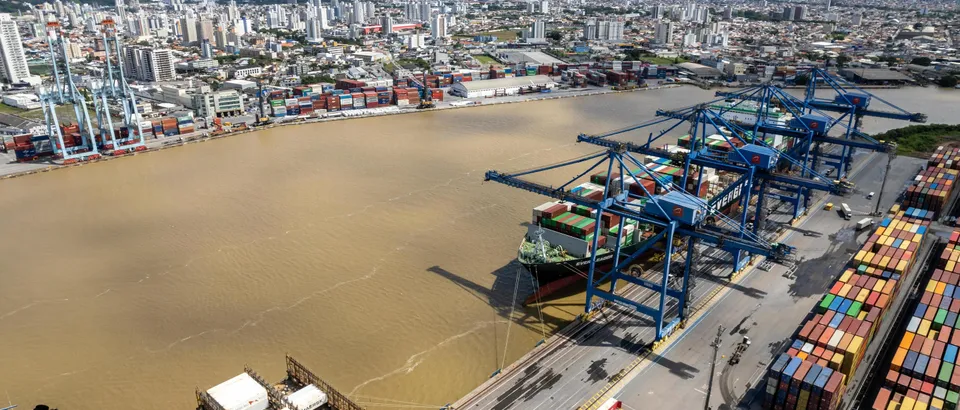
The Port of Navegantes is situated on the Itajaí-Açu River in northern Santa Catarina, directly across from the city of Itajaí. The terminal sits approximately 100 km north of Florianópolis and 220 km south of Curitiba, with direct South Atlantic access via a dredged navigation channel.
Service Region
Navegantes serves as a premier import-export gateway for southern Brazil. For a complete overview of all major Brazilian ports and their service coverage, see our comprehensive Brazil port directory.
- Santa Catarina State: One of Brazil’s most prosperous states, home to the country’s largest meat processing and export industry. The port’s proximity to poultry and pork production clusters makes it the natural gateway for the state’s billion-dollar protein sector, supported by a diversified economy spanning textiles, ceramics, automotive components, and technology.
- Northern Rio Grande do Sul: The industrial corridor from Porto Alegre through Caxias do Sul relies on Santa Catarina ports for containerized imports of machinery, electronics, and industrial components.
- Paraná & Mercosur Markets: Navegantes provides a competitive alternative to Paranaguá for southern Paraná destinations, while also attracting cargo bound for Paraguay and northern Argentina via BR-101 and BR-376.
The port is connected by BR-101 (Brazil’s primary north-south coastal corridor) and BR-470, linking directly to Santa Catarina’s interior and Rio Grande do Sul.
Port Terminals
Portonave operates as a single integrated Private Use Terminal (TUP) with facilities for standard containers, refrigerated cargo, and project cargo:
Portonave Container Terminal
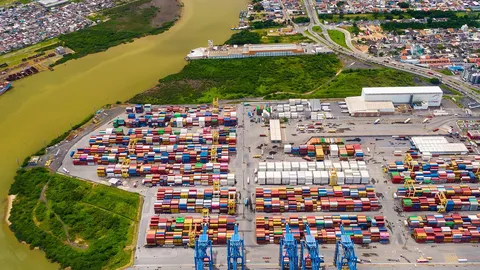
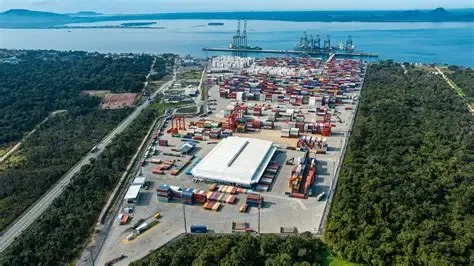
Portonave is the centerpiece of the Port of Navegantes, spanning 400,000 m² with 900 meters of linear quay and three mooring berths. Current terminal assets include:
- 6 Ship-to-Shore (STS) gantry cranes with super post-Panamax capability, expanding to 8 by H2 2026 — including new ZPMC STS cranes handling loads up to 100 tons and vessels up to 400 meters in length.
- 32 Rubber-Tyred Gantry (RTG) cranes (post-expansion), with 14 new 100% electric e-RTG cranes from Konecranes being delivered through 2026.
- 30,000 TEU static storage capacity, supported by an advanced terminal operating system (TOS) and automated gate processes.
- 2 container scanners for non-intrusive customs inspection, reducing examination delays.
The ongoing quay modernization — reinforcing foundations to 56 meters deep and deepening the berth to 17 meters — runs in two 450-meter phases, keeping terminal operations uninterrupted.
Iceport — Automated Cold Storage
Portonave’s Iceport is one of the most advanced cold storage facilities in Latin America. This 50,000 m² fully automated clad-rack warehouse operates at -28°C, featuring 16,000 pallet positions, six transelevators, 13 loading docks, and the Easy WMS management system by Mecalux. Iceport directly serves Santa Catarina’s meat processing industry — the largest in Brazil — providing seamless cold chain integrity from processing plant to vessel loading.
Shipping Routes to This Port
Navegantes is served by regular sailings from major Chinese ports, with strong carrier coverage driven by MSC Group’s terminal ownership and the high volume of Brazil-China reefer cargo trade.
From Shenzhen (Yantian / Shekou)
Shenzhen is well-connected to Navegantes through Asia-to-ECSA service strings. As South China’s primary hub for consumer electronics and auto parts, Shenzhen to Navegantes volumes are supported by MSC, Maersk, COSCO, and CMA CGM services.
From Shanghai
Shanghai provides the most frequent sailings to Navegantes. As the central hub for the Yangtze River Delta manufacturing belt, Shanghai consolidates cargo from Jiangsu, Zhejiang, and Anhui. Carriers including ZIM and Hapag-Lloyd offer direct service strings connecting Shanghai with Navegantes.
From Ningbo
Ningbo-Zhoushan typically shares vessel rotations with Shanghai on ECSA services, providing consistent weekly connections. Ningbo’s strength in machinery, electrical equipment, and industrial goods aligns well with Santa Catarina’s import demand.
From Qingdao and Other Ports
Qingdao serves northern China (Shandong, Hebei) via direct calls or feeder to Shanghai/Ningbo. Xiamen, Tianjin, and Dalian connect through transshipment hubs such as Singapore or Port Klang, adding 3–7 days to total transit.
Transit Time from China to Navegantes
Navegantes is on Brazil’s southern coast, among the farther Brazilian ports from China:
| Origin Port | Transit Time to Navegantes | Sailing Frequency |
|---|---|---|
| Shanghai | 40–48 days | 1–2 per week |
| Ningbo | 41–49 days | 1–2 per week |
| Shenzhen (Yantian) | 38–46 days | 1–2 per week |
| Qingdao | 43–50 days | 1 per week |
| Xiamen | 45–52 days | Bi-weekly |
For LCL (Less-than-Container-Load) shipments, add 5–7 days for consolidation and deconsolidation. Portonave’s industry-leading 114 MPH productivity means berth waiting times are minimal — typically under 12 hours — providing more predictable delivery windows and lower detention risk.
Shipping Cost from China to Navegantes
Ocean freight from China to Navegantes is shaped by Portonave’s private terminal status, strong reefer backhaul, and Asia-ECSA market dynamics:
Factors Affecting Freight Rates
- Private Terminal Economics: Portonave’s commercially set terminal handling charges (THC) typically range $250–$450 per container, competitive with public Brazilian ports.
- Reefer Backhaul Balance: Santa Catarina’s enormous frozen meat exports to Asia ensure strong southbound reefer flows, supporting competitive dry container rates on the China-to-Brazil leg.
- Carrier Competition: As an MSC Group terminal, Portonave benefits from guaranteed MSC calls, plus Maersk, ZIM, Hapag-Lloyd, and CMA CGM services. Long-term FAK/NAC contracts typically yield 15–25% savings versus spot bookings.
- Seasonality: Spot rates rise during Q3–Q4 as retailers build inventory for Black Friday and Christmas, and tighten around Chinese New Year (January–February).
How to Lower Your Shipping Costs
| Strategy | Potential Impact |
|---|---|
| Ship FCL instead of LCL | 30–50% lower per-unit cost |
| Book during off-peak (February–July) | 20–40% rate reduction |
| Pre-clear Brazilian customs documentation | Avoid demurrage & storage charges |
| Leverage reefer backhaul balance | More competitive rates vs. lower-volume ports |
| Consolidate with a China-based forwarder | Access to volume-negotiated rates |
| Use bonded transit (Trânsito Aduaneiro) | Defer ICMS until final destination state |
Partnering with a China-based freight forwarder like DANTFUL gives importers access to competitive carrier contracts and expert navigation of Portonave’s terminal operations and Brazilian customs procedures.
Warehousing Services
The Navegantes-Itajaí logistics corridor offers robust storage and distribution options for China importers:
Bonded Warehousing (Entreposto Aduaneiro)
Brazil’s bonded warehouse regime under Receita Federal allows importers to store goods at Navegantes without immediate payment of import duties, IPI, and ICMS. Duties are deferred until goods exit for domestic consumption — up to 1 year, extendable to 3 years. Bonded facilities support labeling, repackaging, kitting, and quality inspection before customs clearance.
Iceport Cold Storage & Cold Chain Services
Portonave’s on-terminal Iceport facility provides unmatched cold chain integrity for temperature-sensitive imports. For pharmaceuticals or temperature-controlled goods, Iceport offers seamless vessel-to-frozen-storage transfer without leaving the terminal — eliminating temperature excursions common with off-dock cold storage.
Distribution & Logistics Hubs
Key logistics zones in the Santa Catarina corridor include:
- Navegantes-Itajaí Vicinity: Multiple logistics parks within 10 km of the port for cross-docking, container devanning, and regional distribution.
- Blumenau & Vale do Itajaí: Located 50–70 km inland via BR-470, the Itajaí Valley is Santa Catarina’s industrial heartland, with distribution centers serving the state’s textile, technology, and manufacturing sectors.
- Joinville: Brazil’s largest industrial city outside state capitals, 80 km north via BR-101, offering extensive warehousing and logistics infrastructure.
Warehousing Strategy for Southern Brazil
Positioning inventory near Navegantes delivers distinct advantages: unmatched cold chain infrastructure for temperature-sensitive imports, faster cargo release from a private terminal, and broad reach — goods reach all of Santa Catarina within 1 day, Porto Alegre within 1 day, and São Paulo within 2 days via BR-101/BR-116.
Frequently Asked Questions
Q: How does Navegantes compare to Santos and Paranaguá for China imports?
A: Navegantes offers the fastest terminal productivity in Brazil (114 MPH) and streamlined private terminal operations, meaning faster vessel turnaround and cargo release than public ports. While Santos offers more sailings and Paranaguá greater capacity, Navegantes excels for cargo destined to Santa Catarina, Rio Grande do Sul, or Mercosur markets. For refrigerated and temperature-controlled cargo, Portonave’s Iceport makes it the clear first choice among all Brazilian ports.
Q: How long does customs clearance take at Portonave?
A: With properly pre-filed documentation through Receita Federal’s Siscomex system, customs clearance at Portonave typically takes 1–3 business days. Portonave’s private terminal status and integrated container scanners enable more efficient inspections than public ports. Importers in the OEA (Operador Econômico Autorizado) program receive expedited clearance with fewer physical inspections. Working with an experienced customs clearance service can further streamline the process and help avoid costly documentation errors.
Q: What is the cheapest way to ship from China to Navegantes?
A: FCL ocean freight during the off-peak season (February–July) through a China-based forwarder offers the lowest per-unit cost. Portonave’s strong reefer export backhaul to Asia helps maintain competitive dry container rates. For cargo under 15 CBM, LCL consolidation may be more economical. Given the 38–52 day transit, consolidating smaller shipments into FCL through a forwarder’s consolidation service often strikes the best balance between cost and speed.
Q: What cargo types is Navegantes best suited for?
A: Navegantes/Portonave excels in containerized imports — electronics, machinery, auto parts, textiles, and consumer goods — with particular strength in refrigerated and temperature-controlled cargo. The Iceport facility and 2,130 reefer plugs make it the premier Brazilian gateway for frozen food, pharmaceuticals, and any import requiring cold chain integrity. The terminal also handles project cargo, breakbulk, and RoRo shipments.
Q: How will the 2026 expansion affect shipping to Navegantes?
A: The R$2 billion expansion, completing in H2 2026, will increase Portonave’s annual capacity to 2 million TEUs and enable the terminal to handle the world’s largest container vessels (up to 400 meters, 17-meter draft). For importers, this means more frequent sailings, larger volumes per vessel call, competitive rates, and even faster terminal throughput. The addition of 2 new STS cranes and 14 electric RTGs will further enhance Portonave’s already industry-leading productivity.