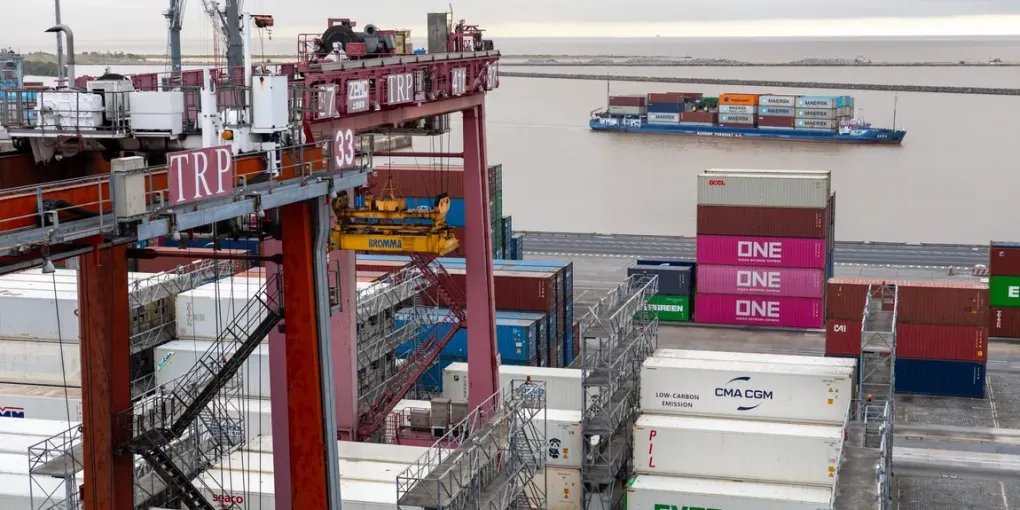
A rate that looks cheap on a Montevideo quote sheet can still cost half again by the time the container is empty. On the China–Uruguay lane the ocean freight is rarely the problem. The problem is that Uruguay taxes imports on the CIF value with three instruments stacked on top of each other — duty, a 5% tasa consular and 22% IVA — and a door to door quote that only covers transport leaves all three for the buyer.
This guide is about door to door shipping from China to Uruguay as one product: what the all-in price covers, what it does not, the Q4 2026 numbers for every cargo size from a 30 kg parcel to a 40ft high cube, the paperwork that DNA requires at Montevideo, and the two legal structures — free zones and the simplified courier regime — that change what you pay. For the country-level overview of routes, ports and modes, start with our shipping from China to Uruguay hub.
Door to Door Shipping from China to Uruguay: What One Price Actually Buys
A door to door shipment is a chain with six links: pickup at the supplier in Yiwu, Guangzhou or Ningbo; export declaration and, for LCL, consolidation into a shared container; the ocean leg or the air leg; Uruguayan import clearance through the Dirección Nacional de Aduanas (DNA); the taxes DNA assesses; and delivery to the consignee address.
Different forwarders quote this chain at different depths, which is why two DDP prices can differ by 40% and neither be wrong:
- Door to port stops at Montevideo and leaves clearance, taxes and trucking with you.
- Door to door, DAP adds clearance and delivery, but DNA bills you for duty and IVA.
- Door to door, DDP is the only version where the number on the invoice is your full landed cost — the forwarder pays duty, the tasa consular and IVA, then delivers.
- Door to door via courier (DHL, FedEx, UPS, consolidator networks) clears small parcels under the postal/courier rules rather than the commercial import regime.
Door to door is a service description, not an Incoterm. DDP and DAP are the terms that price it. If a quote says “door to door” without naming the term, you do not yet know who pays DNA.
Uruguay adds four local quirks that shape the price more than freight rates do. Montevideo runs two competing container terminals, which keeps port handling costs among the lower ones in the region. The country is small enough that “national delivery” means one or two extra days, not a week — except in Rivera, Salto and the northern interior. The tax stack is heavy and value-based, so dense high-value cargo pays proportionally more than bulky low-value cargo. And because Uruguay is a Mercosur member with free zones and free ports, a serious importer can legally avoid the stack entirely by using the country as a distribution platform rather than a market.
Door to Door Shipping Cost from China to Uruguay: Q4 2026 Rates by Cargo Size
Prices below are Q4 2026 all-in figures for pickup in southern or eastern China, international transport, DNA clearance and delivery to a Montevideo address. They exclude Uruguayan import taxes, which the next section works out in full, and they assume normal (non-dangerous) cargo with clean documents.
| Cargo size | Mode | All-in before taxes | Door-to-door transit |
|---|---|---|---|
| Under 30 kg | Express courier (DDP) | $12–$18 per kg | 4–7 days |
| 30–100 kg | Air, consolidated | $11–$16 per kg | 6–10 days |
| 100–300 kg | Air, consolidated | $9–$13 per kg | 6–10 days |
| 300–500 kg | Air, direct | $7–$11 per kg | 5–8 days |
| 1–8 CBM | Sea LCL | $230–$400 per CBM | 42–58 days |
| 20ft FCL (28 CBM) | Sea | $2,900–$5,200 | 38–52 days |
| 40ft FCL (58 CBM) | Sea | $3,500–$6,300 | 38–52 days |
| 40ft high cube (66 CBM) | Sea | $3,700–$6,600 | 38–52 days |
For the freight-only split behind the container lines, our container shipping from China to Uruguay guide lists terminal charges and equipment surcharges separately; the air lines are itemised by airport in the air freight from China to Uruguay rates table.
What Moves the DDP Number on This Lane
Five variables account for almost all of the spread between quotes:
- Declared value. Duty, the tasa consular and IVA are all value-based, so the same 3 CBM costs twice as much to DDP if the goods are worth twice as much. A forwarder cannot quote DDP without your invoice value.
- Density. Air bills on chargeable weight; sea LCL bills on cubic metres with a 1,000 kg per CBM cap. Light bulky cargo is expensive by air and cheap by sea — the reverse for dense machinery.
- Destination. Montevideo and Canelones are next-day from the port. Maldonado and Punta del Este are one extra day. Rivera, Artigas and Salto add 2–4 days and often need a smaller truck.
- Season. Q4 is peak on the Asia–East Coast South America loop. Space from Shanghai and Ningbo tightens from late October and rates typically firm 10–25% into December, so booking 3–4 weeks before the cargo is ready is worth real money.
- Dwell time at destination. Free time at Montevideo is short. Every day a container sits after clearance is billed, and DDP quotes usually assume 3–5 days.
If you want a first-order estimate before talking to anyone, the freight cost calculator gives a starting price for your mode, weight and destination region — useful for budgeting, not a substitute for a quote built on your invoice value.
How Long Does Door to Door Shipping from China to Uruguay Take? Day by Day
Uruguayan buyers usually ask for a single number and get told “about six weeks”. The honest answer is a range, and each segment has a different owner:
| Segment | Sea LCL | Sea FCL | Air |
|---|---|---|---|
| Supplier pickup + export clearance | 2–4 days | 2–4 days | 1–3 days |
| Consolidation (LCL) or gate-in (FCL) | 5–7 days | 3–5 days | — |
| International transit | 30–40 days direct, 35–50 via relay | 30–40 days direct | 3–6 days to MVD via GRU or EZE |
| DNA clearance | 2–4 days | 2–4 days | 1–3 days |
| Final delivery | 1–3 days | 1–2 days | 1–2 days |
| Total door to door | 42–58 days | 38–52 days | 6–10 days |
The lane-level transit breakdown, including what each relay adds, is in our how long it takes to ship from China to Uruguay timeline.
Direct Montevideo Call or the Buenos Aires Relay
Montevideo is a first-class port of call on the Asia–East Coast South America services operated by MSC, Maersk, CMA CGM, COSCO and Hapag-Lloyd, so a direct sailing exists from Shanghai, Ningbo, Shekou and Yantian most weeks. Direct is 30–40 days port to port and it is what you want for anything destined for Montevideo, Canelones, Maldonado or the south.
Relay routings are common on cheaper bookings: transship at Santos, or discharge at Buenos Aires and truck across the river — the latter adds border formalities and 5–10 days. It is also how most cargo reaches Paraguay and inland Argentina, which is why Nueva Palmira, upriver on the Uruguay River, matters: it is a barge and transshipment hub for the Paraná–Paraguay waterway, and part of a regional pattern our China to Paraguay door to door guide covers on the other side of the border.
The Last Leg Inside Uruguay
Delivery inside Uruguay is short but not uniform. Montevideo and Ciudad de la Costa are same-day or next-day from the port, and apartments need someone in portería to receive — a missed appointment can cost you a second delivery attempt. Punta del Este and Maldonado take one more day. Colonia del Sacramento, Salto, Paysandú, Tacuarembó and Rivera add 2–4 days and may require a smaller rigid truck for the final kilometres.
Two practical notes from our desk: containers for Centro and Ciudad Vieja addresses in Montevideo are normally stripped at a warehouse and delivered as pallets, because a 40ft trailer cannot unload there; and if your cargo needs a crane or forklift on arrival, say so before booking, because Uruguayan last-mile trucks are rarely equipped with one.
Uruguay Import Duty, Tasa Consular and 22% IVA: A Worked Door to Door Landed Cost
Uruguay assesses three separate charges on the CIF value (goods + international freight + insurance):
- Import duty (arancel) under the Mercosur Common External Tariff: 0–35%, with most industrial and consumer goods between 0% and 20%.
- Tasa consular: 5% of CIF for goods of non-Mercosur origin, 3% for Mercosur and Chilean origin. Chinese goods pay 5%.
- IVA: 22% standard rate, charged not on CIF alone but on CIF plus duty plus the tasa consular — which is why the effective rate is higher than 22%.
- IMESI applies on top for vehicles, fuels, alcohol, tobacco and cosmetics, and can dwarf the rest.
There is no China–Uruguay free trade agreement in force in 2026, so a certificate of origin does not reduce any of this. Any guide promising FTA savings on this lane is out of date.
Because IVA compounds on duty and the consular fee, the tax burden as a share of CIF is predictable once you know the duty rate:
| Duty rate on CIF | Duty | Tasa consular 5% | IVA 22% | Total tax as % of CIF |
|---|---|---|---|---|
| 0% | 0% | 5.0% | 5.5% | 28.1% |
| 6% | 6% | 5.0% | 6.5% | 35.4% |
| 14% | 14% | 5.0% | 7.1% | 45.2% |
| 20% | 20% | 5.0% | 8.0% | 52.5% |
| 35% | 35% | 5.0% | 9.9% | 70.8% |
Here is the same arithmetic on a real shipment. Three cubic metres of auto parts, FOB $6,000, shipped LCL door to door:
| Line | Amount |
|---|---|
| Goods, FOB China | $6,000 |
| LCL freight, 3 CBM at $170 | $510 |
| Marine insurance | $60 |
| CIF customs value | $6,570 |
| Import duty at 14% | $920 |
| Tasa consular at 5% | $329 |
| IVA 22% on ($6,570 + $920 + $329) | $1,720 |
| Total taxes | $2,969 |
| Landed cost, delivered in Montevideo | $9,539 |
The transport was $570. The taxes were $2,969. Landed cost came to 59% above the invoice value — and that is a mid-range duty rate, not a worst case. This is the number to plan your selling price around, and it is why DDP quotes for high-duty goods look alarming next to port-to-port rates. Our how much shipping from China to Uruguay guide compares the same maths across sea, air and courier.
The 2026 Courier Rules: USD 800 Franquicia and the 60% Single Tax
Small shipments have their own lane, and it changed on 1 May 2026.
The personal franquicia now allows up to USD 800 per person per year across at most three shipments, with IVA payable on top except for US-origin purchases up to USD 200 under the TIFA framework. Franquicias are for personal purchases — using one for stock you intend to resell is not compliant.
The more interesting channel for businesses is the régimen simplificado (prestación única): a single 60% tax on the declared value, minimum USD 20, for shipments up to USD 800 and 20 kg, with no IMESI-liable goods inside, available to companies as well as individuals and without a shipment-count limit.
That flat 60% is not automatically cheaper. Compare it against the general regime: for goods with a 14% duty the general regime costs 45.2% of CIF, so the simplified route is worse; for goods with a 30% duty the general route reaches about 63%, so the simplified 60% wins on simplicity and price. For low-duty capital goods and machinery, the general import regime with a despachante is almost always the cheaper door.
One more constraint that steers the choice: under the general import regime an individual may file only two import DUAs per year through DNA. Regular importers register with the DGI for a RUT and import as a company, or ship DDP with the forwarder as importer of record.
Uruguay Customs Clearance for Door to Door Cargo: DUA, RUT and the Despachante
Uruguayan clearance is broker-bound. Every commercial import is declared on a DUA (Documento Único Aduanero) filed electronically with DNA by a licensed despachante de aduana — you cannot self-file, and a forwarder that offers DDP in Uruguay is working through a local broker. The importer named on the DUA must hold a RUT issued by the DGI, which is why so many first-time buyers discover the paperwork problem only once the container has arrived.
What a clean file looks like:
| Document | Issued by | Common failure |
|---|---|---|
| Commercial invoice | Supplier | Value, Incoterm and HS code disagree with the packing list |
| Packing list | Supplier | Carton count or weights do not match the BL |
| Bill of lading or air waybill | Carrier | Consignee name differs from the RUT holder |
| Certificate of origin | Chamber of commerce | Missing — no duty benefit, but needed for origin control |
| Insurance certificate | Insurer | CIF declared without insurance |
| RUT and DGI registration | Importer | Not registered before vessel arrival |
| Sector permits | URSEC, MSP, MGAP, MIEM | Telecom devices, food, plants and some machinery need prior authorisation |
Clearance itself takes 2–4 working days on a clean file, and pre-clearance while the vessel is still at sea is standard practice with a competent broker. A red-channel inspection adds 2–5 days and usually a storage charge. If your goods continue to Paraguay, Bolivia or Brazil after Montevideo, they move under a Mercosur transit declaration (MIC/DTA) rather than being imported into Uruguay at all — different paperwork, different cost.
Air or Sea Door to Door to Uruguay: Chargeable Weight and the Break-Even
Air and sea are priced on different physical quantities, and mixing them up is the fastest way to overpay.
- Air bills on the greater of actual weight and volumetric weight, with volumetric weight = length × width × height in cm ÷ 6000. One cubic metre of light cargo measures 1,000,000 ÷ 6,000 = 167 kg.
- Sea LCL bills on cubic metres, or on weight at 1,000 kg per CBM, whichever is greater. A cubic metre of dense machinery at 800 kg still bills as one CBM.
| Factor | Air door to door | Sea door to door |
|---|---|---|
| Cost per chargeable kg | $7–$16 | roughly $1–$2 for dense cargo |
| Cost per CBM | $1,200–$2,700 | $230–$400 |
| Transit | 6–10 days | 42–58 days |
| Minimum charge | $50–$150 per shipment | 1–2 CBM minimum |
| Best for | launches, restocks, samples, high-value goods | volume, furniture, machinery, building materials |
| Capital tied up | about a week | 6–8 weeks |
The break-even is an inventory question, not a freight question. Moving $30,000 of stock 40 days faster saves about $395 in capital cost at 12% a year — small next to an air premium of several thousand dollars. Air wins when the cargo is worth enough per kilo to make the premium irrelevant (a container of phones pays its own airfreight through faster turns), when a stock-out costs more than the freight, or when the shipment is a sample that must arrive before a sea order is placed. Sea wins everywhere else, and for anything over 15 CBM FCL usually beats LCL on cost and damage risk. Run your own carton dimensions through the volumetric weight calculator before choosing a mode — a light pallet can bill at twice its scale weight by air and at half its air cost by sea.
DDP vs DAP on China–Uruguay Shipments: Who Pays DNA
This is where door to door quotes most often mislead, so here is the responsibility split:
| Cost or risk | DDP | DAP |
|---|---|---|
| Pickup, export clearance, freight | Forwarder | Forwarder |
| Uruguayan clearance by despachante | Forwarder | You (or your broker) |
| Import duty, tasa consular, IVA | Forwarder, inside the fixed price | You, paid to DNA |
| Delivery to your address | Forwarder | Forwarder |
| Demurrage if clearance is slow | Forwarder | You |
| Who is importer of record | Forwarder or its Uruguayan entity, or you if you hold a RUT | You |
DDP is the practical choice when you do not hold a RUT, when you want a single landed cost to price your own sales against, or when you are testing a supplier and do not want to build a customs relationship yet. DAP makes sense when you already import regularly, have your own despachante, and can recover IVA as a tax credit — under DDP you cannot, because the tax was never assessed in your name.
Whatever the quote says, get two things in writing: the term (DDP or DAP), and the name of the party on the DUA. The difference between the two structures is on the references page of our DDP vs DDU explainer, and the service-scope comparison lives in door to door vs port to port shipping.
Uruguay Free Zones and the Montevideo Free Port: A Legal Way Around the Tax Stack
Uruguay is not only a market of 3.4 million people; it is a distribution platform for the 300 million around it, and its free-zone framework is why.
Goods held in a zona franca or in the Montevideo free port are exempt from import duties and IVA while they stay inside. Tax is triggered only when the goods enter Uruguayan customs territory. Re-export them to Argentina, Brazil, Paraguay or Chile and no Uruguayan import tax is ever assessed. Users can store, re-pack, relabel, assemble and repair inside the zone, and the regime is open to foreign-owned companies.
The relevant locations for a China importer are Zonamerica and the Montevideo free zone for services and light logistics, Nueva Palmira and Fray Bentos on the Uruguay River for barge-based transshipment to Paraguay and Bolivia, Colonia for the Buenos Aires crossing, and Rivera for the Brazilian border trade.
Three honest caveats. First, operating inside a free zone means contracting a user company — it is a structure, not a checkbox. Second, the moment goods leave the zone for a Uruguayan customer, the full duty, tasa consular and IVA apply, so the free zone does not make local sales cheaper. Third, free-zone storage has its own fees, and they exceed port free time quickly. Used well, though, it converts Uruguay from a high-tax destination into a regional hub — and it pairs naturally with sea door to port into Montevideo followed by zone entry, rather than a full DDP delivery.
Frequently Asked Questions
Does door to door shipping from China to Uruguay include duties and taxes?
Only on DDP terms. Door to door describes the service; DDP and DAP decide who pays the DNA bill. Under DDP the forwarder includes duty, the 5% tasa consular and 22% IVA in the fixed price. Under DAP you receive the cargo at your door and pay DNA separately. Most China–Uruguay door to door quotes are DDP — confirm which term applies before comparing prices.
How much does door to door shipping from China to Uruguay cost in Q4 2026?
Transport, clearance and delivery run about $230–$400 per CBM by LCL, $7–$16 per kg by air and $2,900–$6,600 for a full container delivered in Montevideo. Uruguayan taxes then add 28–53% of the CIF value, so $6,000 of goods in 3 CBM typically lands at about $9,500.
How long does door to door sea freight from China to Uruguay take?
42–58 days for LCL and 38–52 days for FCL. The ocean leg is 30–40 days on a direct Montevideo call; add consolidation, DNA clearance and final delivery. Air door to door is 6–10 days and express courier 4–7 days.
Can I import door to door to Uruguay without a RUT?
Yes, but not as importer of record. A licensed despachante must file the DUA and the named importer needs a RUT from the DGI. Importers without a company either ship DDP with the forwarder as importer of record, or use the simplified regime, capped at USD 800 and 20 kg per shipment.
Is door to door the same as DDP?
No. Door to door is the service scope; DDP is the Incoterm that allocates Uruguayan duty and taxes. A door to door shipment can be quoted DDP or DAP, and the gap between them is exactly the DNA bill.
Get a Door to Door Shipping Quote from China to Uruguay in 24 Hours
To price a DDP door to door shipment accurately, a forwarder needs five things: the supplier address or city in China, the cargo description with HS codes, the total invoice value, the carton count and dimensions, and the delivery address in Uruguay.
Send those five and our desk returns a written quote within 24 hours, itemised line by line — freight, destination charges, clearance, duty, tasa consular, IVA and delivery — so you can see exactly what the DDP number contains. If you are still choosing a mode, we will show you the sea and air options side by side before you commit.
Contact our China–Uruguay desk for a Q4 2026 quote, or read the country overview first if you want the wider picture on ports, sailings and modes.