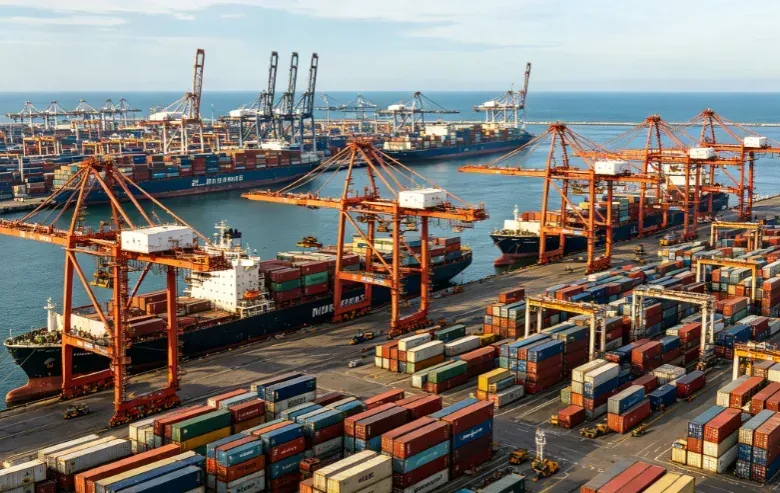
Most importers ask for a container rate before they ask what goes inside the container. On the China–Uruguay lane that order is backwards. Montevideo is a two-terminal port handling roughly a million TEU a year, and the border crossing between “a cheap quote” and “a profitable shipment” is almost never the ocean freight — it is whether your cargo fits the box you paid for, whether the box clears DNA without a red-channel inspection, and whether you hand it back before free time runs out.
China has been Uruguay’s largest trading partner for more than a decade, sending electronics, machinery, auto parts, textiles and plastics south while beef, wool, cellulose and soy head north. Nearly all of that moves in containers. This guide covers the part of container shipping from China to Uruguay that rate tables leave out: equipment selection, pallet and payload math, Q4 2026 pricing by container type, stuffing and VGM, sailing schedules, the demurrage clock at Montevideo, and the full Uruguayan tax stack. For the country-level overview, start with our shipping from China to Uruguay hub.
Container Shipping from China to Uruguay: The Box Decides More Than the Freight Rate
Three numbers govern whether a container to Montevideo pays for itself.
The first is usable volume. A 20ft is sold as 33 CBM, but the internal shell gives you about 28 CBM of practical loading space once pallets, dunnage and the door recess take their share. A 40HC is sold as 76 CBM and loads to about 68. That 2.4× jump between a 20ft and a 40HC costs only 20–30% more in freight — which is why importers who ship 30 CBM in a 20ft are effectively paying for air.
The second is taxable value. Uruguay taxes the CIF value, not the FOB value, so every dollar of freight you save still reduces duty, consular fee and IVA. A $400 saving on the ocean leg is worth roughly $190 in tax on a dutiable consumer-goods line.
The third is time inside the terminal. Free time at Montevideo is measured in days, not weeks. A container that misses clearance by four days can wipe out the entire freight saving with demurrage and storage.
Everything below follows from those three numbers.
Container Types and Capacity for Uruguay: 20GP, 40GP, 40HC and Special Equipment
Ninety-five percent of China–Uruguay cargo moves in three dry containers. The specifications that actually matter at the loading bay:
| Equipment | Internal dimensions (L × W × H) | Nominal volume | Practical load | Tare | Max payload |
|---|---|---|---|---|---|
| 20GP | 5.90 × 2.35 × 2.39 m | 33.2 CBM | ~25–28 CBM | 2,200–2,300 kg | ~28,200 kg |
| 40GP | 12.03 × 2.35 × 2.39 m | 67.7 CBM | ~55–58 CBM | 3,700–3,800 kg | ~26,500 kg |
| 40HC | 12.03 × 2.35 × 2.69 m | 76.4 CBM | ~65–68 CBM | 3,850–3,900 kg | ~26,300 kg |
When the 20ft still wins: dense cargo. Ceramic tiles, steel fittings, machinery, auto parts, bagged chemicals and printing paper hit the 28-tonne payload limit long before they fill 28 CBM. Paying for 68 CBM you cannot use is worse than paying a higher rate per CBM.
When the 40HC wins: anything measured in air rather than kilos — furniture, mattresses, plastic housewares, display fixtures, e-commerce stock. The extra 30 cm of internal height is free floor space for light cargo.
Special equipment is available on this lane but needs booking 3–4 weeks ahead, because empties are repositioned from Asia rather than stored in Montevideo:
- Open-top (20OT/40OT) for over-height machinery that can be craned in from above
- Flat rack (20FR/40FR) for wide or unusually shaped cargo — excavator arms, production lines, boats
- Reefer (20RF/40RF) for temperature-controlled pharma, food ingredients and chemicals; expect a $1,200–$2,500 premium plus a power/PTI surcharge, and remember that reefer plugs at Montevideo are allocated on booking, not on arrival
How Many Pallets Fit in a 20ft or 40ft Container
Importers who buy by the pallet should plan in pallets, not CBM:
| Pallet type | 20ft (single tier) | 40ft / 40HC (single tier) |
|---|---|---|
| Euro pallet 1.2 × 0.8 m | 10–11 | 20–21 |
| Industrial pallet 1.2 × 1.0 m | 9–10 | 20 |
| Half pallet 0.8 × 0.6 m | 20–21 | 40–42 |
Two rules save real money here. Load with the 1.2 m side across the container width — pallets turned the other way waste 10–15% of the floor. And count stacking height, not floor count: 68 CBM of 1.5 m-high pallets will not double-stack in a 40HC (2.69 m internal), so a shipment that looks like 20 pallets on paper becomes 20 pallets of air freight in practice.
Payload, Tare and the Road Limit in Uruguay
The container’s payload plate is rarely the binding constraint — the truck carrying it is. Uruguayan road rules, weigh stations on the main corridors (Ruta 1 toward Colonia and the coast, Ruta 3 toward Salto, Ruta 8 toward Melo) and axle-load limits mean a 20ft loaded to 27 tonnes of steel may need a permit or a split delivery to an inland destination.
If you have weighed cargo, weigh it before booking. For cartons and irregular loads, calculate the volume first with our volumetric weight calculator — the same CBM figure that decides LCL charges also decides whether you need a 20ft or a 40HC.
Container Shipping Cost from China to Uruguay: Q4 2026 Rates by Equipment Type
Rates below are realistic Q4 2026 all-in ranges for direct or near-direct sailings to Montevideo, including origin charges and BAF but excluding Uruguayan taxes. Northern Chinese ports pay a structural premium for the extra sailing distance.
| Equipment | Q4 2026 rate to Montevideo | Cost per usable CBM | Notes |
|---|---|---|---|
| 20GP | $2,500–$4,800 | $89–$171 | Best when cargo is heavy |
| 40GP | $3,100–$5,900 | $53–$102 | Workhorse for 30–55 CBM |
| 40HC | $3,300–$6,200 | $49–$91 | +$150–$300 over 40GP, +10 CBM |
| LCL | $110–$260 per CBM | — | 1–2 CBM minimum, +5–10 days |
| 20RF / 40RF reefer | +$1,200–$2,500 over dry | — | Power and PTI surcharges extra |
Per origin port, the spread looks like this:
| Origin | 20GP | 40GP | 40HC |
|---|---|---|---|
| Shanghai | $2,500–$4,500 | $3,100–$5,500 | $3,300–$5,800 |
| Shenzhen / Yantian | $2,550–$4,600 | $3,150–$5,600 | $3,350–$5,900 |
| Ningbo | $2,600–$4,650 | $3,200–$5,700 | $3,400–$6,000 |
| Guangzhou / Nansha | $2,600–$4,600 | $3,200–$5,600 | $3,400–$5,900 |
| Qingdao | $2,800–$5,000 | $3,400–$6,100 | $3,600–$6,400 |
Run a first-pass estimate on our freight cost calculator before you request quotes, then compare the number with the itemised breakdown below — a quote that is 30% under the range usually means a charge was moved somewhere else.
What the Ocean Rate Does Not Include at Montevideo
- Destination THC at TCP or Montecon, billed per container
- Consular fee and customs brokerage, collected after clearance
- Storage beyond free time at the terminal, charged by the day
- Detention after the container leaves the port, until the empty is returned
- Inland trucking from Montevideo to the interior — Rivera, Salto, Paysandú, Treinta y Tres all add real cost
- Inspections if DNA assigns a physical examination, including re-stuffing labour
For the equipment-only price comparison, our 20ft and 40ft container cost from China to Uruguay breakdown works the ranges port by port; this article is about making the equipment earn its freight.
FCL vs LCL from China to Uruguay: The 15 CBM Break-Even and How Groupage Works
LCL is not “a cheaper container”. It is a different service with its own physics: your cargo is delivered to a Chinese consolidation warehouse (CFS), loaded into a shared container with other shippers’ goods, de-stuffed at a Montevideo CFS, then delivered.
| Factor | FCL | LCL |
|---|---|---|
| Practical break-even | Above ~15–18 CBM | Below ~15 CBM |
| Cost basis | Per container | $110–$260 per CBM, 1–2 CBM minimum |
| Transit | 30–40 days direct | +5–10 days for consolidation and de-stuffing |
| Handling | Sealed door to door | Loaded and unloaded 4+ times |
| Damage risk | Low | Higher — shared space, mixed cargo |
| Customs | One DUA per container | One DUA per house bill, co-loaded cargo |
| Best for | Repeat importers, fragile or high-value goods | Trial orders, samples, mixed SKUs |
Two LCL traps specific to this lane. First, volume is rounded up to the highest 0.5 or 1 CBM by most consolidators, so 10.2 CBM bills as 11. Second, LCL cargo cannot be inspected in isolation — if a co-loaded shipment triggers a red channel at Montevideo, your goods wait with it. On a route where clearance takes 2–4 working days, that can add a week.
If your volumes are irregular, the sensible pattern is LCL for the first two orders, then a 20ft once you exceed 15 CBM consistently, then a 40HC once you pass 30. Our LCL shipping from China to Brazil guide explains the consolidation mechanics in more depth — the process is identical on the Uruguayan lane.
Container Loading for Uruguay: Stuffing Plan, Weight Distribution and VGM
A 35-day voyage across the Indian Ocean and around the Cape, or through the Panama Canal, is a long time for badly packed cargo. Loading is where claims are born.
Weight distribution. Keep the centre of gravity low and centred. Heavy pallets on the floor, in the middle two-thirds of the container, never at the doors. A container loaded front-heavy is hard to handle at the terminal; one loaded door-heavy can unbalance the chassis on the road. Aim for no more than a 60/40 front-to-rear split.
Blocking and bracing. Timber dunnage, airbags and lashing straps are cheap; a shifted load is not. Leave no gaps larger than 10–15 cm — cargo that can move will move. Nail strips to the floor only with the carrier’s permission, and never wedge against the container’s side panels.
Moisture. A steel box crossing climate zones sweats. Use container desiccant bags (1–2 kg per 10 CBM), keep cartons off the floor with pallets, and avoid loading wet or damp packaging. Electronics and textiles are the two categories that claim most often.
Floor loading. Standard container floors take roughly 4.5 tonnes per square metre; concentrated point loads from machinery need steel plates or timber spreaders.
VGM: The Declaration That Stops Your Container at the Gate
Under SOLAS, every packed container needs a Verified Gross Mass before it can be loaded. There are two accepted methods: weighing the packed container on a calibrated weighbridge (Method 1), or adding the cargo, packaging and securing material weights to the tare (Method 2, only with a certified process). The VGM must reach the carrier before the vessel’s documentation cut-off — typically 24 hours before loading.
Get this wrong and the container is refused at the terminal gate. The shipment then misses the sailing, and you pay storage, re-handling and a new booking on top. If your supplier loads the container at their factory, insist on a weighbridge ticket, not an estimate.
Sea Freight Transit Time from China to Uruguay: Schedules, Cut-Offs and Transshipment
| Routing | Port-to-port | Why it varies |
|---|---|---|
| Shanghai → Montevideo, direct | 30–38 days | Weekly-ish Asia–ECSA service |
| Shenzhen / Ningbo → Montevideo, direct | 31–40 days | More carrier choice |
| Via Buenos Aires (feeder or truck) | 35–48 days | Feeder schedule plus Plata crossing |
| Via Santos / Rio Grande | 36–50 days | Brazilian port congestion risk |
| Via Balboa (Panama) | 40–52 days | Two ocean legs, one transshipment |
| LCL, any routing | +5–10 days | Consolidation and de-stuffing |
| Air (via GRU, EZE or MIA) | 4–9 days | For urgent, high-value cargo |
The number that matters commercially is not transit time but the booking calendar. Container release in China, factory loading, VGM submission, terminal gate-in and documentation cut-off stack up to 5–7 days before the vessel sails. Plan backwards from your required delivery date: 40 days sailing, 4 days clearance, 2 days trucking, 7 days pre-sailing, and you are at roughly 53 days from booking to warehouse.
Transshipment is not automatically slower — but it does multiply handling. One transshipment means the container is discharged, stored and reloaded; each of those steps is a chance for damage, mis-routing or a missed connection. On this lane, direct services to Montevideo are worth a $200–$400 premium when your cargo is time-sensitive.
For a mode-by-mode breakdown including air and door-to-door, see our how long it takes to ship from China to Uruguay guide.
Container Demurrage and Free Time at Montevideo Port: The Uruguay Cost Nobody Quotes
Montevideo’s two container terminals — TCP (Terminal Cuenca del Plata, operated by Katoen Natie) and Montecon — sit on a 14-metre channel that lets deep-sea vessels call directly. TCP is in the middle of a US$600 million expansion; the first of five new ZPMC super post-Panamax cranes arrived in September 2026, which will lift berth productivity but also means yard congestion during the transition.
For importers, the relevant clock starts at discharge:
| Phase | Typical free time | Then charged |
|---|---|---|
| Container at terminal (demurrage) | 5–7 calendar days | Per day, rising in tiers after day 5 |
| Container outside terminal (detention) | 7–10 days after gate-out | Per day until empty return |
| Terminal storage after de-stuffing | 2–5 days | Per day, per container or per CBM |
Free time is not automatic. It is written into the carrier’s tariff and the booking confirmation, and it differs between carriers and between terminal operators. Ask for it in writing, because a verbal “about a week” is not what the invoice says.
Three practical defences:
- Pre-clear before arrival. Your despachante can file the DUA as soon as the bill of lading is confirmed, so release happens on day 1, not day 5.
- Book the truck before the vessel berths. Montevideo drayage capacity tightens in the grain and cellulose harvest window.
- De-stuff at the port, not at the warehouse, if you distribute to multiple buyers — a CFS charges less per day than a container does.
If a red-channel inspection is ordered, add 3–7 days. That is usually enough to break free time, which is why the tax and clearance section below matters as much as the ocean rate.
Uruguay Customs for Container Imports: DUA, DNA, Tasa Consular and 22% IVA
Uruguay’s customs authority is the Dirección Nacional de Aduanas (DNA), and filings go through the VUCE single window as a DUA (Documento Único Aduanero). A licensed despachante de aduana files it on your behalf; the importer of record needs a Uruguayan tax ID (RUT).
The tax stack, applied to the CIF value:
| Charge | Rate | Base |
|---|---|---|
| Mercosur common external tariff (TEC) | 0–20%, most consumer goods 12–18% | CIF |
| Tasa consular | 5% (3% for Mercosur-origin goods) | CIF |
| IVA | 22% (10% on some basic goods) | CIF + duty + consular fee |
| IMESI | Category-specific | Vehicles, alcohol, tobacco, fuels |
Note the compounding: IVA is charged on the CIF value plus duty plus the consular fee. That is why Uruguayan landed cost runs far above the invoice value, and why the country’s free zones are so heavily used.
There is no China–Uruguay free trade agreement in force in 2026 — negotiations have been discussed for years but Uruguay’s Mercosur membership limits bilateral deals. A Chinese certificate of origin will not reduce duty.
Documents on the Desk of the Despachante
- Commercial invoice with Incoterm, HS code and precise description
- Packing list with weights, dimensions and pallet count
- Bill of lading (original or telex release) — the container cannot be released without it
- Certificate of origin (statistical and anti-dumping purposes)
- Insurance certificate
- Product-specific permits: DINAMA for chemicals and waste, MGAP for food and animal products, URSEC homologation for telecom devices, MSP for medicines and medical devices
Worked example — landed cost of a 20ft container of electronics, Q4 2026:
| Item | USD |
|---|---|
| FOB value, Shenzhen | 15,000 |
| Ocean freight to Montevideo | 3,200 |
| Marine insurance | 150 |
| CIF value | 18,350 |
| Import duty at 16% | 2,936 |
| Tasa consular at 5% | 918 |
| IVA at 22% on 22,204 | 4,885 |
| Brokerage | 180 |
| Drayage to warehouse | 140 |
| Landed cost | 27,408 |
That is 83% above the FOB price — and 47% of the CIF value is tax. Importers who budget only freight and duty are short by roughly a third of the real number.
Free zones change the math legitimately. Zonamerica, the WTC Free Zone in Montevideo, Colonia and Nueva Palmira allow goods to be imported, stored and re-exported without paying TEC, consular fee or IVA; taxes are triggered only when goods leave the zone into Uruguayan customs territory. If you distribute across the region or hold stock for months, this can be the difference between a viable margin and none.
Frequently Asked Questions
How much does it cost to ship a 40ft container from China to Uruguay in Q4 2026?
A 40GP runs $3,100–$5,900 and a 40HC $3,300–$6,200 to Montevideo, including origin charges and BAF but excluding Uruguayan import taxes. Transshipment routings add $300–$700, and September–November peak surcharges push rates toward the top of the range.
Can I fit 30 CBM into a 20ft container?
No. A 20ft loads to about 25–28 CBM in practice. If you have 30 CBM of light cargo, you either trim to 28 CBM in a 20ft or pay 20–30% more for a 40GP and gain roughly double the space — the 40ft is almost always the better cost per CBM above 25 CBM.
What is VGM and why does it matter for Uruguay shipments?
VGM is the Verified Gross Mass required under SOLAS: the actual weight of the packed container, declared before loading. Without a valid VGM the container is refused at the terminal gate, the sailing is missed, and storage plus re-booking costs land on the shipper.
How much free time do I get at Montevideo before demurrage?
Typically 5–7 calendar days at the terminal after discharge, then per-day demurrage in rising tiers; detention after gate-out usually runs 7–10 days. Both are set by the carrier’s tariff and the terminal, not by law, so confirm them on the booking confirmation before the vessel arrives.
Do I need a Uruguayan company to import a container?
You need an importer of record with a RUT and a licensed despachante to file the DUA. Non-resident buyers can import through a free zone, use a local importer-of-record service, or ship DDP if the forwarder accepts the duty liability. Under DAP you remain responsible for the taxes at clearance.
Which is cheaper, LCL or a 20ft container to Uruguay?
Below about 15 CBM, LCL at $110–$260 per CBM is cheaper. Above 15–18 CBM the 20ft wins, because you stop paying per CBM, avoid the consolidation surcharge and save 5–10 days of transit.
Book a Container to Uruguay With a Loading Plan That Fits
A container to Montevideo is a fixed cost with a variable payoff. Choose the right equipment, load it to a plan, declare an accurate VGM, clear it before free time expires, and the freight rate stops being the number that decides your margin. Get one of those wrong and even a cheap quote becomes expensive.
With 15 years on this lane, Dantful.US International Logistics quotes 20GP, 40GP, 40HC and special equipment from every major Chinese port, provides a loading plan sized to your pallets, and arranges DNA clearance through licensed despachantes so your container leaves the terminal inside free time. Compare the equipment options for your next shipment against our container shipping from China to Paraguay guide if you also distribute into the Mercosur interior.
Ready to book? Contact Dantful.US with your cargo volume, pallet count and destination city for an itemised Q4 2026 container quote within 24 hours — equipment recommendation, VGM support and clearance included.