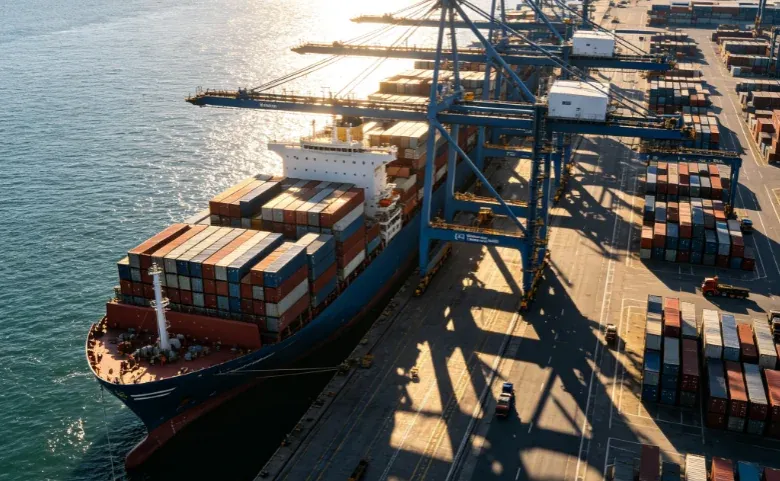
Two importers in Santiago order the same 55 CBM of LED lighting from the same Zhongshan factory in the same week. One books a single 40ft container; the other splits the order across two 20ft boxes. Both boxes berth at San Antonio off the same vessel — and the importer with two boxes pays roughly $1,800 more in freight and destination charges for exactly the same cargo.
On the China–Chile lane there is a second version of that mistake, and it usually costs more: booking the right box for the wrong port. Chile is 4,300 km long and all three of its container gateways sit a third of the way down the country, so the inland haul to Concepción or Antofagasta can swallow everything the box choice saved. This guide prices both halves of the decision — 20ft and 40ft container shipping cost from China to Chile by origin port, the cost-per-CBM ladder, the port-by-port inland math, and the 19% IVA that arrives after the box lands. It comes from 15 years of forwarding practice at Dantful.US International Logistics. If you are still deciding on a mode rather than a box, start with our shipping from China to Chile overview.
20ft and 40ft Container Shipping Cost from China to Chile: October 2026 Rates by Origin Port
These are all-in port-to-port ranges for October 2026, before origin charges in China, destination charges in Chile and IVA.
| Origin → Chilean port | 20ft (20GP) | 40ft (40GP) | 40ft High Cube (40HQ) |
|---|---|---|---|
| Shanghai (Yangshan) → San Antonio | $2,300–$3,050 | $3,400–$4,800 | $3,550–$5,000 |
| Shenzhen (Yantian / Shekou) → San Antonio | $2,250–$3,000 | $3,350–$4,700 | $3,500–$4,900 |
| Guangzhou (Nansha) → Valparaíso | $2,250–$3,000 | $3,350–$4,700 | $3,500–$4,900 |
| Ningbo (Beilun) → Valparaíso | $2,350–$3,100 | $3,450–$4,850 | $3,600–$5,050 |
| Qingdao → San Antonio | $2,450–$3,250 | $3,550–$5,000 | $3,700–$5,150 |
| Shanghai → Iquique | $2,550–$3,400 | $3,700–$5,200 | $3,850–$5,350 |
Three things move these numbers more than the box type does. Origin: southern China is the cheapest loading region on this lane, and its sailings reach San Antonio a day or two earlier; Qingdao and northern ports sit $150–$250 above Shanghai on a 20ft. Season: August to December peak adds 15–30% to base rates, and from November Chile’s own fruit-export season pulls reefer equipment north, which tightens dry-box availability for the southbound leg. Port: Iquique is the priciest gateway for a reason — fewer direct calls — but it can still be the cheapest door for northern Chile once you subtract the inland haul from the centre.
Ask for a rate validity window of three to four weeks rather than a single-day quote, and ask whether BAF/CAF is already inside the number. If you want to sanity-check a quote against your own cargo before you commit, run it through our Freight Cost Calculator.
Cheapest Way to Ship a Container from China to Chile: The Cost-per-CBM Ladder
A broker quoting “20ft for $2,300, 40ft for $3,400” invites the wrong comparison. Divide by what each box actually carries and the ranking is immediate:
| Option | What you are buying | October 2026 rate | Cost per CBM | It wins when |
|---|---|---|---|---|
| LCL | shared container space, 1 CBM minimum | $65–$120 per CBM | $65–$120 | under about 15 CBM |
| 20ft (20GP) | ~28 CBM exclusive | $2,300–$3,100 | $82–$111 | 15–28 CBM, or heavy cargo |
| 40ft (40GP) | ~58 CBM exclusive | $3,400–$4,900 | $59–$85 | 28–58 CBM |
| 40ft High Cube (40HQ) | ~68 CBM exclusive | $3,550–$5,000 | $52–$74 | 55–68 CBM, bulky and light |
The 40ft buys space about 30% cheaper per cubic metre than a 20ft, and the 40HQ is cheaper again — which is why an importer who fills a 20ft to 26 CBM and then books another 20ft three months later is paying for the same mistake twice. Note too that destination charges are billed per container: about $600–$700 of terminal, documentation and delivery-order cost lands as $21 per CBM on a 20ft and $12 per CBM on a 40ft. The fixed charges double the 40ft’s advantage.
Two 20ft Containers or One 40ft to Chile?
| Option for 55 CBM | Ocean freight | Destination + inland | Total before duty and IVA |
|---|---|---|---|
| Two 20ft containers | $5,400 | ~$1,200 | $6,600 |
| One 40ft container | $4,100 | ~$700 | $4,800 |
One 40ft is about $1,800 cheaper for identical volume, and it produces one customs entry instead of two. But four situations genuinely call for two 20ft boxes: cargo heavier than about 26–27 tonnes (see the payload section below), two consignees or two cities, two production dates that cannot be pulled together, or cargo that must not share a container — dangerous goods, food-grade goods, or anything under fumigation.
If your volume sits between 55 and 68 CBM, price a third option: a 40ft standard plus the last few CBM as LCL. LCL bills on chargeable weight — the greater of volume and weight, at 1 CBM to 1,000 kg — so a pallet of dense hardware can cost far more than the space it fills. Our Volumetric Weight Calculator converts carton dimensions into chargeable CBM in seconds; run your own cartons through it before you decide between a 40ft and a 40HQ.
How to Lower Your Container Shipping Cost from China to Chile
- Book in the window, not at the peak. February to May sailings to Chile price 10–20% below the August–December peak, and booking 3–4 weeks ahead locks standard rates instead of spot rates.
- Load the box you pay for. Every 10 CBM of unused space in a 40GP is roughly $590 of freight paid for nothing.
- Avoid the two-box reflex. Above 28 CBM, one 40ft beats two 20ft on freight, destination charges and customs files.
- Keep the origin flexible. Shenzhen or Guangzhou instead of Qingdao is usually $150–$250 per box on this lane.
- Get the Form F before the vessel sails. It is the cheapest document in the file: it removes the 6% duty entirely (see the customs section).
20ft vs 40ft vs 40HQ Container for Chile: Capacity, Payload and Pallet Counts
| Spec | 20ft (20GP) | 40ft (40GP) | 40ft High Cube (40HQ) |
|---|---|---|---|
| Internal dimensions | 5.90 × 2.35 × 2.39 m | 12.03 × 2.35 × 2.39 m | 12.03 × 2.35 × 2.69 m |
| Geometric interior volume | ~33 CBM | ~67 CBM | ~76 CBM |
| Usable volume after stowage | ~28 CBM | ~58 CBM | ~68 CBM |
| Tare weight | ~2.2 t | ~3.8 t | ~3.9 t |
| Max gross (equipment rating) | 30.48 t | 32.5 t | 32.5 t |
| Practical cargo cap in central Chile | 26–27 t | 26–27 t | 26–27 t |
| Euro pallets (1.2 × 0.8 m) | 10–11 | 20–21 | 20–21 |
| Best cargo profile | 15–28 CBM or dense and heavy | 28–58 CBM, mixed SKUs | 55–68 CBM, bulky and light |
Two lines in that table cause most of the trouble on this lane. The first is usable versus geometric volume: nobody loads 33 CBM into a 20ft, because pallets, dunnage and door clearance eat 10–15% of the interior. The second is the practical cargo cap, which is lower than the equipment rating on both boxes: on the San Antonio and Valparaíso corridors to Santiago, the grades on Route 68 and Route 78 mean a standard tractor-trailer combination normally runs at around 26–27 tonnes of cargo per container. Heavy cargo above that is permit territory, not paperwork you can fix on arrival.
Which is why density, not volume, should pick your box:
| Cargo | Typical density | Box to book |
|---|---|---|
| Furniture, packaging, apparel, plastics | 120–200 kg/CBM | 40HQ — fill it, then keep filling it |
| Appliances, hardware, auto parts | 300–500 kg/CBM | 40GP |
| Ceramic tile, sanitaryware, marble | 1,200–1,800 kg/CBM | 20GP — weight-limited long before full |
| Steel, machinery, castings | 2,000+ kg/CBM | 20GP, or two, with VGM and permits checked early |
Never leave the Verified Gross Mass to the last morning before loading. A misdeclared overweight container is rolled, reweighed and fined, and on a Chile service with fortnightly sailings that costs you a whole rotation.
Shipping a Container to Chile: San Antonio, Valparaíso or Iquique?
Chile’s container traffic concentrates in a 200 km band around Santiago, and each gateway has a different job description:
- San Antonio — Chile’s largest container port by volume and the default for central Chile. Two competing terminals, STI and DP World San Antonio, keep berthing competitive, and Santiago is 110 km inland on a dual-carriageway.
- Valparaíso — the historic gateway, served by TPS and TCV, with the same 110–120 km run to Santiago and strong coverage from Ningbo and Guangzhou sailings. Slightly smaller, occasionally slower to discharge in peak weeks.
- Iquique — northern Chile’s port, with fewer direct calls and higher ocean freight, but the natural entry for Antofagasta, Calama and mining-supply cargo. It is also the door to ZOFRI, the Iquique free zone where goods can be stored with duty and IVA suspended and re-exported to Bolivia or southern Peru.
The inland leg is where the port decision is really made. These are typical per-container trucking ranges from the port to the destination city:
| Destination | From San Antonio / Valparaíso | From Iquique |
|---|---|---|
| Santiago | $350–$550 | not competitive |
| Rancagua / Talca | $450–$700 | not competitive |
| Concepción / Biobío | $700–$1,000 | not competitive |
| La Serena / Coquimbo | $650–$950 | $900–$1,300 |
| Antofagasta | $1,800–$2,600 | $450–$750 |
| Calama / mining region | $2,300–$3,100 | $900–$1,400 |
Read the last two rows twice. For Antofagasta, paying $2,900 more in ocean freight to berth at Iquique instead of San Antonio is one of the few cases where a dearer container rate is the cheaper door-to-door number. For Santiago, the opposite is true: the extra ocean cost of Iquique is pure waste.
How Long Does It Take to Ship a Container from China to Chile? Sea Transit Times by Port
| Origin → destination | At-sea transit | Typical frequency |
|---|---|---|
| Shanghai → San Antonio | 25–31 days | weekly direct |
| Ningbo → Valparaíso | 26–33 days | weekly direct |
| Shenzhen (Yantian) → San Antonio | 28–35 days | weekly direct |
| Guangzhou → Valparaíso | 27–34 days | weekly, some via transshipment |
| Qingdao → San Antonio | 30–37 days | fortnightly |
| LCL (consolidated, any origin) | 30–40 days | weekly consolidation cut-off |
Published transit is not your timeline. Add 2–4 days for Chilean customs and SAG clearance, 1–2 days for terminal release and delivery order, and the inland run — same day for Santiago, two to three days for Antofagasta. Realistic door-to-door is 35–45 days for a full container to Santiago and 40–50 days for LCL. Transshipment via Callao or Balboa adds 5–10 days and is the usual reason a quoted 30 days becomes 42; if a sailing date matters, ask for the transshipment port in writing. The port-by-port breakdown, including air options, is in our how long does it take to ship from China to Chile guide.
What Is Inside a Container Quote to Chile: Freight-Only vs Door-to-Door DDP
The ocean rate is roughly half of what you pay. A Chile file looks like this:
| Stage | Charge | Typical range |
|---|---|---|
| Origin | Ocean freight (the quoted container rate) | see table above |
| Origin | THC and documentation at the Chinese port | $120–$260 per container |
| Origin | Export clearance, VGM and ENS filing | $80–$180 per shipment |
| Destination | Terminal handling and port charges, San Antonio or Valparaíso | $150–$350 per container |
| Destination | Delivery order, BL release and documentation | $60–$120 per container |
| Destination | Licensed customs broker (agente de aduanas) | $120–$250 per entry |
| Destination | SAG inspection — wood packaging, food, plants | $150–$400 when triggered |
| Destination | Almacenaje / storage after free days (usually 5–7) | $40–$120 per container per day |
| Destination | Inland trucking to the consignee | see port table above |
| Destination | Duty (0% with Form F) and IVA of 19% on CIF plus duty | percentage of CIF |
Two clarifications that decide your final invoice. First, a door-to-door quote is a service, not an Incoterm: it can be built on DDP, where the forwarder includes Chilean duty and IVA in the fixed price, or on DAP, where the cargo is delivered to your door but you settle duty and IVA yourself. Most Chile quotes are DDP — but ask which term you are being quoted, because the two totals differ by thousands of dollars on a 40ft. Second, Chilean customs requires a licensed customs broker for commercial imports, so a “we clear it ourselves” promise from a supplier is not an option here.
Container Shipping to Chile Cost After Customs: 19% IVA, 6% Duty and the China–Chile FTA Form F
Chile applies a 6% MFN import duty on most goods plus IVA of 19% on the CIF value plus duty. Under the China–Chile FTA, in force since 2006 and deepened by the 2019 protocol, goods of Chinese origin enter at 0% duty when the shipment carries a valid FTA certificate of origin, commonly called Form F. That single document is worth more than any rate negotiation on this lane:
| Item | 20ft container | 40ft container |
|---|---|---|
| Cargo FOB value | $12,000 | $27,000 |
| Ocean freight (Shanghai → San Antonio) | $2,700 | $4,100 |
| Marine insurance | $60 | $130 |
| CIF value | $14,760 | $31,230 |
| Duty with Form F | 0% = $0 | 0% = $0 |
| Duty without Form F (6% MFN) | $886 | $1,874 |
| IVA 19% on CIF + duty, with Form F | $2,804 | $5,934 |
| Total duty + IVA with Form F | $2,804 | $5,934 |
| Total duty + IVA without Form F | $3,858 | $8,164 |
Missing the Form F costs $1,054 on a 20ft and $2,230 on a 40ft — more than the entire freight difference between the two box sizes. The certificate must match the commercial invoice description, the HS code and the consignee exactly; a mismatch is treated as no certificate at all.
Three more Chilean customs realities worth knowing before you book. IVA is a cash-flow event, not a cost: it is settled in Chilean pesos at the exchange rate of the entry date, and VAT-registered importers recover it. Undervaluation gets queried: Aduana can raise an Informe de Variación de Valor when a declared price looks low against comparable entries for the same HS code, which freezes the container until the value is defended. And imported goods must be declared by a registered importer with a RUT, which is the first thing a new importer discovers when the container is already at anchor. A forwarder who runs these checks before loading is worth more than one who shaves $100 off the ocean rate — the freight forwarder from China to Chile comparison shows what to look for in the paperwork before the box is sealed.
Reefer Container Cost from China to Chile: Equipment, Power and Fruit-Season Surcharges
Chile is not only an import market; it is one of the southern hemisphere’s largest fruit exporters, and that changes equipment economics in both directions. A 40ft reefer from Shanghai to San Antonio prices around $5,000–$7,000 in October 2026, roughly $1,500–$2,000 above a dry 40HQ on the same sailing, and the gap widens between November and April when Chinese and Chilean exporters compete for the same reefer fleet in opposite directions.
If your cargo needs temperature control, budget for these lines as well: the genset / power supply charge at origin and at sea ($120–$300 per container), a watertight pre-trip inspection ($80–$150), any cold treatment required by SAG for fruit or plant products, and the fact that an unplugged reefer at destination accrues storage from hour one. Reefer bookings also need 3–4 weeks of notice in season — a late reefer on this lane does not wait for the next sailing, it waits for the next available reefer, which can be a fortnight later.
Out-of-gauge and flat-rack cargo follows the same logic with a wider spread: machinery and project cargo from China to Chile typically prices 40–90% above a standard container of the same length, plus OOG surcharges and a permit check on the Chilean side.
Frequently Asked Questions About Container Shipping Costs to Chile
Q: How much does a 20ft container cost from China to Chile in October 2026?
A: Port to port, a 20ft (20GP) from Shanghai to San Antonio runs $2,300–$3,100, and $2,250–$3,000 from Shenzhen or Guangzhou. Ningbo adds $50–$100 and Qingdao $150–$250. Origin charges in China, destination charges in Chile and IVA of 19% are added on top.
Q: How much does a 40ft container cost from China to Chile?
A: A 40ft standard from Shanghai to San Antonio runs $3,400–$4,900 in October 2026, and a 40ft High Cube $3,550–$5,000. The 40HQ usually costs only 5–10% more than the 40GP while adding about 10 CBM of usable volume.
Q: Is a 20ft or a 40ft container cheaper per CBM to Chile?
A: The 40ft, by roughly 30%: $59–$85 per CBM against $82–$111 per CBM in a 20ft. Destination charges are billed per container, not per CBM — about $21 per CBM on a 20ft against $12 on a 40ft — which widens the gap further.
Q: How long does it take to ship a container from China to Chile?
A: Direct sailings take 25–31 days from Shanghai to San Antonio and 26–33 days from Ningbo to Valparaíso; Shenzhen and Qingdao run 28–37 days. LCL adds 5–10 days for consolidation, and door-to-door delivery to Santiago usually totals 35–45 days.
Q: Do these container rates include Chilean duties and IVA?
A: No. Port-to-port rates cover ocean freight and surcharges only. With a Form F certificate most Chinese goods pay 0% duty instead of the 6% MFN rate, and then IVA of 19% on CIF plus duty. Terminal handling, SAG inspection, the customs broker and inland delivery are separate.
Q: Is it cheaper to ship two 20ft containers or one 40ft container to Chile?
A: For 55 CBM, one 40ft is cheaper: about $4,800 in freight and destination charges against roughly $6,600 for two 20ft boxes, with one customs entry instead of two. Two 20ft boxes win when the cargo exceeds about 26–27 tonnes, when there are two consignees, or when the order is produced in two batches.
Get a 20ft or 40ft Container Rate from China to Chile
The right container is the one that matches your cargo density, your volume and your destination city — not the one with the smallest number on the quote. On this lane that usually means a 40HQ for bulky consumer goods under 26 tonnes, a 20GP for tile, steel and machinery, and a hard look at Iquique whenever the delivery address is north of La Serena.
Two useful next reads: our sea freight from China to Chile guide covers sailing schedules and terminals in more detail, and the 20ft container shipping cost from China to Brazil breakdown shows how the same per-CBM logic prices out on a neighbouring South American lane. Shipping from Shenzhen or Yantian specifically? The Shenzhen to Chile rate guide covers both terminals.
Ready to price your own box? Contact Dantful.US with your cargo volume, weight and destination city, and we will quote a 20ft, a 40ft and a 40HQ side by side — itemised, with the Chilean duty and IVA position spelled out before you book. If you prefer the all-in route, our door-to-door shipping from China to Chile page sets out what a DDP delivery to your warehouse includes.