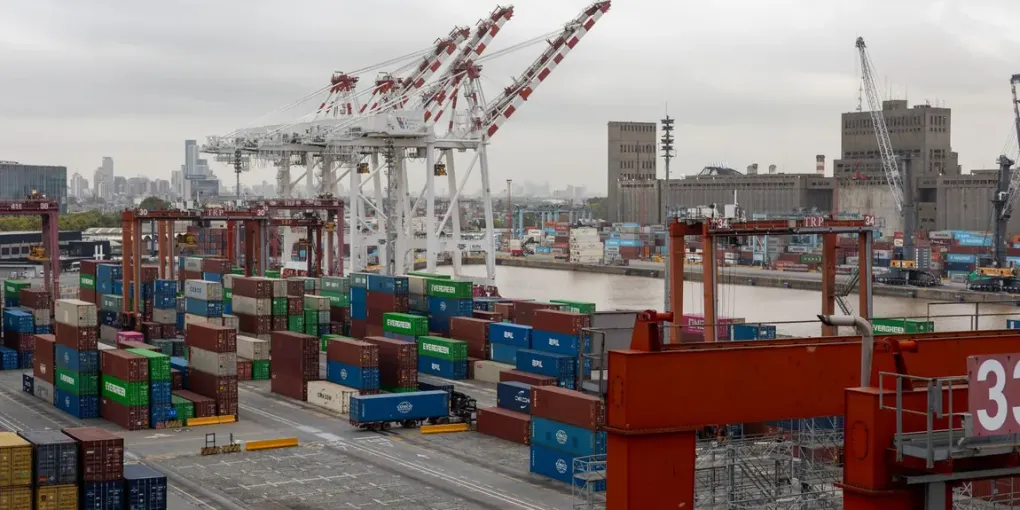
The quote in front of the importer in Avellaneda looks like an easy decision: $2,980 for a 20ft, $4,250 for a 40ft High Cube. Same supplier, same sailing, both to Buenos Aires. He books the 20ft and saves $1,270 — and then pays about $1,900 more per cubic metre of cargo than the importer three doors down who took the 40HQ.
That gap is not a rate problem. It is a container-size decision made on the headline number instead of on capacity. This guide prices the 20ft and 40ft container cost from China to Argentina box by box — Q4 2026 rates per origin port, what each container physically carries once a pallet is in it, the Argentine tax stack that applies to the CIF value, and the demurrage clock at Buenos Aires that quietly outruns the freight discount. It draws on 15 years of forwarding practice at Dantful.US International Logistics. If you are still choosing a mode rather than a box, start with our shipping from China to Argentina overview.
20ft and 40ft Container Shipping Cost from China to Argentina: Q4 2026 Rates by Origin Port
These are all-in port-to-port ocean ranges for Q4 2026 — ocean freight plus BAF/CAF — before origin charges in China, Argentine terminal charges and Argentine tax.
| Origin → Argentine port | 20ft (20GP) | 40ft (40GP) | 40ft High Cube (40HQ) |
|---|---|---|---|
| Shanghai → Buenos Aires | $2,250–$3,000 | $3,000–$4,300 | $3,150–$4,500 |
| Shenzhen (Yantian / Shekou) → Buenos Aires | $2,250–$3,000 | $3,000–$4,300 | $3,150–$4,500 |
| Ningbo (Beilun) → Buenos Aires | $2,300–$3,050 | $3,050–$4,350 | $3,200–$4,550 |
| Guangzhou (Nansha) → Buenos Aires | $2,300–$3,050 | $3,050–$4,350 | $3,200–$4,550 |
| Qingdao → Buenos Aires | $2,450–$3,250 | $3,200–$4,550 | $3,350–$4,750 |
| Shanghai → La Plata (TecPlata) | $2,350–$3,100 | $3,100–$4,400 | $3,250–$4,600 |
| Shanghai → Zárate / Rosario (river) | $2,400–$3,150 | $3,150–$4,450 | $3,300–$4,650 |
Two things about this table matter more than the numbers. First, the spread between origins is small — $200 on a 20ft from Shanghai to Qingdao — while the spread between box types per unit of cargo is 30–40%. Importers spend their negotiating energy in the wrong place. Second, the ranges are wide on purpose: a standard booking settles in the lower half, while a peak-season spot booking with guaranteed equipment and a fixed sailing reaches $5,400 on a 40HQ. Ask for a 3–4 week validity window, and ask explicitly whether BAF/CAF is already inside the number.
Q4 2026 note: South Atlantic capacity has eased since the 2024–2025 disruptions, but August–December peak surcharges still add 10–20% to base rates, and the pre-Lunar New Year rush (late January) starts pulling equipment in December. Booking 3–4 weeks out is the single cheapest habit on this lane.
20ft vs 40ft vs 40HQ Container to Argentina: What Each Box Actually Carries
| Spec | 20ft (20GP) | 40ft (40GP) | 40ft High Cube (40HQ) |
|---|---|---|---|
| Internal dimensions | 5.90 × 2.35 × 2.39 m | 12.03 × 2.35 × 2.39 m | 12.03 × 2.35 × 2.69 m |
| Geometric interior volume | ~33 CBM | ~67 CBM | ~76 CBM |
| Usable volume after stowage | ~28 CBM | ~58 CBM | ~68 CBM |
| Tare weight | ~2.2 t | ~3.8 t | ~3.9 t |
| Max gross (equipment rating) | 30.48 t | 30.48–32.5 t | 30.48–32.5 t |
| Practical cargo cap in Argentina | 26–27 t | 25–26 t | 25–26 t |
| Pallet americano (1.2 × 1.0 m) | 9–10 | 20–21 | 20–21 |
| Euro pallet (1.2 × 0.8 m) | 11 | 23–25 | 23–25 |
| Best cargo profile | 15–28 CBM, or dense and heavy | 28–58 CBM, mixed SKUs | 55–68 CBM, bulky and light |
The Argentine pallet convention is worth knowing before you book: the 1.2 × 1.0 m “pallet americano” is the default here, not the 1.2 × 0.8 Euro pallet used in Europe and much of Asia. That 20 cm difference costs you three pallet positions in a 40ft. If your Chinese supplier palletises to Euro dimensions because the last buyer was German, a 40ft that should take 25 pallets takes 21.
Two further lines in the table cause most of the trouble on this lane.
Usable versus geometric volume. Nobody loads 33 CBM into a 20ft. Pallets, dunnage, door clearance and the last metre of unusable height eat 10–15% of the interior, and once you load by pallet rather than by loose carton the real figure is closer to 25–26 CBM.
The practical 26-tonne ceiling. Argentina’s national road law caps a road train at 45 tonnes gross and 10.5 tonnes per axle, and the Buenos Aires–Córdoba and Buenos Aires–Mendoza corridors are routinely weighed at peaje scales. A standard tractor-trailer therefore runs at 26–27 tonnes of cargo on a 20ft and slightly less on a 40ft, whose own tare is heavier. Anything above that needs a special permit — which is a decision made before loading, not a conversation you want to have at the terminal gate.
Density, not volume, should pick the box:
| Cargo | Typical density | Box to book |
|---|---|---|
| Furniture, packaging, apparel, plastics | 120–200 kg/CBM | 40HQ — fill it and keep filling |
| Appliances, hardware, auto parts, toys | 300–500 kg/CBM | 40GP |
| Ceramic tile, sanitaryware, stone | 1,200–1,800 kg/CBM | 20GP — weight-limited at ~18 CBM, not 28 |
| Steel, machinery, castings | 2,000+ kg/CBM | 20GP, or two, with VGM checked early |
That third row is the most expensive mistake in Argentine importing. A 20ft of porcelain tile from Foshan reaches the road-weight ceiling at roughly 18 CBM, so the “28 CBM” you were quoted is not available to you — and if you booked a 40HQ for tile, you will pay for 68 CBM and legally load about 14 tonnes, barely a fifth of the box.
Cost per CBM and per Pallet from China to Argentina: Which Container Wins
Dividing the ocean rate by what the box actually holds changes the ranking immediately, and it is the only comparison that survives contact with a real quote:
| Option | What you are buying | Q4 2026 rate | Cost per CBM | It wins when |
|---|---|---|---|---|
| LCL | shared space, 1 CBM minimum | $95–$185 per CBM | $95–$185 | under ~15 CBM |
| 20ft (20GP) | ~28 CBM exclusive | $2,250–$3,000 | $80–$107 | 15–28 CBM, or dense cargo |
| 40ft (40GP) | ~58 CBM exclusive | $3,000–$4,300 | $52–$74 | 28–58 CBM |
| 40ft High Cube (40HQ) | ~68 CBM exclusive | $3,150–$4,500 | $46–$66 | 55–68 CBM, bulky and light |
Then add the fixed charges, which are billed per container and not per CBM: Argentine terminal handling, delivery order and documentation at Buenos Aires run $550–$800 whether the box is 20ft or 40ft. That is $20–$29 per CBM on a 20ft and $9–$14 on a 40ft, so the fixed block doubles the 40ft’s advantage before a single peso of duty is calculated.
Two 20ft Containers or One 40ft to Argentina?
| Option for 55 CBM | Ocean freight | Destination charges | Total before duty |
|---|---|---|---|
| Two 20ft containers | $4,900 | ~$1,300 | $6,200 |
| One 40ft container | $3,300 | ~$700 | $4,000 |
One 40ft is about $2,200 cheaper for the same cargo, produces one customs file instead of two, and clears through one despachante instead of two. Four situations genuinely justify two 20ft boxes: cargo above the 26-tonne road limit, two consignees or two distant destinations, production halves that cannot be pulled together, and cargo that must not share air — food-grade goods, fumigated timber, or anything with a strong odour.
How Many Pallets Fit, and What That Costs
A 40HQ at $3,150–$4,500 carrying 20 pallets americano works out at $158–$225 per pallet excluding destination and duty. The same 40HQ filled with 25 Euro pallets drops to $126–$180 per pallet. Neither number belongs in a negotiation until you have confirmed which pallet standard your factory actually builds to — and if the answer is “loose cartons”, ask the supplier to quote a palletised loading plan before you choose between a 40GP and a 40HQ. If you need to convert carton dimensions into chargeable volume first, run them through our Volumetric Weight Calculator.
Container Shipping to Argentina After the Port: Mercosur Duty, IVA 21% and No China FTA
Argentina’s tax stack is charged on the CIF value — and on this lane, CIF includes your ocean freight. That single detail has a consequence most guides miss: every dollar of freight you pay is taxed twice, once by duty and again by IVA. A $400 saving on ocean freight is really a $590 saving after Argentine tax.
| Charge | Basis | Q4 2026 rate |
|---|---|---|
| Import duty (arancel, Mercosur CET) | CIF | 0–35%; most consumer goods 14–20%, electronics 14–16%, textiles up to 35%, capital goods 0–14% |
| Statistics fee (tasa de estadística) | CIF | 3% |
| IVA | CIF + duty + fee | 21% (10.5% reduced rate on a few categories) |
| IVA perception (advance) | CIF + duty + fee | 10–20%, creditable against your VAT return |
| Income tax perception (Ganancias) | CIF + duty + fee | 6–11%, creditable for registered importers |
| Provincial turnover tax (IIBB) | CIF + duty + fee | ~2–3% in Buenos Aires province, creditable |
Clearing is handled by a licensed despachante de aduana filing through the customs system MARÍA, with the shipment declared for import and released once the VEP payment posts and customs grants the levante. Since the 2024 deregulation the old SIRA licence regime is gone — most goods no longer need prior approval — but HS classification, NCM codes and the declared value are checked hard, and a misclassified NCM is the most common reason a container sits.
Worked Example: The Same Cargo in a 20ft and a 40HQ
| Line | 20ft of tile and hardware | 40HQ of furniture and appliances |
|---|---|---|
| FOB value | $16,000 | $34,000 |
| Ocean freight (Shanghai → Buenos Aires) | $2,450 | $3,900 |
| Insurance | $90 | $185 |
| CIF value | $18,540 | $38,085 |
| Duty at 16% / 18% | $2,966 | $6,855 |
| Statistics fee 3% | $556 | $1,143 |
| IVA 21% on CIF + duty + fee | $4,633 | $9,677 |
| Total Argentine tax | $8,156 (44% of CIF) | $17,675 (46% of CIF) |
| Landed at your Buenos Aires warehouse | $27,346 | $56,460 |
Read the last row against the CIF row and the lesson is that freight is not where the money goes. Tax is 44–46% of the cargo value, and it scales with the value of what you import, not with the box. That is precisely why the 40HQ wins on volume: the fixed $550–$800 of terminal charges spread across 68 CBM instead of 28, and the same tax percentage sits on a lower freight-per-CBM base.
The China–Argentina FTA that does not exist. There is no free trade agreement between China and Argentina in force, and none imminent. Standard Mercosur CET duty applies to Chinese-origin goods. If you import similar goods into Chile you pay 0% with a Form F certificate; on the Argentine lane there is no equivalent document, and any supplier or forwarder telling you otherwise is working from 2018-era content. The nearest legitimate saving is correct NCM classification, which can move duty several points.
If you would rather not run this stack yourself, a DDP door-to-door quote folds freight, clearance, duty, IVA and delivery into one price — but door to door is the service and DDP is the Incoterm; under DAP you keep paying the Argentine duty yourself. Confirm which term a quote is written on before you compare it with a port-to-port rate.
Shipping Time from China to Argentina by Container: Buenos Aires, Zárate, Rosario or La Plata
| Origin → destination | At-sea transit | Typical frequency |
|---|---|---|
| Shanghai → Buenos Aires | 32–42 days | weekly direct |
| Shenzhen (Yantian) → Buenos Aires | 32–42 days | weekly direct |
| Ningbo → Buenos Aires | 34–43 days | weekly direct or via transshipment |
| Qingdao → Buenos Aires | 37–47 days | fortnightly |
| Any origin → La Plata (TecPlata) | 33–43 days | 1–2 direct calls weekly |
| Buenos Aires → Zárate (river leg) | +2–3 days | feeder or barge |
| Buenos Aires → Rosario (river leg) | +3–5 days | feeder or barge |
The port decision is where a cheap ocean rate can be wasted. Buenos Aires absorbs roughly 80% of Argentina’s containerised imports through five terminals on the city waterfront — Terminales Río de la Plata (terminals 1–3) plus Terminal 4 — with Exolgan across the Riachuelo in Dock Sud handling a large share of the deep-sea calls. Draft in the access channel limits how heavily vessels can load, so carriers often exchange cargo at Montevideo or Santos before the final leg.
TecPlata in La Plata, 60 km downriver, takes direct Asian calls with less city congestion and usually discharges a day or two faster; it is the better door for La Plata, Berazategui and the southern industrial belt, and a worse one for the north of Greater Buenos Aires. Zárate, 90 km upriver, and Terminal Puerto Rosario, 300 km up the Paraná, serve the agricultural and industrial interior — but vessels reach them only within the river’s draft limits, so cargo is frequently relayed from Buenos Aires or Montevideo, and you should add the river days to whatever transit the carrier publishes.
Ask for the transshipment port in writing. A 30-day quote that transships at Santos routinely becomes 40, and on a fortnightly northern-China service a missed connection costs a full rotation.
Free Time and Demurrage in Buenos Aires, Argentina: The Container Cost Nobody Quotes
This is the line item that erases a $500 freight saving in a week. Argentine terminals typically grant 5–7 free days from discharge, counted from vessel arrival — not from the day your documents are ready.
| Charge | When it starts | Typical Q4 2026 cost |
|---|---|---|
| Terminal storage / demurrage (dry box) | after 5–7 free days | $60–$120 per container per day, escalating |
| Container detention (empty not returned) | after free time, or after gate-out plus 5–7 days | $40–$90 per container per day |
| Fiscal warehouse (depósito fiscal) storage | when the container leaves the terminal before release | $18–$40 per CBM per week |
| Document amendment / re-inspection | on a wrong NCM or invoice mismatch | $120–$450 per file |
Three habits keep you inside the free window. Start the despachante before the vessel sails, not on the arrival notice — the MARÍA filing needs the commercial invoice, packing list, bill of lading and certificate of origin, and a supplier who corrects an invoice three days after arrival has already burnt half your free time. Budget the VEP payment in advance: the levante comes after the payment posts, and a Friday discharge with a Monday payment is two free days gone. And for cargo you cannot clear quickly, price the depósito fiscal option — moving the box out of the terminal into a fiscal warehouse stops terminal demurrage at a fraction of the daily rate.
One more Argentine quirk: because the country exports far more tonnage than it imports in containerised terms on some corridors, southbound dry equipment is usually available — the constraint is sailing frequency, not boxes. On a fortnightly service, a one-week delay in your supplier’s readiness is a two-week delay in arrival.
When a Container Is the Wrong Answer: LCL and Air Freight Costs from China to Argentina
Under about 15 CBM, LCL usually beats an exclusive box, even with its slower consolidation:
| Volume | LCL at $95–$185 per CBM | 20ft equivalent | Better choice |
|---|---|---|---|
| 5 CBM | $475–$925 | ~$2,250+ | LCL |
| 12 CBM | $1,140–$2,220 | ~$2,250+ | LCL, or 20ft if heavy |
| 18 CBM | $1,710–$3,330 | ~$2,250–$3,000 | Depends on density — price both |
| 25 CBM | $2,375–$4,625 | ~$2,250–$3,000 | FCL 20ft |
LCL is billed on chargeable weight — the greater of volume and weight at 1 CBM = 1,000 kg — so a dense pallet of hardware pays for far more than the space it occupies, and LCL loses its advantage fast once density rises.
Air freight lands at Ezeiza (EZE) in Buenos Aires, with Córdoba (COR) and Mendoza (MDZ) as secondary gateways:
| Weight tier | Q4 2026 rate (USD/kg) | Transit |
|---|---|---|
| 45–100 kg | $5.4–$8.0 | 5–10 days |
| 100–300 kg | $4.8–$7.4 | 5–10 days |
| 300–500 kg | $4.3–$6.8 | 5–9 days |
| 500+ kg | $4.0–$6.2 | 5–9 days |
| Express courier (DHL/FedEx/UPS) | $9–$15 | 3–6 days |
Air is charged on chargeable weight at a divisor of 6000 — length × width × height in cm ÷ 6000 — so a light, bulky carton can bill at double its actual weight. Keep packaging dense, and use air for first trial orders, urgent restocks, spare parts and high-value electronics; switch to a container the moment volume justifies it. Our air freight from China to Argentina guide covers the EZE clearance and ARCA side in detail.
How to Cut Your 20ft or 40ft Container Cost from China to Argentina
- Book the box that matches your density, not your instinct. Tile and stone belong in a 20ft at ~18 CBM; furniture belongs in a 40HQ at 60+ CBM. Getting this wrong is a $1,500–$2,500 error, not a rounding difference.
- Load pallets to the Argentine standard. A 1.2 × 1.0 m pallet plan recovers three positions in a 40ft that a Euro plan wastes.
- Treat freight as a dutiable cost. Every $100 saved on ocean freight also saves $16–$20 of duty and $24–$29 of IVA, because Argentina taxes CIF.
- Use La Plata when your warehouse is south. TecPlata’s direct calls avoid Buenos Aires city congestion and usually discharge faster.
- Start clearance before arrival. Five to seven free days disappear quickly when the invoice is wrong.
- Check the sailing, not just the rate. On a fortnightly northern-China service, a cheaper quote that misses the connection costs more than the premium on the weekly one.
- Compare three quotes line by line. Ask every forwarder to split ocean freight, origin charges, destination charges and documentation. Our how much is shipping from China to Argentina guide shows what belongs in each line, and the China to Brazil container guide applies the same discipline on the region’s largest lane.
Before you commit, sanity-check any quote against your own cargo with our Freight Cost Calculator — it turns box type, volume and destination into a starting price you can hold a forwarder to.
Frequently Asked Questions About Container Costs from China to Argentina
How much does a 20ft container cost from China to Argentina in Q4 2026?
Port to port, a 20ft from Shanghai or Shenzhen to Buenos Aires runs $2,250–$3,000, and $2,450–$3,250 from Qingdao. Origin charges in China, Argentine terminal charges of $550–$800 per container, duty and IVA are additional.
How much does a 40ft container cost, and is the 40HQ worth the premium?
A 40GP runs $3,000–$4,300 and a 40HQ $3,150–$4,500 — an 8% premium for roughly 10 CBM more usable volume. If your cargo is light and bulky, the 40HQ is the cheapest space on the lane at $46–$66 per CBM.
Is it cheaper to ship two 20ft containers or one 40ft to Argentina?
One 40ft, by about $2,200 for 55 CBM, plus one customs file instead of two. Two 20ft boxes only win above the 26-tonne road limit, for two separate consignees, or for cargo that must not share a container.
How long does a container take from China to Argentina?
32–42 days at sea from Shanghai, 34–43 from Ningbo, 37–47 from Qingdao. Add 3–5 days for river terminals and 3–6 days for clearance and trucking — realistically 40–50 days door to door. See our how long does it take to ship from China to Argentina breakdown for the port-by-port version.
What taxes apply to my container?
Mercosur CET duty of 0–35% (most consumer goods 14–20%), a 3% statistics fee, and 21% IVA on CIF plus duty plus fee, plus creditable perceptions for IVA and income tax. Around 44–46% of the CIF value in total on typical consumer goods, and there is no China–Argentina FTA to reduce it.
How much demurrage will I pay at Buenos Aires?
Free time is typically 5–7 days from discharge. After that, dry-container demurrage runs $60–$120 per day, and empty-container detention adds $40–$90 per day. A fiscal warehouse at $18–$40 per CBM per week for cargo you cannot clear quickly often beats terminal demurrage.
Get a 20ft or 40ft Container Quote for Argentina
Argentina is a market where the box choice, the CIF tax base and the free-time clock decide your landed cost far more than the ocean rate does. Q4 2026 rates are the most workable they have been in two years — 20ft from $2,250, 40HQ from $3,150 to Buenos Aires — and the importers who win are the ones who match the box to the cargo and start clearance before the vessel arrives.
Ready to ship? Contact Dantful.US for a free, itemised 20ft or 40ft quote from any Chinese port to Buenos Aires, La Plata, Zárate or Rosario — with terminal charges, duty and IVA shown as separate lines, not folded into one number.