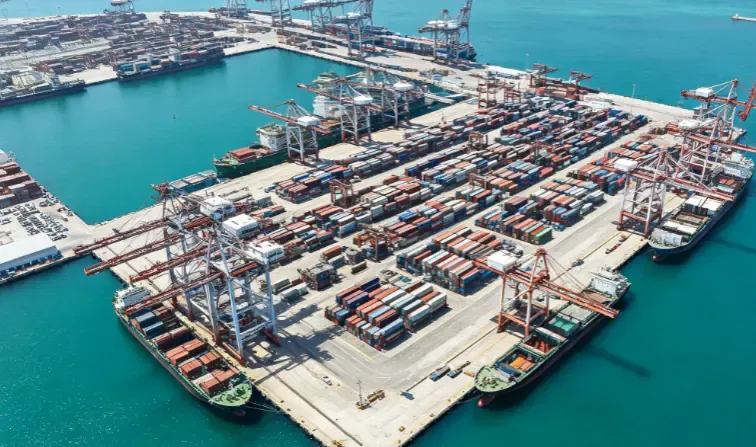
Shenzhen exports more to Latin America than any other Chinese city, and the reason is not the port — it is what sits behind it. Huaqiangbei alone supplies a large share of the phone accessories, chargers and LED modules sold across the Caribbean, while Baoan, Longgang and Guangming hold the factories that build power banks, drones, e-scooters and solar kits. That cargo profile is what makes shipping from Shenzhen to Venezuela a different problem from loading ceramics in Foshan or machinery in Shanghai: a large part of it contains lithium cells, which decides whether it flies, sails, or never leaves the warehouse at all.
Venezuela adds the second constraint. No carrier sails China–Venezuela direct, every box relays through Panama, Kingston, Cartagena or a Mediterranean hub, and the destination applies one of the heaviest tax stacks in South America once IVA and the foreign-currency tax are counted. This guide covers Q4 2026 rates out of Yantian and Shekou, the real transit numbers by relay port, air freight from SZX against the Hong Kong option, the dangerous-goods rules for batteries, and the SENIAT clearance mechanics. For the country-level overview, start with our shipping from China to Venezuela hub.
Shipping from Shenzhen to Venezuela: Yantian, Shekou and the Panama Relay
Shenzhen has two working terminals and neither is a formality. Yantian (CNYTN) is the deep-water mainline facility on the eastern side of the city, one of the largest single container terminals in the world, and the terminal that most Asia–South America and Caribbean strings actually call. Shekou (CNSHK), on the western side, is smaller, sits minutes from Baoan and Nanshan factories, handles more feeders, barges and intra-Asia traffic, and is where most LCL consolidation in Shenzhen happens.
| Loading point | Best for | Trade-off |
|---|---|---|
| Yantian | FCL to South America and the Caribbean; the largest carrier allocations | 60–90 minutes from western Shenzhen factories; earlier cut-off pressure in peak weeks |
| Shekou | LCL groupage, Baoan/Nanshan/Dongguan suppliers, smaller FCL bookings | Fewer direct mainline calls; more cargo relays twice |
| Chiwan / Da Chan Bay | Selected strings and project cargo | Used when the booking or cut-off requires it |
| Hong Kong (Kwai Tsing) | Air-sea combinations and cargo that must fly from HKG | Cross-border trucking and a separate export declaration |
On the Venezuelan side there is no direct call at all, so the relay port is a decision you should see in writing on the quote:
| Relay | Feeder into | Notes |
|---|---|---|
| Balboa / Cristóbal (Panama) | Puerto Cabello, La Guaira | The most common routing; weekly feeders, best frequency |
| Kingston (Jamaica) | La Guaira, Puerto Cabello | Common on Caribbean strings; can add 2–4 days |
| Cartagena (Colombia) | Puerto Cabello | Good for cargo consolidated with Colombian volumes |
| Mediterranean hub (Algeciras, Valencia) | La Guaira | Cheapest on some weeks, but 45–62 days door to door |
The destination port matters as much as the origin one. Puerto Cabello handles the bulk of containerised imports and feeds Valencia, Maracay and the industrial interior. La Guaira is closest to Caracas but has less yard capacity and suffers more when clearance slips. If your consignee is not in Greater Caracas, Puerto Cabello is usually the safer nomination, because a bigger yard absorbs a delayed clearance instead of billing you storage. Suppliers in Guangzhou or Foshan should also compare loading at Nansha — our shipping from Guangzhou to Venezuela guide prices that alternative.
Shenzhen to Venezuela Shipping Cost: Q4 2026 FCL, LCL and Air Rates
These are realistic Q4 2026 all-in rates to La Guaira or Puerto Cabello — ocean freight, origin THC and documentation included, Venezuelan duties, IVA and IGTF excluded:
| Shenzhen → La Guaira / Puerto Cabello | Q4 2026 rate |
|---|---|
| 20ft FCL (20GP) | $1,900–$4,100 |
| 40ft FCL (40GP) | $2,650–$5,200 |
| 40ft FCL high cube (40HC) | $2,800–$5,450 |
| LCL, per CBM | $120–$290 |
| Air freight from SZX, per kg | $5.0–$10.5 |
| Express courier, per kg | $11–$20 |
The spread on FCL is wide because the lane has no direct service: the same box costs materially more if it relays twice, if it waits four days at Balboa for a feeder, or if the carrier applies a peak-season surcharge in the weeks before Christmas. Ask for the relay port and the rate validity date, not just the number. Our freight cost calculator gives a starting figure for a specific weight and volume before you request quotes.
LCL wins below roughly 10–12 CBM on this lane, and the reason is specific to Venezuela: destination charges at Puerto Cabello and La Guaira are high relative to other South American ports, so a small LCL consignment can pay almost as much in destination fees as in ocean freight. Expect a $40–$95 consolidation charge at the Shenzhen CFS plus deconsolidation and terminal handling in Venezuela. Above 15 CBM, a 20ft container is usually cheaper even when it sails half empty — the container shipping from China to Venezuela guide compares the box sizes directly.
Q4 2026 reality check. Caribbean feeder capacity tightens from October as reefer and consumer-goods volumes build toward December. Rates hold, but space on the Panama and Kingston relays fills. Book three to four weeks ahead if the cargo must arrive before mid-December, and confirm whether the quote includes the feeder leg or only the ocean leg — on this lane that single line item is where quotes diverge most.
Sea Freight Transit Time from Shenzhen to Venezuela: 30–46 Days Through Panama or Kingston
Transit on this lane is a sum of four parts, and a quote that gives one number is hiding three of them:
| Routing | Ocean to relay | Feeder and port time | Clearance and delivery | Door-to-door |
|---|---|---|---|---|
| Yantian → Balboa/Cristóbal → Puerto Cabello | 24–30 days | 3–6 days | 3–6 working days | 32–42 days |
| Yantian → Kingston → La Guaira | 26–32 days | 4–7 days | 3–6 working days | 34–45 days |
| Yantian → Cartagena → Puerto Cabello | 26–32 days | 4–6 days | 3–6 working days | 34–44 days |
| Yantian → Mediterranean hub → La Guaira | 38–48 days | 5–8 days | 3–6 working days | 45–62 days |
| LCL groupage, any routing | 24–32 days | +4–8 days consolidation | 3–8 working days | 38–52 days |
| Air freight from SZX | 3–5 days | — | 2–4 days | 5–9 days |
Two things push the real date past the quoted one. First, feeder frequency: a vessel that arrives at Balboa on a Thursday may wait until the following Tuesday for the Puerto Cabello feeder, and no carrier prices that waiting into the transit time. Second, SENIAT inspection — a red-channel declaration can hold a container for a week while the invoice value is verified. Our how long does it take to ship from China to Venezuela guide breaks the timeline down segment by segment, including the pre-clearance steps that run while the box is still at sea.
For planning, work backwards. If the goods must be on shelves for a December campaign, the container needs to leave Yantian by the middle of November, which means booking in the third week of October and having the SENIAT pre-declaration filed before the vessel sails.
Air Freight from Shenzhen to Venezuela: SZX or Hong Kong, Rates and Chargeable Weight
No freighter flies Shenzhen–Venezuela non-stop. Cargo from SZX connects through Miami (MIA), Panama (PTY), Bogotá (BOG), Madrid (MAD) or Lisbon (LIS) into Maiquetía (CCS), with Valencia (VLN) and Maracaibo (MAR) served by domestic uplift. Hong Kong (HKG) has deeper freighter capacity on the Atlantic and Latin American lanes, but moving mainland cargo across the boundary adds a separate export declaration and 1–2 days.
| Service from SZX | Rate | Door-to-door transit |
|---|---|---|
| Consolidated air, 45–100 kg | $8.5–$10.5 per kg | 7–9 days |
| Consolidated air, 100–300 kg | $6.8–$9.2 per kg | 5–8 days |
| Consolidated air, 300–500 kg | $5.8–$8.2 per kg | 5–7 days |
| Blocked space, 500–1,000 kg | $5.3–$7.6 per kg | 5–7 days |
| Blocked space, 1,000 kg+ | $5.0–$7.0 per kg | 5–7 days |
| Express courier (DHL/FedEx/UPS) | $11–$20 per kg | 4–8 days |
Airlines bill the greater of actual and volumetric weight, at length × width × height in centimetres ÷ 6000. The classic Shenzhen case: a carton of 60 × 50 × 40 cm measures 120,000 ÷ 6000 = 20 kg chargeable, so a shipment of phone cases weighing 11 kg actual bills at 20 kg — nearly double. Check the numbers before you compare air against sea, using our volumetric weight calculator. Dense cargo — chargers, tools, metal fittings, battery packs — bills at actual weight and flies efficiently; packaging, cases and LED panels do not.
Venezuela also restricts some air imports by product category, and the consignee must hold an active RIF before the airline will release. Our air freight from China to Venezuela guide covers the hub routings and the airport-side documentation in more detail.
Lithium Batteries and Power Banks from Shenzhen to Venezuela: What Can Fly and What Must Sail
This is the section most Shenzhen exporters actually need, and the one competitors skip. Shenzhen is the world’s largest source of power banks, e-scooters, drones, solar storage and battery-containing electronics, and every one of those products is regulated dangerous goods.
- Classification. Loose lithium-ion cells and power banks are UN3480; batteries packed with equipment or contained in equipment are UN3481. Lithium metal cells — coin cells, some remote controls — are UN3090/UN3091. The class is 9 either way, and the packing instruction changes with the state of charge and the watt-hour rating.
- Documents you must have. A UN38.3 test report from the cell manufacturer, an MSDS, a DG declaration completed by a trained shipper, and packaging that meets the relevant packing instruction. Without UN38.3 the cargo does not move, by air or by sea, no matter what the forwarder promises.
- Air is stricter than sea. For UN3480 by air, IATA rules require a state of charge of 30% or less and forbid loose cells in passenger aircraft. Most express couriers refuse loose power banks outright; equipment with installed batteries (UN3481) is normally accepted. Budget a higher rate and an extra 1–2 days for DG acceptance checks.
- Sea is the practical route for volume. Carriers accept class 9 under IMDG with a DG booking, a container packing certificate and often a stowage restriction away from heat sources. Expect a DG surcharge of $150–$450 per container and a booking lead time of 10–14 days, because DG slots are limited per vessel and per relay.
- Declare it. Undeclared batteries found in a container at Balboa or Puerto Cabello lead to the whole box being held, fined or returned at the shipper’s cost, and the consignee’s customs record suffers. On a lane where clearance already takes 3–6 working days, a DG hold can add three weeks.
Products without cells — cables, phone cases, LED strips, metal hardware, solar mounting — carry none of this and should not be quoted at DG rates. Mixing them into a DG booking only raises the cost of the whole consignment.
Venezuela Customs Clearance for Shenzhen Cargo: SENIAT, 16% IVA and 3% IGTF
Venezuelan customs is administered by SENIAT, through its Aduanas division, with declarations filed electronically in SIDUNEA by a licensed customs agent (agente aduanal). The importer must be registered with a valid RIF and appear as the consignee of record; a foreign buyer using a Venezuelan agent as importer of record shifts both the tax liability and the compliance risk to that agent, which is why the arrangement needs to be explicit.
The tax stack is what surprises first-time importers:
| Charge | Base | Typical rate |
|---|---|---|
| Arancel (import duty) | CIF value | 0–35%, commonly 10–20% on consumer goods and machinery |
| IVA | CIF + duty | 16% |
| IGTF | Payments settled in foreign currency | 3% |
There is no China–Venezuela free trade agreement, so Shenzhen goods pay the general tariff with no preference to claim. Classification is done on the NANDINA tariff, and the code decides both the duty rate and whether a permit applies. Electronics, telecoms equipment and radio devices can require CONATEL authorisation; food, cosmetics and medicines need health registration; and used machinery is treated differently from new.
Worked example — 8 CBM of LED lighting, LCL from Shekou to Puerto Cabello:
| Line | Amount |
|---|---|
| FOB Shenzhen | $12,000 |
| LCL freight, 8 CBM at ~$185 including origin charges | $1,480 |
| Marine insurance | $80 |
| CIF value | $13,560 |
| Import duty at 14% | $1,898 |
| IVA 16% on $15,458 | $2,473 |
| IGTF 3% on the foreign-currency payment | $538 |
| Agent, terminal handling and inland delivery | $690 |
| Landed cost in Puerto Cabello | $19,160 (+60% over FOB) |
The taxes — not the freight — are 26% of the landed cost here, and they are charged on a CIF value your invoice controls. That is why invoice accuracy matters more on this lane than rate shopping, and why an under-declared value is a bad trade: SENIAT can re-value the cargo, apply penalties and hold the container while it does.
Documents to have ready before the vessel arrives: commercial invoice, packing list, bill of lading, certificate of origin, insurance certificate, RIF of the consignee, the agent’s power of attorney, and product-specific permits where applicable. Missing one document at Puerto Cabello costs storage in dollars per day.
Door to Door Shipping from China to Venezuela: DDP vs DAP and Who Pays the Duty
Door to door is a service, not an Incoterm: the forwarder collects at the supplier in Shenzhen and delivers to the consignee’s address in Venezuela. How that service is quoted depends on the term underneath it, and the difference is who pays the Venezuelan duty, IVA and IGTF.
| Term | Freight to door | Venezuelan duties and taxes | Best when |
|---|---|---|---|
| DDP (Delivered Duty Paid) | Included | Included in the all-in price, paid by the forwarder | You want one landed number and no local tax registration |
| DAP (Delivered at Place) | Included | Paid by the consignee on arrival | The consignee has a RIF and an agent and wants the tax credit |
| Port to port | To the port only | Consignee’s responsibility | You have your own clearance partner in Venezuela |
Most Shenzhen e-commerce sellers shipping to Venezuela choose DDP because it converts an unpredictable tax bill into a fixed cost per kilo or per CBM. The trade-off is that DDP pricing is only as reliable as the forwarder’s declared value — if the shipment is later re-valued, someone absorbs the difference, and it will not be the customs service. Ask which term the quote is on, in writing, and whether the IGTF is inside it. Our door to door shipping from China to Venezuela guide compares the DDP and DAP cost structures line by line.
How to Lower the Cost of Shipping from Shenzhen to Venezuela
| Strategy | Typical saving | What to watch |
|---|---|---|
| Load at the terminal nearest the supplier (Shekou for Baoan/Dongguan, Yantian for Longgang and eastern Shenzhen) | $150–$380 per container | The sailing must still meet your deadline |
| Consolidate LCL shipments into one booking | $200–$600 | Watch the destination fees, which are high in Venezuela |
| Split a battery shipment: electronics by air, cells by sea | 20–35% on mixed orders | Requires two bookings and separate DG documents |
| Nominate Puerto Cabello instead of La Guaira for interior consignees | $200–$500 plus 2–4 days | Confirm feeder availability first |
| Choose a single-relay routing over a Mediterranean one | 10–15 days | Check the rate validity date |
| Pre-file the SENIAT declaration while the box is at sea | Avoids storage, not rate | Needs complete documents 2–3 weeks out |
| Book 3–4 weeks ahead for November and December sailings | Avoids PSS and rollover fees | Locks in the sailing date |
None of these are tricks. On the Shenzhen–Venezuela lane the two decisions that move money most are made before the container is packed: which terminal loads it, and whether the battery content forces it onto a slower, more expensive DG booking.
Frequently Asked Questions
How much does it cost to ship from Shenzhen to Venezuela in Q4 2026?
In Q4 2026 a 20ft container from Yantian or Shekou to La Guaira or Puerto Cabello runs $1,900–$4,100 all-in to port, a 40ft $2,650–$5,200 and a 40ft HQ $2,800–$5,450, excluding Venezuelan import taxes. LCL is $120–$290 per CBM, air freight from SZX is $5.0–$10.5 per kg and express couriers charge $11–$20 per kg.
How long does shipping from Shenzhen to Venezuela take?
Sea freight takes 32–46 days door to door on a Panama or Kingston relay: 2–4 days for loading and export clearance, 28–38 days sailing plus transshipment, and 3–6 working days for SENIAT clearance and trucking. Mediterranean routings run 45–62 days. Air freight from SZX delivers in 5–9 days door to door.
Should I load my container at Yantian or Shekou?
Yantian is the deep-water mainline terminal and carries the large South America and Caribbean strings, so it is the default for FCL. Shekou is closer to Baoan, Nanshan and Dongguan factories and is where most LCL consolidation happens. The container yard cut-off, which closes 24–48 hours before sailing, usually decides the question.
Can I ship lithium batteries and power banks from Shenzhen to Venezuela?
Yes, as declared dangerous goods. Power banks and loose cells are UN3480, batteries in or with equipment are UN3481, and every shipment needs a UN38.3 report, an MSDS, DG packing and a carrier that accepts class 9. Many couriers refuse loose power banks by air; volume moves by sea with a DG booking and a $150–$450 surcharge per container.
What import taxes does Venezuela charge on goods from Shenzhen?
Venezuela applies its national tariff, with rates reaching 35% and most consumer goods and machinery between 10% and 20% of CIF. IVA at 16% is charged on CIF plus duty, and the IGTF of 3% applies to payments settled in foreign currency. There is no China–Venezuela free trade agreement.
Get a Shenzhen to Venezuela Shipping Quote in 24 Hours
Shenzhen cargo to Venezuela fails on two things: a battery declaration that was never made, and a relay port nobody named in writing. Both are settled before the container leaves the yard. Tell us what the goods are — and specifically whether they contain cells — which district your supplier is in, the volume or weight, and the delivery city, and we will quote the terminal, the relay port and the clearance basis by name.
Contact Dantful.US for a free, itemised Shenzhen–Venezuela quote within 24 hours.