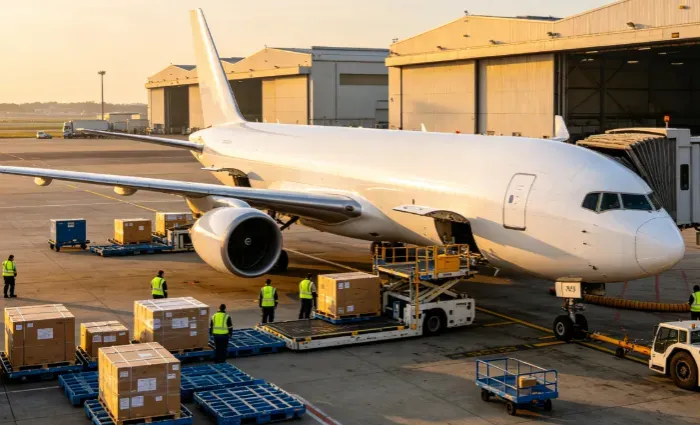
Two events in 2026 rewrote what it costs and how long it takes to fly cargo from China to Venezuela. The first was the 24 June double earthquake of magnitude 7.2 and 7.5 that damaged the runway and terminal at Simón Bolívar International Airport (CCS) in Maiquetía, closing Venezuela’s main air gateway; international cargo flights only restarted on 5 August. The second was quieter but equally structural: the Conviasa Caracas–Moscow–Guangzhou service — until then the only direct air link between the two countries — was cancelled in January, so every shipment from China now transships.
The result is a lane where air freight still delivers in five to nine days door to door, but where space, routing and customs paperwork have all changed within the last three months. For Q3 2026, air freight from China to Venezuela runs USD 4.4–$8.8 per kilogram depending on weight tier and origin, roughly six to nine times the per-kilo cost of sea freight — a premium that only makes sense for a specific type of cargo. This guide gives you the current rates by weight bracket, the routing options that actually exist this quarter, the volumetric-weight arithmetic that decides your invoice, and the SENIAT and COMEX requirements that now apply to air cargo specifically. For the full picture of your shipping options, start with our shipping from China to Venezuela guide.
Air Freight Rates from China to Venezuela: Q3 2026 Cost per Kilo
Air cargo is priced per kilogram, and the rate falls as the shipment gets heavier — that is the single most useful thing to know before you ask for a quote. Below are Q3 2026 rates for general cargo, airport to airport, excluding fuel and security surcharges.
| Chargeable weight | Rate per kg (USD) | Typical shipment | Transit (airport to airport) |
|---|---|---|---|
| 45–100 kg | $7.5–$8.8 | Samples, spare parts, first orders | 3–6 days |
| 100–300 kg | $6.2–$7.4 | Restocks, electronics, tools | 4–6 days |
| 300–1,000 kg | $5.2–$6.2 | Seasonal stock, machinery parts | 4–7 days |
| 1,000 kg + | $4.4–$5.4 | Bulk airfreight, project components | 5–8 days |
Origin matters almost as much as weight. Guangzhou (CAN) and Shenzhen (SZX) price USD 0.3–0.5 per kg below Shanghai (PVG) on the Venezuela lane because the southbound freighter network out of the Pearl River Delta has more belly and combi capacity into the Caribbean basin. Hong Kong (HKG) runs USD 0.5–1.0 per kg higher — better for embargo-sensitive or high-value cargo, harder to justify on price alone.
On top of the base rate, budget for:
- Fuel and security surcharges — commonly USD 0.40–0.80 per kg, adjusted monthly by the carrier
- Air waybill fee — USD 50–80 per shipment
- Minimum charge — USD 180–250 per air waybill, which matters on small parcels
- Chinese export customs and terminal handling — charged per shipment, not per kilo
- Venezuelan airport handling and storage (almacenaje) — USD-denominated and time-sensitive, see the reopening section below
Rates move for four reasons: capacity into CCS while the airport runs at reduced throughput, the frequency of your hub connection, mandatory dangerous-goods surcharges, and the pre-Golden Week squeeze each October when Chinese factories push orders out before the 1–7 October shutdown. If you are tracing a quote line by line, our Freight Cost Calculator gives you the arithmetic baseline to compare a forwarder’s numbers against.
How Long Does Air Freight from China to Venezuela Take? Transit Times by Routing
Air freight transit time from China to Venezuela is not one number: it is six segments, and only one of them is the flight. The table below is what a well-run Q3 2026 shipment looks like.
| Segment | What happens | Realistic duration |
|---|---|---|
| 1. Booking and space confirmation | Carrier space reserved, AWB drafted, cargo dimensions confirmed | 1–2 days (book 7–10 days ahead in Q3) |
| 2. Supplier pickup and export customs | Trucking to PVG/CAN/SZX, export declaration released | 1–2 days |
| 3. Terminal handling and screening | X-ray, security, ULD build-up, AWB issued | 1 day |
| 4. First air leg and hub connection | China to Istanbul, Madrid, Panama, Miami or Doha | 2–4 days |
| 5. Second air leg to Venezuela | Hub to CCS, Valencia (VLN) or Maracaibo (MAR) | 1 day |
| 6. SENIAT clearance and delivery | DUA filed, duties and IVA paid, inland transport | 1–4 days |
Add those blocks and you get five to nine days door to door, with occasional twelve- to fifteen-day shipments when a hub connection slips or SENIAT orders an inspection. Airport-to-airport alone is three to six days. The one segment importers consistently underestimate is the last: clearance of air cargo normally runs one to three working days with clean documents, but a tariff-code mismatch or a missing sector permit puts the shipment in the physical-inspection queue, and the days start multiplying. Our how long does it take to ship from China to Venezuela breakdown shows the same segment logic applied to sea freight so you can compare the two clocks honestly.
Chargeable Weight for Air Freight from China to Venezuela: Volumetric Weight Explained
Airlines do not bill your gross weight — they bill the greater of gross weight and volumetric weight, and on a lane like Venezuela, where most cargo is consumer goods in light cartons, volumetric almost always wins. The formula for air freight is:
Volumetric weight (kg) = length × width × height (cm) ÷ 6,000
A 60 × 40 × 40 cm carton weighing 12 kg on the scale is charged at 60 × 40 × 40 ÷ 6,000 = 16 kg, not 12 kg. At $7.5 per kg that is $120 instead of $90 for the same box. Stack 200 of those cartons and the volumetric premium becomes a 500 kg difference on your air waybill.
Two practical rules follow. First, ask your supplier to pack dense: consolidating loose items into fewer, fuller cartons can cut your chargeable weight by 15–30% with no change in product. Second, always confirm whose dimensions the forwarder used, because volumetric weight is recalculated at the airport and surprises at that stage cannot be undone. Run your own carton dimensions through the Volumetric Weight Calculator before you accept a quote — if your number and the forwarder’s differ by more than a few kilos, ask why.
Air Cargo Routes from China to Caracas in 2026: Istanbul, Madrid, Panama, Miami or Doha
There is no direct China–Venezuela cargo flight in 2026. The Conviasa Guangzhou service that briefly connected the two countries stopped operating in January, and nothing has replaced it, so the question is not whether your cargo transships but where.
| Routing | Hub | Status in Q3 2026 | Airport-to-airport |
|---|---|---|---|
| Shanghai/Guangzhou/Shenzhen → Istanbul → CCS | IST | Turkish Airlines returns to Venezuela on 1 October with four weekly frequencies; before that, capacity is tight | 3–5 days |
| Shanghai/Guangzhou → Madrid → CCS | MAD | Iberia resumed Madrid–Caracas in April 2026 and Air Europa restarted in September; strong belly capacity | 3–6 days |
| Guangzhou/Shanghai → Panama City → CCS | PTY | The 5 August cargo restart flight into Maiquetía arrived from Panama; freighter and charter capacity | 4–7 days |
| Shanghai/Guangzhou → Miami → CCS | MIA | The US–Venezuela air link reopened in April 2026 after seven years, and American Airlines restarted Miami–Caracas on 3 September | 4–7 days |
| Shanghai/Guangzhou → Doha → CCS | DOH | Qatar Airways begins Venezuela operations on 4 November 2026 — useful for Q4 planning, not yet available | 4–7 days |
Chinese origin airports used on this lane are Shanghai Pudong (PVG), Guangzhou Baiyun (CAN), Shenzhen Bao’an (SZX) and Hong Kong (HKG), with Beijing and Qingdao feeding via domestic legs. On the Venezuelan side, Maiquetía (CCS) remains the main international cargo gateway, with Arturo Michelena (VLN) in Valencia and La Chinita (MAR) in Maracaibo as secondary options; both now sit under BAER, the state airport authority, following the September 2026 reorganisation of regional terminals. If your consignee is in Valencia, Maracay or the industrial belt, air cargo arriving at VLN can save a full day of inland trucking — worth asking about explicitly rather than accepting CCS by default.
Air Freight to Venezuela After the June 2026 Earthquakes: Maiquetía Reopening Timeline
This is the part of the lane that no 2025 guide can tell you, because the situation changed twice this year:
| Date | What happened |
|---|---|
| 24 June 2026 | Twin earthquakes of magnitude 7.2 and 7.5 strike northern Venezuela; La Guaira state is worst hit; CCS suffers damage to both runway and terminal and becomes inoperable |
| 5 August 2026 | International cargo operations resume at CCS, beginning with a freighter arriving from Panama |
| 1 September 2026 | Passenger operations resume using temporary terminals; fourteen airlines return progressively through September |
| Late September 2026 | The airport has been reported at roughly half of its pre-earthquake capacity |
| 1 October 2026 | Turkish Airlines restores Venezuela service with four weekly frequencies |
| 4 November 2026 | Qatar Airways is scheduled to begin operations |
What does that mean when you book this quarter? Four things. Book seven to ten days before your cargo is ready, not two, because freighter space into a half-capacity gateway fills early. Expect longer dwell at the cargo terminal, which translates into almacenaje charges that run daily — ask your forwarder to confirm the free storage window in writing. Consider a secondary gateway such as Valencia or Maracaibo if your consignee is closer to them. And build one to two days of slack into any hard deadline, because schedule instability at a partially reopened airport is normal rather than exceptional.
Air Freight vs Sea Freight vs Express from China to Venezuela: Which One Fits Your Cargo
Air freight is fast and expensive; sea freight is slow and cheap; express couriers sit between the two on both axes. The decision is arithmetic, not preference.
| Factor | Air freight | Sea freight (LCL) | Express courier |
|---|---|---|---|
| Door-to-door transit | 5–9 days | 40–55 days | 3–6 days |
| Typical cost | $4.4–$8.8/kg | $120–250 per CBM | $8–15/kg |
| Minimum charge | $180–250 per AWB | ~$120–250 (1 CBM) | First-kg plus per-kg rate |
| Best for | Urgent restocks, high-value, light cargo | Bulk, heavy, non-urgent | Documents, samples, e-commerce parcels |
| Customs handling | Broker + SENIAT clearance | Broker + SENIAT clearance | Courier clears, duty billed to you |
| Break-even logic | Below ~300 kg with an urgent deadline | Above ~1 CBM when time allows | Below ~50 kg, low value |
The rule of thumb that survives contact with real invoices: a 300 kg air shipment costing roughly $1,800–2,200 competes directly with 3 CBM of LCL at $400–700 plus forty days of waiting — so air is justified when the goods are valuable enough that six extra weeks of tied-up capital costs more than the freight difference, or when a stock-out costs more than both. For anything over a tonne and not urgent, sea wins on almost every scenario; our sea freight from China to Venezuela guide prices that alternative in detail.
A word on what can fly at all. Lithium batteries and power banks (UN3480/UN3481), magnets, aerosols, liquids and anything pressurised need dangerous-goods documentation, and some Chinese carriers refuse them outright — declare them at quotation stage, never at the airport. Counterfeit branded goods are seized. Used goods and vehicles move under separate regimes. And on the import side, telecom devices may require CONATEL homologation, while many consumer goods need SENCAMER certification, so check the tariff code before you commit to a mode.
Customs Clearance for Air Cargo to Venezuela: SENIAT, the COMEX Planilla Única and 16% IVA
Venezuelan import formalities changed at the start of 2026, and air cargo importers need to know two of those changes specifically.
First, Decreto 5.198 (Gaceta Oficial 6.952, published 31 December 2025, in force 5 January 2026) reformed 1,371 tariff subheadings and renamed the old import licence regime: Régimen Legal 9 is now Permiso de COMEX, issued through the COMEX automated system. Sector permits — sanitary, agricultural, health registrations — are requested in the same system, and capital goods (BK) and IT/telecom goods (BIT) can now combine their IVA exemption with the COMEX tariff exoneration certificate in a single procedure.
Second, the Planilla Única de Importación (PUI) became the mandatory digital pre-clearance document during 2026. You enter the tariff code for your product before you buy, and the system returns every applicable regulation and permit for that code. Done properly, it removes the classic Venezuela surprise of discovering a sector permit requirement after the cargo is already airborne. Every air importer now needs an RIF registration with SENIAT, a Venezuelan customs agent filing the DUA, and the PUI in hand before arrival if they want clearance in one to three days.
Then the tax arithmetic, on a CIF basis:
| Charge | Rate | Basis |
|---|---|---|
| Arancel (customs duty) | 0–20% ad valorem, code-dependent | CIF value |
| Tasa de servicio aduanero | 1% | CIF value |
| IVA | 16% | CIF value + arancel |
| IGTF | 3% | Payments made in foreign currency |
A worked example: goods FOB $4,000, air freight $900, insurance $100 — CIF $5,000. Duty at 15% is $750, the customs service fee is $50, and IVA at 16% on $5,750 is $920. Total charges $1,720, about 43% on top of the goods value, before inland delivery — and if you settle in dollars, add 3% IGTF on the payment. One caveat worth raising with your broker: OFAC partially eased Venezuela-related banking sanctions in April 2026, which has made dollar routing easier than in 2024–25, but screening still applies and some counterparties remain cautious, so allow a few extra days on the payment side of any first shipment.
Small shipments have their own ladder, and it explains why air courier prices look inconsistent between operators: courier shipments up to USD 100 FOB arrive duty- and IVA-free under SENIAT Resolution 3.283; between USD 101 and 2,000 FOB they fall under the so-called Alto Valor regime, where couriers apply their own clearance surcharge, commonly quoted around 35%; above USD 2,000 FOB you are in a formal import with an agent and a DUA, which is exactly where the air freight rates in this guide apply.
Documents your air shipment needs
- Air waybill (AWB) — issued by the forwarder
- Commercial invoice and packing list — with HS code and country of origin
- Certificate of origin (especially where a preferential or BK/BIT treatment is claimed)
- Planilla Única de Importación (COMEX) referencing the tariff code
- RIF and importer registration with SENIAT
- Customs declaration (DUA) filed by your Venezuelan customs agent
- Sector permits where the code requires them: SENCAMER, CONATEL, INSAI or health registrations
- Insurance certificate if you carry cargo cover
Door to Door Air Freight from China to Venezuela: DDP vs DAP and What the All-In Price Covers
Door to door is a service scope: your forwarder collects from the supplier in China and delivers to the consignee’s address in Venezuela. DDP and DAP are the Incoterms used to quote that service, and they are not the same thing — under DDP the forwarder includes Venezuelan import duties, IVA and customs charges in the fixed price; under DAP the cargo is delivered to the door but the consignee pays those charges on arrival. A door-to-door quote is not automatically DDP, and misreading the two is the fastest way to a doubled landed cost.
| Cost line | DDP door to door | DAP door to door |
|---|---|---|
| Chinese pickup and export clearance | Included | Included |
| Air freight and hub connection | Included | Included |
| Venezuelan customs clearance service | Included | Included |
| Arancel, IVA, customs service fee | Included in the fixed price | Billed to the consignee |
| Inland delivery in Venezuela | Included | Included to the named place |
| Who carries FX and tax risk | Forwarder | Consignee |
For air cargo to Venezuela, most importers choose DDP on their first shipments precisely because the duty component is hard to predict while tariff codes are still being confirmed — the all-in number removes the surprise. Confirm three lines in writing before you pay a deposit: whether the price is DDP or DAP, whether IVA is included, and whether airport storage charges beyond the free window are covered. Our door to door shipping from China to Venezuela guide covers the service scope in more detail, and if you need a forwarder who files in Venezuela and manages the COMEX paperwork rather than just booking space, our freight forwarder from China to Venezuela checklist shows what to verify before you commit.
Frequently Asked Questions About Air Freight from China to Venezuela
How much does air freight from China to Venezuela cost per kilo?
In Q3 2026, general cargo prices at USD 7.5–8.8 per kg for 45–100 kg, USD 6.2–7.4 for 100–300 kg, USD 5.2–6.2 for 300–1,000 kg and USD 4.4–5.4 per kg above one tonne, airport to airport. Guangzhou and Shenzhen run USD 0.3–0.5 per kg below Shanghai. Fuel, security and terminal surcharges are extra.
How long does air freight from China to Venezuela take?
Five to nine days door to door is realistic, made up of one to two days of pickup and export customs, one day of handling, two to four days of flight and hub connection, and one to four days of clearance and delivery. Airport-to-airport is three to six days, but a SENIAT inspection can add up to a week.
Is there a direct cargo flight from China to Venezuela?
No. The Conviasa Caracas–Moscow–Guangzhou route, the only direct connection, was cancelled in January 2026. Cargo now transships through Istanbul, Madrid, Panama City, Miami or — from November 2026 — Doha, which is why routing choice moves your transit time by two to three days.
Is Maiquetía airport open for cargo again?
Partially. Cargo operations resumed on 5 August 2026 after the 24 June earthquakes damaged the runway and terminal, and passenger flights returned on 1 September using temporary terminals. The airport has been reported at roughly half of its previous capacity, so book seven to ten days ahead and expect a longer, chargeable stay at the cargo terminal.
Can I ship batteries or electronics to Venezuela by air?
Electronics without batteries ship normally. Lithium batteries, power banks, magnets, aerosols and liquids require dangerous-goods documentation, and some carriers refuse them entirely, so declare them when you request a quote. Telecom equipment may also need CONATEL homologation and many consumer goods need SENCAMER certification.
What documents do I need to import from China to Venezuela by air?
An air waybill, commercial invoice, packing list, certificate of origin, the COMEX Planilla Única de Importación for your tariff code, an RIF with SENIAT, and the DUA filed by your Venezuelan customs agent, plus any sector permit that the code triggers.
Get a China to Venezuela Air Freight Quote Before Q4 Space Tightens
The window between now and the end of the year is the tightest of 2026 on this lane: Maiquetía is still running at reduced capacity, Chinese factories close for Golden Week on 1–7 October, Turkish Airlines capacity only returns on 1 October and Qatar Airways arrives in November, and year-end inventory builds into December. Importers who lock space early in Q4 pay less and wait less than those who book reactively.
Send us your cargo details — product, carton dimensions, gross weight, pickup city in China, consignee address in Venezuela and whether you need DDP or DAP — and we will come back with a rate by weight tier, a realistic door-to-door window and the clearance documents your tariff code requires. With fifteen years on the China–Americas lane at Dantful.US International Logistics, we quote the airport storage and duty lines other forwarders leave out, so the number you approve is the number you pay. Request your China to Venezuela air freight quote and we will confirm space before the Golden Week cutoff.