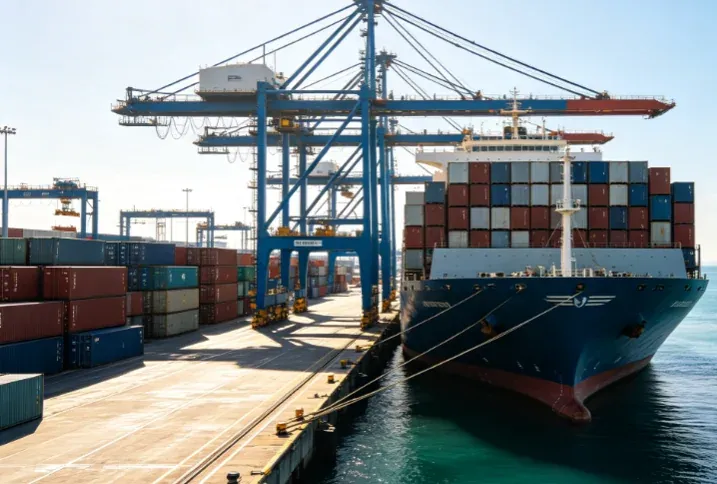
Every autumn Guangzhou fills up with buyers. The Canton Fair’s autumn session runs from mid-October into early November, and the contracts signed in the Pazhou halls become containers that leave through Nansha, 60 km downriver on the Pearl River estuary. Guangzhou Port is one of the world’s five largest container ports, moving over 26 million TEU a year, and the deep-water Nansha port area now carries the great majority of that ocean volume.
That sourcing geography is what makes shipping from Guangzhou to Venezuela different from loading in Shanghai or Ningbo. Your cargo is not coming from one industrial park — it is coming from a dozen supplier districts scattered across the Pearl River Delta, often on separate invoices, and it has to be consolidated into one export declaration before a single box can sail. This guide covers how that actually works in October 2026: which Guangzhou port loads your container, what FCL, LCL and CAN air freight cost, how long transit really takes once the Venezuelan relay is counted, and the SENIAT clearance and tax stack waiting at the other end. For the country-level overview, start with our shipping from China to Venezuela hub.
Shipping from Guangzhou to Venezuela in 2026: Which Port Actually Loads Your Container
“Guangzhou” is a loading region, not a single berth. Four options are in play, and the right one depends on where your suppliers are and which sailing you can still make.
| Loading point | Trucking from central Guangzhou | Why you would choose it | What it costs you |
|---|---|---|---|
| Nansha (Guangzhou Port, deep water) | 1–1.5 h, 60–70 km | Mainline South America and Caribbean strings; berths that take 20,000 TEU-class vessels; the default for PRD consolidation | Later cut-off pressure; barge or truck feeds from upriver yards |
| Huangpu (upriver Guangzhou) | 0.5–1 h | Cheapest drayage for eastern Guangzhou and Dongguan cargo; short barge hops to Nansha | Shallower draft, mostly feeders and barges; usually 1–3 extra days and a barge fee |
| Yantian / Shekou (Shenzhen) | 2.5–4 h | Deepest water and the largest South America allocations; wins when eastern Shenzhen or Dongguan is your base | $350–$750 per 40ft of trucking, one extra day, Shenzhen export formalities |
| Hong Kong | 3–4 h plus boundary crossing | Rarely justified for Venezuela | Cross-border paperwork, higher drayage, no rate advantage on this lane |
The supplier map matters as much as the port map, because it decides how many pickups the consolidation runs and how much room for error the cut-off leaves you:
- Foshan and Shunde — ceramics, tiles, sanitaryware, furniture, appliances. Heavy, dense cargo that behaves very differently in a container than what most cost guides assume.
- Zhongshan and Jiangmen — lighting, LED fittings, metal products, hardware.
- Dongguan and Huizhou — electronics, power supplies, small appliances, plastic housewares.
- Panyu and Baiyun — sporting goods, audio equipment, promotional items.
- Guangzhou city itself — apparel, textiles, shoes, packaging, spare parts.
On the Venezuelan side there is a second decision, because no carrier sails China–Venezuela direct. Every container relays, and the gateway you nominate decides the inland leg:
| Consignee region | Gateway | What to expect |
|---|---|---|
| Caracas and the central corridor | La Guaira | Closest to the capital, smaller terminal, more congestion-sensitive |
| Valencia, Maracay, the industrial interior | Puerto Cabello | Venezuela’s busiest container port, more feeder coverage, best all-round choice |
| Maracaibo and Zulia | Maracaibo | Fewer Asia connections; expect $250–$600 more per container |
| The Oriente (Puerto La Cruz, Maturín) | Guanta | Thinner frequencies, $250–$500 premium |
| Paraguaná and the western coast | Guaranao / Punto Fijo | Niche; confirm feeder capacity before booking |
Guangzhou to Venezuela Shipping Cost in October 2026: Nansha FCL, LCL and CAN Air Rates
Realistic October 2026 all-in ocean rates from Nansha to the main Venezuelan gateways, including origin THC, documentation and the ocean leg, excluding Venezuelan duties and IVA:
| Nansha → La Guaira or Puerto Cabello | October 2026 rate |
|---|---|
| 20ft FCL (20GP) | $1,850–$3,900 |
| 40ft FCL (40GP) | $2,600–$5,050 |
| 40ft FCL high cube (40HC) | $2,750–$5,300 |
| LCL, per CBM | $115–$285 |
| Air freight from CAN, per kg | $5.0–$10.5 |
| Express courier, per kg | $11–$20 |
South China sits at the low end of the national range on this lane because the Pearl River Delta generates more Latin America volume than any other Chinese region, so carriers allocate more capacity here and compete harder for the cargo. The spread inside the range is still wide, and it is explained almost entirely by routing:
| Cost element, 20ft from Nansha | October 2026 level |
|---|---|
| Ocean freight base (South China to a Panama or Caribbean hub) | $1,150–$2,600 |
| BAF/CAF fuel surcharges and peak-season adjustment | $200–$400 |
| Origin THC, export documentation and security fees | $120–$250 |
| Transshipment relay leg to Venezuela | $120–$300 |
| Destination THC, delivery order and port local charges | $200–$400 |
| All-in total (20ft, to La Guaira or Puerto Cabello) | ≈ $1,850–$3,900 |
Model the whole invoice rather than the ocean number with our Freight Cost Calculator, which adds the surcharges and destination charges that teaser quotes leave out.
October 2026 reality check. Capacity into Venezuela is thin, so one omitted vessel can remove a large share of a month’s space. Rates move with short notice. Book three to four weeks ahead, insist on a written rate validity date, and treat a space reservation as real only once you hold a carrier booking number.
Then the Venezuelan end, which is where most first-time importers under-budget:
| Destination charge | Typical October 2026 level |
|---|---|
| Venezuelan port and terminal handling | $200–$400 per container |
| Agente aduanal (customs broker) fee | $120–$300 per declaration |
| SENIAT inspection and bonded storage, if selected | $90–$250 |
| Trucking Puerto Cabello → Valencia or Caracas | $150–$450 |
| Trucking to interior cities (Barquisimeto, Maracay, San Cristóbal) | $400–$1,100 |
20ft vs 40ft Container Cost from Guangzhou to Venezuela: Where the Size Switch Pays
Guangzhou cargo rarely behaves like the generic “light consumer goods” that box-choice guides assume. Compare the boxes on cost per usable CBM, then check the weight ceiling before you commit:
| Option | October 2026 rate | Usable volume | Cost per CBM | Wins when |
|---|---|---|---|---|
| 20ft FCL (20GP) | $1,850–$3,900 | ~28 CBM | ~$66–$139 | 15–28 CBM, or any dense cargo |
| 40ft FCL (40GP) | $2,600–$5,050 | ~58 CBM | ~$45–$87 | 28–55 CBM of light cargo |
| 40ft FCL high cube (40HC) | $2,750–$5,300 | ~67 CBM | ~$41–$79 | Bulky, low-density cargo above 45 CBM |
A 40ft costs roughly 35–40% more than a 20ft while carrying about 2.1 times the volume, so the break-even sits near 25–28 CBM — but only for cargo that is light enough to fill volume before weight. Foshan tiles, sanitaryware and cast-iron hardware are not. A 20ft holds about 28,000 kg and a 40ft about 26,500 kg, so dense cargo is weight-limited long before it is volume-limited: you can hit the 20ft ceiling at roughly 15–18 CBM of ceramic tiles, and the 40ft ceiling at around 16 CBM of the same cargo. For a dense shipment, the 40ft is not a saving — it is a bigger bill for the same tonnage.
Under roughly 12–15 CBM, LCL at $115–$285 per CBM is the cheaper answer, but check how your cargo is measured. LCL is charged on the greater of weight and volume (W/M), so a dense pallet billed at 1,000 kg per CBM pays on weight, not volume. Our 20ft and 40ft container cost from China to Venezuela article works the same comparison across every Chinese origin port.
Sea Freight Transit Time from Guangzhou to Venezuela: Nansha Strings and the Relay That Sets Your Date
Quoted transit times on this lane are port-to-port on the best routing available, and almost never what the importer experiences:
| Segment | Single relay via Panama or the Caribbean | Double relay | European relay |
|---|---|---|---|
| Pickup and consolidated export clearance at Nansha | 2–4 days | 2–4 days | 2–4 days |
| Ocean leg from Nansha | 26–32 days | 30–38 days | 38–50 days |
| Feeder and hub dwell | 1–3 days | 3–6 days | 4–8 days |
| Discharge and terminal in Venezuela | 1–3 days | 1–3 days | 2–4 days |
| SENIAT clearance | 3–6 working days | 3–6 working days | 3–6 working days |
| Trucking to final destination | 1–3 days | 1–3 days | 1–3 days |
| Door to door total | 34–48 days | 38–54 days | 50–68 days |
Two realities stretch that further. Nansha’s Venezuela services are effectively weekly after the relay, so a box that misses the feeder waits for the next one — that single miss is worth five to seven days and is invisible in the quote. And SENIAT clearance depends on the tax payment actually reaching the Venezuelan treasury, not on the paperwork being filed, which is why a payment routed late can hold a container at Puerto Cabello while storage and demurrage build. Our how long does it take to ship from China to Venezuela guide breaks the same segments down across every mode.
Air Freight from Guangzhou to Venezuela: CAN Rates, Chargeable Weight and the 6000 Divisor
Guangzhou Baiyun (CAN) is one of Asia’s largest cargo airports, and there is no non-stop freighter to Venezuela. Every consignment connects — through a Gulf or European hub such as Istanbul, Doha, Amsterdam, Madrid or Lisbon, or across the Pacific and up through Panama City or Bogotá — before landing at Maiquetía (CCS) for Caracas. Valencia (VLN), Maracaibo (MAR) and Barcelona (BLA) are the secondary options and usually cost more.
| Service from CAN | October 2026 rate | Door-to-door transit |
|---|---|---|
| Consolidated air, 45–100 kg | $9.0–$10.5 per kg | 7–10 days |
| Consolidated air, 100–300 kg | $7.5–$9.5 per kg | 6–9 days |
| Blocked space, 300–500 kg | $6.5–$8.5 per kg | 6–9 days |
| Blocked space, 500–1,000 kg | $5.5–$7.5 per kg | 5–8 days |
| Blocked space, 1,000 kg+ | $5.0–$7.0 per kg | 5–8 days |
| Express courier (DHL/FedEx/UPS) | $11–$20 per kg | 4–8 days |
Airlines bill the greater of actual and volumetric weight, with volumetric weight calculated as length × width × height in centimetres ÷ 6000, and a $50–$150 minimum per shipment. That formula decides whether air is viable for what you actually bought in Guangdong. A carton measuring 60 × 40 × 40 cm has a volumetric weight of 16 kg (96,000 ÷ 6000) but might weigh only 9 kg filled with LED fittings — you pay for 16 kg, so light bulky goods are the worst cargo to fly. Run your packed dimensions through our Volumetric Weight Calculator before you request a quote, and repack dense where you can.
| Air freight from CAN | Sea freight from Nansha | |
|---|---|---|
| Door-to-door transit | 5–10 days | 34–48 days |
| Typical cost | $5.0–$10.5 per kg | ~$66–$139 per CBM (20ft) |
| Best for | Canton Fair samples, spare parts, high-value electronics, urgent restocks | Volume, heavy goods, ceramics, furniture |
| Minimum charge | $50–$150 per shipment | One CBM |
| Capital tied up | Days | 5–7 weeks |
Air is the right answer when five weeks of sea transit costs more than the air premium — a production line stopped for want of a spare part, a first trial order placed at the fair, or high-value electronics where inventory financing matters. Above 300 kg the per-kilo rate falls sharply and the decision becomes genuinely close. Our air freight from China to Venezuela guide covers the carrier and hub choices in detail.
Venezuela Customs Clearance for Guangzhou Cargo: SENIAT, the DUA, 16% IVA and 3% IGTF
Venezuelan customs is administered by SENIAT, and imports are declared through a DUA filed electronically by a licensed agente aduanal. The importer must hold an active RIF tax number and be registered in the importers’ registry.
- Import duty (arancel) — Venezuela applies its own national tariff rather than the Andean Community’s external tariff, with rates reaching 35% at the top and most machinery and consumer goods between 10% and 20% of CIF.
- IVA at 16% on the CIF value plus duty — usually the largest single line in the tax stack.
- IGTF at 3% on payments settled in foreign currency, which covers most import settlements in Venezuela and is the charge importers most often forget to model.
- Customs service and inspection fees, plus bonded storage (almacenaje) if SENIAT selects the container for physical inspection.
- Product registrations — food, cosmetics, medicines and agrochemicals need health registration; electrical and telecom goods need conformity approval before release.
- No China–Venezuela FTA — there is no preferential duty in force, so classification accuracy is the only lever you have on the duty line.
The Guangzhou-specific risk sits in the invoices, not the freight. The classic Pearl River Delta purchase is six to ten small suppliers on one consolidated container, each issuing its own invoice in its own format, and the declared customs value has to reconcile with all of them and with the bank payment. That is where Venezuelan clearance files get opened, queried and delayed.
Worked example — a consolidated 40ft of furniture, lighting and hardware from Foshan, Zhongshan and Jiangmen:
| Line | Amount |
|---|---|
| FOB Nansha | $21,000 |
| Ocean freight and origin charges | $3,850 |
| Marine insurance | $140 |
| CIF value | $24,990 |
| Import duty at 15% | $3,749 |
| IVA 16% on $28,739 | $4,598 |
| IGTF 3% on the foreign-currency settlement of freight, duty and IVA | $366 |
| Port, broker, inspection and trucking | $1,000 |
| Landed cost at the warehouse | $34,703 (+65% over FOB) |
That 65% uplift — about $598 per usable CBM — is the number to build a Venezuelan business case on. A product whose margin cannot absorb it is not a freight problem; it is a product-selection problem, and the container shipping from China to Venezuela guide shows how box choice interacts with it.
Documents Required to Import from Guangzhou into Venezuela: Invoices, Certificate and the DUA File
| Document | Who issues it | Notes for this lane |
|---|---|---|
| Commercial invoice | Each PRD supplier | Descriptions must match the DUA; Spanish descriptions reduce query risk |
| Packing list | Supplier, verified by the forwarder | Required for inspection selection at Puerto Cabello |
| Bill of lading (sea) or air waybill (air) | Carrier | Consignee must match the RIF registration exactly |
| Certificate of origin | Supplier or CCPIT | Required for tariff determination even without a preference |
| RIF and import registry evidence | Venezuelan importer | Confirm validity before the vessel sails, not after |
| HS classification | Forwarder and agente aduanal | Drives duty; confirm against the real product, not a supplier description |
| Health or conformity certificates | Supplier, per product | Mandatory for food, cosmetics, medicines, electrical and telecom goods |
| Marine insurance certificate | Forwarder or broker | Cover at roughly 0.1–0.3% of value |
| End-use statement | Importer | Helps clear enhanced compliance review on dual-use items |
| China export declaration and export invoice | Chinese exporter of record | One declaration per container; the supplier’s export invoice is issued after export, so do not hold the booking for it |
Two Guangzhou specifics matter here. First, when several suppliers share a container, one company has to act as the exporter of record on the Chinese side, and the consolidation must be physically completed — repacked to one set of marks — before that declaration is made. Second, the export invoice a supplier gives you for the customs file is not the domestic VAT invoice; the two look different and confusing them delays both the export declaration and your rebate expectations. Our door to door shipping from China to Venezuela guide explains how a single DDP structure bundles these documents, and when DAP is the better term.
Cutting the Cost of Shipping from Guangzhou to Venezuela: Consolidation, Cargo Density and Payment Routing
| Strategy | What it saves | Caveat |
|---|---|---|
| Consolidate all PRD suppliers at one Nansha-area warehouse | Removes multiple drayage legs and one export declaration | Needs 7–14 days of free storage before cut-off; book it |
| Repack to raise density before air or LCL | Directly cuts chargeable weight on air and billed volume on W/M LCL | Adds packing cost and a day at the warehouse |
| Choose the gateway your consignee’s truck can actually reach | $150–$1,100 of inland trucking | Maracaibo and Guanta have thinner sailings |
| Get the HS code in writing before shipping | Duty is 10–20% of CIF for most goods with no FTA relief | A wrong code is a clearance delay, not just a cost |
| Pre-file the DUA while the box is at sea | 3–5 days at the port | Needs complete documents before departure |
| Align the payment milestone with the sailing, not arrival | Removes the most common cause of warehouse delay | Requires treasury planning around bank screening |
| Screen consignee, end user and product against the applicable sanctions lists | Avoids refused bookings and frozen payments | Vendors and state entities need extra review |
Sanctions are a commercial factor on this lane rather than a legal ban on the goods. The US program targets designated Venezuelan individuals, entities and state companies, not the country’s imports as a whole, but carriers and correspondent banks apply enhanced due diligence: documentation is read closely, some lines decline the trade, and payments clear slowly. Because the IGTF falls on foreign-currency settlements, a payment that bounces and is re-routed costs you twice — time at the port and the tax again. Agree the Incoterm in writing (DDP or DAP), keep the consignee’s registration current, and let the forwarder see the invoice set before the container is stuffed.
Frequently Asked Questions
How much does it cost to ship from Guangzhou to Venezuela in 2026?
In October 2026 a 20ft container from Nansha to La Guaira or Puerto Cabello runs $1,850–$3,900 all-in to port, a 40ft $2,600–$5,050 and a 40ft HQ $2,750–$5,300, excluding Venezuelan import taxes. LCL is $115–$285 per CBM, air freight from CAN is $5.0–$10.5 per kg and express couriers charge $11–$20 per kg.
How long does shipping from Guangzhou to Venezuela take?
Sea freight takes 34–48 days door to door on a single-transshipment Caribbean routing: 2–4 days of loading and export clearance at Nansha, 26–32 days at sea plus a relay, and 3–6 working days for SENIAT clearance and trucking. Routings that relay through Europe run 50–68 days. Air freight from CAN delivers in 5–10 days door to door.
Should I load my container at Nansha or truck it to Shenzhen?
Nansha is the default for Guangzhou: the deep-water berths take the mainline vessels on the South America and Caribbean strings and the trucking from most Pearl River Delta factories is under two hours. Yantian or Shekou can win when your supplier is in eastern Shenzhen or Dongguan and the carrier allocates more space there, but you add $350–$750 per 40ft and a day of trucking. Let the forwarder confirm which port still meets the vessel cut-off.
Is LCL or FCL cheaper from Guangzhou to Venezuela?
Below roughly 12–15 CBM, LCL at $115–$285 per CBM is cheaper, provided the cargo is not dense. From 15 to 28 CBM it depends on density: a 20ft holds 28 CBM but only about 28,000 kg, so dense Foshan ceramics hit the weight ceiling at around 15–18 CBM and a 40ft gains you nothing. Above 28 CBM of light cargo, a 40ft or 40ft HQ wins on cost per CBM.
What import duty and taxes does Venezuela charge on goods from Guangzhou?
Venezuela applies its national tariff, with rates up to 35% and most machinery and consumer goods between 10% and 20% of CIF. IVA at 16% is charged on CIF plus duty, and the IGTF of 3% applies to foreign-currency payments. There is no China–Venezuela FTA, so classification and invoice accuracy are the only levers on the duty line.
Are there sanctions restrictions on shipping from Guangzhou to Venezuela?
Sanctions target designated Venezuelan individuals, entities and state companies rather than the whole country, so ordinary commercial cargo is not embargoed. Carriers and banks apply enhanced due diligence: documentation is scrutinised, some lines refuse the trade, and payments clear more slowly. Screen the consignee and end user, add an end-use statement for dual-use items, and align payment with the sailing date.
Get a Guangzhou to Venezuela Shipping Quote in 24 Hours
Venezuela rewards importers who treat this lane as a compliance exercise with a freight component: a named routing, the right entry port, one clean export declaration covering every Pearl River Delta supplier, and a payment plan that reaches the carrier before the vessel does. Send us your supplier addresses in Guangzhou, Foshan, Zhongshan and Dongguan, the consignee details in Venezuela and the cargo description, and we will quote the routing, the gateway and the full landed cost — duty, IVA and IGTF included — so you can price your goods before you commit. Contact our team for a written quote within 24 hours.