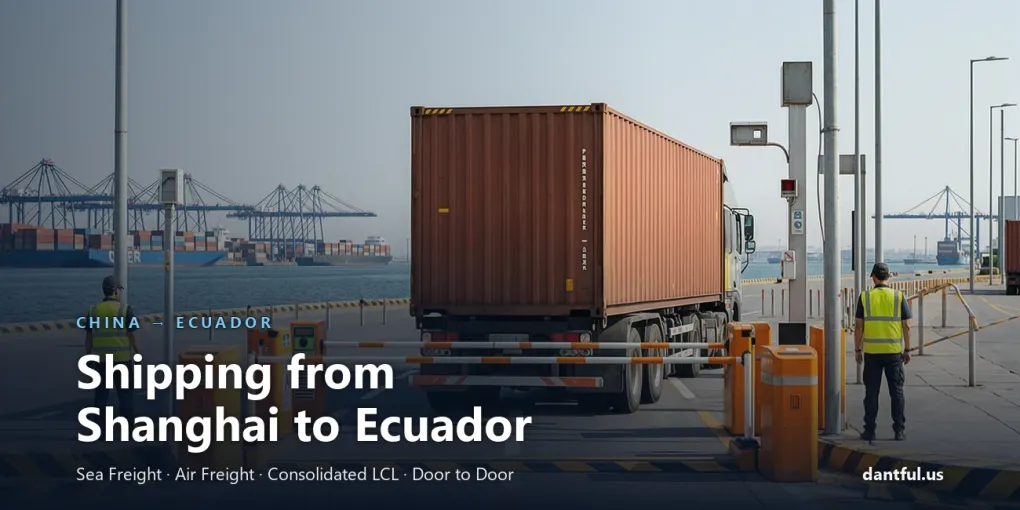
Shanghai does not load your container where a truck can simply drive up to a quay. Close to half of the port’s 51-million-TEU throughput leaves from Yangshan, a deep-water terminal group on islands in the Shengsi archipelago 32.5 km offshore, reached either by a truck queue across the Donghai Bridge or by a barge working the Yangtze estuary. On the Ecuador lane that geography is not trivia — it decides your cut-off, your drayage bill and, in a tight week, whether your cargo sails at all.
Shipping from Shanghai to Ecuador is therefore a two-part problem: getting the box to the right terminal inside the Yangtze Delta, and then keeping it on a West Coast South America string that reaches Guayaquil without a month of relays. This guide covers the Shanghai end in detail — terminal nomination, Q4 2026 rates, transit, air out of PVG, and the Ecuadorian tax stack you inherit on arrival.
The cargo is heavy and industrial more often than not. Jiangsu sends machinery, bearings, photovoltaic modules, cables and petrochemicals; Anhui sends appliances and auto parts; Shanghai itself sends instruments, electronics and chemicals. Ecuador buys pumps, generators, motorcycles, hand tools, plastic mouldings, appliances and steel in exactly those rhythms. Our shipping from China to Ecuador hub covers the country regime; this page covers what changes when the load port is Shanghai.
Shipping from Shanghai to Ecuador in Q4 2026: The Island Port Problem
Four loading areas handle almost everything that leaves Shanghai for South America, and they are not interchangeable. The nomination follows the cargo, not the rate sheet.
| Terminal area | Draft alongside | How cargo reaches it | Nominate it when |
|---|---|---|---|
| Yangshan Phase I–III | 15–16 m | Truck over the 32.5 km Donghai Bridge, or barge from Taicang and Nantong | Default for mainline West Coast South America strings; the widest carrier spread |
| Yangshan Phase IV | 16–17.5 m, automated | Same bridge or barge, more yard automation | Megaship calls and overflow when Phase I–III is booked out; often a day later on cut-off |
| Waigaoqiao | 12.5–14.2 m, capped by the Yangtze channel | Direct truck from Pudong, Songjiang, Baoshan, Jiading | Small lots, late cargo, LCL, and anything that cannot make the Yangshan cut-off |
| Wusongkou / Luojing | 8–12 m | Road, plus river berths | Ro-ro, breakbulk, project cargo and domestic feed — rarely a routine Ecuador container |
The barge is the part importers underestimate. More than half of Yangshan’s containers arrive by water rather than road, because a barge slot from Taicang or Nantong costs $120–$260 less per 40ft than a bridge truck and does not queue. The trade-off is timing: a barge needs to be booked five to seven days before the vessel and adds one to two days, and a barge that misses the feeder window means your container waits for the next one.
Practically, an export box out of Shanghai gates in four to seven days before sailing, with the terminal CY cut-off 24–48 hours ahead of departure. Q4 tightens all of that: blanked sailings and the pre-Chinese-New-Year build-out compress bookings, so a 40HQ booked two weeks out is normal and three weeks is safe.
Shipping Cost from Shanghai to Ecuador: Q4 2026 FCL, LCL and Air Rates
Five lines decide the invoice, and only one of them is ocean freight. Port to port, Q4 2026:
| Service | Rate | What is included |
|---|---|---|
| 20GP, Shanghai → Posorja / Guayaquil | $1,450–$2,480 | Ocean freight, BAF included, THC excluded |
| 40GP, Shanghai → Posorja / Guayaquil | $2,150–$3,780 | Same strings, same cut-off |
| 40HQ, Shanghai → Posorja / Guayaquil | $2,220–$3,920 | Best per-CBM value above 30 CBM |
| LCL, Shanghai CFS → Guayaquil | $65–$135 per CBM | $85–$130 minimum per shipment |
| Air, PVG → GYE or UIO | $3.5–$6.6 per kg | Consolidated, by weight break |
The four lines that get missed:
- Origin charges — THC, documentation, export declaration, VGM and CFS handling, $300–$620 per container.
- Drayage to the terminal — $250–$530 depending on the Jiangsu, Anhui or Zhejiang origin city in the table below, plus the bridge or barge leg.
- Ecuadorian destination charges — $250–$450 per container at Posorja or Guayaquil, plus $50–$70 per bill of lading.
- Brokerage and inland trucking — $150–$320 for the DAI, then $420–$880 to move a 40ft from the coast to Quito, Ambato or Cuenca.
Cube economics favour a container on this lane because Shanghai export cargo is usually machinery and parts rather than bulk. A 40HQ at $2,220–$3,920 across 46 usable CBM is $48–$85 per CBM; the same 46 CBM as LCL bills $2,990–$6,210 plus CFS handling at both ends. The crossover sits near 15 CBM, where the $300–$620 of origin charges on a container stop being cheap. Run both figures through our Freight Cost Calculator before committing to a box, and treat the result as a starting price rather than a quote.
Sea Freight Transit Time from Shanghai to Ecuador: Busan, Manzanillo and the Canal
No carrier runs Shanghai–Ecuador as a dedicated shuttle. Boxes load on West Coast South America strings that call Shanghai, then either transit the Panama Canal or relay at Busan or Manzanillo. The relay port, not the load port, sets your arrival date.
| Route | Port to port | What sets the date |
|---|---|---|
| Shanghai → Posorja (DP World, 15.5 m draft) | 29–35 days | Deep water, no tidal restriction, weekly strings |
| Shanghai → Guayaquil (Contecon, TPG, Fertisa) | 31–37 days | About 40 nm upriver behind a 9.7–11 m channel |
| Shanghai → Manta | 33–39 days | Deep-water port, thinner Asia coverage, good for Manabí consignees |
| Shanghai → Puerto Bolívar (Machala) | 35–41 days | Banana belt; reefers and project cargo, feeder from the mainline |
| Shanghai → Esmeraldas | 36–42 days | Few Asia calls; usually a feeder out of Guayaquil |
| PVG → GYE (air) | 5–8 days door to door | 2–4 flight days through a European or Gulf hub, plus clearance |
Two clocks run underneath the schedule. The canal clock is the transit slot: a Panama booking that slips, or a dry year’s draft and slot restrictions at Gatun, moves the whole string by a week. The tidal clock belongs to Guayaquil, where deep-draft vessels wait for water 40 nautical miles up the Guayas; Posorja, 60 km downriver with 15.5 metres of natural draft, deletes that wait and lands the same sailing two to four days earlier.
| Stage | Time |
|---|---|
| Supplier pickup and CFS consolidation in the delta | 3–6 days |
| Barge booking or bridge trucking, gate-in, export declaration, VGM | 2–4 days |
| Ocean leg to Posorja or Guayaquil | 29–37 days |
| Discharge and terminal handling | 1–3 days |
| SENAE clearance in ECUAPASS, including aforo | 2–5 working days |
| Duty, IVA and ISD settlement | Same day to 2 days |
| Inland delivery to Quito, Ambato or Cuenca | 1–2 days |
Door to door, six weeks is the honest number for a Q4 booking. For the full breakdown by mode and route, see how long it takes to ship from China to Ecuador.
Cheapest Way to Ship from Jiangsu to Ecuador: Shanghai or Ningbo?
Shanghai and Ningbo compete for the same delta cargo, and on ocean freight they barely differ — the spread on a 40HQ is $30–$90. Everything downstream of the factory gate is what actually separates them.
| Origin | Truck to Yangshan / Waigaoqiao | Truck to Ningbo | Better gateway |
|---|---|---|---|
| Shanghai (Pudong, Songjiang, Jiading) | $250–$390 | $600–$900 | Shanghai, decisively |
| Suzhou, Wuxi, Changzhou | $360–$530 | $520–$780 | Shanghai |
| Nanjing, Zhenjiang | $470–$650 | $600–$860 | Shanghai |
| Nantong, Taicang, Zhangjiagang | $150–$280 by barge | $430–$650 | Shanghai, by barge |
| Hefei, Anhui | $490–$670 | $700–$980 | Shanghai |
| Hangzhou, Jiaxing, Huzhou | $300–$450 | $260–$400 | Ningbo, marginally |
| Yiwu, Jinhua, Wenzhou, Taizhou | $560–$820 | $80–$260 | Ningbo, clearly |
Three rules follow. Southern Jiangsu and Anhui cargo belongs in Shanghai, where the bridge or barge leg is shorter than the road to Beilun. Zhejiang’s light-industrial south belongs in Ningbo, and paying Shanghai drayage for a Yiwu carton lot is money thrown away — our Ningbo to Ecuador guide covers that end. And if the cargo is chemical, dangerous goods or oversized machinery, Shanghai wins regardless of the trucking number, because Yangshan takes classes and dimensions that Beilun will refer elsewhere.
Air Freight from Shanghai to Ecuador: PVG Rates, Quito Altitude and Chargeable Weight
PVG is China’s largest cargo airport, handling close to four million tonnes a year across the PACTL and Eastern Air Logistics terminals plus the west freight area. There is no direct freighter to Ecuador: every shipment relays through a European or Gulf hub, or across the Pacific via Los Angeles or Mexico City.
| Weight break | PVG → GYE | PVG → UIO | Typical use |
|---|---|---|---|
| 45–100 kg | $5.4–$6.6 per kg | $5.8–$7.2 per kg | Samples, spare parts, first orders |
| 100–300 kg | $4.6–$6.0 per kg | $5.0–$6.6 per kg | Urgent restocks, electronics |
| 300–500 kg | $4.0–$5.4 per kg | $4.4–$6.0 per kg | Season launches, machinery parts |
| 500–1,000 kg | $3.7–$5.0 per kg | $4.1–$5.6 per kg | Project spares, high-value density |
| 1,000 kg+ | $3.5–$4.6 per kg | $3.9–$5.2 per kg | Contract volumes |
Quito is the trap in that table. UIO sits at 2,813 metres, and thin air cuts uplift: carriers apply hot-and-high payload penalties, some cap piece weight, and rates run $0.3–$0.8 per kg above Guayaquil on the same routing. If the consignee is in Quito but the cargo is not urgent, land it in GYE and truck it up the Sierra — the road leg is $420–$880 per 40ft equivalent and usually cheaper than the air premium on anything above a few hundred kilos.
Air is priced on chargeable weight, whichever is greater between actual kilos and volumetric kilos at L × W × H in centimetres ÷ 6,000. A 60 × 50 × 40 cm carton weighing 12 kg bills as 20 kg, so light bulky goods pay two-thirds more than their scale weight suggests. Check the number on our Volumetric Weight Calculator before you accept a quote built on actual weight.
| Sea freight | Air freight | |
|---|---|---|
| Transit, port to port | 29–37 days | 2–4 flight days |
| Cost basis | $2,220–$3,920 per 40HQ | $3.5–$6.6 per kg |
| Minimum sensible shipment | About 15 CBM | 45 kg |
| Best for | Machinery, appliances, steel, chemicals | Samples, electronics, spare parts, launches |
LCL Shipping from Shanghai to Ecuador: Consolidation and the 15 CBM Line
LCL out of Shanghai consolidates at Waigaoqiao container freight stations or inside the Yangshan bonded logistics park, where non-cleared cargo can be held under customs supervision and stuffed without leaving the zone. That is a real advantage for mixed orders from four or five delta suppliers.
| LCL volume | Freight at $65–$135/CBM | Verdict |
|---|---|---|
| 2 CBM | $130–$270 (minimum applies) | LCL, no question |
| 5 CBM | $325–$675 | LCL — the typical first order |
| 10 CBM | $650–$1,350 | LCL, unless the cargo is bulky |
| 15 CBM | $975–$2,025 | Break-even; price a 20GP alongside |
| 25 CBM+ | $1,625–$3,375 | A 20GP usually wins on cost and damage risk |
Four rules keep Shanghai groupage out of trouble. Mark every supplier’s cartons with the shipper name, because an unmarked mixed pallet is the most common cause of a disputed short-shipment. Keep dangerous goods out of a general consolidation — one hidden aerosol or lithium pack holds the entire container. Declare every HS line, since SENAE reclassifies vague descriptions such as “machine parts” at the aforo stage and charges the delay back to you. And treat wood packaging as a compliance item: ISPM 15 stamping or the pallet is rejected at destination. For door delivery instead of port to port, compare with our door to door from China to Ecuador guide.
Import Duty from China to Ecuador for Shanghai Cargo: SENAE, 15% IVA and the FTA Certificate
Ecuador’s tax stack is layered, and the order of calculation matters more than the headline numbers.
| Charge | Base | Rate |
|---|---|---|
| Ad valorem duty | CIF value | Tariff line rate; 0% on most industrial lines with a valid China–Ecuador FTA certificate of origin |
| FODINFA | CIF value | 0.5% |
| IVA | CIF + duty + FODINFA | 15% |
| ISD | Money remitted to China | 5% |
The FTA has been in force since May 2024 and covers the bulk of machinery, electrical goods and industrial inputs, but the certificate has to be right: issued by China Customs or CCPIT Shanghai, matching the invoice consignee, and covering the HS line you actually declare. Textiles, footwear, appliances and some steel lines sit on multi-year phase-outs, so a Shanghai appliance shipment can still carry real duty while the pump beside it clears at zero.
Worked example: $12,000 CIF of FTA-eligible machinery, HS 8479, cleared in Guayaquil.
| Line | Calculation | Amount |
|---|---|---|
| Duty | 0% under the FTA | $0 |
| FODINFA | 0.5% × $12,000 | $60 |
| IVA | 15% × ($12,000 + $0 + $60) | $1,809 |
| ISD | 5% × $10,000 remitted | $500 |
| Total | $2,369 — 19.7% of cargo value |
Regulated products add paperwork before they add tax: INEN technical conformity for electrical and mechanical goods, ARCOTEL homologation for anything that transmits, ARCSA registration for food, cosmetics and medicines, and an Agrocalidad permit for plant or animal products. Missing certificate equals a red-channel aforo and a demurrage clock that runs at $40–$90 a day.
How to Ship from Shanghai to Ecuador: Documents, Bookings and a Clean Aforo
- Book three weeks out in Q4. Nominate the terminal at booking — Yangshan for rate and sailing choice, Waigaoqiao for a late box — and confirm whether the carrier accepts your commodity (chemicals and DG are restricted by class).
- Move the cargo to the terminal. Truck over the bridge for Shanghai metro and southern Jiangsu, barge for Taicang, Nantong and Zhangjiagang. Verify the carton count against the packing list at the CFS gate.
- Clear Chinese export and file VGM. Export declaration, licence where the HS line needs one, and a verified gross mass four to seven days before sailing.
- Load and get the bill of lading right. Consignee must match the RUC holder in Ecuador, and the description must match the invoice line by line — a mismatch here is the single most common clearance delay.
- Pre-alert documents 72 hours before arrival. Invoice, packing list, BL, certificate of origin, insurance certificate and product certificates go to the Ecuadorian broker before the vessel berths.
- File the DAI in ECUAPASS and pass aforo. SENAE assigns green, yellow or red; red means physical inspection and two to five extra working days.
- Settle duty, IVA, FODINFA and ISD, then deliver. Quito and Cuenca are one to two days by road from Guayaquil, Ambato a day and a half; book the truck before the container is released, not after.
Frequently Asked Questions
How much does it cost to ship a container from Shanghai to Ecuador in Q4 2026?
Port to port out of Yangshan or Waigaoqiao, a 20GP to Posorja or Guayaquil runs $1,450–$2,480, a 40GP $2,150–$3,780 and a 40HQ $2,220–$3,920, before $300–$620 of origin charges and $250–$450 of Ecuadorian destination charges. LCL bills $65–$135 per CBM with an $85–$130 minimum, and consolidated air freight from PVG runs $3.5–$6.6 per kg by weight break.
How long does sea freight from Shanghai to Ecuador take?
Shanghai to Posorja is 29–35 days port to port and 31–37 days to the Guayaquil terminals. Add 3–6 days for pickup and consolidation, 2–4 days for the barge or gate-in, 2–5 working days for SENAE clearance and 1–2 days inland, so door to door is 40–53 days and six weeks is the honest planning figure.
Should I load at Yangshan or Waigaoqiao for an Ecuador shipment?
Yangshan handles the West Coast South America strings with 15–17.5 metres of draft and the widest carrier choice, but it sits on an island reached by a 32.5 km bridge or by barge. Waigaoqiao is cheaper to reach by truck from Pudong, Songjiang or Baoshan and suits late cargo or small lots. Take Waigaoqiao when the box is late; take Yangshan when rate and sailing date matter more than $100 of drayage.
Is Shanghai cheaper than Ningbo for cargo going to Ecuador?
The ocean rate is within $30–$90 per container, so inland trucking decides it. Factories in Suzhou, Wuxi, Changzhou, Nanjing and Hefei are $120–$320 cheaper per 40ft through Shanghai, while Yiwu, Jinhua, Wenzhou and Taizhou cargo loads cheaper through Ningbo. Southern Jiangsu suppliers shipping chemicals or dangerous goods usually stay with Shanghai for the wider DG acceptance.
What taxes apply when a Shanghai container arrives in Ecuador?
You pay ad valorem duty at the tariff line rate — 0% on most industrial lines under the China–Ecuador FTA with a valid certificate of origin — plus 0.5% FODINFA, 15% IVA on the duty-inclusive CIF value and 5% ISD on the money remitted to China. On $12,000 CIF of FTA-eligible machinery that totals about $2,369, or 19.7% of cargo value, before brokerage.
Can I ship machinery or dangerous goods from Shanghai to Ecuador?
Yes, and Shanghai is the best-equipped gateway in China for both. Over-height machinery needs a flat rack or open top booked two to three weeks ahead with a verified centre of gravity. Dangerous goods need an IMDG class, UN number, MSDS and carrier approval six to eight weeks out, because Ecuador requires SENAE authorisation for several classes and Yangshan accepts DG only on nominated sailings.
Get a Shanghai to Ecuador Rate in 24 Hours
Send us the commodity, HS code, carton count and CBM, the supplier address in the delta, and whether the consignee is in Guayaquil, Quito or Cuenca. We will come back with a Yangshan and a Waigaoqiao comparison, the FCL and LCL option side by side, an air rate out of PVG if speed matters, and the Ecuadorian duty and IVA estimate in the same message. No obligation until you approve the booking.
Talk to a Shanghai freight specialist — or read the sea freight from China to Ecuador guide first if you are still choosing a mode.