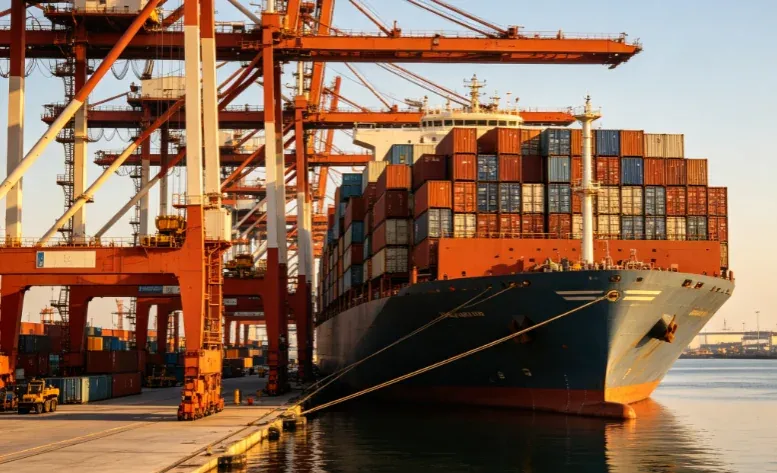
A forwarder quotes you 28 days from Yantian to Ecuador. Your container arrives on day 44. Nobody lied — the 16-day difference is not sailing time at all, it is a tidal window in the Guayas river, an aforo colour assigned by SENAE, and one certificate of origin that reached the broker after the vessel berth. Ecuador is a dollarised economy with clean, competitive ocean rates and well-run ports, and it still produces some of the widest transit-time spreads in South America for reasons that have nothing to do with the carrier.
This guide answers how long it takes to ship from China to Ecuador in October 2026 mode by mode, then takes apart the three invisible clocks that decide whether your cargo lands at the bottom or the top of every range you are quoted. For the commercial side of the same journey, the China to Ecuador shipping hub and the how much shipping from China to Ecuador cost guide are the natural next reads.
How Long Does It Take to Ship from China to Ecuador? October 2026 Answer by Mode
| Mode | Ocean / air leg | Door to door | Typical use |
|---|---|---|---|
| Sea FCL (20ft or 40ft) | 27–36 days port to port | 38–50 days | Full containers, 15 CBM and up |
| Sea LCL (groupage) | Sailing plus consolidation | 43–58 days | 1–15 CBM, no deadline pressure |
| Air freight | 2–5 days flight | 5–11 days | Urgent, high-value, under ~2 CBM |
| Express courier (DHL/FedEx/UPS) | 1–3 days flight | 3–7 days | Samples, documents, spares |
Those four lines are the honest October 2026 answer. The rest of this article is about the spread inside them.
Door-to-door time builds up from six blocks, and only one of them is the ocean:
| Stage | Time | Who controls it |
|---|---|---|
| Factory ready to gate-in at the Chinese terminal | 3–7 days | Supplier and trucking cut-off |
| Ocean sailing to Posorja or Guayaquil | 27–36 days | Carrier string and port of call |
| Discharge, berth and terminal handling | 1–3 days | Terminal, tidal window at Guayaquil |
| SENAE clearance in ECUAPASS | 2–5 working days | Broker, aforo channel, documents |
| Duty, IVA and ISD settlement | Same day to 2 days | Importer and bank |
| Inland delivery (Guayaquil to Quito, Cuenca, Ambato) | 1–3 days | Distance, weather, holidays |
Two of those six blocks have nothing to do with the ship — which is exactly why one importer gets 38 days and another gets 50 on the same vessel.
China to Ecuador Shipping Time: Three Clocks That Never Appear in the Quote
Every quote you receive is a sailing time. Three other clocks run in parallel, and all three are controllable once you know they exist.
1. The river clock. Guayaquil is a river port: terminals such as Contecon Guayaquil, Terminal Portuario Guayaquil and the Fertisa facilities sit about 40 nautical miles up the Guayas, behind a channel of roughly 9.7–11 metres depending on dredging and tide. Deep-draft vessels wait for water, berths queue, and in a dry year the restriction tightens. Posorja, 60 km downriver on the open Pacific with 15.5 metres of natural draft and no tidal restriction, removes the clock entirely. Same sailing, same carrier, and a two-to-four-day difference at the Ecuadorian end — this is the single largest avoidable variable on the lane.
2. The aforo clock. Ecuadorian customs, SENAE, does not clear every shipment the same way. Your declaration in ECUAPASS is channelled into aforo: automatic (released, no inspection), documentary (papers reviewed, 1–2 days), or physical (the container is opened, typically 2–4 extra working days). The channel is assigned by risk profiling and random selection, so the honest answer to “how long is clearance” is 2–5 working days with a tail that reaches eight.
3. The document clock. The China–Ecuador free trade agreement has been in force since 1 May 2025 and most industrial goods enter at 0% tariff — but only with a valid Form F certificate of origin matching the exporter on the bill of lading. A missing or mismatched Form F does not just cost money at 5–15% MFN rates; it stops the release while the broker resolves it, which is where the demurrage starts. The same applies to an inactive RUC or an unsigned appointment letter for your agente afianzado de aduana, who is mandatory for commercial imports.
| Clock | Days at risk | How to defuse it |
|---|---|---|
| River / tidal window at Guayaquil | 0–4 | Nominate Posorja for Quito and coastal consignees |
| Aforo channel at SENAE | 0–4 working days | Correct HS classification, complete documents, no valuation gaps |
| Documents and Form F | 0–5 days | Issue and courier the certificate before sailing, not after |
| Booking after cut-off | 5–7 days | Book 3–4 weeks ahead of the cargo cut-off |
Sea Freight Transit Time from China to Ecuador: Posorja, Guayaquil and the Transshipment Detour
Two routings exist — a direct West Coast South America (WCSA) call, or a transshipment — and on this lane the direct option is genuinely direct, because Posorja can take the deep-draft vessels that call Ecuador.
| Routing | Port to port | Frequency | Comment |
|---|---|---|---|
| Direct WCSA call at Posorja | 27–34 days | Weekly | Fastest and most stable; no tidal restriction |
| Direct call at Guayaquil river terminals | 30–36 days | Weekly | Tidal window and berth queues apply |
| First transshipment at Busan or Hong Kong | 33–42 days | 2–3 sailings weekly | One more handover, one more documentation window |
| Relay via Manzanillo (MX), Colon, Callao or Paita | 34–45 days | Weekly per hub carrier | Common when direct space is full in peak season |
Transit Time from Shanghai, Ningbo, Shenzhen and Qingdao to Ecuador
The Chinese load port moves the number by two to four days, mostly because of how the string is sequenced rather than distance:
| Chinese origin | To Posorja | To Guayaquil |
|---|---|---|
| Yantian / Shekou (Shenzhen) | 27–32 days | 30–35 days |
| Nansha (Guangzhou) | 28–33 days | 31–36 days |
| Shanghai (Yangshan) | 28–33 days | 31–36 days |
| Ningbo (Beilun) | 29–34 days | 32–36 days |
| Qingdao | 30–35 days | 33–38 days |
Because mainline strings on this trade run weekly rather than daily, a booking made after the cargo cut-off waits seven days for the next vessel — the largest avoidable delay on the lane, and a bigger one than any port decision. The sea freight from China to Ecuador guide covers the rate side and the Posorja-versus-Guayaquil trade-off in detail, and the container shipping from China to Ecuador breakdown shows what each container size does to the schedule.
Air Freight Transit Time from China to Ecuador: UIO, GYE and Express Couriers
There is no non-stop freighter service between China and Ecuador, so air cargo connects — most often through Miami (MIA), Bogota (BOG), Lima (LIM) or Panama City (PTY) — and lands at Quito’s Mariscal Sucre (UIO) or Guayaquil’s Jose Joaquin de Olmedo (GYE).
| Chargeable weight | Air rate per kg | Door-to-door transit |
|---|---|---|
| Under 45 kg | $5.2–$7.6 | 5–8 days |
| 45–100 kg | $4.6–$6.8 | 5–9 days |
| 100–300 kg | $4.0–$6.0 | 6–10 days |
| 300–500 kg | $3.7–$5.4 | 7–11 days |
| 500–1,000 kg | $3.5–$5.0 | 7–11 days |
Air freight bills on chargeable weight — the greater of gross weight and volumetric weight, where volumetric weight is length × width × height in centimetres divided by 6,000. A pallet of light packaging that physically weighs 60 kg can bill at 200 kg, and that single rule explains most air-freight invoice surprises. Run your carton dimensions through the Volumetric Weight Calculator before you accept a quote, and use the Freight Cost Calculator to check whether the air premium is worth the weeks it buys on this lane.
Express couriers complete the door-to-door journey in 3–7 days and are the right answer for documents, samples and emergency spares. Above roughly 250–300 kg, or about 2 CBM, the gap widens quickly and sea freight wins unless the cargo margin is high enough to carry the air premium.
LCL Shipping Time from China to Ecuador: Why Groupage Adds Five to Ten Days
Several competitor pages claim LCL is faster than FCL on this lane, quoting “9–18 days”. That is wrong, and booking on it is how importers miss deadlines. LCL is structurally slower:
- Origin consolidation: your pallets wait at the CFS until the co-loaded container is full — 3–7 days, sometimes longer for odd dimensions.
- Shared sailing: an LCL box sails on the groupage booking, which is not always the first available vessel.
- Destination deconsolidation: at Posorja or Guayaquil the container is stripped and your cargo released to a warehouse before delivery, adding 1–3 days.
- Clearance order: each house bill is declared separately, and deconsolidation must finish first.
Net effect: LCL runs 5–10 days longer than an FCL container on the same string, and the gap widens in peak season. Above roughly 13–15 CBM the economics also flip, because a 20ft container carries about 28–30 CBM for a price close to a full LCL consignment of the same volume — our door to door shipping from China to Ecuador guide sets out the DDP versus DAP choice for that move.
Customs Clearance Time in Ecuador for China Imports: SENAE, ECUAPASS and Aforo
Clearance is where a 40-day shipment becomes a 47-day shipment, and it is also the most predictable block if the paperwork is right.
| Stage | Time |
|---|---|
| Documents prepared before arrival (invoice, packing list, B/L, Form F, insurance, INEN or ARCSA approvals) | 3–7 days before berthing |
| DAI filed in ECUAPASS by the agente afianzado | Same day to 1 day after manifest |
| Aforo channel assigned and processed | Automatic: same day · Documentary: 1–2 days · Physical: 2–4 working days |
| Duty, FODINFA, IVA and ISD settlement | Same day to 2 days |
| Release and pickup from the terminal | 1 day |
| Typical clean clearance | 2–5 working days |
Two Ecuador-specific charges affect timing rather than rate: the ISD (5% on payments remitted abroad) must be settled to release goods, and it is creditable against income tax, so importers rarely plan to lose it — but a slow treasury cycle can hold a container longer than the aforo did. Free time is also tighter than in the United States: expect around 5–7 free days of terminal storage and 7–14 days of container detention, with storage at roughly $20–$44 per 20ft per day and detention at $36–$68 per day once those lapse. Building the document set while the vessel is at sea is worth more than any rate negotiation.
Peak Season and Delay Risk: When to Book China to Ecuador Shipping in 2026
The lane has a calendar, and bookings that ignore it lose one to two weeks.
| Period | Effect | Book ahead |
|---|---|---|
| August–December (South American peak) | 10–20% space premium, longer berth queues | 3–4 weeks |
| October (Ecuadorian public holidays and presidential transitions) | Thinner customs and terminal staffing on holiday Mondays | 3 weeks |
| Late November–December | Christmas and year-end restocking, feeder congestion | 3–4 weeks |
| Chinese New Year (early February 2027) | Pre-holiday rush, then a two-week lull | 4 weeks before the break |
| January–April (Ecuadorian rainy season) | Landslides on the Aloag–Santo Domingo road can add 1–3 days to Quito deliveries | Plan a buffer |
| February (Carnival) | Two-day national shutdown; aforo and trucking queues on either side | Add 1–3 days |
Seven Ways to Shorten Shipping Time from China to Ecuador
| Lever | Days saved |
|---|---|
| Nominate Posorja instead of Guayaquil where the consignee allows | 0–4 |
| Book before the cargo cut-off, not after | 5–7 |
| Pre-file the DAI and appoint the agente afianzado while the vessel is sailing | 2–4 |
| Hold a valid Form F certificate of origin before berthing | 0–5 (and 5–15% duty) |
| Avoid LCL when the deadline is fixed | 5–10 |
| Ship by air when the cargo is under ~2 CBM and urgent | 30–40 |
| Send documents to the consignee at sailing, not at arrival notice | 2–3 |
Frequently Asked Questions
How long does it take to ship from China to Ecuador in 2026?
In October 2026 sea freight takes 27–36 days port to port and 38–50 days door to door. LCL adds 5–10 days, air freight delivers in 5–11 days door to door, and express couriers take 3–7 days.
How long does sea freight from China to Ecuador take?
Direct WCSA sailings reach Posorja in 27–34 days port to port, and Guayaquil river terminals in 30–36 days because of the tidal window. Transshipment via Busan, Manzanillo, Colon, Callao or Paita adds 5–12 days.
Why does the Guayaquil river channel change the transit time?
Guayaquil sits 40 nautical miles up the Guayas behind a roughly 9.7–11 metre channel, so deep-draft ships wait for water. Posorja has 15.5 metres of natural draft and no tidal restriction, which is why the same sailing can deliver four days apart.
How long does customs clearance take in Ecuador?
A clean import clears SENAE in 2–5 working days once the DAI is filed in ECUAPASS. A physical aforo adds 2–4 working days, and a missing Form F certificate or an inactive RUC is the usual reason clearance stretches past a week.
Should I ship to Posorja or Guayaquil if speed matters most?
Posorja, when the consignee is in Quito or on the coast — no tidal waiting and fewer rollovers usually outweigh the extra 60 km of trucking. Guayaquil, when the cargo stays in the city industrial belt.
What delays shipments from China to Ecuador the most?
Booking after the weekly cut-off, the Guayaquil tidal window in the dry season, a physical aforo inspection, and documents arriving after the vessel. Peak season adds a 15–30% rate premium and up to 10–14 days of waiting time.
Get a China to Ecuador Transit Time and Quote in 24 Hours
Transit time on this lane is decided before the vessel sails: the string you book, whether you nominate Posorja or Guayaquil, and whether the Form F and the DAI are ready while the cargo is still at sea. Send us the supplier address, the cargo dimensions and the delivery city in Ecuador, and we will come back with the sailing, the realistic door-to-door date and an itemised rate — so your ETA is a plan rather than a hope.
Contact Dantful.US for a free, itemised China–Ecuador quote with a working timeline within 24 hours.