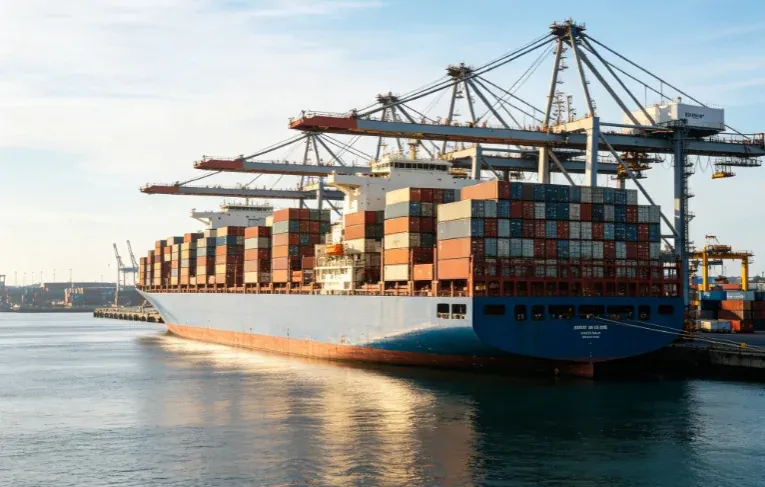
Two importers in Lima buy the same 55 CBM of floor tile from the same Foshan factory in the same month. The first books one 40ft container; the second splits the order across two 20ft boxes. Both sail in the same week and berth at Callao within three days of each other — but the second importer pays roughly 41% more in ocean freight for exactly the same volume of cargo.
That gap is what this guide is about. 20ft and 40ft container shipping cost from China to Peru is not one number, it is a decision about how you pay for space — and on this lane that decision moves your landed cost per cubic metre from about $282 to $334 on bulky cargo. Below are the Q3 2026 rates by origin port, the specs that matter at Callao and Chancay, the road-weight rule that quietly rules out a 40ft for dense cargo, and the duty and IGV math for both box sizes. It comes from 15 years of forwarding practice at Dantful.US International Logistics. If you are still choosing between sea, air and door-to-door, start with our shipping from China to Peru overview first.
20ft vs 40ft Container Cost from China to Peru: The Per-CBM Math That Decides It
Quotes are usually compared the wrong way. A broker says “20ft for $2,400, 40ft for $3,400” and the smaller number feels cheaper. It is not: the 40ft costs about 40% more but carries more than twice the volume, so you are buying space at a 30% discount.
| Box | Usable volume | Q3 2026 ocean freight, Shanghai → Callao | Cost per CBM |
|---|---|---|---|
| 20ft (20GP) | ~28 CBM | $2,400–$3,200 | $86–$114 / CBM |
| 40ft (40GP) | ~58 CBM | $3,400–$4,900 | $59–$84 / CBM |
| 40ft High Cube (40HQ) | ~68 CBM | $3,600–$5,100 | $53–$75 / CBM |
| LCL (shared) | per CBM used | $70–$125 / CBM | $70–$125 / CBM |
Divide the container rate by the usable CBM and the picture flips immediately. The same table also shows the break-even that decides most bookings on this lane:
| Your cargo volume | The box that costs least |
|---|---|
| Under 15 CBM | LCL — a 20ft would bill you for empty space |
| 15–28 CBM | 20ft (20GP) |
| 28–58 CBM | 40ft (40GP) |
| 58–68 CBM, bulky and light | 40ft High Cube (40HQ) |
Above roughly 15 CBM, containers beat LCL per CBM, and above 28 CBM a 40ft beats two 20ft on both freight and destination charges. That last point is worth money, and we come back to it below.
20ft, 40ft and 40HQ Container Specs for Peru Imports: Capacity, Payload and Pallets
Peru’s import mix is unusual: heavy building materials and ceramics on one side, electronics and apparel on the other. The right box for those two cargo profiles is not the same one.
| Spec | 20ft (20GP) | 40ft (40GP) | 40ft High Cube (40HQ) |
|---|---|---|---|
| Internal dimensions | 5.90 × 2.35 × 2.39 m | 12.03 × 2.35 × 2.39 m | 12.03 × 2.35 × 2.69 m |
| Geometric interior volume | ~33 CBM | ~67 CBM | ~76 CBM |
| Usable volume after stowage | ~28 CBM | ~58 CBM | ~68 CBM |
| Tare weight | ~2.2 t | ~3.8 t | ~3.9 t |
| Max gross (equipment rating) | 30.48 t | 32.5 t | 32.5 t |
| Practical cargo cap in Peru | 21–22 t | 21–22 t | 21–22 t |
| Euro pallets (1.2 × 0.8 m) | 10–11 | 20–21 | 20–21 |
| Best cargo profile | 15–28 CBM or dense/heavy | 28–58 CBM, mixed SKUs | 58–68 CBM, bulky and light |
Two numbers surprise first-time importers. First, usable volume is far below geometric volume — a 20ft is not a 33 CBM box in practice; stowage gaps, pallet footprints, dunnage and door clearance eat 10–15%. Second, the practical cargo cap in Peru is the same 21–22 t for a 40ft as for a 20ft, because the limit is the road, not the steel. That is the subject of a section further down, and it is the single most expensive misunderstanding on this lane.
20ft and 40ft Container Shipping Cost from China to Peru: Q3 2026 Rates by Origin Port
Rates below are realistic all-in port-to-port ranges to Callao for Q3 2026, before origin charges in China, destination charges in Peru and IGV. Chancay direct-express sailings price within the same band, occasionally at a small premium.
| Origin → Callao | 20ft (20GP) | 40ft (40GP) | 40ft HQ (40HQ) |
|---|---|---|---|
| Shanghai (Yangshan) → Callao | $2,400–$3,200 | $3,400–$4,900 | $3,600–$5,100 |
| Shenzhen (Yantian/Shekou) → Callao | $2,350–$3,150 | $3,350–$4,800 | $3,550–$5,050 |
| Guangzhou (Nansha) → Callao | $2,350–$3,150 | $3,350–$4,800 | $3,550–$5,050 |
| Ningbo (Beilun) → Callao | $2,450–$3,300 | $3,500–$5,000 | $3,650–$5,150 |
| Qingdao → Callao | $2,550–$3,450 | $3,600–$5,200 | $3,750–$5,350 |
| Shanghai → Chancay (direct express) | $2,500–$3,350 | $3,550–$5,100 | $3,700–$5,300 |
Three things move these numbers more than the box type does. Season: the August–December peak adds 15–30% to base rates and tightens 40HQ equipment before the Lunar New Year rush — book three to four weeks ahead and hold a rate-validity window rather than a single-day quote. Origin: southern China saves 1–3 days of sailing and often $50–$100 per container, while Qingdao prices highest on this lane. Surcharges: BAF/CAF is usually already inside a quoted container rate, but it is not always — ask. If you want to sanity-check a rate before you sign, run the numbers through our Freight Cost Calculator.
One more comparison belongs in this table: LCL runs $70–$125 per CBM with a one-CBM minimum, which is why a 12 CBM order should not be forced into a container, and an 18 CBM order should not stay in LCL.
What Is Inside a 20ft or 40ft Container Quote from China to Peru: Every Charge Explained
The container rate is roughly half of what you actually pay. These are the charges that appear on a Peru lane file:
| Stage | Charge | Typical range |
|---|---|---|
| Origin | Ocean freight (the quoted container rate) | see table above |
| Origin | THC and documentation at the Chinese port | $120–$260 per container |
| Origin | Export customs clearance and ENS filing | $80–$180 per shipment |
| Destination | Terminal handling and port charges at Callao or Chancay | $150–$350 per container |
| Destination | Delivery order and documentation fee | $60–$120 per container |
| Destination | SUNAT inspection, if the container is pulled to the red channel | $200–$600 per container |
| Destination | Inland trucking, Callao or Chancay → Lima warehouse | $350–$480 per container |
| Destination | Storage beyond free days, or demurrage/detention | $50–$200 per container per day |
| Destination | Duty (0% under the FTA with a certificate of origin) and IGV 18% | percentage of CIF + duty |
Here is the detail most importers miss: destination charges are charged per container, not per CBM. Roughly $600 of terminal, documentation and delivery-order cost lands as $21 per CBM on a 20ft and $10 per CBM on a 40ft. The 40ft already wins on freight per CBM; the fixed destination charges double that advantage. It also means the “cheap 20ft rate” a broker quotes rarely survives contact with the destination invoice — always ask for an itemized all-in quote naming every one of the lines above.
Two 20ft Containers or One 40ft to Peru: Which Costs Less for Your Cargo Volume?
For the same 50–55 CBM of cargo, this is the comparison that matters:
| Option | Ocean freight | Destination + inland | Total before duty and IGV |
|---|---|---|---|
| Two 20ft containers | $4,800–$6,400 | ~$2,040 | $6,840–$8,440 |
| One 40ft container | $3,400–$4,900 | ~$1,080 | $4,480–$5,980 |
One 40ft is roughly $2,300–$2,500 cheaper for the same volume, and it clears one customs file instead of two. Yet there are four situations where two 20ft boxes are genuinely the right answer, and a forwarder who blinks at that is selling you the wrong service:
- Cargo heavier than about 21–22 tonnes. The road cap applies per container, so a 40ft cannot legally carry it in one box (see the next section).
- Two consignees or two warehouses. Splitting one 40ft across Lima and Arequipa often costs more in de-consolidation than the second box costs.
- Two production dates. If a supplier can only finish half the order in time for the sailing, one 20ft now plus one 20ft later can be cheaper than missing the vessel with a 40ft.
- Incompatible cargo. Dangerous goods, food-grade goods and anything with fumigation or certification requirements should not share a container if the paperwork can be kept separate.
If your volume sits between 55 and 68 CBM, there is a third option worth pricing: ship a 40ft standard and move the last 3–8 CBM as LCL. LCL bills on chargeable weight — the greater of volume and weight, at a ratio of 1 CBM to 1,000 kg — so heavy leftover cargo can be more expensive per CBM than the space it occupies. Our Volumetric Weight Calculator converts carton dimensions into chargeable CBM in seconds; run your own cartons through it before deciding between a 40ft and a 40HQ.
20ft Container Weight Limits for Peru: Why Heavy Cargo Stops at 21–22 Tonnes
A 20ft container is rated to a maximum gross weight of 30.48 tonnes and its tare is about 2.2 tonnes, so the equipment itself would accept around 28 tonnes of cargo. A 40ft is rated at 32.5 tonnes gross with a 3.8-tonne tare. On paper, both boxes are heavy-lift machines.
In Peru they are not, because the binding constraint is the highway, not the container. Road weight rules for the Callao–Lima corridor cap a standard six-axle tractor-trailer combination at roughly 48 tonnes gross. Subtract the tractor, the chassis and the container tare and you are left with about 21–22 tonnes of cargo per container — the same figure whether you book a 20ft or a 40ft, and notably less than the 26.5 tonnes some overseas quote sheets promise.
The practical consequence for importers:
| Cargo | Typical density | Box to book |
|---|---|---|
| Furniture, packaging, insulation, apparel | 120–200 kg/CBM | 40HQ — volume-limited, fill it |
| Appliances, hardware, auto parts | 300–500 kg/CBM | 40GP |
| Ceramic tile, sanitaryware, marble, cement | 1,200–1,800 kg/CBM | 20GP — weight-limited long before it is full |
| Steel, machinery, castings | 2,000+ kg/CBM | 20GP, with VGM and permit checks |
For tile, ceramics and steel, the 40ft is a trap: you can only load it to about a third of its volume before you hit the road limit, and you pay for the empty 40 CBM. Two 20ft boxes, or one 20ft plus a small LCL top-up, is the honest answer. Note also that the Verified Gross Mass must be filed before loading — a misdeclared overweight container gets rolled, reweighed and fined, and it delays everyone behind it in the stack.
Landed Cost of a 20ft and a 40ft Container to Peru: Duty, IGV and the China–Peru FTA
Under the China–Peru FTA, in force since 2010 and upgraded by a protocol signed in November 2024, most Chinese manufactured goods enter Peru at 0% duty with a valid certificate of origin. Without that certificate the general rate applies, and on sensitive lines the duty band runs to 6–11%. Whichever box you choose, the certificate is the single largest saving on the file.
Here is the full tax math for one 20ft and one 40ft of the same product, shipped to Callao in Q3 2026:
| Item | 20ft container | 40ft container |
|---|---|---|
| Cargo FOB value | $13,000 | $28,000 |
| Ocean freight (Shanghai → Callao) | $2,800 | $4,100 |
| Insurance | $65 | $140 |
| CIF value | $15,865 | $32,240 |
| Duty with FTA certificate | 0% = $0 | 0% = $0 |
| Duty without certificate (11% line) | $1,745 | $3,546 |
| IGV 18% on CIF + duty (with certificate) | $2,856 | $5,803 |
| Total duty + IGV, FTA basis | $2,856 | $5,803 |
| Total duty + IGV, no certificate | $4,915 | $9,988 |
The missing certificate costs $2,059 more on the 20ft and $4,185 more on the 40ft — more than the entire freight difference between the two box sizes.
And now the number that should change how you book. Landed cost per CBM, including freight, insurance, duty, IGV, destination charges and inland delivery, for the same three cargo profiles in the same box sizes:
| Cargo profile | Value density | Landed cost per CBM, 20ft | Landed cost per CBM, 40ft | 40ft advantage |
|---|---|---|---|---|
| Bulky, low-value (tile, furniture) | $150/CBM | $334 | $282 | 15.6% |
| Mid-value (hardware, auto parts) | $450/CBM | $688 | $636 | 7.6% |
| High-value (electronics) | $1,400/CBM | $1,809 | $1,757 | 2.9% |
Read that table twice, because it runs against the usual advice. The 40ft is dramatically better on bulky, low-value cargo — where freight is a large share of what you pay — and almost irrelevant on high-value electronics, where IGV and the goods themselves dominate the bill. So: if you import tile, furniture or hardware and your volume fits a 40ft, never book a 20ft to “save money”. If you import electronics, stop optimising the box and optimise the sailing date instead. And on either profile, get the documents right — the certificate of origin and the invoice-to-packing-list match are exactly the checks a good freight forwarder from China to Peru should be running before the container is sealed.
Frequently Asked Questions
Q: How much does a 20ft container cost from China to Peru in Q3 2026?
A: Port to port, a 20ft from Shanghai to Callao runs $2,400–$3,200, and $2,350–$3,150 from Shenzhen or Guangzhou. Qingdao departures price $150–$250 higher. Origin charges in China, destination charges in Peru and IGV of 18% are added on top.
Q: How much does a 40ft container cost from China to Peru?
A: A 40ft standard from Shanghai to Callao runs $3,400–$4,900 in Q3 2026, and a 40ft High Cube $3,600–$5,100. The 40HQ usually costs only 5–10% more than the 40GP while adding about 10 CBM of volume.
Q: Is a 20ft or a 40ft container cheaper per CBM to Peru?
A: The 40ft, by roughly 30%: $59–$84 per CBM against $86–$114 per CBM in a 20ft. Destination charges work the same way, because they are billed per container — about $21 per CBM on a 20ft and $10 per CBM on a 40ft.
Q: How much cargo fits in a 20ft container to Peru?
A: About 28 CBM usable, or 10–11 Euro pallets. A 40ft holds roughly 58 CBM and a 40HQ about 68 CBM. Usable volume sits 10–15% below the geometric interior volume because of stowage gaps, pallets and door clearance.
Q: What is the weight limit for a container to Peru?
A: Practically 21–22 tonnes of cargo per container, for both 20ft and 40ft, because Peru road weight rules cap the gross combination weight of a standard tractor-trailer. Dense cargo like tile, ceramics or steel is weight-limited, so two 20ft boxes can legally carry more than one 40ft.
Q: Do these container rates include Peruvian duties and IGV?
A: No. Port-to-port rates cover ocean freight and surcharges only. Under the China–Peru FTA most goods pay 0% duty with a certificate of origin, then IGV of 18% on CIF plus duty, plus terminal handling, the customs broker and inland delivery.
Get a 20ft or 40ft Container Rate from China to Peru
The right box is not the cheapest box — it is the one that matches your cargo density, your volume and your destination. On the Peru lane that usually means a 40ft for bulky consumer goods under 21 tonnes, a 20ft for tile, ceramics and steel, and a hard look at LCL below 15 CBM. Q3 2026 rates have stayed steady rather than spiking, which makes this a good quarter to lock a rate-validity window instead of chasing the market weekly.
Two useful next reads: our sea freight from China to Peru guide covers Callao versus Chancay and the full sailing schedule, and the 20ft container shipping cost from China to Brazil breakdown shows how the same per-CBM logic prices out on a neighbouring lane.
Ready to price your own container? Contact Dantful.US with your cargo volume, weight and destination city, and we will quote a 20ft, a 40ft and a 40HQ side by side so you can see the per-CBM difference before you book.