Two containers are booked from Shanghai to Callao eleven days apart. They berth four days apart. Nothing broke, nothing was late in a way anyone could claim for: the first box went on a vessel that was rolled once when the carrier blanked the sailing, and the second went on the replacement. For the Lima importer waiting on both, the difference between a 26-day transit and a 37-day transit was a phone call and a booking date, not an ocean.
That is the honest shape of the question how long does it take to ship from China to Peru. There is a published transit time, and then there is the calendar your buyer actually works to — production finished, cargo collected, vessel sailed, container discharged, SUNAT released, truck at the door. Four clocks run on a China–Peru shipment and only one of them is the ocean. This guide sets out what each one costs you in days, on Q4 2026 schedules, from fifteen years of running this corridor at Dantful.US International Logistics.
How Long Does It Take to Ship from China to Peru in Q4 2026? The Short Answer
Four numbers cover almost every shipment, and they are not interchangeable — one is port to port, one is airport to airport, two are door to door.
| Mode | What the number measures | Q4 2026 |
|---|---|---|
| Sea FCL, direct to Callao | Port to port, vessel sailing to berth | 22–30 days |
| Sea FCL, direct to Chancay | Port to port on the China–Chancay express | 23–26 days |
| Sea LCL | CFS to CFS | 29–37 days |
| Air freight, consolidated | Airport to airport | 3–7 days |
| Air freight, door to door | Supplier door to Lima address | 5–9 days |
| Express courier (DHL/FedEx/UPS) | Door to door, all-in | 3–6 days |
| Door to door by sea, FCL | Supplier door to Lima address | 34–45 days |
| Door to door by sea, LCL | Supplier door to Lima address | 38–50 days |
Two rules of thumb make those ranges usable. First, the only number worth promising a customer is the door-to-door one, because everything upstream of it is schedule and everything downstream of it is paperwork. Second, the spread inside each range is not carrier quality — it is origin port, gateway and whether your booking survives the sailing it was made for. The country-level picture of modes and costs sits in our shipping from China to Peru overview; this article is about the clock.
Sea Freight Transit Time from China to Peru: Callao, Chancay and the Transshipment Penalty
Peru has two gateways that matter for Chinese cargo and they behave nothing alike. Callao still handles roughly 90% of the country’s containerised imports, with DP World Callao on the south mole and APM Terminals Callao on the north mole, and it sits inside the Lima conurbation. Chancay, opened in November 2024 about 80 km up the coast, is the COSCO Shipping Ports and Volcán deepwater terminal built specifically for this trade, with 17.8 m of draft, roughly a million TEU of first-phase capacity and dedicated direct loops to Asia.
| Lane | Service | Port to port |
|---|---|---|
| Shanghai → Callao | Direct | 24–30 days |
| Shenzhen/Yantian → Callao | Direct | 22–28 days |
| Ningbo → Callao | Direct | 25–31 days |
| Qingdao → Callao | Direct | 28–35 days |
| Shanghai → Chancay | Direct express | 23–26 days |
| Any China port → Callao | Transshipment via Busan, Hong Kong, Singapore or Manzanillo | 30–40 days |
| Callao → Paita / Matarani / Ilo | Feeder | 2–6 days |
Read the table in three directions and the lane explains itself.
Down the column, the southern origins are quicker because Yantian and Shekou are earlier calls on the Asia–West Coast South America rotation; Qingdao pays three to five days for being last on and first off in the wrong order. If your supplier is in Shandong and the last mile is Lima, the $250–$350 you save on a Qingdao rate buys you four days of nothing.
Across the gateways, Chancay is genuinely faster than Callao on the express — a week on some voyages — but the advantage is schedule-shaped, not universal. Chancay’s window is stable because the terminal was built for this traffic and is not fighting the Lima metro for yard space. Its feeder and inland network is still filling in, so cargo for Arequipa, Cusco or the south is usually better off discharged at Callao.
Through the transshipment row, the penalty is real and under-quoted: 8–12 days added, plus a second discharge and reload, plus the odds of a missed connection. Transshipment is the right answer for secondary Chinese origins with no direct call and for equipment emergencies. It is the wrong answer for a shipment with a date on it.
One more number that never appears on a rate sheet: Callao discharge to truck. Congested berth windows push it to 2–4 days in a heavy import week, which is why a “24-day” sailing can produce a 29-day arrival at the warehouse with nobody having done anything wrong. Our sea freight guide for Peru covers the carrier rotations and the port-by-port schedule behind this table.
Air Freight Transit Time from China to Peru: 3–7 Days When Nothing Goes Wrong
Lima’s Jorge Chávez (LIM) is the only international cargo airport that matters, and there is no daily dedicated freighter from a Chinese hub into it. Most air cargo to Peru moves on a connection — Hong Kong or Shanghai into Los Angeles, Mexico City, Madrid or Amsterdam, then down to Lima — which is why the honest door-to-door figure is 5–9 days rather than the three days a flight schedule implies.
| Service | Weight break | Transit | Rate per kg, Q4 2026 |
|---|---|---|---|
| Express courier (DHL/FedEx/UPS) | any | 3–6 days door to door | $10–$18 |
| Consolidated air, via a hub | 45–100 kg | 6–9 days door to door | $6.5–$9 |
| Consolidated air | 100–300 kg | 5–8 days door to door | $5–$7.5 |
| Consolidated air, direct capacity | 300 kg + | 4–7 days door to door | $3.5–$7 |
The two days most importers lose before wheels-up are the ones nobody prices: supplier pickup and export declaration (1–2 days, longer if the factory is inland), plus screening and build-up in the consolidator’s shed. A Wednesday booking does not fly Wednesday.
Air also bills on the greater of actual weight and volumetric weight, at length × width × height in centimetres divided by 6000. A crated machine measuring 200 × 120 × 110 cm occupies 4.4 CBM and bills at 440 kg even if the crate weighs 260 kg — a 69% surcharge on paper. Run the carton dimensions before you accept a per-kilo quote; our volumetric weight calculator applies the same division the airline does.
Air earns its premium on a narrow band of cargo: launch stock, spare parts that stop a production line, high-value electronics, and anything where the product value per kilogram sits above roughly $8–$12. Below that line, sea wins on cost by so wide a margin that the extra three weeks is cheaper than the freight.
Door to Door Shipping Time from China to Peru: What Fills the 34–45 Day Number
A door-to-door quote collapses the four clocks into one figure, which is convenient until something slips and nobody can say which stage ate the week. Here is the breakdown to ask for.
| Stage | FCL | LCL | Air |
|---|---|---|---|
| Supplier pickup and export declaration | 2–4 days | 2–4 days | 1–3 days |
| Consolidation (LCL) or gate-in and sailing (FCL) | 1–3 days | 4–6 days | — |
| Ocean or air transit | 23–27 days to Chancay, 24–30 to Callao | same plus a relay | 2–4 days to LIM |
| Discharge and terminal release | 1–2 days | 2–4 days | same day |
| SUNAT clearance | 1–3 working days | 1–3 working days | 1–2 working days |
| Final delivery | 1–2 days in Lima | 1–2 days in Lima | 1–2 days in Lima |
| Total door to door | 34–45 days | 38–50 days | 5–9 days |
LCL pays two extra taxes in time: four to six days of consolidation at a Chinese CFS before the container is even stuffed, and two to four days of de-stuffing at a Callao warehouse before the cargo is released. That is why 12 CBM of LCL routinely lands three to five days after a 20ft booked the same week. The delivered-cost comparison between the two sits in our door to door guide for Peru.
The last line is where Peruvian geography bites. Callao and Chancay to a Lima warehouse is same-day or next-day. Arequipa is 1,000 km down the Panamericana Sur and takes 2–3 days. Cusco 3–4, Puno 4–5, and Iquitos is air or river only — a container that clears in Callao on Tuesday is not in Iquitos on Thursday.
Peru Customs Clearance Time: How Long SUNAT Holds a Container at Callao
SUNAT clears imports through the DAM (Declaración Aduanera de Mercancías), filed electronically by a licensed despachador de aduana. You cannot file it yourself, and you cannot clear commercial cargo without a RUC tax number. Both have to exist before the vessel arrives, not after.
| Scenario | Days added after discharge |
|---|---|
| DAM filed before berthing, green or orange channel | 1–3 working days |
| Document review with a query back to the broker | +1–2 working days |
| Red-channel physical inspection | +2–4 working days |
| Missing or mismatched certificate of origin | +3–10 days |
| Missing sector permit (DIGESA, SENASA, DIGEMID, MTC) | +5 days to weeks |
Three things control that clock, and none of them is the carrier.
The first is the certificate of origin. The China–Peru Free Trade Agreement has been in force since 2010 and, with a valid certificate, most Chinese industrial goods enter at 0% ad valorem; without it the same cargo pays 6% or more, and the delay while a certificate is re-issued from China is measured in days. Under a DDP door-to-door quote the forwarder absorbs that duty, which is exactly why a serious forwarder pushes the document back to the supplier before the vessel sails.
The second is the channel. SUNAT routes each DAM to green, orange or red. Green is documentary release; red is a physical inspection with the container moved to an inspection bay. Classification accuracy, consistent weights and a broker who declares what is actually in the box are what keep a file green, and the penalty for guessing is two to four working days plus the terminal’s storage meter running.
The third is the statutory clock. The DAM has to be numbered within 15 calendar days of the vessel’s arrival, and cargo still undeclared 30 days after arrival can be declared legally abandoned. Nobody plans to test that rule, but it defines how much slack exists: none worth relying on.
Then the money clock starts, in parallel. Callao terminals typically give 5–7 free days from discharge and then charge $40–$85 per day for a 20ft and $75–$150 for a 40ft in storage; carrier detention on the equipment runs 7–10 free days and then $30–$60 / $55–$110 per day until the empty comes back. A container cleared on day two pays nothing. A container cleared on day nine pays four figures, and it is the paperwork — not the ocean — that decides which one you get.
Shipping Cost from China to Peru: What Three Weeks of Speed Actually Costs
Cost is the other half of the transit-time decision, and it is worth putting on the same page as the days.
| Option | Q4 2026 rate | Effective cost per kg |
|---|---|---|
| Sea FCL, 20ft, port to port | $2,300–$3,100 | $0.12–$0.16 at 20 tonnes |
| Sea LCL | $65–$115 per CBM | $0.07–$0.12 at 1,000 kg per CBM |
| Air, consolidated | $3.5–$7.5 per kg | as billed, on chargeable weight |
| Express courier | $10–$18 per kg | as billed |
The arithmetic that matters: moving a 1,000 kg consignment from sea to air costs roughly $4,000–$6,000 more and saves about 25 days. That works out to $160–$240 per day of inventory brought forward. If the goods will earn a gross margin faster than that — a launched product, a seasonal line that has to be on shelf for the December peak — air pays for itself. If they will sit in a Lima warehouse earning nothing, it does not. A rough inventory carrying cost of 1.5–2% of goods value per month is the floor for that comparison, and the stock-out cost is usually larger than the carrying cost.
For a first-pass figure before you talk to anyone, the freight cost calculator returns a starting price by mode and destination region. Treat it as a floor: Peruvian destination charges vary by terminal and by carrier, and the calculator does not know your commodity.
How to Plan a China to Peru Shipment Date: Working Backwards From Delivery
The reliable way to answer “how long will this take” is to stop adding days forward and start subtracting them from the date the goods are needed. A worked example — 12 CBM of furniture and lighting that must be in a Lima warehouse by 15 January 2027:
| Step back from delivery | Date | What has to be true |
|---|---|---|
| Goods in Lima warehouse | 15 Jan 2027 | Delivery booked, address confirmed |
| Clearance and inland buffer | 5 days | DAM filed before berthing |
| Vessel alongside Callao | 10 Jan 2027 | 26-day direct sailing from Shanghai |
| Sailing from Shanghai (ETD) | 15 Dec 2026 | Container gated in by 13 Dec |
| Supplier production complete | 5 Dec 2026 | Balance paid, inspection passed |
| Space booked and confirmed | 20 Nov 2026 | Booking made 3–4 weeks before ETD |
| Cut-off | When it falls |
|---|---|
| Booking confirmation | 3–4 weeks before ETD |
| Shipping instruction and VGM data | 48–72 hours before ETD |
| Documentation (SI, HS codes, certificate of origin) | 3–5 days before ETD |
| Container yard cut-off | 24–48 hours before ETD |
| Gate-in at the Chinese terminal | 3–7 days before ETD |
Two failure modes recur in that calendar. The booking is made the week the cargo is ready, which in a tight December capacity market means a roll to the next sailing — usually seven days. And the certificate of origin is requested after the container has sailed, which turns a clean 0% duty entry into a paid assessment plus a delay. Both are cheap to prevent at booking time and expensive to fix afterwards.
Tracking a China to Peru Shipment: B/L, Container Number and the DAM
Once the box is on the water, three checkpoints tell you more than any tracking app.
- Bill of lading and container number — carrier sites and aggregators show the vessel’s actual position and any roll. Check the vessel name and voyage on the B/L matches the booking before the container gates in; a rolled booking is visible here first.
- Terminal record at Callao or Chancay — the DP World Callao and APM Terminals Callao portals show discharge, gate-out availability and free-time expiry, which is the number that starts costing money.
- SUNAT’s VUCE and DAM status — the channel assignment and release state live in SUNAT’s system, visible to your broker. Ask for the channel, not for reassurance: green, orange and red have very different clocks.
When China to Peru Shipping Time Slips: Blank Sailings, Swell and Chinese New Year
Every delay on this lane has a name, a typical price in days, and a specific fix. The pattern across 2026 is that carriers manage capacity on the Asia–West Coast South America loop with monthly blank sailings, so the schedule is less reliable than the transit time suggests.
| Cause | Typical days added | What prevents it |
|---|---|---|
| Blank sailing rolls your booking | 7 | Book 3–4 weeks out, hold a second sailing option |
| Missed transshipment connection | 7–14 | Pay for a direct call when a date matters |
| Callao berth congestion and yard dwell | 2–6 | Choose Chancay for northern Lima cargo in peak weeks |
| Heavy swell closing Callao or Paita | 1–3 | Insure; no schedule survives a port closure |
| Red-channel SUNAT inspection | 2–4 working days | Accurate classification and weights |
| Certificate of origin re-issued after sailing | 3–10 | Demand it before gate-in |
| Chinese New Year factory shutdown | 2–3 weeks | Sail by the second week of January 2027 |
| Peru’s grape and blueberry export season, Dec–Mar | 1–5 on reefer | Book reefer plugs and space early |
The calendar items on that list are the ones worth diarising now. Chinese New Year falls on 6 February 2027; factories in Guangdong and Zhejiang start closing a week or two before and reopen slowly, so a shipment that must land in Lima by early March needs to sail by the second week of January and be booked in December 2026. In Peru, the Fiestas Patrias holidays of 28–29 July and the Christmas–New Year week slow SUNAT and terminal staffing, and between December and March the country’s own fruit export season competes for reefer plugs and vessel space at Callao — inbound reefer cargo feels that squeeze first.
Swell deserves a line of its own. Callao and Paita close to operations when Pacific swell exceeds their operating limits, most often between May and September, and a two-day closure cascades into a week of berth delays. No forwarder can schedule around it; cargo insurance and a buffer can absorb it.
Frequently Asked Questions
How long does it take to ship from China to Peru in Q4 2026?
By sea, 22–30 days port to port to Callao depending on the origin port, or 23–26 days to Chancay on the direct express. Air is 3–7 days airport to airport and 5–9 days door to door, express courier 3–6 days. Door to door by sea runs 34–45 days for a full container and 38–50 days for LCL.
How long does sea freight from Shanghai to Peru take?
24–30 days from Shanghai to Callao on a direct call, and 23–26 days to Chancay on the dedicated China–Chancay express. Add discharge, 1–3 working days of SUNAT clearance and 1–2 days of trucking for the warehouse date.
Why is my container later than the transit time I was quoted?
Because the quote was port to port on a named vessel. A roll from a blank sailing adds about 7 days, a missed transshipment connection 7–14 days, a red-channel inspection 2–4 working days, and a re-issued certificate of origin 3–10 days.
How long does customs clearance take in Peru?
One to three working days once the DAM is filed before berthing, on the green or orange channel. A red-channel inspection adds 2–4 working days, and cargo still undeclared 30 days after arrival risks legal abandonment.
Is air freight worth the extra cost from China to Peru?
It saves 25–30 days for roughly $4,000–$6,000 more per tonne. That is worth it for launch stock, spare parts, and cargo worth more than about $8–$12 per kilogram; it is not worth it for furniture, tiles, machinery or anything that will sit in the warehouse.
When should I book before Chinese New Year 2027?
Chinese New Year falls on 6 February 2027. To have goods in Lima by early March, sail by the second week of January — which means confirming space in the first half of December 2026, three to four weeks before the sailing date.
Get a China to Peru Transit Schedule in 24 Hours
Tell us the origin city, the destination city, the cargo volume and the date the goods have to be on the shelf. We will come back with the sailing, the gateway — Callao or Chancay — the transit in days, the cut-off dates that make it work, and the delivered total including SUNAT duty and 18% IGV. If the date is impossible, we will say so and show you the air option that meets it.
Start at contact Dantful.US with the shipment details, or read the container shipping guide for Peru if you are still choosing the box. Fifteen years on this corridor, and the schedules we quote are the ones we hold space on.
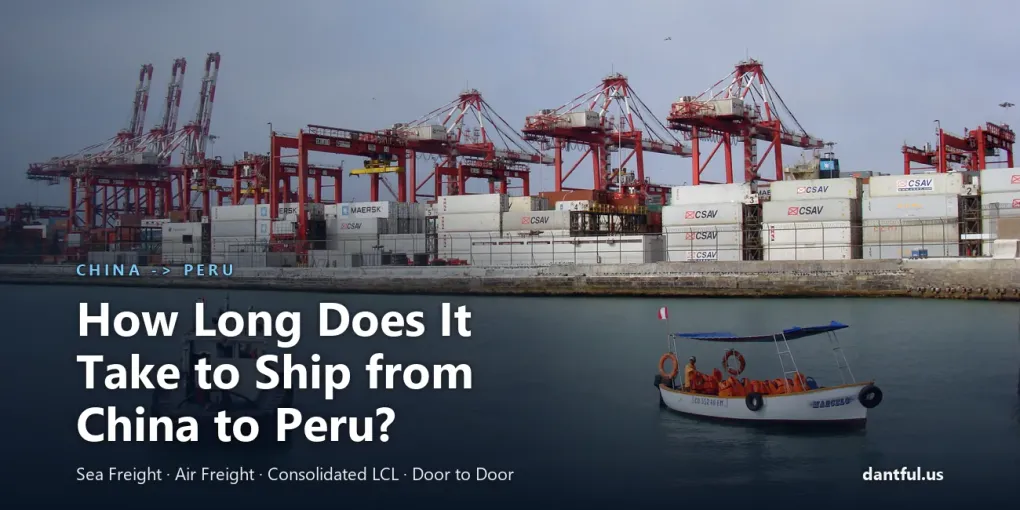
Cover photo: Port of Callao, Peru — Quado678, CC BY-SA 3.0, via Wikimedia Commons.