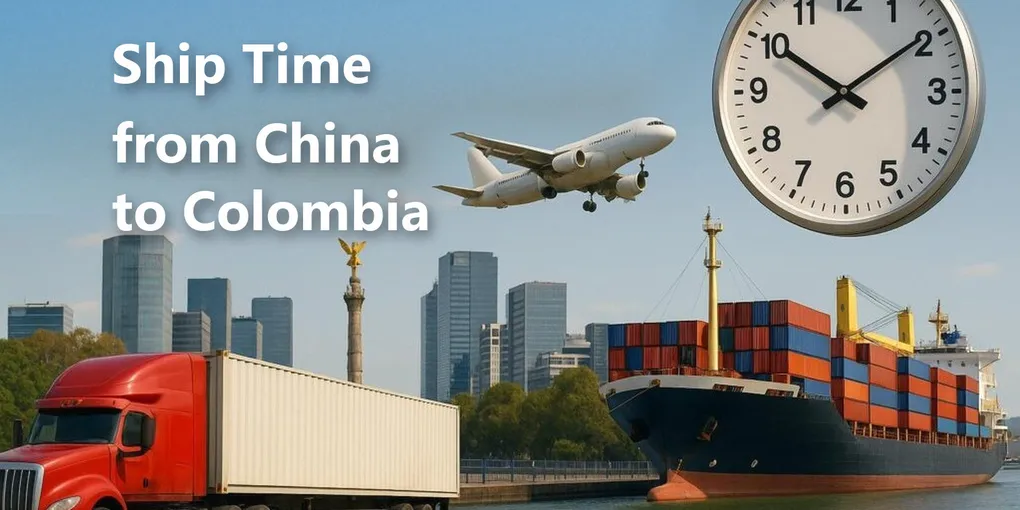
A forwarder quotes you 30 days from Shanghai to Cartagena. Your container is on a truck to Medellín on day 43. Nothing in that quote was dishonest — ocean legs on this lane are stable — but the number you were given only covered one of the five blocks that make up a delivery, and on no other South American lane is the block you control before booking worth so many days.
Colombia is the only major market on the continent where the same cargo can arrive at two different oceans, and where the receiving airport sits higher than most ski resorts. That combination makes how long it takes to ship from China to Colombia a question about geography as much as about carriers. This guide breaks down the Q4 2026 transit times by mode, then shows where the days actually go: the coast decision, the 2,548-metre airport, the DIAN release clock, and the four delays that are worth planning around. If you want the commercial picture of the same lane, our China to Colombia shipping hub covers services and routing, and the cost guide prices it.
How Long Does It Take to Ship from China to Colombia? Q4 2026 Answers by Mode
| Mode | Ocean or air leg | Door to door | Typical cargo |
|---|---|---|---|
| Sea FCL to Buenaventura | 28–40 days port to port | 36–48 days | Full containers, 15 CBM and up, western Colombia |
| Sea FCL to Cartagena | 32–45 days port to port | 38–52 days | Full containers, Atlantic coast and Medellín |
| Sea LCL (groupage) | Sailing plus consolidation | 43–58 days | 1–15 CBM, no hard deadline |
| Air freight to Bogotá (BOG) | 2–4 days flight | 4–10 days | Urgent, high value, under ~2 CBM |
| Express courier | 1–3 days flight | 3–6 days | Samples, documents, spare parts |
Two things about that table matter more than the numbers. The first is that the sea ranges overlap: a well-booked Cartagena container can beat a badly booked Buenaventura one, because the ocean leg is the part you do not control and the truck leg is the part you do. The second is that the air column is the only one that survives a supply-chain emergency — the price per kilo is five to ten times sea, and it is still the cheapest way to protect a launch date.
A door-to-door figure on this lane is built from six blocks, and only one of them is a ship:
| Stage | Q4 2026 time | Who controls it |
|---|---|---|
| Production ready to truck to the Chinese terminal | 3–7 days | Supplier and booking cut-off |
| Ocean leg to Buenaventura or Cartagena | 28–45 days | Carrier string, canal, transshipment |
| Discharge, berth and terminal handling | 1–3 days | Terminal and vessel rotation |
| DIAN declaration and levante | 2–5 working days | Broker, VUCE permits, inspection channel |
| Arancel and IVA settlement | Same day to 2 days | Importer and bank |
| Inland trucking to the consignee | 4 hours to 3 days | Distance, altitude, road conditions |
Sea Freight Transit Time from China to Colombia: Buenaventura vs Cartagena
Both coasts work, and both are served weekly from China. The difference is where the container ends up after discharge, and the gap is measured in days, not hours.
| Chinese origin | Colombian port | Port to port | Routing |
|---|---|---|---|
| Yantian (Shenzhen) | Buenaventura | 28–38 days | Direct West Coast South America string |
| Shanghai (Yangshan) | Buenaventura | 30–40 days | Direct WCSA, occasionally via Balboa |
| Ningbo | Buenaventura | 31–41 days | Direct or Busan relay |
| Qingdao | Buenaventura | 33–43 days | Direct WCSA weekly |
| Shanghai | Cartagena | 32–45 days | Panama Canal transit or Balboa relay |
| Yantian | Cartagena | 32–44 days | Usually one transshipment |
| Ningbo | Cartagena | 33–46 days | Caribbean relay at Kingston or Colon |
| Shanghai | Barranquilla | 36–48 days | Magdalena river terminal, draft-dependent |
Buenaventura is the Pacific gateway and the shorter ocean leg from every Chinese port, because the vessel crosses the Pacific once instead of crossing it and then threading the Panama Canal. Terminals here — the SPRB container facility and Puerto Bahía — handle the bulk of Colombia’s Pacific boxes, and the truck to Cali takes 3–4 hours while Bogotá is a 6–8 hour climb through the Cordillera Occidental. What you accept in exchange is volatility: Buenaventura dwell time swings hard in the September–November import peak, and a two-day queue at the gate erases the ocean advantage in one afternoon.
Cartagena is the Caribbean hub, with the widest weekly choice of Asia services and the most mature transshipment connections in the country. Ocean transit looks four to six days longer on paper, and the truck to Medellín runs 12–14 hours, to Bogotá 16–20 hours. It still wins door to door for Medellín, Barranquilla, Santa Marta and the whole Atlantic industrial belt, and it wins on predictability for anyone restocking e-commerce in Q4.
Barranquilla is the river option: the Magdalena channel depth governs how much a vessel can load, sailings are thinner, and 36–48 days is realistic. For cargo staying inside the Barranquilla free zone or moving up the river corridor, the extra week is still cheaper than trucking from another coast.
The coast decision, in one line: Buenaventura for Bogotá, Cali, Pereira and the Cauca Valley; Cartagena for Medellín, the Atlantic coast and anything that cannot tolerate Pacific congestion. Getting this wrong does not add hours — it adds days and $600–$1,500 of trucking on a 40GP. Our sea freight guide for Colombia goes deeper on terminals, sailing strings and port charges.
Air Freight Transit Time from China to Colombia: El Dorado at 2,548 Metres
Flight time from PVG, SZX, CAN or HKG to Bogotá is 2–4 days on scheduled cargo and belly capacity, and the full door-to-door figure lands at 4–10 days once export handling, DIAN clearance and delivery are counted. That is the headline. The local detail that changes real ETAs is the airport itself.
El Dorado sits at 2,548 metres above sea level. Thin air reduces lift, so a freighter that leaves Shanghai at maximum payload cannot carry the same tonnage out of — or into — Bogotá. In practice this means heavy, dense consignments are sometimes weight-capped on the last leg, staged through Miami or Mexico City, or routed to a lower airport: Cartagena (CTG) at sea level, Cali (CLO) at 964 metres, or Medellín José María Córdova (MDE) at 2,142 metres. It also means night cargo slots at BOG are coordinated and finite, so a missed slot pushes a shipment to the next window rather than the next hour.
For light, high-value cargo — electronics, pharma, fashion, spare parts — none of this matters and Bogotá is the fastest door in the country. For dense cargo (machinery parts, printed matter, liquids, tiles), ask specifically which airport receives the freight, because a D2D quote that assumes BOG can quietly become a six-day itinerary with a stop in Miami.
Air is also the one mode where the billing logic changes the answer to “how long”. Airlines charge the greater of actual weight and volumetric weight, calculated as length × width × height in centimetres divided by 6,000. A carton that weighs 40 kg but measures 120 × 80 × 70 cm bills at 112 kg — so loose packaging costs money on this lane even when the flight has space. Run your dimensions through our volumetric weight calculator before you request rates. Our air freight guide covers the carrier options and per-kilo bands.
LCL Shipping Time from China to Colombia: Why Consolidated Cargo Loses a Week
LCL is quoted with the same sailing as FCL and almost never arrives on it. Add 5–10 days to any FCL figure and you are close:
| Stage | Added time | Why |
|---|---|---|
| Waiting for the container to fill | 2–7 days | Your cargo sails when the consolidator closes the box |
| CFS handling in China | 1–2 days | Stuffing, measuring, documentation |
| Deconsolidation in Colombia | 2–4 days | Unstuffing at a CFS before release |
| DIAN treatment of consolidated cargo | 0–4 days | Mixed cargo invites documentary review or inspection |
The last row is the one importers underestimate. A consolidated container holds several importers’ goods under one bill of lading, so a single mis-declared item holds up the whole deconsolidation, not just its owner. In Colombia, where DIAN can select consolidated cargo for scanning or physical inspection, that risk is real rather than theoretical.
The consequence is a planning rule rather than a complaint: LCL is a cost tool, not a speed tool. If your deadline is hard and your volume is above roughly 13–15 CBM, a 20GP container will usually arrive earlier and cost less per CBM, because it clears as a single unit. Below 15 CBM, LCL remains the right answer — just put the extra week in your calendar instead of discovering it at the destination.
Colombia Customs Clearance Time for China Imports: DIAN, VUCE and the Levante
Clearance is the block importers blame for everything and measure least. Here is what the clock actually contains.
The declaration is filed electronically with DIAN by a licensed agencia de aduanas — Colombia requires a registered customs agent for commercial imports, and this is not a formality you can skip with a cheap broker. Any product needing prior authorisation (certain chemicals, used goods, some textiles, agricultural inputs) needs that permit through VUCE before the vessel arrives, and a permit applied for after discharge adds its processing time to your demurrage bill, not to the carrier’s.
Once filed, the shipment is channelled:
| Channel | Time | What happens |
|---|---|---|
| Documentary review | 1–2 working days | DIAN checks invoice, HS code, value and permits |
| Non-intrusive inspection | 1–3 working days | Scanner at the terminal, no container opening |
| Physical inspection | 2–5 working days | Container devanned and examined |
Then comes the levante — the release that lets the container leave the terminal. Arancel and 19% IVA on the duty-inclusive CIF value must be settled first, which is why a bank delay looks exactly like a customs delay to the consignee.
One structural fact separates Colombia from most of its neighbours: there is no free trade agreement between China and Colombia. Chile, Peru and Ecuador all grant preferential treatment to Chinese-origin goods with the right certificate. Colombia does not. Your cargo pays the MFN arancel — commonly 0%, 5%, 10% or 15% by HS code — and anti-dumping duties apply to several textile, footwear and steel categories. So there is no certificate shortcut to chase, and the only lever that shortens clearance is accurate classification and complete documents filed before arrival.
Realistic answer: 2–5 working days for a clean entry, with a tail to eight. Budget five.
Shipping Cost vs Transit Time from China to Colombia: The Break-Even
Time and money trade off at a predictable rate on this lane, and the rate is set by value density, not by preference.
| Mode | Effective cost | Transit | Where it wins |
|---|---|---|---|
| Sea FCL, 40GP | $3,600–$5,200 per container | 36–52 days door to door | Goods worth under ~$20/kg |
| Sea LCL | $70–$125 per CBM | 43–58 days | 1–15 CBM, flexible timing |
| Air freight | $5.00–$8.50 per kg, $50–$150 minimum | 4–10 days | Goods worth over ~$60/kg or a broken stock-out |
| Express courier | $10–$15 per kg | 3–6 days | Under 45 kg, launches, replacement parts |
A 40GP carrying 20 tonnes of goods worth $60,000 pays roughly $0.22 per kg for the ocean leg. The same goods by air would cost $100,000 or more in freight — the decision makes itself. Reverse the numbers and the answer reverses: 300 kg of electronics worth $80,000 sitting in a Colombian warehouse as a stock-out costs more per day than the air premium charges once. Model your own shipment with our freight cost calculator before deciding, because the break-even sits at a different dollar value for every product.
The practical version most importers converge on: put 80–90% of volume on the water, keep an air budget for the 10% that protects a launch or a contract penalty, and never let a seasonal peak force an emergency air shipment of cargo that could have sailed three weeks earlier.
How to Shorten Shipping Time from China to Colombia: Six Levers
None of these require a better carrier. All of them are available to any importer.
- Fix the coast before you fix the sailing. A door-to-door comparison of Buenaventura and Cartagena regularly finds two to four days that were being lost to inland trucking.
- Book inside the cut-off, not after it. Missing a weekly cut-off costs seven days, which is more than any carrier can recover. In Q4, book three to four weeks ahead.
- File documents before the vessel sails. Commercial invoice, packing list, bill of lading, HS code and any VUCE permit should be with your broker while the container is still at sea. Pre-arrival filing is what turns a five-day clearance into a two-day one.
- Nominate the broker before you book the freight. The agent who will file with DIAN should see the invoice at production stage, not at discharge.
- Cross the LCL threshold deliberately. At 15 CBM the 20GP usually arrives earlier and clears faster; splitting the difference across two LCL bookings buys you two deconsolidation waits.
- Plan around the Colombian calendar. Semana Santa, the December–January holidays and the September–November import peak all compress terminal and customs capacity. A shipment that lands on a holiday eve waits.
Why China to Colombia Shipping Time Slips: Four Delays You Can Plan For
| Delay | Days at risk | How to absorb it |
|---|---|---|
| Buenaventura congestion, September–November | 2–6 | Switch to Cartagena for Atlantic destinations; book early; avoid arrival in the last week of the month |
| Panama Canal draft or slot restrictions | 2–8 | Ask whether the Cartagena service transits the canal or relays at Balboa; relay routings are more resilient |
| Road blockades on the Cali–Buenaventura corridor | 1–4 | Keep 3–5 days of buffer for Pacific cargo; hold a secondary carrier for the inland leg |
| DIAN physical inspection | 2–5 | Correct HS codes, complete permits, pre-arrival filing, consolidated cargo avoided where possible |
Every one of those is a schedule risk, not a cargo risk: the box is fine, the calendar is not. That distinction matters because it tells you where to spend money — on buffer and on documentation, never on a faster vessel that the terminal will hold anyway.
Frequently Asked Questions
How long does it take to ship from China to Colombia in Q4 2026?
Sea freight runs 28–40 days port to port into Buenaventura and 32–45 days into Cartagena, which becomes 36–50 days door to door once export handling, DIAN clearance and inland trucking are added. LCL adds 5–10 days to the same sailing. Air freight delivers in 4–10 days door to door, and express couriers in 3–6 days.
How long does sea freight from China to Colombia take?
Yantian to Buenaventura is the fastest common string at 28–38 days, Shanghai to Buenaventura 30–40 days, Shanghai to Cartagena 32–45 days through the Panama Canal, and Shanghai to Barranquilla 36–48 days because of the Magdalena river draft. Transshipment at Balboa, Colon, Busan or Manzanillo adds 4–10 days.
Is Buenaventura or Cartagena faster for Colombia?
For Bogotá, Cali and the Cauca Valley, Buenaventura is usually two to four days faster overall because the ocean leg is shorter and the truck climb takes 6–8 hours instead of 16–20. For Medellín, Barranquilla, Santa Marta and the Atlantic coast, Cartagena wins despite a longer ocean leg. The decision flips during Buenaventura congestion peaks from September to November.
How long does air freight take from China to Colombia?
Flight time is 2–4 days from PVG, SZX or CAN to Bogotá El Dorado, and 4–10 days door to door. El Dorado sits at 2,548 metres, so dense heavy cargo is sometimes payload-capped or staged through Miami, Mexico City or Medellín, which adds a day. Cartagena at sea level and Cali at 964 metres absorb heavy freight more easily.
How long does customs clearance take in Colombia?
A complete import declares and releases in 2–5 working days. The declaration is filed with DIAN by a licensed agencia de aduanas, VUCE handles any prior permit, and the shipment is channelled to documentary review, non-intrusive scanning or physical inspection. Physical inspection adds 2–5 working days, and a wrong HS code or an unpaid IVA line pushes release past a week.
What delays shipments from China to Colombia the most?
Four causes dominate: booking after the weekly cut-off, Buenaventura terminal congestion in the September to November import peak, Panama Canal draft or slot restrictions on Cartagena routings, and DIAN inspections on consolidated LCL cargo. Road blockades on the Cali to Buenaventura corridor are the fifth risk, and they can add three days with no notice.
Get a China to Colombia Transit Time and Quote in 24 Hours
Transit time is a planning number, and planning numbers only work when they are built from your cargo rather than from an average. Tell us the goods, the volume, the Chinese factory city and the Colombian delivery address, and we will return a realistic door-to-door ETA with the coast decision already made — inside 24 hours, from people who have moved this lane for 15 years.
Request a China to Colombia quote and we will include the transit breakdown for both Buenaventura and Cartagena so you can see where your days are going before you book.