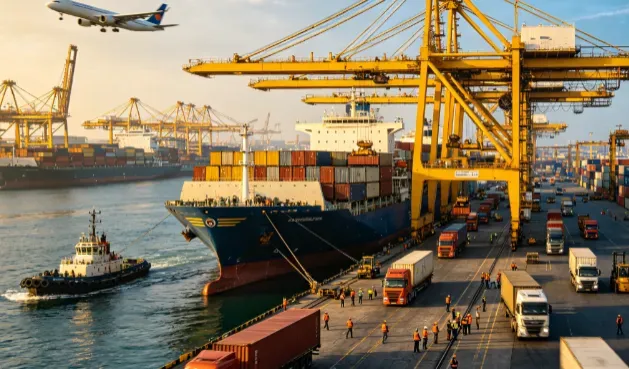
Sourcing from Vietnam means navigating freight, export paperwork, and US customs across three time zones. DDP shipping from Vietnam to USA collapses all of that into one transaction. Under Incoterms 2020, DDP (Delivered Duty Paid) means your freight forwarder handles everything: factory pickup → Vietnam export clearance → ocean or air freight → US import customs → duty payment → last-mile delivery. You receive the goods. That’s it.
With Vietnam’s exports to the US topping $136 billion in 2025 — textiles, furniture, electronics, footwear — DDP turns a multi-vendor headache into a single predictable cost. For importers who already move goods via shipping from China to USA, the DDP model works similarly on the Vietnam lane, but with its own ports, carriers, and tariff considerations. This guide covers real DDP costs by route and mode, door-to-door transit times from every major Vietnamese port, the complete 7-step process, Amazon FBA DDP from Vietnam, and how to pick a forwarder that won’t leave you stranded at US customs.
How DDP Shipping from Vietnam to USA Works: The Complete Process
Understanding the end-to-end timeline helps you plan inventory, set customer expectations, and spot where delays typically happen. Here’s the full door-to-door shipping from Vietnam to USA DDP workflow — each step with the documents you’ll need and the realistic time involved.
Step 1: Supplier Pickup in Vietnam (Day 1–2)
Once your goods are ready, your forwarder arranges trucking from the factory or warehouse to the export port. This covers all major industrial zones: Ho Chi Minh City (District 7, Binh Duong, Dong Nai), Hanoi and Bac Ninh provinces in the north, and the Da Nang area in central Vietnam. For FCL shipments, the container is typically loaded at the supplier’s facility under your forwarder’s supervision.
Step 2: Vietnam Export Customs Clearance (Day 2–3)
Vietnam’s export procedures are relatively streamlined, but missing a single document can stall your shipment for days. Your forwarder files the export declaration with Vietnam Customs (VNACCS system) using this document package:
| Document | Purpose |
|---|---|
| Commercial Invoice | Declares the transaction value between buyer and seller |
| Packing List | Details weight, dimensions, and contents of each carton/pallet |
| Bill of Lading (B/L) or Airway Bill (AWB) | Contract of carriage issued by the shipping line or airline |
| Certificate of Origin (Form B) | Proves Vietnamese origin — critical for tariff classification |
| Export Declaration Form | Filed electronically through VNACCS |
| Product-specific permits | Required for wood (FLEGT license), agricultural goods, textiles with quota |
Most straightforward shipments clear Vietnamese export customs within 24–48 hours. Shipments involving restricted goods, incorrect HS code classification, or discrepancies between declared and physical cargo weight are the most common causes of delays.
Step 3: Port Handling & Container Loading (Day 3–5)
Your cargo arrives at the port and is staged for loading. For FCL (Full Container Load) from Vietnam, your goods remain sealed in the same container from origin to destination — more secure and typically faster. The cost tipping point sits around 13–15 CBM: below that, LCL is usually cheaper per shipment; above it, FCL wins on cost-per-unit and transit stability. In our experience, importers who switch from LCL to FCL around this threshold typically see 10–15% lower per-unit logistics costs. For LCL (Less than Container Load) shipments, multiple shippers’ cargo is consolidated into one container at a CFS (Container Freight Station) before sailing. LCL adds 2–3 days of handling at both origin and destination but keeps costs manageable for smaller volumes. If you’re deciding between modes, see our dedicated guide on Vietnam-USA container FCL & LCL options.
Step 4: International Transit — Sea or Air (Day 3–40)
Sea freight from Vietnam to the US West Coast takes 20–30 days port-to-port, while East Coast destinations run 35–40 days. Major carriers serving these routes include Maersk, MSC, CMA CGM, and COSCO. For a deeper breakdown of sea freight from Vietnam to USA rates and sailing schedules, we’ve covered the full lane in detail. Direct sailings from Cai Mep International Terminal (Vietnam’s deep-water port in Ba Ria-Vung Tau) to Los Angeles/Long Beach are the fastest ocean option.
Air freight from Tan Son Nhat (SGN) or Noi Bai (HAN) airports to LAX, JFK, or ORD takes 1–3 days in the air. See our air freight from Vietnam to USA guide for current per-kg rates and capacity updates. Air DDP from Vietnam is ideal for high-value electronics, urgent restocking, or samples — though it costs 4–8× more than sea freight per kg. In one recent case, a client shipping smartphone accessories chose air DDP for their initial 300 kg launch inventory to meet a hard Amazon delivery window, then switched to sea freight for ongoing replenishment — cutting logistics costs by over 60% after launch. Your forwarder should provide real-time tracking through every leg.
Step 5: US Import Customs Clearance (Day 1–3 After Arrival)
This is where DDP earns its value. Your forwarder’s US customs broker files the entry with US Customs and Border Protection (CBP). The key filings include:
- ISF (Importer Security Filing / “10+2”): Must be filed at least 24 hours before the vessel departs Vietnam. Late filing triggers a $5,000+ CBP penalty.
- CBP Form 3461 (Entry Manifest): Filed upon arrival to release the goods.
- CBP Form 7501 (Entry Summary): Filed within 10 days of release, with final duty calculations.
CBP may select shipments for examination. Random inspections (VACIS/NII x-ray scans) take 1–2 days. Intensive exams (tailgate or CES) can take 5–7 days and incur additional charges. Accurate paperwork and correct HS (Harmonized System) codes are your best defense.
Step 6: Duty & Tax Payment
Under DDP, your forwarder pays all import charges on your behalf before CBP releases the goods. For goods from Vietnam in 2026, you should budget for:
| Charge Type | Rate | Applies To |
|---|---|---|
| Standard import duty | Varies by HS code (0%–37.5%) | All imports |
| Reciprocal tariff (Vietnam) | 20% additional on customs value | Most goods from Vietnam |
| Section 232 (steel) | 25% additional | Steel products |
| Section 232 (aluminum) | 10% additional | Aluminum products |
| Anti-dumping (AD) / CVD | Case-specific | Select goods (tires, frozen fish, certain steel) |
| MPF (Merchandise Processing Fee) | 0.3464% of customs value (min $31.67, max $614.35) | All formal entries |
Calculation example: A $10,000 shipment of wooden furniture (HS code 9403.60, duty rate ~0%) from Ho Chi Minh City would face: $0 standard duty + $2,000 reciprocal tariff (20% × $10,000) + $34.64 MPF = $2,034.64 total import charges. For the latest tariff updates affecting Vietnamese goods, check our Vietnam-US tariffs tracker. Always confirm current rates with your forwarder — tariff policies shift frequently.
Step 7: Final-Mile Delivery to Your US Address (Day 2–5)
After CBP releases the shipment, the forwarder arranges trucking from the port to your final destination — whether that’s a commercial warehouse, a 3PL, or an Amazon FBA fulfillment center. This covers all 50 states, with the fastest delivery to California, Texas, and the Northeast corridor. Residential deliveries and lift-gate requirements typically add 1–2 days and a surcharge.
Vietnam to USA DDP Shipping Cost: What to Expect
Most forwarders hide behind “contact us for a quote.” Here are realistic DDP shipping rates from Vietnam to USA based on current market conditions, so you can budget before you engage a forwarder.
Disclaimer: These are market-reference ranges based on June 2026 spot rates and do not constitute a binding quote. Actual pricing depends on your specific cargo type, HS code classification, fuel surcharges at time of booking, and final delivery ZIP code. Always request a formal line-item quotation for your specific shipment.
All figures include ocean/air freight, both-end customs clearance, duties (standard rates — reciprocal tariff is additional), and final delivery.
DDP Sea Freight Cost Estimates
These are door-to-door DDP estimates from major Vietnamese ports to US destinations. Reciprocal tariff (20%) is listed separately because it varies by HS code applicability.
| Container Type | Ho Chi Minh → Los Angeles | Hai Phong → Los Angeles | Ho Chi Minh → New York | Hai Phong → New York |
|---|---|---|---|---|
| 20GP FCL (DDP base) | $3,200 – $4,500 | $3,500 – $4,800 | $4,800 – $6,500 | $5,000 – $6,800 |
| 40GP/HQ FCL (DDP base) | $4,500 – $6,200 | $4,800 – $6,500 | $6,500 – $8,800 | $6,800 – $9,200 |
| LCL (per CBM, DDP base) | $280 – $420 | $300 – $450 | $380 – $550 | $400 – $580 |
| Reciprocal tariff (20%) | Add ~20% × declared value | Same | Same | Same |
Notes: DDP base includes sea freight + Vietnam export clearance + US import brokerage + duty (standard rate only) + final trucking. Actual rates fluctuate with spot market conditions, fuel surcharges (BAF), and peak season demand (Jul–Oct). The reciprocal tariff is assessed on the customs value (CIF), not the DDP total.
DDP Air Freight Cost Estimates
For time-sensitive cargo — electronics, urgent FBA replenishment, or samples — here are DDP air freight from Vietnam to USA estimates:
| Weight Break | Ho Chi Minh → Los Angeles | Ho Chi Minh → New York | Hanoi → Los Angeles |
|---|---|---|---|
| 45 kg+ | $6.50 – $8.50/kg | $7.00 – $9.00/kg | $6.80 – $8.80/kg |
| 100 kg+ | $5.20 – $7.00/kg | $5.80 – $7.50/kg | $5.50 – $7.20/kg |
| 300 kg+ | $4.50 – $5.80/kg | $4.80 – $6.20/kg | $4.60 – $5.90/kg |
| 500 kg+ | $3.80 – $5.00/kg | $4.20 – $5.50/kg | $4.00 – $5.20/kg |
Air DDP rates quoted per chargeable weight kg (actual vs. volumetric — whichever is higher, calculated as L×W×H cm / 6000). Reciprocal tariff of 20% applies additionally if the declared value triggers it.
What’s Included (and What’s Not) in a DDP Quote
Not all DDP quotes are created equal. When comparing freight forwarders, request a line-item breakdown rather than a single lump sum. A transparent DDP quote should itemize:
- Origin trucking (factory → port)
- Vietnam export customs brokerage & documentation fees
- Ocean/air freight (base rate + BAF + security surcharges)
- US customs brokerage fee (ISF + entry filing)
- Import duty & reciprocal tariff (estimated by HS code)
- Merchandise Processing Fee (MPF) and Harbor Maintenance Fee (HMF) for sea freight
- Destination trucking (port → final address)
Watch for these extras, which may or may not be included: customs exam fees ($100–$500 if your container is pulled for inspection), chassis and detention charges if the container sits too long at the destination, residential/lift-gate delivery surcharges, and warehousing/storage if clearance is delayed. In our experience, the cheapest DDP quote on paper rarely stays the cheapest after these hidden charges surface — we’ve seen importers save $800–$1,200 by choosing a slightly higher upfront quote that included all ancillary fees versus the “lowest bidder” that billed them later.
Transit Time: How Long Does DDP Shipping from Vietnam to USA Take?
Transit times vary significantly by origin port, destination, and mode. Here are realistic, port-specific estimates for both ocean freight and total DDP door-to-door timelines. For a full door-to-door Vietnam to USA timeline with seasonal adjustments, see our dedicated transit guide.
Sea Freight DDP Transit Times
| Origin Port (Vietnam) | Destination (USA) | Ocean Transit | Total DDP (Door-to-Door) |
|---|---|---|---|
| Ho Chi Minh (Cat Lai / Cai Mep) | Los Angeles / Long Beach, CA | 20–25 days | 28–33 days |
| Ho Chi Minh (Cat Lai / Cai Mep) | Houston, TX | 25–30 days | 33–40 days |
| Ho Chi Minh (Cat Lai / Cai Mep) | New York / New Jersey | 35–40 days | 43–50 days |
| Hai Phong | Los Angeles / Long Beach, CA | 25–30 days | 33–38 days |
| Hai Phong | Houston, TX | 30–35 days | 38–45 days |
| Hai Phong | New York / New Jersey | 35–40 days | 43–50 days |
| Da Nang | Los Angeles / Long Beach, CA | 25–30 days | 33–38 days |
For DDP shipping from Vietnam to California, Ho Chi Minh to Los Angeles/Long Beach is the fastest and most competitive lane — 28–33 days door-to-door. For DDP shipping from Vietnam to Texas, expect 33–40 days to Houston. East Coast shipments consistently take 43–50 days regardless of the Vietnamese origin port. Add 7–10 days during peak season (August–October).
Air Freight DDP Transit Times
| Service Level | Transit | Best For |
|---|---|---|
| Airport to airport | 3–5 business days | Buyers with their own US customs broker |
| DDP door-to-door (air) | 7–12 business days | Full-service, duty-included solution |
| Express courier (DHL/FedEx/UPS, small parcels) | 3–7 business days | Samples, documents, sub-200 kg shipments |
For time-sensitive shipments, see our DHL Express shipping time from Vietnam to USA breakdown.
What Slows Things Down
- Tet Holiday (Vietnamese Lunar New Year): Factories close for 1–2 weeks (late January/February), and port operations run at reduced capacity for up to 3 weeks. Book at least 4 weeks ahead for shipments around Tet.
- US peak season (August–October): Container spot rates spike, and LA/Long Beach terminals face congestion. If you can, ship between March–June for the best rates and fastest clearance.
- Customs holds: Misclassified HS codes, missing Certificates of Origin, or value discrepancies are the top three reasons your shipment sits in CBP limbo. Each extra day of storage at the port costs $50–$150 depending on the terminal.
Vietnam Origin Ports & US Destination Coverage
Choosing the right origin port depends on where your supplier is located. Vietnam’s geography — long and narrow — means the port you use directly impacts inland trucking cost and sailing frequency.
Cat Lai / Cai Mep (Ho Chi Minh City area) — Vietnam’s largest port complex, handling over 15 million TEUs annually. Cat Lai serves intra-Asia and feeder routes, while the deep-water Cai Mep International Terminal accommodates direct mainline vessels to the US without transshipment. If your supplier is anywhere south of Nha Trang (textiles, furniture, footwear), this is your port.
Hai Phong — Northern Vietnam’s gateway, handling over 40 million tons of cargo annually. Serves Hanoi, Bac Ninh, Hai Duong, and the Red River Delta industrial zones. Dominant for electronics, machinery, and automotive parts exports. Most shipments from Hai Phong transship through a hub port (Hong Kong, Singapore, or Busan) before crossing the Pacific, which adds 3–5 days versus direct sailings from Cai Mep.
Da Nang — Central Vietnam’s primary port, handling about 12 million tons annually. Smaller volume and fewer direct sailings, but well-positioned for central highlands coffee, handicrafts, and the growing industrial zones in Quang Nam and Quang Ngai provinces.
On the US side, the destination port determines both transit time and final delivery cost. Los Angeles/Long Beach handles roughly 40% of US container imports and offers the fastest trucking to California, Arizona, Nevada, and the Pacific Northwest. According to the World Shipping Council, the LA/LB complex consistently ranks as the busiest container port in the Western Hemisphere. New York/New Jersey and Savannah serve the East Coast population centers. Houston is the best entry point for Texas and the broader Gulf/South Central region. A good freight forwarder will route your shipment to the port closest to your final delivery address — not necessarily the cheapest ocean rate — because trucking cost and transit from port to door can swing a quote by $300–$800.
DDP Shipping from Vietnam to Amazon FBA USA
If you’re an Amazon seller sourcing from Vietnam, DDP shipping to Amazon FBA deserves its own conversation — because FBA has requirements that standard commercial deliveries don’t.
Vietnam’s Amazon FBA Opportunity
Vietnam has quietly become a top-5 sourcing country for Amazon sellers, particularly in home goods, kitchenware, textiles, footwear, and handcrafted decor. The combination of competitive labor costs, improving quality standards, and tariff advantages versus some Chinese-origin goods makes it a compelling sourcing alternative. But Amazon’s compliance requirements — labeling, packaging, pallet specs, and delivery appointments — are unforgiving. We’ve seen a single rejected FBA shipment cost a client over $2,500 in storage fees, rework costs, and three weeks of lost sales — all because the pallet height exceeded Amazon’s 72-inch limit by two inches.
The FBA DDP Process from Vietnam
- Supplier pickup + optional quality inspection. Your forwarder collects goods from the factory. Many sellers add a third-party inspection at this stage — catching defects in Vietnam is far cheaper than dealing with Amazon returns.
- FBA prep and labeling. This is where a specialized forwarder makes all the difference. Every unit needs an FNSKU barcode. Every carton needs a shipment label with the correct FBA warehouse address. Pallets must meet Amazon’s spec (48″ × 40″ GMA-standard, max 72″ height). Boxes must comply with the “50 lb rule” (anything over 50 lbs needs a “Team Lift” label; anything over 100 lbs needs “Mechanical Lift”).
- Export clearance + ocean/air freight. Same process as any DDP shipment, but the commercial invoice must align with the shipment data you entered in Seller Central — mismatches between declared value and Amazon’s system trigger CBP scrutiny.
- US customs clearance under DDP. Critical nuance: Amazon does not act as the Importer of Record (IOR). Even though the goods are destined for an Amazon warehouse, someone else — your forwarder or a designated customs broker — must be the IOR. Dantful.US handles this as part of our standard FBA DDP service.
- FBA delivery appointment. Unlike commercial deliveries where a truck just shows up, FBA warehouses require a scheduled delivery window through Amazon Carrier Central. No appointment = refused at the gate. Appointments in Q3/Q4 can be booked out 2–3 weeks in advance during peak season — plan accordingly.
Products That Ship Well from Vietnam to FBA via DDP
| Category | HS Code Range | Typical Duty | Notes |
|---|---|---|---|
| Wooden furniture | 9403.50–9403.60 | 0% | Reciprocal tariff 20% still applies |
| Upholstered seating | 9401.61–9401.71 | 0% | No Section 232 (no steel frame exposure) |
| Textile home goods | 6302–6307 | 3%–10.5% | Bed linens, curtains, towels |
| Footwear | 6402–6405 | 6%–37.5% | Varies widely by material |
| Ceramics/kitchenware | 6911–6912 | 0%–9.8% | Porcelain vs. stoneware classification matters |
| Plastic housewares | 3924 | 3.4%–6.5% | Kitchen utensils, storage containers |
Rates as of 2026; always verify with CBP’s HTS lookup tool or your customs broker.
DDP vs DDU vs FOB vs EXW: Which Incoterm Actually Fits?
DDP shipping from Vietnam to USA isn’t always the right answer — and we tell clients this upfront. If you already have a US customs broker, maintain your own continuous customs bond, or you’re importing goods with minimal duty exposure, another Incoterms 2020 rule might save you money. Here’s the honest, side-by-side comparison:
| Incoterm | Seller / Forwarder Handles | You Handle | Risk Transfers | Best When |
|---|---|---|---|---|
| EXW (Ex Works) | Nothing beyond factory gate | Everything: trucking, both customs, freight, duty | At factory door | You have a full logistics team already in place |
| FOB (Free on Board) | Vietnam trucking + export clearance | Ocean freight + US clearance + duty + delivery | When goods cross the ship’s rail | You have a US customs broker and want to control ocean freight |
| CIF (Cost, Insurance, Freight) | Everything up to destination port (incl. insurance) | US customs + duty + delivery | At destination port | You want to compare forwarders on ocean rates but handle US side yourself |
| DDU / DAP (Delivered at Place) | Full transport + US customs clearance | Import duties and taxes only | At final destination | You want to pay duties yourself (e.g., duty drawback eligibility) |
| DDP (Delivered Duty Paid) | Everything including duties | Nothing — just receive the goods | At final destination | You want one predictable cost, one point of contact, and zero customs headaches |
The decision tree: If you don’t have a US customs bond, don’t know your HS codes, or just want to know exactly what your landed cost is before the container even sails — DDP is the right choice. This is why the vast majority of Amazon FBA sellers, first-time importers, and growing SMEs use DDP when sourcing from Vietnam. For a deeper comparison, read our guide on which shipping term is best for your business and our CIF vs FOB breakdown for US importers.
How to Choose a Reliable DDP Freight Forwarder from Vietnam to USA
The quality gap between freight forwarders on the Vietnam–USA lane is enormous. Some run a tight operation with in-country teams and licensed US customs brokers; others are essentially middlemen reselling space and hoping nothing goes wrong. Here’s how to tell them apart.
The 7-Point Evaluation Checklist
- Vietnam in-country presence. Does the forwarder have staff or a vetted partner on the ground in Ho Chi Minh City, Hai Phong, or Da Nang? Can they physically inspect cargo before loading? A forwarder who’s never set foot in Cat Lai port can’t solve problems there.
- US customs brokerage license. Under DDP, the forwarder acts as your Importer of Record and clears goods through CBP. They (or their designated broker) must hold a valid US Customs Broker License and maintain an active customs bond. Ask for their license number. If they won’t share it, walk away.
- FMC / NVOCC registration. For ocean freight, any forwarder issuing their own Bill of Lading must be registered as an NVOCC (Non-Vessel Operating Common Carrier) with the Federal Maritime Commission (FMC). This is a non-negotiable compliance requirement for US-bound shipments.
- Route-specific volume. Ask directly: “How many containers have you shipped from Vietnam to the USA in the last 12 months?” Forwarders with consistent volume on this lane get better rates from carriers and faster resolutions when things go wrong — their calls get answered first.
- Line-item DDP pricing. A trustworthy forwarder will give you a quote that breaks out every component listed in the cost section above. A single lump-sum number with no breakdown is a red flag.
- FIATA / IATA certifications. FIATA certification signals compliance with international freight forwarding standards set by the International Federation of Freight Forwarders Associations. IATA certification is required for air freight agents. These aren’t just logos on a website — they require audited financial and operational standards, and they’re non-negotiable if you’re shipping by air.
- Tracking and communication. Can you see where your container is right now — not just “en route” but which vessel, which port, and the ETA? A forwarder who updates you before you have to ask is worth their fee.
Red Flags
- The DDP quote is 30%+ below competitors (someone’s skipping customs bonds or under-declaring values)
- They can’t provide a US customs bond or broker license number
- They only accept FCL and refuse LCL shipments
- They’re unreachable on weekends (shipping doesn’t stop on Saturday — your forwarder shouldn’t either)
At Dantful.US International Logistics, we bring 15+ years of freight forwarding experience, FIATA and IATA certifications, a dedicated Vietnam partner network covering all major ports, and a US-licensed customs brokerage team to every DDP shipment. Our Americas-focused route expertise means we don’t dabble in Vietnam–USA — it’s one of our core lanes. For a broader look at how tariffs and trade policy shape this lane, see our analysis From Tariffs to Transit Routes.
FAQs
What is DDP shipping and how does it work from Vietnam to the USA?
DDP (Delivered Duty Paid) is an Incoterms 2020 rule where the seller or freight forwarder handles every step of the international shipping process — factory pickup, Vietnam export customs, ocean or air freight, US import clearance, duty and tax payment, and final delivery — all the way to your door. You simply receive the goods without dealing with separate customs brokers, carriers, or tax filings.
How much does DDP shipping from Vietnam to the USA cost?
DDP sea freight from Ho Chi Minh to Los Angeles ranges from approximately $3,200–$4,500 for a 20-foot container and $4,500–$6,200 for a 40-foot container (DDP base, excluding the 20% reciprocal tariff). DDP air freight starts around $4.50–$8.50/kg depending on weight and route. LCL DDP runs $280–$550 per CBM. These are market estimates — actual quotes vary by cargo type, season, and duty rate.
How long does DDP shipping take from Vietnam to the USA?
Sea freight DDP door-to-door: 28–33 days from Ho Chi Minh to Los Angeles, 33–40 days to Houston, and 43–50 days to New York. Air freight DDP: 7–12 business days door-to-door. Express courier (small parcels): 3–7 business days.
What’s the difference between DDP and DDU shipping from Vietnam to the USA?
Under DDP, the freight forwarder pays all import duties and taxes on your behalf. Under DDU (Delivered Duty Unpaid), the forwarder handles transportation and customs clearance but you pay the duties and taxes separately upon entry. DDP offers all-inclusive pricing; DDU gives you more control over the customs payment process but requires you to have a US customs bond.
Can I use DDP shipping from Vietnam to Amazon FBA in the USA?
Yes. DDP is the most popular shipping method for Amazon FBA sellers sourcing from Vietnam. Your forwarder handles everything through to FBA warehouse delivery, including FBA labeling, palletizing, customs clearance, and scheduling the delivery appointment through Amazon Carrier Central. Since Amazon does not act as the Importer of Record, your forwarder must serve as the IOR.
What documents are needed for DDP shipping from Vietnam to the USA?
The essential package includes: Commercial Invoice, Packing List, Bill of Lading (sea) or Airway Bill (air), Certificate of Origin (Form B), Vietnam Export Declaration, and US CBP entry forms (ISF, Form 3461, Form 7501). Product-specific permits (FLEGT for wood, phytosanitary certificates for agricultural goods) may also apply.
How are import duties calculated for goods shipped from Vietnam to the USA?
Duties are calculated on the CIF value (Cost + Insurance + Freight). The formula: (CIF Value × HS Code Duty Rate) + (CIF Value × 20% reciprocal tariff) + (CIF Value × 0.3464% MPF, capped at $614.35) + $27.75 HMF for sea freight. Additional Section 232 duties (25% steel, 10% aluminum) apply if your goods contain those materials. Anti-dumping duties may apply to specific commodities.
Get A Free Shipping Quote