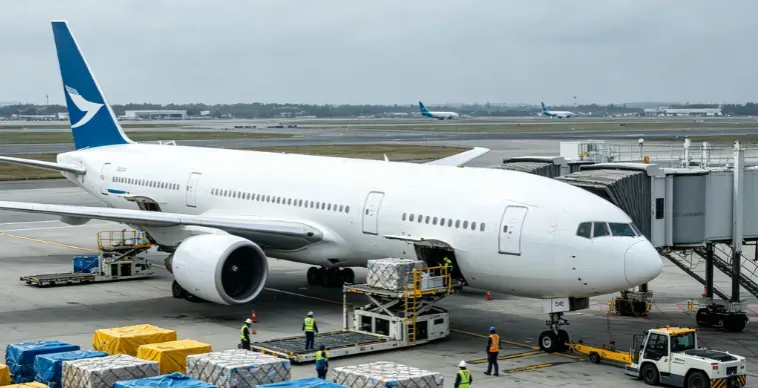
Vietnam’s rise as a “China+1” manufacturing hub is driving surging demand for air freight from Vietnam to Brazil — but between 40–50 day sea transit and Brazil’s notoriously complex customs system, even experienced importers struggle to get it right. This guide from Dantful.US — a freight forwarder with 15+ years on Asia-to-Americas lanes — covers airports, airlines, door-to-door costs, transit times, customs compliance, Incoterms, and the air-vs-sea decision, so you can ship confidently from day one. For other Americas routes, see our guides on Air Freight from Vietnam to USA, Air Freight from Vietnam to Canada, and Air Freight from Vietnam to Mexico.
Vietnam to Brazil Air Freight: Routes, Airports & Transit Times
Understanding your airport options on both ends of the journey is the first step to planning an efficient air freight shipment. The Vietnam–Brazil corridor spans roughly 17,800 km (11,000 miles) and is served by several major international carriers operating through Middle Eastern, European, and African transit hubs.
Vietnam Departure Airports
SGN (Tan Son Nhat International Airport, Ho Chi Minh City) is Vietnam’s busiest cargo gateway and the primary departure point for air freight to Brazil. Located in the heart of southern Vietnam’s manufacturing belt — including the industrial provinces of Binh Duong, Dong Nai, and Long An — SGN handles the bulk of the country’s electronics, textiles, and footwear exports. Emirates SkyCargo operates a reliable SGN-to-GRU service with departures every 1–2 days, making this the most frequently served route for Vietnam–Brazil air cargo.
HAN (Noi Bai International Airport, Hanoi) serves northern Vietnam’s rapidly growing industrial clusters, including the electronics and machinery manufacturing zones in Bac Ninh, Hai Phong, and Thai Nguyen. For shippers in the north, HAN offers direct cargo connections to Brazil via Qatar Airways Freighter and Turkish Cargo, with 2–4 departures per week. Ethiopian Airlines also operates a HAN-to-GRU freighter service via Addis Ababa.
DAD (Da Nang International Airport) handles a smaller volume of international cargo but can be a practical option for shippers in central Vietnam — particularly for textiles and garments produced in the Da Nang–Hoi An–Quang Nam region. Cargo from DAD is typically trucked to SGN or HAN for long-haul flight connections.
Brazil Arrival Airports
GRU (Guarulhos International Airport, São Paulo) is Brazil’s primary international cargo gateway, handling approximately 40% of all air cargo imports into the country. As the default destination for most Vietnam–Brazil air freight, GRU offers the widest selection of ground handling agents, customs brokers, and last-mile delivery options. If you’re unsure which airport to choose, GRU is the safest bet.
VCP (Viracopos International Airport, Campinas) has grown into a major cargo hub in recent years, driven by its role as the Latin American hub for several express courier networks and its proximity to São Paulo’s sprawling logistics parks. VCP can be a smart alternative to GRU — especially during peak season when GRU experiences congestion — but note that not all airlines serve VCP directly. Check with your freight forwarder before selecting this airport.
GIG (Galeão International Airport, Rio de Janeiro) is a secondary gateway serving southeastern Brazil. Cargo volumes at GIG are significantly lower than at GRU or VCP, but it can be convenient for importers based in Rio de Janeiro state or Espírito Santo.
Transit Time Breakdown
Flight times on the Vietnam–Brazil route are surprisingly fast given the distance — but door-to-door timelines depend on much more than just the hours spent in the air.
| Route | Airline | Flight Time | Frequency |
|---|---|---|---|
| SGN to GRU | Emirates SkyCargo (via DXB) | ~1 day 4 hours | Every 1–2 days |
| HAN to GRU | Qatar Airways Cargo (via DOH) | ~1 day 5 hours | 2–4× per week |
| HAN to GRU | Turkish Cargo (via IST) | ~1 day 9 hours | 2–4× per week |
| HAN to GRU | Ethiopian Airlines Cargo (via ADD) | ~1 day 9 hours | 1–2× per week |
Total door-to-door transit time — including factory pickup in Vietnam, export customs clearance, flight time, import customs clearance, and last-mile delivery in Brazil — typically ranges from 5 to 10 business days. Express and priority services can reduce this to 3–5 business days, though this comes at a premium cost.
Several factors can extend your transit time beyond these estimates. Customs channel assignment in Brazil is the biggest variable: Green channel shipments clear within hours, while Red channel inspections can add 5–15 business days. Seasonal congestion during Q4 (October–December) routinely adds 1–3 days due to higher cargo volumes and reduced available capacity. Carrier routing also matters — a 1-stop connection is faster than a 2-stop routing, but often more expensive.
Air Freight Costs from Vietnam to Brazil
Air freight pricing is not a flat per-kilo rate — it depends on shipment weight, dimensions, the specific route, seasonal demand, and the service level you choose. According to the IATA TACT (The Air Cargo Tariff) rate structure, air freight base rates follow weight breakpoints, origin-destination pairs, and carrier-specific commodity classifications. Below are realistic 2026 rate ranges based on current market conditions and carrier tariffs for the Vietnam–Brazil lane.
Rate Ranges by Weight Bracket
| Weight Bracket | Estimated Rate (per kg) | Notes |
|---|---|---|
| 0–45 kg | $8.50–$12.00 | Express / premium consolidation pricing |
| 45–100 kg | $6.50–$9.00 | Entry-level consolidated rates |
| 100–300 kg | $5.00–$7.50 | Volume discounts begin to apply |
| 300–500 kg | $4.50–$6.50 | Strong rate improvement |
| 500–1,000 kg | $4.00–$5.50 | Near-contract pricing territory |
| 1,000 kg+ | $3.50–$5.00 | BSA (Block Space Agreement) or charter rates available |
Important: These rates represent base freight charges only. All-in rates — including fuel surcharges, security surcharges, and terminal handling fees — typically run 20–35% above the base figures shown above. Rates are also subject to monthly fuel index adjustments and seasonal capacity fluctuations; always request a current, binding quotation before committing to a shipment. We believe in full pricing transparency — the quote you receive from Dantful.US includes all applicable charges with no hidden fees, so you can budget with confidence.
Understanding Chargeable Weight
Airlines don’t charge based on your cargo’s actual weight alone. They charge based on whichever is greater: actual weight or volumetric weight. The formula is:
Volumetric Weight (kg) = Length × Width × Height (cm) ÷ 6,000
Here’s a real-world example: imagine you’re shipping a carton of garments weighing 100 kg with dimensions of 120 × 100 × 80 cm. The volumetric weight calculation would be (120 × 100 × 80) ÷ 6,000 = 160 kg. Even though your cargo only weighs 100 kg on the scale, you’ll be charged for 160 kg.
This is particularly important for Vietnam’s textile and footwear exporters — lightweight, bulky goods are heavily penalized by volumetric pricing. If your cargo consistently has a low density, consolidating shipments or switching to sea freight for the bulk portion may be more cost-effective than air freight.
Additional Fees to Budget For
Beyond the base freight rate, expect to pay:
- Fuel surcharge: 15–25% of base rate, adjusted monthly based on jet fuel indices
- Security surcharge: Approximately $0.10–$0.20 per kg
- Terminal handling charges: Applied at both origin (SGN/HAN) and destination (GRU/VCP)
- Customs brokerage fees: Separate fees for Vietnam export clearance and Brazil import clearance
- Cargo insurance: 0.3–0.5% of declared cargo value — highly recommended for shipments to Brazil
Cost-Saving Strategies
- Consolidate shipments: Combining multiple smaller consignments under a single Air Waybill (AWB) can reduce your per-kg rate by 20–40% compared to shipping each piece individually via express courier.
- Ship off-peak: Air freight rates spike 20–30% during Q4 (October–December) as retailers rush holiday inventory. Q1 and Q2 typically offer the most favorable pricing.
- Commit to regular volume: If you ship 500 kg or more per month consistently, freight forwarders can offer contract rates 15–25% below spot market pricing.
- Accept flexible routing: A 2-stop connection (e.g., HAN to ADD to GRU) can save 10–15% compared to a 1-stop routing (e.g., HAN to DOH to GRU).
- Adopt a hybrid strategy: Ship 80% of your volume via sea freight for baseline inventory and use air freight only for urgent replenishment or seasonal peak demand. This balances cost and speed effectively. For importers comparing rates across different Asian origins, see our breakdown of Shipping Cost from China to Brazil for a useful pricing benchmark.
Step-by-Step Door-to-Door Air Freight Process
Understanding the full journey your cargo takes — from a Vietnamese factory floor to a Brazilian warehouse — helps you anticipate timelines, avoid costly mistakes, and communicate effectively with your logistics partners.
Step 1: Booking & Cargo Collection
The process begins with confirming your shipment details: dimensions, weight, commodity type, HS Code, and the agreed Incoterm. Your freight forwarder then arranges a truck to collect the cargo from your supplier’s factory or warehouse — common pickup locations include the industrial zones of Binh Duong, Dong Nai, Bac Ninh, and Hai Phong. In our experience, allowing a 24-hour buffer between cargo readiness and the scheduled pickup time avoids the last-minute production delays that frequently derail air freight timelines — especially during Vietnam’s rainy season (May–October), when road conditions around industrial parks can slow trucking significantly. Before the truck departs, verify that all carton markings match the packing list and photograph the cargo. These photos serve as valuable documentation for insurance claims should any disputes arise later.
Step 2: Export Customs Clearance in Vietnam
Vietnam has invested heavily in customs digitalization, and most export declarations are now processed electronically through the VNACCS/VCIS system within hours. Required documents include a Commercial Invoice, Packing List, Export Declaration (Tờ khai hải quan), and — depending on the destination and product — a Certificate of Origin. If your shipment uses any wooden packaging (pallets, crates), the wood must bear the IPPC stamp and be accompanied by a valid Fumigation Certificate. Certain goods — particularly electronics, agricultural products, and items subject to export controls — may require additional permits from Vietnamese authorities.
Step 3: Air Transport
Once cleared for export, your cargo is delivered to the departure airport’s cargo terminal (SGN or HAN). The airline or its ground handler issues the Air Waybill (AWB) — and this is where a critical Brazil-specific requirement comes into play: the consignee’s CNPJ (company tax ID) or CPF (individual tax ID) must appear on the AWB. Brazil customs does not accept “To Order” consignee notations. After security screening and ULD (Unit Load Device) build-up, your cargo is loaded onto the aircraft. Most Vietnam–Brazil routes involve a single transit stop — typically in Dubai (DXB), Doha (DOH), or Istanbul (IST) — before continuing to GRU or VCP. You can track your shipment in real time using the AWB number on the airline’s cargo tracking portal. Brazil customs will reject an AWB over a single missing digit — we’ve seen it happen.
Step 4: Import Customs Clearance in Brazil
This is the most complex step in the journey and deserves its own dedicated section. See Section 5 below for a comprehensive breakdown.
Step 5: Last-Mile Delivery in Brazil
After customs release, your cargo is transferred to a domestic trucking provider for final delivery. Brazil’s vast geography means last-mile transit can add anywhere from 1 day (for delivery within São Paulo state) to 5+ days (for destinations in the North or Northeast regions). For e-commerce sellers using Amazon FBA Brazil, direct injection to Amazon fulfillment centers is available — coordinate this with your freight forwarder in advance to ensure the correct delivery appointment and labeling requirements. For a complete walkthrough of the door-to-door journey including sea freight alternatives, see our guide to door to door shipping from Vietnam to Brazil.
Process Flowchart: See the visual diagram below for an at-a-glance overview of the entire door-to-door journey.
Brazil Customs Clearance & Import Compliance
If there’s one section of this guide to read twice, it’s this one. Brazil’s customs regime is among the most complex in the world — a reality acknowledged by both the International Federation of Freight Forwarders Associations (FIATA) and the International Air Transport Association (IATA) in their respective trade facilitation reports. Even minor documentation errors can result in costly delays, fines, or cargo abandonment. Getting this right before your shipment leaves Vietnam is the single most important thing you can do to ensure a smooth delivery. Getting this right before your shipment leaves Vietnam is the single most important thing you can do to ensure a smooth delivery.
Pre-Shipment: What Your Brazilian Importer MUST Have
RADAR License / Siscomex Registration: Per Receita Federal (Brazil’s Federal Revenue Service) regulations under Normative Instruction RFB No. 1,603/2016, every entity importing goods into Brazil must be registered through the Siscomex system and hold an active RADAR license. Without this, your cargo cannot clear customs — period. RADAR registration is the #1 prerequisite, and failure to confirm it before shipping is the leading cause of cargo abandonment at Brazilian airports.
CNPJ or CPF: The importer’s tax identification number — CNPJ for companies or CPF for individuals — must be clearly stated on both the Commercial Invoice and the Air Waybill. This is non-negotiable. Shipments arriving without a valid CNPJ/CPF on the AWB will be held and may be returned or destroyed at the shipper’s expense.
NCM Code Classification: Brazil uses the Mercosur Common Nomenclature (NCM) , which is based on the international HS Code system but adds two additional digits for regional specificity. Accurate NCM classification determines your duty rate, tax applicability, and whether additional certifications (ANVISA, INMETRO, ANATEL) are required. Incorrect classification triggers fines of 1–5% of the CIF value plus interest.
Required Documentation Checklist
| Document | Critical Requirements |
|---|---|
| Commercial Invoice | Must show importer CNPJ; freight charges stated explicitly (no “As Agreed”); original “Blue Signature” preferred by many customs officers |
| Packing List | Gross and net weights must match AWB exactly; discrepancies trigger Red channel |
| Air Waybill (AWB) | Draft must be sent to Brazil agent before flight departure; CNPJ on consignee field |
| Certificate of Origin | May reduce duties under applicable trade preference programs |
| Fumigation Certificate | Required if ANY wood packaging used; must be issued ≤ 15 days before shipment |
Brazilian Import Taxes Explained
Brazil applies taxes cumulatively — meaning each tax is calculated on top of the previous one. This “tax-on-tax” structure can result in a total tax burden far higher than the nominal rates suggest.
| Tax | Rate | Applied On |
|---|---|---|
| II (Import Duty) | 0–35% (most manufactured goods: 10–20%) | CIF value |
| IPI (Industrialized Product Tax) | 0–30% | CIF + II |
| PIS-COFINS | ~9.25% combined | CIF value |
| ICMS (State VAT) | 17–20% (varies by state) | CIF + II + IPI + PIS-COFINS + ICMS itself |
Real-world example: A $10,000 shipment (CIF value) with a 15% II rate and 10% IPI, destined for São Paulo (18% ICMS), would face approximately:
- II: $10,000 × 15% = $1,500
- IPI: ($10,000 + $1,500) × 10% = $1,150
- PIS-COFINS: $10,000 × 9.25% = $925
- ICMS: Calculated on the grossed-up base including itself to ~$3,200
Total tax burden: ~$6,775 (67.75% of CIF value)
This is not an exaggeration — it’s the reality of importing into Brazil. Understanding these costs upfront prevents unpleasant surprises and helps you price your products accurately in the Brazilian market.
Customs Clearance Channels
When your cargo arrives at GRU or VCP, Brazilian customs assigns it to one of three inspection channels:
- 🟢 Green Channel (60–70% of air shipments): Documentation is in order — automatic release within hours. This is what you’re aiming for.
- 🟡 Yellow Channel (20–25%): A customs officer reviews your documentation. If everything matches, release typically takes 1–3 business days.
- 🔴 Red Channel (5–10%): Physical cargo inspection plus document review. Cargo is held until the inspection is complete — this can add 5–15 business days. Red channel is most commonly triggered by weight discrepancies, NCM code errors, or undervaluation.
Brazil-Specific Air Freight Rules You Need to Know
These rules are unique to Brazilian air freight and catching them before your shipment leaves Vietnam can save you significant headaches:
- No Domestic Transit Rule: The first Brazilian airport where your cargo lands must be the final customs clearance point. If your destination is Viracopos (VCP), your cargo cannot transit through Guarulhos (GRU) first — the airline must operate a direct flight into VCP. Confirm this routing with your freight forwarder before booking.
- Partial Shipment Restriction: Brazilian customs records the weight of the first arrival as the consignment’s total weight. If you split a 500 kg shipment into two 250 kg batches, customs may flag the second arrival as under-declared. Always ship a single consignment as one complete unit.
- No “To Order” Consignee: Unlike sea freight bills of lading, air waybills to Brazil must name a specific consignee with a valid CNPJ/CPF. “To Order” or generic consignee notations are not accepted.
Product-Specific Certifications
Certain product categories require pre-approval from Brazilian regulatory agencies before import:
- ANVISA (National Health Surveillance Agency): Required for medical devices, pharmaceuticals, food products, cosmetics, and sanitizing products
- INMETRO (National Institute of Metrology): Mandatory certification for electronics, toys, household appliances, and auto parts
- ANATEL (National Telecommunications Agency): Required for any product with wireless, radio frequency, or telecommunications functionality
- MAPA (Ministry of Agriculture): Required for agricultural products, animal-derived goods, and food commodities
ISPM 15 Wood Packaging Compliance
All solid wood packaging materials — including pallets, crates, and dunnage — must be heat-treated or fumigated in compliance with ISPM 15 standards and display a visible IPPC stamp on at least two opposite sides. For importers who also source products from other Asian manufacturing hubs, our guide to Shipping from China to Brazil covers the logistics landscape from a complementary origin perspective. Non-compliance can result in fines of up to $2,900 per non-compliant package or, in severe cases, destruction of the cargo at the importer’s expense. A practical alternative is to use plastic pallets, plywood, or metal packaging, which are exempt from ISPM 15 requirements. For comprehensive customs and brokerage support on this lane, our Freight Forwarder from China to Brazil resource outlines the compliance expertise you should expect from any logistics partner handling Brazil-bound cargo.
Incoterms Guide for Vietnam to Brazil Air Freight
Choosing the right Incoterm for your air freight shipment is one of the most consequential decisions you’ll make — yet it’s often overlooked. Unlike sea freight, where FOB (Free On Board) is the industry standard, air freight involves different risk transfer points and cost allocations. The wrong Incoterm can leave you unexpectedly liable for charges you never budgeted for.
Incoterm Comparison for Air Freight
| Incoterm | Who Handles Export Clearance? | Who Pays Air Freight? | Who Handles Import Clearance? | Best For |
|---|---|---|---|---|
| EXW (Ex Works) | Buyer | Buyer | Buyer | Experienced importers with a Vietnam-based logistics partner |
| FCA (Free Carrier) | Seller | Buyer | Buyer | ⭐ Most importers — best balance of control and cost |
| CIP (Carriage & Insurance Paid) | Seller | Seller | Buyer | Buyers wanting predictable freight costs; seller arranges carriage + insurance to Brazil |
| DAP (Delivered at Place) | Seller | Seller | Buyer | Buyers wanting door delivery but managing own customs |
| DDP (Delivered Duty Paid) | Seller | Seller | Seller (in theory) | ⚠️ Legally restricted in Brazil — see warning below |
Which Incoterm Should You Choose?
FCA (Free Carrier) — Recommended for Most Importers: Under FCA, your Vietnamese supplier is responsible for delivering the goods to the carrier you nominate and handling export customs clearance. For a deeper comparison of how different shipping terms affect your bottom line, see our analysis of EXW vs FOB Explained: Cost, Risk, and Responsibility Comparison. You control the air freight booking, the choice of airline, and — crucially — the Brazil import clearance process through your own customs broker. This is the sweet spot: your supplier handles what they know best (Vietnam export formalities), while you retain control over the more complex Brazil-side logistics.
DAP (Delivered at Place) — Best for Convenience: If you have a reliable customs broker in Brazil but want minimal involvement in the Vietnam-side logistics, DAP is an excellent choice. Your freight forwarder manages everything from factory pickup in Vietnam through to delivery at your door in Brazil — you only handle the import customs clearance and associated duties and taxes.
The DDP Trap: Many first-time importers assume DDP (Delivered Duty Paid) is available for Brazil. It is not — at least not in the true legal sense. Brazilian law requires that only a locally registered entity with an active RADAR license can clear goods through customs. A foreign seller or forwarder cannot legally act as the importer of record. “DDP-like” arrangements exist through third-party importers, but these add cost, legal exposure, and complexity. Be extremely cautious of any provider promising true DDP to Brazil without explaining the underlying legal structure. For a detailed exploration of this topic from a related origin, read our guide on DDP shipping from China to Brazil, which covers the regulatory constraints and alternative solutions in depth.
Incoterms Decision Flowchart: Use the visual guide below to quickly determine the best Incoterm for your Vietnam–Brazil air freight shipment.
Types of Cargo Best Suited for Air Freight from Vietnam to Brazil
Not every product that Vietnam exports to Brazil is a good candidate for air freight. Understanding which cargo types make economic sense to ship by air — and which are better off on a container ship — helps you allocate your logistics budget effectively.
Vietnam–Brazil Cargo Suitability by Category
| Cargo Type | Vietnam Export Strength | Air Freight Suitability | Key Consideration |
|---|---|---|---|
| Electronics & Components | Very High (Samsung, LG, Foxconn factories) | ✅ Excellent | High value-to-weight ratio; INMETRO/ANATEL certification may be required |
| Machinery & Industrial Parts | High | ✅ Good | Downtime cost often justifies the air freight premium |
| Garments & Textiles | Very High (Nike, Adidas, Uniqlo supply chains) | ⚠️ Selective | Volumetric-heavy to expensive; air only for samples or urgent seasonal stock |
| Footwear & Leather Goods | High | ⚠️ Selective | Similar to textiles; use air selectively for premium/high-value items |
| Agricultural & Perishable Products | Moderate (coffee, cashews, pepper, seafood) | ✅ Perishable | Requires temperature control and MAPA certification |
| E-commerce Parcels | Growing Rapidly | ✅ Excellent | New 2024 tax rules apply (20% import tax under $50; 60% on excess + 17% ICMS) |
Special Cargo Types
Dangerous Goods (DG) — including lithium batteries commonly found in electronics — must be declared, packaged per IATA Dangerous Goods Regulations (DGR), and shipped on DG-certified aircraft. Note that many passenger flights restrict or prohibit DG cargo; freighter aircraft offer more flexibility but require advance booking.
Perishable / Cold Chain Cargo — such as frozen seafood (pangasius, shrimp), fresh produce, and pharmaceuticals — requires active temperature-controlled containers or ULDs. Brazil’s ANVISA may inspect temperature logs as part of the import clearance process, so maintaining a complete cold chain record is essential.
Oversized / Project Cargo — machinery or industrial equipment that exceeds standard aircraft door dimensions requires main-deck freighter aircraft like the Boeing 747-8F or 777F. Airlines operating these aircraft on the Vietnam–Brazil corridor include Qatar Airways Cargo and Turkish Cargo. Expect to book 2–4 weeks in advance for oversized shipments. Importers who also source from other Asian manufacturing hubs may find our Air Freight from Taiwan to Brazil guide useful for understanding cross-regional air freight options.
Air Freight vs. Sea Freight: Vietnam to Brazil
For most importers, the fundamental logistics decision is not just “how to ship” but “which mode to use.” For a broader perspective on this trade-off, our Air Freight vs Sea Freight from China to USA: Cost, Time & Best Choice guide explores the decision framework in detail. The table below provides a clear head-to-head comparison to guide your choice.
Head-to-Head Comparison
| Factor | Air Freight | Sea Freight (FCL) | Sea Freight (LCL) |
|---|---|---|---|
| Door-to-Door Transit | 5–10 days | 40–50 days | 45–55 days |
| Cost (per kg) | $4.00–$12.00 | $0.80–$2.00 (high volume) | $1.50–$3.50 |
| Minimum Shipment | 1 kg (express) / 45 kg (consolidated) | 1 × 20ft container (~28 CBM) | 1 CBM |
| Customs Complexity | Moderate | High | High |
| Damage/Theft Risk | Lower | Higher (longer transit exposure) | Higher (multiple handling) |
| Best For | Urgent, high-value, perishable, samples | Large-volume, non-urgent, bulky | Medium-volume, non-urgent |
Decision Framework: When to Choose Air Freight
Choose air freight when:
- Your cargo value exceeds approximately $30/kg (the air freight cost represents a small fraction of the goods’ value)
- A stockout would cost more in lost sales than the air freight premium
- You’re shipping perishable or seasonal products with a limited selling window
- You need samples, prototypes, or trade show materials delivered urgently
- Production downtime at your Brazilian operation would cost more than air freight
Decision Framework: When to Choose Sea Freight
Choose sea freight when:
- You’re shipping bulky, low-value-density goods (furniture, construction materials, packaging)
- You maintain predictable inventory levels and can plan 40–50 days ahead
- Your shipment volume exceeds 3–5 CBM, where LCL sea freight becomes cost-competitive
- Cash flow management is a priority, and lower per-unit logistics cost matters more than speed
FAQs
How long does air freight take from Vietnam to Brazil?
Flight time from Vietnam to Brazil ranges from approximately 1 day 4 hours (SGNtoGRU via Emirates) to 1 day 9 hours (HANtoGRU via Turkish or Ethiopian). Total door-to-door transit — including pickup, export clearance, the flight itself, import clearance, and last-mile delivery — typically takes 5–10 business days. Express and priority services can achieve 3–5 business days.
How much does air freight cost per kg from Vietnam to Brazil?
Standard consolidated air freight for shipments of 100 kg or more ranges from $5.00 to $9.00 per kg (all-in). Heavy shipments exceeding 1,000 kg can achieve rates of $3.50–$5.00 per kg base, plus fuel and security surcharges. Small shipments under 45 kg fall in the $8.50–$12.00 per kg range. Rates fluctuate with fuel surcharges and seasonal demand — expect 20–30% increases during Q4 peak season.
What documents are required for Brazil import customs clearance?
Essential documents include: Commercial Invoice (showing the importer’s CNPJ, with explicit freight charges), Packing List (weights must match the AWB exactly), Air Waybill (with CNPJ on the consignee field — draft must be sent to Brazil before flight departure), Certificate of Origin, and a Fumigation Certificate if any wood packaging is used. The importer must also hold an active RADAR license and Siscomex registration.
Can I ship DDP (Delivered Duty Paid) to Brazil?
True DDP is not permitted under Brazilian law — only a locally registered entity with an active RADAR license can legally clear goods through Brazilian customs. “DDP-like” arrangements exist through third-party importers, but these introduce additional costs, legal complexity, and compliance risks. The recommended alternatives are FCA (for experienced importers) or DAP (for convenience).
What are the most common mistakes when shipping air freight from Vietnam to Brazil?
The six most frequent — and costly — mistakes are: (1) assuming DDP is available in Brazil, (2) forgetting to include the importer’s CNPJ/CPF on the AWB, (3) weight or quantity discrepancies between the Packing List and AWB, (4) using untreated wood packaging without IPPC stamps, (5) shipping products that require ANVISA, INMETRO, or ANATEL certification without obtaining it first, and (6) under-declaring cargo value to reduce duties — which almost always triggers a Red channel inspection and substantial fines.
Get A Free Shipping Quote