

Every year, over three million TEUs of containerized cargo move through the Port of Vancouver — and a large portion of that volume originates from China. If you are an importer, an Amazon FBA seller, or a business owner sourcing products from Chinese manufacturers, understanding how shipping from China to Vancouver works is not optional. It is the difference between a predictable supply chain and one plagued by surprise fees, customs delays, and missed restocking windows.
In this guide, you will get a complete, no-nonsense breakdown of every shipping method available — sea freight (FCL and LCL), air freight, door-to-door DDP, and rail intermodal — along with real 2026 cost data, transit time comparisons, a step-by-step Canadian customs walkthrough, and a practical Amazon FBA delivery strategy for Vancouver-area fulfillment centers. By the end, you will know exactly which method fits your budget, timeline, and business model — and how to avoid the costly mistakes that first-time importers make.
Sea Freight from China to Vancouver
Sea freight is the backbone of Shipping from China to Canada, handling the vast majority of cargo by volume. It is also the most cost-effective option for shipments above a few cubic meters. The process follows a well-established path: your supplier delivers goods to a consolidation warehouse (for LCL) or directly to the port terminal (for FCL), the container is loaded onto a vessel, crosses the Pacific in roughly two to three weeks, and arrives at one of Vancouver’s three container terminals for discharge and customs clearance.
FCL (Full Container Load) Shipping
FCL means you book an entire container exclusively for your cargo. It makes financial sense when your shipment exceeds 12 to 15 cubic meters (CBM). You pay a flat rate for the container regardless of whether it is filled to capacity, so maximizing utilization directly lowers your per-unit freight cost.
The three standard container types on this route are:
| Container Type | Internal Capacity | Typical Cargo Fit | Best For |
|---|---|---|---|
| 20ft GP (20GP) | ~33 CBM / 28,000 kg | 10–12 standard pallets | Smaller FCL shipments, heavy goods |
| 40ft GP (40GP) | ~67 CBM / 28,000 kg | 20–24 standard pallets | Most common, best value for volume |
| 40ft High Cube (40HQ) | ~76 CBM / 28,000 kg | 22–26 standard pallets | Bulky but lightweight cargo |
FCL pros: fastest sea transit (no consolidation delays), exclusive container use (lower damage risk), flat-rate pricing. FCL cons: higher upfront cost, inefficient for very small volumes.
LCL (Less than Container Load) Shipping
LCL means your cargo shares a container with shipments from other importers. You only pay for the space you use, calculated per cubic meter. LCL is the go-to choice for shipments under 12 CBM — think of it as the “pay-as-you-go” model for ocean freight.
LCL shipments go through a consolidation process: your cargo is combined with others at a CFS (Container Freight Station) in China, then deconsolidated after arrival at a Vancouver-area warehouse. This adds roughly 3 to 7 extra days to the total transit compared to FCL, but keeps your cash flow flexible when you are shipping smaller batches.
The minimum chargeable volume for LCL is typically 1 CBM, so shipments smaller than that pay a premium on a per-CBM basis.
Major Chinese Origin Ports & Their Vancouver Connections
Your choice of origin port affects both transit time and cost. Here is how the four busiest Chinese ports stack up for the Vancouver route:
| Origin Port | Key Terminal(s) | Major Carriers | Transit to Vancouver | Best For |
|---|---|---|---|---|
| Shanghai | Yangshan Deep-Water Port | Maersk, MSC, CMA CGM | 14–20 days | East China / Yangtze River Delta manufacturing |
| Ningbo | Ningbo-Zhoushan Port | COSCO, Evergreen, ONE | 15–20 days | Zhejiang province — furniture, electronics, hardware |
| Shenzhen | Yantian / Shekou | COSCO, OOCL, ONE | 16–22 days | South China / Pearl River Delta — consumer goods, electronics |
| Qingdao | Qingdao Port | COSCO, HMM | 18–25 days | North China — machinery, chemicals, processed goods |
Shanghai consistently offers the fastest transit and most competitive rates to Vancouver due to its high sailing frequency and carrier competition. Shenzhen, while slightly slower, gives you the advantage of proximity to the manufacturing heartland of Guangdong province — reducing your domestic trucking cost from factory to port.
Vancouver’s Arrival Terminals
Once your container reaches Canada, it docks at one of three terminals operated by the Vancouver Fraser Port Authority:
- Deltaport (Roberts Bank): The largest and deepest container terminal in Canada. Handles the majority of Trans-Pacific mega-vessel traffic. Served by COSCO, OOCL, ONE, and Maersk. Best road and rail connections for inland distribution.
- Centerm (Burrard Inlet): Downtown-adjacent terminal specializing in intermodal transfers. Direct rail link to CN and CPKC networks. Served by MSC and CMA CGM.
- Vanterm (Burrard Inlet): Smaller terminal also in Burrard Inlet, handling regional and feeder services alongside mainline vessels.
Knowing which terminal your carrier calls at matters because it affects your inland drayage cost and transit time to your final destination.
Pro Tip: Transloading at Vancouver
One logistics strategy that experienced importers use is transloading: unloading a 40ft ocean container at a Vancouver warehouse and reloading the cargo into a 53ft domestic trailer. Because Canadian domestic trailers can carry roughly 30% more volume per load than ocean containers, transloading can cut your inland freight cost by 15% to 25% when shipping to Calgary, Edmonton, or Toronto. The trade-off is an extra 2 to 4 days of handling time.
Air Freight from China to Vancouver
When your supply chain cannot afford a three-week ocean crossing, air freight delivers. It is the fastest commercial shipping method, moving cargo from major Chinese airports to Vancouver International Airport (YVR) in as little as one day of flight time.
When Air Freight Makes Sense
Air freight is the right call when:
- Your cargo is high-value (electronics, luxury goods, medical devices) and the inventory carrying cost of ocean transit outweighs the air premium
- You need urgent restocking to avoid stockouts on Amazon or retail shelves
- You are shipping perishable or seasonal goods with a tight shelf life
- Your shipment is relatively lightweight — under roughly 200 kg, where the air-vs-ocean cost gap narrows
Transit Times from Major Chinese Airports
| Origin Airport | Flight Time to YVR | Typical Door-to-Door |
|---|---|---|
| Shanghai Pudong (PVG) | 10–12 hours | 3–5 days |
| Shenzhen Bao’an (SZX) | 11–13 hours | 3–5 days |
| Guangzhou Baiyun (CAN) | 11–13 hours | 3–5 days |
| Beijing Capital (PEK) | 10–12 hours | 3–6 days |
Air Freight Rates (2026)
Air freight pricing is weight-tiered — the more you ship, the lower your per-kilogram rate:
| Weight Tier | Rate per kg (USD) |
|---|---|
| Under 45 kg | $8.00–$12.00 |
| 45–100 kg | $6.50–$9.00 |
| 100–300 kg | $5.00–$7.50 |
| 300–500 kg | $4.50–$6.50 |
| 500+ kg | $4.00–$5.50 |
During the peak season (August through October), add a 10% to 15% surcharge to the rates above. Airlines also impose fuel surcharges and security fees that fluctuate monthly.
Chargeable Weight: What You Actually Pay For
Airlines charge by chargeable weight, which is the greater of your shipment’s actual gross weight and its volumetric weight. The formula is:
Volumetric Weight (kg) = (Length × Width × Height in cm) ÷ 6,000
For example, a box measuring 100×80×60 cm and weighing 50 kg has a volumetric weight of (100×80×60) ÷ 6,000 = 80 kg. You pay for 80 kg, not 50 kg. This is why dense, compact products ship more cost-effectively by air than bulky, lightweight ones.
Air Freight vs Express Courier
For very small shipments (under 30 kg), express couriers like DHL, UPS, and FedEx are often faster and simpler than air freight:
| Criteria | Air Freight | Express Courier |
|---|---|---|
| Transit time (door-to-door) | 3–7 days | 2–5 days |
| Cost for 20 kg | ~$100–$180 | ~$160–$240 |
| Cost for 200 kg | ~$900–$1,500 | ~$1,600–$3,000 |
| Customs handling | Separate broker needed | Included |
| Tracking granularity | Milestone-based | Real-time per scan |
| Best for | Commercial shipments 45+ kg | Samples, documents, parcels |
Door-to-Door DDP Shipping to Vancouver
For many importers, especially those new to international trade or running Amazon FBA businesses, the most attractive option is DDP (Delivered Duty Paid) — a door-to-door service where the freight forwarder handles literally everything from the supplier’s factory in China to your doorstep in Vancouver, including all customs clearance, duties, and taxes.
What Each Incoterm Actually Covers
Understanding Incoterms 2020 is essential before you sign any shipping contract. Here is how the four most common terms play out in a China-to-Vancouver context:
| Responsibility | EXW | FOB | CIF | DDP |
|---|---|---|---|---|
| Factory to China port trucking | Buyer | Seller | Seller | Forwarder |
| China export customs | Buyer | Seller | Seller | Forwarder |
| Ocean/air freight | Buyer | Buyer | Seller | Forwarder |
| Insurance during transit | Buyer | Buyer | Seller (minimum) | Forwarder |
| Canada import customs | Buyer | Buyer | Buyer | Forwarder |
| Duties & GST/HST payment | Buyer | Buyer | Buyer | Forwarder |
| Vancouver port to door delivery | Buyer | Buyer | Buyer | Forwarder |
With DDP, you receive one all-inclusive quote and one point of contact. There are no surprise bills from customs brokers, no last-minute GST payment demands, and no coordinating between a Chinese forwarder, a shipping line, a Canadian customs broker, and a local trucking company.
The DDP Process Step by Step
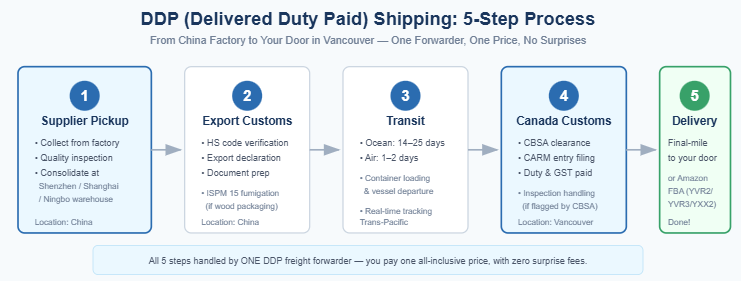
- Supplier Pickup: Your forwarder collects the cargo from your supplier’s factory — anywhere in China. If you use multiple suppliers, cargo is consolidated at the forwarder’s warehouse (typically in Shenzhen, Shanghai, or Ningbo) before container loading.
- China Export Customs: The forwarder prepares the export declaration, verifies HS codes and commercial documentation, and clears Chinese customs. For certain products, additional inspections (quality, fumigation for wood packaging under ISPM 15) may apply.
- International Transit: Cargo moves by ocean (FCL or LCL) or air to Vancouver.
- Canadian Customs Clearance: The forwarder — or their affiliated CBSA-licensed customs broker — files the entry via the CARM portal, pays all applicable duties and taxes, and resolves any CBSA examination requests.
- Final-Mile Delivery: Once cleared, cargo is trucked to your residential, commercial, or Amazon FBA address in Greater Vancouver — or beyond, to Calgary, Edmonton, Toronto, or anywhere in Canada.
What DDP Costs
The DDP premium over a basic port-to-port freight quote is typically $200 to $500 per shipment, depending on complexity. This covers customs brokerage, duty/tax advancement, and final-mile coordination. For most importers, the value lies in cost predictability — you know your total landed cost upfront, which is critical for pricing your products and managing your margins.
GST/HST in DDP
In a DDP arrangement, the forwarder pays 5% federal GST on the CIF value of your goods (cost + insurance + freight) plus any applicable duties. For imports into British Columbia, only the 5% federal GST applies — there is no provincial sales tax component on imported goods, unlike Ontario or Quebec where HST applies.
2026 Shipping Costs: Complete Price Breakdown by Method
One of the biggest frustrations we hear from importers is receiving a freight quote that looks affordable, only to discover that it covers less than half of the total cost. Here is a fully transparent, line-by-line breakdown of what shipping from China to Vancouver actually costs in 2026.
Sea Freight FCL Rates (Port to Port, USD)
| Origin Port | 20ft GP | 40ft GP | 40ft HQ |
|---|---|---|---|
| Shenzhen (Yantian) | $1,600–$2,600 | $2,500–$4,200 | $2,800–$4,500 |
| Shanghai | $1,650–$2,800 | $2,200–$4,500 | $2,600–$4,800 |
| Ningbo | $1,550–$2,500 | $2,100–$3,800 | $2,400–$4,200 |
| Qingdao | $1,760–$2,900 | $2,500–$4,100 | $2,800–$4,500 |
Note: These are spot-market ranges as of mid-2026. Rates fluctuate weekly based on carrier capacity, fuel surcharges (BAF), and seasonal demand. Contract rates for regular shippers are typically 10–20% lower.
Sea Freight LCL Rates
| Origin Port | Rate per CBM (USD) |
|---|---|
| Shanghai → Vancouver | $45–$65 |
| Ningbo → Vancouver | $55–$80 |
| Shenzhen → Vancouver | $65–$95 |
| Qingdao → Vancouver | $75–$110 |
Minimum charge: 1 CBM. The larger your LCL volume, the lower the per-CBM rate — consolidating multiple small orders into one shipment can meaningfully reduce your unit cost.
The Real Landed Cost: Beyond the Freight Quote
Here is what a complete landed cost calculation looks like for a representative shipment:
Scenario: One 20ft container, CIF value $20,000 (goods + insurance + freight), shipping from Shenzhen to a warehouse in Burnaby, BC.
| Cost Component | Typical Range | This Shipment |
|---|---|---|
| Ocean freight (20GP, spot) | $1,600–$2,600 | $2,100 |
| Origin charges (trucking + export customs + docs) | $300–$600 | $400 |
| Destination terminal handling (THC) | $300–$600 | $450 |
| Drayage (port → Burnaby warehouse) | $250–$500 | $350 |
| Customs brokerage fee | $150–$350 | $200 |
| Canadian duty (average 5% MFN rate) | 0–18% of CIF | $1,000 (5%) |
| GST (5% on CIF + duty) | 5% | $1,050 |
| Total Landed Cost | — | $5,550 |
The base ocean freight of $2,100 represents only 38% of the total cost. This is why comparing quotes solely on the freight rate is misleading — you must look at the complete picture.
2026 Rate Trends & What to Expect
The Trans-Pacific freight market has been volatile. In May 2026, 20ft container spot rates from China to Vancouver surged approximately 44% month-over-month, driven by post-Chinese New Year restocking demand, carrier blank sailings, and Vancouver port congestion. Peak season surcharges (PSS) of $640 to $2,000 per FEU are expected from August through October. Our recommendation: if your cargo is not time-sensitive, book during November through July when rates are historically 15–25% lower.
Money-Saving Strategies
| Strategy | Potential Savings | How to Execute |
|---|---|---|
| Ship off-peak (Nov–Jul) | 15–25% | Plan inventory around seasonal rate cycles |
| Use 40ft over 2×20ft | ~20% per CBM | Consolidate orders to fill a 40ft |
| Optimize container loading | 10–15% | Work with your forwarder on pallet/carton layout |
| Book 4–6 weeks ahead | 5–10% | Avoid last-minute premium pricing |
| Consider Prince Rupert | 5–10% on drayage | Alternate port with less congestion |
Shipping Transit Times: Door-to-Door Comparison Across All Methods
Transit time is not just about the ocean crossing or the flight — and how long it takes to ship from China to Canada depends heavily on your chosen method and origin. It includes pickup, consolidation, customs clearance at both ends, and final delivery. Here is the complete picture for all methods to Metro Vancouver:
| Shipping Method | Port-to-Port / Airport-to-Airport | Door-to-Door (Greater Vancouver) | Best For |
|---|---|---|---|
| Sea FCL (direct) | 14–22 days | 20–30 days | Large volumes, cost priority |
| Sea LCL | 16–25 days | 25–35 days | Small batches under 12 CBM |
| Sea + Rail intermodal | 14–22 days + 5–10 days rail | 25–40 days (to Toronto/Montreal) | Inland Canada, lower cost than all-truck |
| Air Freight | 1–2 days | 3–7 days | Urgent, high-value, perishable |
| Express Courier | 1–2 days | 2–5 days | Samples, documents, sub-30 kg parcels |
| DDP Sea (LCL) | N/A | 25–40 days | Hassle-free, taxes included |
What Affects Your Transit Time
- Vancouver port congestion: In early 2026, vessels waited an average of 2–3 days for berth assignment, and containers dwelled at the terminal for an additional 3–4 days before being available for pickup. Booking 4–6 weeks ahead is strongly recommended during congested periods.
- CBSA customs examination: Random or targeted inspections can add 1–5 business days. Having accurate, complete documentation minimizes this risk.
- Peak season bottlenecks: August through October and the weeks before Chinese New Year (January/February) see elevated volumes across all carriers and terminals.
- Winter weather: Rail intermodal shipments from Vancouver to inland destinations can face weather-related delays of 1–3 days during the Canadian winter months (December–February).
Canadian Customs Clearance, CARM Compliance & Required Documents
Canadian customs can feel intimidating, but the process is systematic once you understand it. Here is what happens when your shipment arrives at Vancouver — and what you must prepare in advance.
The CBSA Clearance Process
- eManifest Submission: Your customs broker electronically submits shipment data to the Canada Border Services Agency (CBSA) before the vessel or aircraft arrives.
- CBSA Review: The system either releases the shipment automatically or flags it for a documentation review, a container scan, or a physical examination.
- Duty & Tax Payment: Duties and GST are calculated and paid — either by your broker or by your forwarder under a DDP arrangement.
- Release & Delivery: Once released, the cargo is available for drayage from the terminal to your warehouse.
CARM: The System Every Importer Must Know
CARM (CBSA Assessment and Revenue Management) became mandatory for all Canadian importers in 2025. It is a digital portal where importers must:
- Register for a Business Number (BN) with an Import/Export RM account through the Canada Revenue Agency (CRA)
- Post security (a customs bond) to guarantee duty and tax payments
- Manage their own customs entries or delegate access to a licensed customs broker
If you are not CARM-registered, your cargo cannot clear Canadian customs — period. Most freight forwarders specializing in the China-Canada lane are CARM-compliant, but always verify before booking.
Required Documents Checklist
| Document | Required? | Who Prepares It |
|---|---|---|
| Commercial Invoice | Always | Your supplier / exporter |
| Packing List | Always | Your supplier / exporter |
| Bill of Lading (B/L) | Sea freight | The carrier or forwarder |
| Airway Bill (AWB) | Air freight | The carrier or forwarder |
| Canada Customs Invoice (CCI) | Yes (or equivalent) | You or your customs broker |
| Certificate of Origin | If claiming preferential duty | Your supplier or local Chamber of Commerce |
| HS Code Classification | Always | You or your broker |
| Import Permits / Licenses | For controlled goods | You (apply via relevant Canadian agency) |
| CARM BN + RM Account | Mandatory since 2025 | You (register via CRA) |
HS Codes & Duty Rates
Every product imported into Canada must be classified under a 10-digit HS (Harmonized System) Code. This code determines your duty rate, which ranges from 0% to 18% depending on the product category. Here are common chapters for China-to-Canada trade:
| Product Category | HS Chapter | Typical MFN Duty Rate |
|---|---|---|
| Furniture (wooden) | 94 | 0–9.5% |
| Electronics / appliances | 85 | 0–6.5% |
| Textiles & apparel | 61–63 | 0–18% |
| Machinery & parts | 84 | 0–6.5% |
| Toys & sporting goods | 95 | 0–8% |
Many Chinese-origin goods qualify for Canada’s Most-Favored-Nation (MFN) tariff rate — the lowest non-preferential rate available.
Cargo Insurance: Do Not Skip It
Cargo insurance costs approximately 0.2% to 0.5% of your cargo’s declared value and covers physical loss or damage during transit, as well as certain delay-related losses. Without it, a single damaged container can wipe out the profit margin on months of orders. We always recommend comprehensive All Risks coverage for shipments on the China-to-Vancouver route.
Amazon FBA Shipping from China to Vancouver
If you sell on Amazon.ca, shipping from China to Amazon FBA Canada is a specialized service — and the Vancouver area is home to three major fulfillment centers: YVR2 (Delta), YVR3 (New Westminster), and YXX2 (Abbotsford). Getting your inventory from a Chinese factory to one of these FCs requires careful coordination — Amazon imposes strict delivery appointment windows, labeling standards, and carton specifications.
FBA Shipping Methods to Vancouver
| Method | Volume Range | Typical Door-to-FC Time | Best When |
|---|---|---|---|
| LCL Sea + DDP | 3–18 CBM | 25–35 days | Replenishment inventory, moderate budget |
| FCL Sea + DDP | 18+ CBM | 20–30 days | Large restocking runs, lowest per-unit cost |
| Air Freight DDP | Any volume (weight-limited) | 5–9 days | Urgent restocking, avoid stockouts |
The FBA Prep Process at Origin
Before your goods leave China, they must be FBA-ready:
- FNSKU labeling: Each unit receives a unique barcode linked to your Amazon SKU
- Poly-bagging / over-boxing: Products that could leak, separate, or be damaged must be bagged per Amazon packaging requirements
- Pallet building: Pallets must comply with Amazon’s dimension, weight, and stacking rules (typically 120×100 cm, max 1,500 lbs per pallet in Canada)
- Carton-level labeling: Every carton needs an Amazon shipment label and (for case-packed shipments) a case label
- Shipment plan creation: You create a shipment plan in Seller Central, which assigns the destination FC and generates the required FBA shipment ID
The Surrey Warehouse Strategy
The smartest approach for FBA shipments under one full container is to use a Surrey-based staging warehouse as an intermediate step:
- Your LCL cargo clears customs at Vancouver and is trucked to a warehouse in Surrey, BC — less than 30 minutes from the port and the YVR2/YVR3 fulfillment centers
- At the warehouse, your cargo is deconsolidated, inspected for damage, re-labeled if needed, and palletized to Amazon’s exact specifications
- A scheduled truck delivery takes your cargo to the assigned FC during its approved appointment window
This buffer step prevents the #1 FBA shipping pain point: having an entire shipment rejected at the FC dock because one carton is mislabeled or a pallet is over-height. The Surrey staging model adds 2–3 days but eliminates the much costlier risk of rejection and re-delivery.
DDP vs DAP for FBA: Why DDP Wins
DAP (Delivered at Place) means the forwarder delivers to the FC but you remain responsible for duties and taxes — meaning you need your own CARM account, BN, and broker relationship. DDP bundles everything under the forwarder’s responsibility. For Amazon sellers who want to focus on selling rather than logistics, DDP is almost always the better choice.
How to Choose the Best Freight Forwarder for China-to-Vancouver Shipments
Not every freight forwarder is equipped for the Vancouver lane. The route has its own complexities — CARM compliance, specific terminal procedures, FBA appointment challenges, and transloading logistics. Choosing the wrong partner can cost you time, money, and your Amazon seller metrics.
8 Questions to Ask Before You Book
- “Are you FIATA or IATA certified?” — These international certifications are the minimum standard for a professional, compliant forwarder. If they cannot answer this, walk away.
- “Do you have your own consolidation warehouse in China?” — A forwarder with their own facility in Shenzhen, Shanghai, or Ningbo has far more control over your cargo than one who subcontracts everything.
- “Are you CARM-registered, and can you provide your CBSA Business Number?” — Any forwarder handling your Canadian customs must be on the CARM system. Ask for proof.
- “Can you provide a line-item landed cost quote?” — If a forwarder only gives you a lump-sum number without breaking it down, you cannot compare quotes fairly — and you are likely overpaying somewhere.
- “Do you have experience delivering to Amazon FBA warehouses YVR2, YVR3, and YXX2?” — Amazon FC deliveries require appointment scheduling, specific pallet specs, and carrier compliance. General freight experience is not enough.
- “Do you hold direct contracts with Trans-Pacific carriers?” — Forwarders with direct carrier contracts get priority space allocation and better rates, especially during peak season. Those who buy from consolidators pay spot-market markups.
- “What happens if my cargo is held for CBSA inspection?” — A good forwarder has a clear escalation process. A bad one will tell you to “wait and see.”
- “Can I see photos of my cargo before it sails?” — Pre-shipment photos are a basic quality assurance step. If a forwarder cannot provide them, they may not have physical access to your cargo at all.
Why Dantful.US?
We built our business around the exact routes and services this guide covers. Here is what that means for your Vancouver-bound shipments:
- 15+ years based in Shenzhen, China — We know the export side intimately: Chinese customs procedures, factory coordination, quality inspections, and the fastest way to get cargo from Guangdong, Zhejiang, or Jiangsu onto a vessel bound for Vancouver.
- FIATA & IATA dual-certified — These are not just badges. They represent audited financial stability, professional competency, and adherence to international freight forwarding standards.
- Americas specialists — The China-to-Vancouver lane is one of our core routes — alongside Shipping from China to USA and other Americas destinations. We do not spread ourselves thin across every trade lane — we focus on what we do best: reliable, cost-effective shipping from China to North and South America.
- Direct carrier contracts — Our Trans-Pacific relationships with major ocean and air carriers mean competitive rates and — just as importantly — guaranteed space allocation when the market tightens during peak season.
- Dedicated account manager — You deal with one real person who knows your cargo, your preferences, and your business — from your first quote through every subsequent shipment.
Get a free, line-item quote for your next China-to-Vancouver shipment. No hidden fees, no surprises — just transparent pricing and professional service from a team that has been doing this for over 15 years.
FAQs
How long does shipping from China to Vancouver take?
Port-to-port sea freight FCL takes 14–22 days from Shanghai or Shenzhen. Door-to-door, including customs clearance and local delivery, takes 20–30 days for FCL and 25–35 days for LCL. Air freight takes 3–7 days door-to-door. See the full transit time comparison table in Section 6 for all methods.
How much does it cost to ship a container from China to Vancouver?
As of mid-2026, a 20ft container costs approximately $1,550–$2,900 USD port-to-port, while a 40ft container ranges from $2,100–$4,800 USD, depending on the origin port. These are the freight charges only — the true landed cost includes origin handling, terminal fees, drayage, customs brokerage, duties, and GST. See the complete cost breakdown in Section 5.
What is the cheapest way to ship from China to Vancouver?
Sea freight LCL is the cheapest option for shipments under 12 CBM ($45–$110 per CBM). For larger volumes, sea freight FCL using a 40ft container offers the lowest per-unit cost. Shipping during the off-peak season (November through July) and booking 4–6 weeks in advance can save an additional 15–25%.
What documents do I need to ship from China to Vancouver?
At minimum: Commercial Invoice, Packing List, Bill of Lading (sea) or Airway Bill (air), Canada Customs Invoice (or equivalent), and accurate HS Code classifications. Depending on your product, you may also need a Certificate of Origin, import permits, and compliance certificates. See the full checklist in Section 7.
How does Amazon FBA shipping from China to Vancouver work?
Ship your inventory by sea (LCL or FCL) or air to Vancouver. Clear customs (DDP recommended). Stage the cargo at a Surrey, BC warehouse for FBA prep — labeling, palletization, and inspection — then deliver to your assigned fulfillment center (YVR2, YVR3, or YXX2) during a scheduled appointment window. See Section 8 for a complete walkthrough with a real cost example.
Is shipping from Shenzhen faster than from Shanghai to Vancouver?
No. Shanghai is slightly faster (14–20 days direct) compared to Shenzhen (16–22 days) because Shanghai is closer to the great-circle Trans-Pacific route. However, if your goods are manufactured in Guangdong province, Shenzhen’s shorter domestic trucking distance often offsets the slightly longer ocean transit.
Leave a reply