

If you are planning shipping from Ningbo to USA in 2026, you have walked straight into one of the most volatile freight markets in recent memory. Between late April and mid-June 2026, spot rates on the China–US trade lane more than doubled — Ningbo to the West Coast surged from roughly $2,900 to $6,300 per 40-foot container, while East Coast rates topped $7,500. Carriers declared full vessel utilization across the board, and “space sold out” became the standard reply from shipping agents. For importers, the question is no longer just “how much does it cost” — it is “how do I secure space at a predictable cost without exposing my business to hidden fees, customs delays, or compliance risks I did not see coming.”
This guide draws on 15 years of hands-on freight forwarding experience in shipping from China to USA, based in Shenzhen with a dedicated Ningbo operations network. It covers every stage of the journey: which shipping method fits your cargo, what real-world transit times look like door-to-door, how 2026’s rate surge affects your bottom line, which hidden costs catch importers off guard, what documentation U.S. Customs actually requires, and how to pick a freight forwarder in Ningbo you can trust — including the red flags that signal trouble before you hand over a single container.
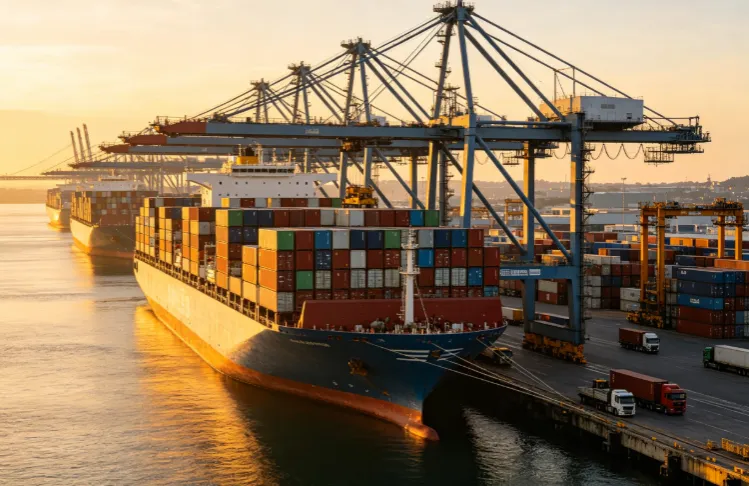
Why Ningbo Port? China’s Powerhouse Gateway to America
Ningbo-Zhoushan Port is not just another name on the list of China’s export hubs — it is the world’s third-busiest container port by throughput, handling over 30 million TEUs annually and connecting to more than 600 ports across 100-plus countries. For importers sourcing from China’s manufacturing heartland, Ningbo represents a strategic advantage that goes well beyond the headline throughput numbers.
What makes Ningbo genuinely different — and this is something most competitor guides miss — is its deep integration with the Yangtze River Delta manufacturing cluster. Yiwu, the world’s largest small-commodities wholesale market, sits just a two-hour truck drive away. Yongkang (hardware and power tools), Wenzhou (footwear and apparel), and Taizhou (plastics and molds) form an industrial belt that feeds directly into Ningbo’s container terminals. Trucking a full container from Jinhua or Yiwu to Ningbo costs approximately $80–$130, compared to $180–$220 for the longer haul to Shanghai. That $100-per-container difference compounds quickly when you are moving multiple loads per month.
The port infrastructure itself is purpose-built for efficiency. Three major container terminal complexes — Beilun, Chuanshan, and Meishan — operate deep-water berths capable of handling the largest vessels afloat, including 24,000-TEU megaships. The port runs 24/7 with automated gantry cranes and an integrated on-dock logistics park where warehousing, cargo inspection, and customs processing happen in a single zone — no need to shuttle containers across town between facilities. During peak season, this translates into a meaningful edge: Ningbo consistently shows less vessel-waiting congestion than Shanghai, meaning more predictable departure schedules when predictability is most valuable.
Major carriers serving the Trans-Pacific trade lane from Ningbo include COSCO, MSC, CMA CGM, Maersk, ONE, OOCL, Evergreen, and HMM — all offering multiple weekly sailings to both U.S. coasts. Whether you are shipping full containers to Los Angeles or consolidated cargo to Savannah, the sailing frequency out of Ningbo gives you options rather than forcing you onto whatever vessel happens to have space.
Shipping Methods from Ningbo to USA: Sea, Air & Express Compared
Choosing the right shipping method from Ningbo comes down to three variables: how fast you need it, how much you are shipping, and what your budget looks like. For most importers, sea freight from China to USA serves as the cost-effective backbone, while air freight from China to USA covers time-sensitive needs. Most importers fit into one of five lanes, summarized below.
| Shipping Method | Door-to-Door Time | Cost Range | Best For |
|---|---|---|---|
| DDP Sea Freight | 25–40 days | $1.9–$3.9/kg | Bulky or non-urgent cargo; most cost-effective per unit |
| DDP Air Freight | 6–12 days | $4–$10/kg | Medium-weight shipments with tight deadlines |
| Express Courier (DHL/UPS/FedEx) | 3–7 days | $6–$15/kg | Small parcels, samples, urgent documents |
| FCL (Full Container Load) | 25–35 days | $2,900–$6,500 per 40HQ | Bulk cargo exceeding 15 CBM |
| LCL (Less than Container Load) | 30–40 days | $80–$250 per CBM | Smaller mixed loads from multiple suppliers |
For time-critical shipments under ~50 kg, express shipping from China to USA via DHL, UPS, or FedEx delivers in under a week — ideal for samples, small-batch replenishment, and urgent documents.
Sea Freight: FCL vs. LCL
FCL (Full Container Load) gives you exclusive use of an entire container. The standard container types are the 20GP (20-foot, ~33 CBM capacity), 40GP (40-foot, ~67 CBM), and 40HQ (40-foot high-cube, ~76 CBM). The economic threshold is straightforward: if your shipment exceeds roughly 15 CBM, FCL almost always beats LCL on both cost and transit time. For time-sensitive FCL shipments, the Matson CLX express service from Ningbo to Los Angeles cuts the ocean transit to just 12–14 days — the fastest surface option on this route.
LCL (Less than Container Load) lets you share container space with other shippers, paying only for the cubic meters you occupy. The trade-off is an extra 3–5 days for consolidation at origin and deconsolidation at the destination CFS (Container Freight Station). LCL is ideal when you are sampling a new supplier, shipping seasonal restocks, or consolidating goods from multiple factories around Yiwu and Jinhua into a single shipment.
Air Freight from Ningbo to USA
When speed matters more than freight cost, air freight from Ningbo delivers. Cargo is charged by chargeable weight — the greater of actual weight or volumetric weight (length × width × height in cm ÷ 6,000). This is critical to understand: a lightweight but bulky shipment of furniture cushions may cost more by air than a dense carton of metal hardware, even if the scales say otherwise. Ningbo Lishe International Airport handles a growing share of export air cargo, though for the broadest carrier selection (including dedicated freighters), many forwarders route through Shanghai Pudong — just three hours away by truck — giving you access to virtually every major air cargo carrier serving the U.S. market.
Quick Decision Guide
Not sure which method fits? Here is a practical shortcut:
- “I’m an Amazon FBA seller buying home goods from Yiwu for the first time” → DDP sea freight with LCL consolidation. Cost-effective, and your forwarder handles labeling and FBA compliance.
- “My electronics shipment to Los Angeles is already behind schedule” → DDP air freight, 6–8 days door-to-door.
- “I just need five sample cartons to test a new supplier” → Express courier (DHL or FedEx). Fast, trackable, and no minimum volume requirement.
How Long Does Shipping from Ningbo to USA Take?
Transit time depends primarily on which coast your cargo is headed for. If you need a broader comparison across all Chinese ports, see our detailed breakdown of how long it takes to ship from China to USA. The table below maps the four major shipping methods against six key U.S. destination gateways.
| Destination Port | FCL Ocean | LCL Ocean | Air Freight | Express Courier |
|---|---|---|---|---|
| Los Angeles / Long Beach (West Coast) | 13–18 days | 17–25 days | 3–5 days | 3–5 days |
| Oakland / Seattle (West Coast) | 14–20 days | 18–28 days | 4–6 days | 3–5 days |
| New York / New Jersey (East Coast) | 25–35 days | 30–40 days | 5–8 days | 4–7 days |
| Savannah / Miami (East Coast) | 30–40 days | 35–45 days | 6–9 days | 4–7 days |
| Houston (Gulf Coast) | 28–35 days | 33–43 days | 6–9 days | 4–7 days |
| Chicago (Inland — rail-connected) | 22–28 days | 28–38 days | 5–8 days | 4–7 days |
Door-to-Door Timeline: A Stage-by-Stage Breakdown
What the table above does not show is what happens between port arrival and your warehouse receiving dock. A door-to-door shipment passing through Los Angeles typically breaks down into four stages:
| Stage | Activities | Typical Duration | Key Control Point |
|---|---|---|---|
| China Segment | Factory pickup → Ningbo warehouse → export customs declaration | 2–4 days | Complete customs declaration at least 1 day before vessel cutoff |
| Ocean Transit | Vessel loading → Trans-Pacific crossing → arrival at U.S. port | 13–35 days | Direct sailings avoid transshipment delays; Matson CLX cuts LA transit to 12 days |
| U.S. Port & Customs | Unloading → ISF/AMS processing → CBP clearance → duty payment → container release | 3–7 days | Pre-file ISF before vessel departure; pre-clear customs where possible |
| Final-Mile Delivery | Truck or rail from port → delivery to your address | 1–3 days | Schedule delivery appointments in advance during peak season |
What Can Delay Your Shipment
Three common disruptors affect real-world transit times: port congestion (LA/LB vessel wait times jump from 1 day off-season to 3–5 days during the August–October peak), customs examinations (CBP inspects roughly 3–5% of shipments, adding 2–5 days when flagged), and Panama Canal restrictions (drought-related draft limits and transit-slot reductions have lengthened some Asia–East Coast routings). Booking 4–6 weeks ahead during peak season and choosing DDP shipping — where the forwarder pre-manages all customs touchpoints — are the two most effective ways to keep your timeline predictable.
Ningbo to USA Shipping Cost: 2026 Freight Rates, Hidden Fees & How to Save
The 2026 Rate Surge: What Happened and Why
If you have requested a freight quote in the last 60 days, you already know the story: China–U.S. container rates have gone vertical. Between late April and mid-June 2026, spot rates from Ningbo to the U.S. West Coast rose from approximately $2,900 to $6,300 per 40-foot container — a 117% increase. East Coast rates climbed from roughly $3,900 to $7,500. As of June 2026, carriers across the board reported that all sailings were fully booked, with June capacity entirely sold out weeks in advance. Industry reports describe the situation as the most severe space shortage since the post-pandemic peak.
Four forces combined to create this squeeze. First, U.S. retailer restocking demand surged — China’s May 2026 exports rose 19.4% year-over-year in dollar terms, driven by inventory rebuilding ahead of the summer shopping season. Second, the Red Sea disruption has now diverted over 300,000 TEU of global fleet capacity around the Cape of Good Hope for more than 18 months, effectively removing that tonnage from the market. Third, carriers have become disciplined about capacity management — blanking sailings when demand softens to prop up rates. Fourth, equipment shortages at major Chinese ports have created a scramble for empty containers, with cargo rollovers becoming common.
2026 Reference Freight Rates
The table below represents spot-market ranges as of mid-2026. Contract rates (for importers with volume commitments) typically run 15–25% below these figures. All prices are estimates — always obtain a binding quote before committing inventory.
| Route (Ningbo to U.S.) | 20GP Container | 40GP / 40HQ Container | Typical Ocean Transit |
|---|---|---|---|
| Los Angeles / Long Beach | $2,900 – $6,300 | $5,400 – $6,500 | 18–20 days |
| New York / New Jersey | $3,400 – $7,500 | $6,500 – $7,500 | 30–33 days |
| Houston | $3,200 – $6,800 | $6,200 – $7,200 | 25–28 days |
| Seattle / Tacoma | $2,800 – $6,000 | $5,200 – $6,300 | 15–18 days |
Hidden Costs That Catch First-Time Importers Off Guard
The base ocean freight rate is just the starting line — and shipping cost from China to USA can vary by thousands of dollars depending on the factors above. Importers who budget only for the per-container charge routinely discover a stack of additional fees they never saw coming. The most common hidden costs include:
| Fee Type | What It Is | Typical Range |
|---|---|---|
| Demurrage | Storage charge when your container sits at the terminal beyond the free period (usually 4–7 days) | $100–$300 per day |
| Detention | Charge for keeping the carrier’s container beyond the allowed free days after pickup | $75–$200 per day |
| Peak Season Surcharge (PSS) | Carrier-imposed surcharge during high-demand periods (typically Sep–Dec) | $300–$600 per container |
| General Rate Increase (GRI) | Quarterly carrier rate adjustment applied across the board | $300–$1,000 per container |
| Destination Terminal Charges | THC, chassis fee, pre-pull fee, documentation fee at the U.S. port | $300–$800 combined |
| Customs Exam Fees | X-ray or physical inspection charges if CBP flags your container | $100–$300 (X-ray); $400–$1,000+ (intensive) |
The single most effective way to avoid surprise destination charges is to ship under DDP (Delivered Duty Paid) terms. With DDP, your forwarder provides an all-inclusive door-to-door price that covers freight, customs clearance, duties, and destination handling — so you never open an invoice you did not anticipate.
Six Strategies to Optimize Your Shipping Costs
- Ship during the off-peak window (February–May). Freight rates historically drop 15–25% from their autumn peak. If your inventory cycle allows, build buffer stock during the spring lull — for more strategies, see our roundup of the cheapest shipping from China to USA.
- Consolidate multiple suppliers into full containers. Instead of shipping three separate LCL loads from Yiwu, Yongkang, and Taizhou, have them delivered to a Ningbo consolidation warehouse and loaded into a single FCL — cutting your per-unit freight cost by 20–30%.
- Switch from LCL to FCL once you cross ~15 CBM. Beyond that threshold, LCL surcharges (CFS fees, documentation per shipment) eat away the apparent savings of paying only for the space you use.
- Combine contract rates with spot-market flexibility. If you ship regularly, negotiate an annual volume commitment for a base allocation at a discounted rate, then top up with spot bookings when needed.
- Optimize your packaging. Standardized carton sizes, minimal void fill, and stackable pallets reduce your volumetric footprint — which matters for both ocean LCL (charged by CBM) and air freight (charged by chargeable weight).
- Ship via Ningbo, not Shanghai, if your suppliers are in Zhejiang. The trucking-cost advantage ($80–$130 vs. $180–$220) adds up across shipments, and Ningbo’s lower port-handling fees add further savings.
Seasonal Planning Calendar
| Period | What Is Happening | Action |
|---|---|---|
| Jan–Feb | Chinese New Year — factories close for 2–4 weeks | Ship 3–4 weeks before the holiday; expect production delays through late February |
| Feb–May | Off-peak shipping season; lowest rates of the year | Optimal window for large-volume bookings and cost-sensitive shipments |
| May–Jun | Prime Day and Back-to-School inventory buildup | Book space by early May to avoid the pre-peak rate climb |
| Aug–Oct | Peak season — Black Friday and Christmas restocking | Book 4–6 weeks in advance; expect PSS surcharges and tighter space |
| Nov–Dec | Year-end factory rush + carrier capacity cuts | Finalize Q4 shipments by early November; plan Q1 orders before CNY shutdown |
Customs Clearance & Required Documentation for USA Imports
China Export Customs at Ningbo
Before your cargo can leave China, it must clear China Customs export procedures. The required documents include the customs declaration form, commercial invoice, packing list, and the export contract. The standard process — electronic submission through the China E-Port system, customs review, possible physical inspection, and release — typically takes 1–2 days. The most important operational detail: submit your customs declaration at least one full business day before the vessel cutoff time. Missing this window means your container gets rolled to the next sailing. Also critical for many shipments: any wooden packaging (pallets, crates, dunnage) must carry an IPPC heat-treatment stamp, or it will be rejected at the destination port.
U.S. Import Documentation Checklist
Navigating US customs clearance for imports from China requires precise paperwork. Missing even one filing deadline can trigger fines starting at $5,000. Here is what you need:
| Document | Purpose | Critical Deadline |
|---|---|---|
| ISF Filing (10+2) | Importer Security Filing — tells CBP who is shipping what, from where, to whom | Must be filed at least 24 hours before vessel departure from Ningbo; late or inaccurate filings trigger $5,000+ fines |
| AMS (Automated Manifest System) | Carrier’s electronic manifest submitted to CBP | Filed before vessel departure alongside ISF |
| Bill of Lading (B/L) | Proof of carriage contract and title to the goods | Original B/L or telex release required to claim cargo at destination |
| Commercial Invoice | Declares cargo value, HS code classification, country of origin, and Incoterms | Accuracy is critical — undervaluation triggers CBP audits and penalties |
| Packing List | Itemized breakdown of carton count, weight, dimensions, and contents per piece | Must match the commercial invoice and physical shipment exactly |
| Customs Bond | Financial guarantee required for all ocean imports into the U.S. | Must be active before cargo arrives; your forwarder provides this under DDP terms |
| Certificate of Origin | Verifies where goods were manufactured | May qualify your goods for preferential duty rates under applicable trade programs |
UFLPA Compliance: A 2026 Priority
One topic absent from nearly every competing guide is the Uyghur Forced Labor Prevention Act (UFLPA), and in 2026 it has become a material compliance risk for importers. CBP enforcement has intensified, with detained shipments spanning textiles, apparel, cotton products, solar panels, polysilicon, tomatoes, and aluminum goods. The operational presumption under UFLPA is that goods from certain regions and industries are presumed to involve forced labor unless proven otherwise — shifting the burden of proof onto the importer. If your product falls into a high-scrutiny category, work with a forwarder that can help assemble the necessary supply-chain documentation: supplier audit reports, raw-material sourcing certificates, and production-flow records. Dantful.US assists clients with UFLPA compliance review as part of its pre-shipment documentation service.
U.S. Import Duties: A Rough Guide
Duty rates vary by HS Code (Harmonized System) classification. As a general reference:
- Electronics: 2–4%
- Furniture: 0–1%
- Textiles and apparel: 5–15%
- Toys: 0–6%
- Kitchenware and housewares: 2–7%
Keep in mind that Section 301 tariffs remain in effect on a range of Chinese-origin goods, adding an additional 7.5%–25% on top of the base rate. Correct HS code classification is the single most important factor in getting your duty estimate right — an error here can mean thousands of dollars in unexpected charges or, worse, a CBP penalty notice.
Common Customs Delays and How to Avoid Them
- ISF errors or late filing → Provide accurate supplier, manufacturer, and cargo data to your forwarder at least 72 hours before the filing deadline.
- Wrong HS code → Have a licensed customs broker review your product classification before the shipment departs.
- Undervaluation → Declare the actual transaction value. CBP’s targeting algorithms flag suspiciously low declared values and the resulting exam can delay your cargo by weeks.
- Missing permits (FDA, FCC, EPA) → If your product touches food, drugs, cosmetics, electronics with radio transmitters, or chemicals, confirm the applicable U.S. agency requirements before you book the shipment.
DDP, DDU & FOB Explained: Choosing the Right Shipping Terms
The Incoterm you choose determines who pays for what, who bears risk at each stage, and — most critically for new importers — who handles U.S. customs. For many importers, DDP shipping from China to USA is the simplest path: one price, one provider, door-to-door. The wrong choice can turn a seemingly cheap freight quote into an expensive ordeal.
Incoterms at a Glance
| Incoterm | Meaning | Seller (Shipper) Covers | Buyer (Importer) Covers | Best For |
|---|---|---|---|---|
| EXW (Ex Works) | Factory gate pickup | Goods ready at factory | Everything — trucking, export clearance, ocean freight, import clearance, duties, delivery | Buyers with their own logistics team in China |
| FOB (Free On Board) | Delivered onto the vessel at Ningbo | Factory → Ningbo port + export clearance + loading | Ocean freight + insurance + U.S. import clearance + duties + delivery | Importers with an established U.S. customs broker |
| CIF (Cost, Insurance & Freight) | Delivered to the U.S. port with insurance | Factory → U.S. destination port (freight + insurance included) | U.S. import clearance + duties + delivery | Buyers who want freight coverage but handle their own customs |
| DDU / DAP (Delivered Duty Unpaid) | Delivered to your U.S. address, excluding duties | Factory → your door (except customs clearance + duties) | U.S. import clearance + duties | Businesses with a U.S. importer-of-record and customs bond |
| DDP (Delivered Duty Paid) | Delivered to your U.S. address, all-inclusive | Everything — trucking, freight, customs, duties, delivery | Nothing — just receive the goods | First-time importers, Amazon FBA sellers, anyone without U.S. import infrastructure |
Which Incoterm Should You Choose? A Practical Framework
If you are torn between the two most common terms, our deep dive on CIF vs FOB: which is better for US importers walks through the cost and risk trade-offs in detail. For a quick decision, here is how we guide our clients:
- “I am importing from China for the first time and do not have a U.S. company or import bond” → DDP. Your forwarder handles 100% of the process. You pay one all-inclusive price and receive the goods at your door.
- “I already have a U.S. customs broker and an import bond, and I want cost visibility on each line item” → FOB, paired with your own broker for destination clearance.
- “I am shipping high-value electronics and cannot afford a surprise-duty bill at the port” → DDP. The forwarder pre-calculates duties based on the correct HS code and builds them into your quote — locking in your total landed cost.
- “I am an Amazon FBA seller and need labeling, palletizing, and warehouse delivery” → DDP with FBA prep. This covers factory pickup, quality inspection, FBA label application, ocean freight, U.S. customs clearance, duty payment, and final delivery to the Amazon fulfillment center.
- “I source from three suppliers in Yiwu, Yongkang, and Wenzhou, each shipping small volumes” → DDP with consolidation. All three shipments are collected and combined at a Ningbo warehouse before shipping as a single consolidated load — cutting freight cost significantly compared to three separate LCL shipments.
DDP in Practice: A 40HQ Furniture Shipment from Ningbo to Los Angeles
To make DDP tangible, here is the step-by-step journey of a 40-foot high-cube container of furniture from a factory in Jinhua, Zhejiang, to a warehouse in Los Angeles:
- Factory pickup — Truck collects the loaded container at the supplier’s facility and hauls it to the Ningbo consolidation warehouse (1–2 days).
- Warehouse processing — Cargo is inspected, palletized, and labeled. If it is an FBA shipment, FNSKU labels are applied here (1–2 days).
- Export customs — The forwarder submits the customs declaration through China’s E-Port system. Clearance typically completes within 1 day.
- Ocean transit — The vessel departs Ningbo and crosses the Pacific. A standard carrier takes 15–18 days to Los Angeles; Matson’s CLX express service does it in 12–14 days.
- U.S. port arrival — The container is unloaded at the Port of Los Angeles/Long Beach (1–2 days).
- Import clearance — The forwarder’s U.S. customs broker files the entry, processes ISF/AMS, pays the calculated duties and taxes, and obtains CBP release (1–3 days).
- Final delivery — A truck picks up the released container and delivers it to the consignee’s address in the Los Angeles area (1 day).
Total door-to-door: approximately 25–30 days. The importer receives one door-to-door invoice and never deals with a terminal, a customs officer, or an unexpected fee.
How to Choose a Reliable Freight Forwarder in Ningbo
All the data and strategies in this guide depend on one variable: the freight forwarder who executes your shipment. Choose well, and the complexity described above becomes someone else’s job. Choose poorly, and you learn the hard way why the cheapest quote is rarely the best value.
Why a Ningbo-Based Forwarder Matters
A forwarder with boots on the ground in Ningbo brings three concrete advantages — and choosing the right freight forwarder makes the difference between a shipment that clears customs in two days and one that accrues storage charges for two weeks. First, local customs-broker relationships — brokers who process declarations at Ningbo Customs daily have institutional knowledge of which commodity codes draw scrutiny and how to keep documentation exam-ready, which translates to faster clearance and lower inspection rates. Second, dedicated trucking networks — a Ningbo-based forwarder runs regular shuttle trucks to Yiwu, Jinhua, Wenzhou, and Taizhou, meaning shorter pickup response times and lower per-kilometer rates than a forwarder dispatching trucks from Shanghai. Third, direct carrier contracts — forwarders who load significant volume out of Ningbo hold service contracts with COSCO, MSC, Maersk, and CMA CGM that give them priority space allocation and better rates than a forwarder booking Ningbo cargo through a Shanghai office.
A Five-Step Selection Framework
- Verify credentials. A legitimate freight forwarder shipping to the United States must hold an FMC (Federal Maritime Commission) registration for ocean freight. Look also for FIATA and IATA certifications — these are the international gold standards for freight forwarding professionalism and are not handed out to just anyone. Ask to see their business license and certification documents before signing anything.
- Check route-specific experience. How many years has this forwarder been running the Ningbo-to-USA lane? Do they handle your specific cargo type — furniture, electronics, textiles, machinery? General experience helps; category-specific experience prevents costly mistakes.
- Demand a line-by-line quote. A credible forwarder provides a transparent breakdown: origin pickup, export customs fee, ocean freight, destination terminal charges, customs brokerage, duty estimate, and final delivery. A lump-sum number with no backup detail is a warning sign.
- Test communication before you commit. Send an inquiry and measure the response: How fast do they reply? Is the answer clear or evasive? Can they communicate in English? Do they assign a dedicated account manager, or are you routed to a different person every time? If communication is poor before you have given them money, it will not improve after.
- Review contract terms and cargo insurance coverage. Understand what is and is not included. Does the forwarder offer All-Risk cargo insurance (covering total loss, partial loss, theft, and general average), or only basic carrier liability (which covers a fraction of your cargo’s value)? Insurance typically costs 0.3–0.6% of the cargo value — a negligible expense against the cost of an uninsured loss.
Red Flags: Six Signals to Walk Away
- The quoted rate is significantly below market — below-cost pricing almost always means hidden charges on the back end.
- They refuse to provide a line-item cost breakdown.
- They cannot produce FMC or FIATA certification when asked.
- Their answers to customs and tax questions are vague or dismissive.
- They operate without a physical office or a reachable landline number.
- Online reviews are consistently negative, or they cannot provide any verifiable client references.
Why Importers Choose Dantful.US International Logistics
Dantful.US International Logistics brings 15-plus years of freight forwarding expertise to every Ningbo-to-USA shipment. We hold FIATA and IATA dual certification, maintain an active FMC registration, and operate a dedicated Ningbo operations team with direct access to local customs brokers, contract trucking fleets, and carrier service contracts with all major shipping lines on the Trans-Pacific route. Our core offering — transparent, all-inclusive DDP door-to-door shipping — covers factory pickup, export clearance, ocean or air freight, U.S. import customs, duty and tax payment, and final delivery to your door, Amazon FBA center, or distribution warehouse. Every client receives a dedicated account manager who stays with your shipment from booking to delivery, providing real-time tracking and single-point accountability. We also operate secure warehousing facilities in the United States for clients who need storage, transloading, or distribution support after their cargo arrives.
FAQs
How long does shipping from Ningbo to Los Angeles take?
FCL ocean freight takes 13–18 days port-to-port (12–14 days on Matson’s CLX express service). Door-to-door DDP including customs clearance and final delivery typically takes 25–30 days total.
How much does it cost to ship a container from Ningbo to the USA?
As of mid-2026, a 20GP container to the West Coast ranges from approximately $2,900 to $6,300, while a 40HQ container to the East Coast runs roughly $6,500 to $7,500, depending on the carrier, sailing date, and spot-market conditions. Always request a real-time quote — rates are shifting weekly in the current market.
Is Ningbo cheaper than Shanghai for shipping to the USA?
Yes — for suppliers based in Zhejiang province (Yiwu, Jinhua, Wenzhou, Taizhou, Yongkang), shipping via Ningbo saves approximately $80–$120 per container in trucking costs alone, plus lower port-handling fees. Ningbo also tends to experience less vessel congestion than Shanghai during peak season, which means more reliable departure schedules.
What is the cheapest way to ship from Ningbo to the USA?
DDP sea freight is the most economical option for shipments over roughly 2 CBM, at approximately $1.9–$3.9 per kilogram door-to-door. Shipping during the February–May off-peak window can reduce costs by an additional 15–25%.
What documents are required for shipping from Ningbo to the USA?
The core document set includes the Bill of Lading (B/L), Commercial Invoice, Packing List, ISF Filing (submitted at least 24 hours before vessel departure), and a valid Customs Bond. Depending on your product category, additional permits from the FDA, FCC, or EPA may be required.
What is the best shipping method from Ningbo to the USA for a first-time importer?
DDP sea freight. Your forwarder manages the entire journey — pickup, export clearance, ocean freight, U.S. import clearance, duties and taxes, and final delivery — under a single all-inclusive price. You do not need a U.S. import license, a customs bond, or prior experience with international logistics.
Leave a reply