

The shipping cost from Vietnam to Brazil is rarely what the first quote makes it seem. A 40-foot container from Ho Chi Minh City to Santos might show $2,100 in base freight, but surcharges, customs brokerage, and port fees push the real pre-tax number to $4,000–$10,000. Then Brazil’s six-layer import tax system kicks in — typically adding 60% to over 100% on top of your CIF value. Your actual landed cost? Roughly 1.6 to 2.0 times the value of your goods, a multiplier that catches first-time importers off guard every time.
We handle this route regularly at Dantful.US International Logistics, and every number in this guide comes from real Vietnam-to-Brazil shipments, not public rate tables or generic freight calculators. If you want a customized quote built from your actual cargo instead, reach out — we’ll give you an itemized estimate, not a teaser rate.
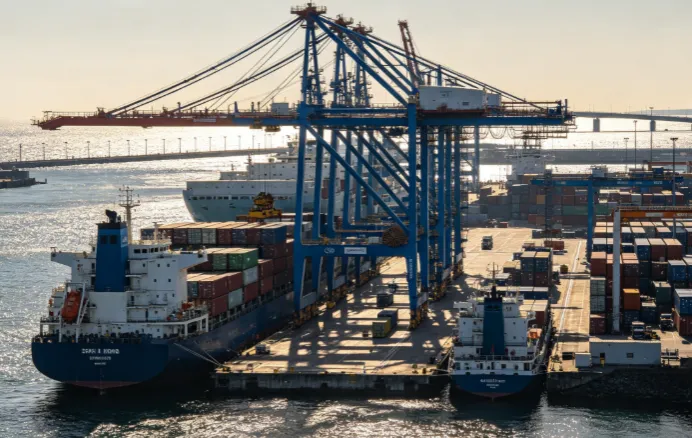
Sea Freight Transit Time from Vietnam to Brazil
Before diving into costs, you need to understand the shipping routes — because your choice of origin port in Vietnam and destination port in Brazil directly impacts both your transit time and your freight rate. Vietnam has three primary container ports serving Brazil-bound cargo, each with different sailing frequencies and transit durations. On the Brazilian side, four major ports handle the vast majority of containerized imports from Asia.
Ho Chi Minh City (Cat Lai Port) is Vietnam’s largest and best-connected container port, offering the most frequent sailings to South America and the fastest transit times to Brazil — typically 29 to 33 days to Santos. Hai Phong, the gateway for Northern Vietnam’s manufacturing hubs, requires transshipment through a regional hub (Singapore, Hong Kong, or Busan), extending the journey to 39 to 42 days to Santos. Da Nang, serving Central Vietnam, falls in between at 33 to 39 days to Santos. A notable development for this trade lane is the CMA CGM and Maersk SEAS3/ASAS2 express service, launched in April 2025, which connects Vung Tau directly to Santos in just 29 days using 6,500 TEU vessels — currently the fastest option on the market.
On the Brazilian side, the Port of Santos in São Paulo state handles approximately 30% of Brazil’s total foreign trade and is the undisputed primary gateway for containerized imports from Asia. Paranaguá in Paraná serves the country’s southern industrial and agricultural corridor. Rio de Janeiro remains a major container and general cargo hub, while Itapoá in Santa Catarina has emerged as a fast-growing private terminal with modern infrastructure and efficient turnaround times — an increasingly popular alternative for importers serving Brazil’s southern states.
Below is the complete transit time matrix for Vietnam-to-Brazil ocean freight, organized by origin and destination port pair:
| Origin Port (Vietnam) | Santos (SP) | Paranaguá (PR) | Rio de Janeiro (RJ) | Itapoá (SC) |
|---|---|---|---|---|
| Cat Lai (HCMC) | 29–33 days | 33–40 days | 28–35 days | 35–42 days |
| Hai Phong | 39–42 days | 35–40 days | 47–49 days | 42–48 days |
| Da Nang | 36–39 days | 33–37 days | 40–45 days | 38–44 days |
| Vung Tau (Express) | 29 days | — | — | — |
The trans-Pacific routing from Vietnam to Brazil typically crosses the South China Sea, transships through a major hub like Singapore or Busan, then crosses the Pacific Ocean toward the South American coast — either via the Cape of Good Hope or the Panama Canal depending on the carrier’s service loop. These routing choices are why transit times vary significantly between carriers even for the same port pair, and they also affect your freight rate: faster routings command premium pricing. For importers also sourcing from China, our Shipping Routes from China to Brazil page covers the major carrier service loops on this same Asia–South America corridor.
Sea Freight Costs from Vietnam to Brazil
The most common question we receive is “what is the sea freight rate from Vietnam to Brazil?” — and the honest answer is that the base ocean freight is only the starting point. Understanding both the headline rate and every surcharge underneath it is essential to accurate budgeting.
FCL (Full Container Load) Rates by Port Pair
Full Container Load (FCL) shipping means you book an entire container — either a 20-foot container (20GP), a 40-foot container (40GP), or a 40-foot High Cube (40HC) — for your exclusive use. This is the most cost-effective option when your shipment volume exceeds approximately 8–12 CBM. The following table shows current base ocean freight rates and estimated all-in ranges by route:
| Route | 20′ Container (Base Freight) | 40′ / 40′ HC (Base Freight) | Typical All-In Range (40′ HC)* |
|---|---|---|---|
| Cat Lai → Santos | $1,700–$1,900 | $2,100–$2,400 | $5,000–$8,500 |
| Cat Lai → Paranaguá | $1,800–$2,000 | $2,200–$2,600 | $5,500–$9,000 |
| Hai Phong → Santos | $1,800–$2,100 | $2,300–$2,700 | $6,000–$10,000+ |
| Hai Phong → Paranaguá | $1,900–$2,200 | $2,400–$2,800 | $6,500–$10,000+ |
*All-in range includes base freight + BAF, CAF, THC, documentation, customs brokerage, cargo insurance, and inland delivery. Excludes Brazilian import duties and taxes.
The gap between the base freight ($2,100–$2,400) and the all-in cost ($5,000–$10,000+) is where many importers get caught off guard. Here is exactly what fills that gap — a line-by-line breakdown of every surcharge and fee for a realistic shipment: one 40′ HC from Ho Chi Minh City to Santos with a $30,000 cargo value:
| Cost Item | Estimated Cost | Notes |
|---|---|---|
| Base Ocean Freight | $2,200 | Carries rate; varies by carrier and season |
| BAF (Bunker Adjustment Factor) + CAF | $400 | Fuel surcharge; adjusts monthly based on bunker fuel prices |
| Vietnam THC + Documentation | $250 | Terminal handling at Cat Lai + Bill of Lading issuance |
| Vietnam Customs Brokerage | $300 | Export declaration filing via VNACCS/VCIS system |
| Cargo Insurance (0.4% of value) | $120 | All-risk coverage for $30,000 declared value |
| Brazil Port THC | $350 | Terminal handling at Santos — Brazilian ports charge among the highest THC globally ($130–$165/CBM) |
| Brazil Customs Brokerage | $600 | Despachante Aduaneiro fees; mandatory for all commercial imports into Brazil |
| Inland Delivery (Santos → São Paulo, ~100 km) | $400 | Trucking from port to final warehouse; varies significantly by distance |
| Subtotal (Port-to-Door, Pre-Tax) | $4,620 | — |
| Brazilian Import Duties & Taxes (estimated 60% of CIF) | $18,000 | II + IPI + PIS + COFINS + ICMS + AFRMM (detailed in Section 6) |
| Total Landed Cost | $52,620 | ≈1.75× the $30,000 CIF value |
Notice that Brazilian import duties and taxes represent the single largest line item — larger than the freight itself, the insurance, and all handling fees combined. We will dissect exactly how these taxes are calculated in Section 6.
LCL (Less than Container Load) Costs
If your shipment is smaller than a full container, Less than Container Load (LCL) allows you to share container space with other shippers and pay only for the volume you use. LCL base rates from Vietnam to Brazil range from approximately $30 to $150 per CBM, depending on the port pair and your total volume.
LCL pricing follows the W/M (Weight or Measure) rule — the carrier charges whichever is greater between your cargo’s actual weight (per 1,000 kg) and its volumetric weight (per CBM). The minimum chargeable volume is typically 1 CBM, meaning even a 0.3 CBM shipment pays for a full cubic meter. At both ends of the journey, your cargo passes through a Container Freight Station (CFS) where it is consolidated with other shipments into a shared container at origin, then deconsolidated at destination — each CFS handling adds fees and approximately 5 to 10 extra transit days compared to FCL.
The break-even point where FCL becomes cheaper per unit than LCL is typically around 8 to 12 CBM. If your shipment consistently exceeds 8 CBM, booking a 20-foot container usually delivers a lower cost per cubic meter than continuing with LCL — and you gain the additional benefit of faster transit. For China-origin shipments to the same destination, our 20 ft Container Shipping Cost from China to Brazil guide provides comparable benchmarks.
Air Freight & Express Shipping Costs from Vietnam to Brazil
Sea freight is the default choice for most Vietnam-to-Brazil shipments, but there are scenarios where air freight or express courier services make more sense — and understanding the cost trade-offs helps you make the right call for your specific cargo.
Air Freight Rates (Commercial Cargo)
Commercial air freight from Vietnam to Brazil costs approximately $3.00 to $8.00 per kilogram for general cargo, with rates decreasing at higher weight tiers. The major airports on each end are Tan Son Nhat (SGN) and Noi Bai (HAN) in Vietnam, connecting to Guarulhos International (GRU) or Viracopos (VCP) in São Paulo. Standard air freight transit time is 5 to 10 days door-to-door — 1 to 2 days of actual flight time plus handling and customs clearance at both ends.
A critical concept in air freight pricing is chargeable weight: carriers calculate both the actual gross weight and the volumetric weight (Length × Width × Height in centimeters ÷ 6,000), then charge based on whichever is higher. This means lightweight, bulky cargo — think furniture, packaging materials, or certain textiles — can cost far more per kilogram than dense, compact goods like electronics or metal components. In addition to the per-kilogram rate, air freight shipments incur fuel surcharges, security surcharges, an Airway Bill (AWB) issuance fee, and terminal handling charges at both airports.
Express Courier (DHL, FedEx, UPS)
For small shipments — product samples, prototypes, documents, or very small commercial orders — express courier services provide the fastest delivery option. Approximate express rates from Vietnam to Brazil are:
| Weight | FedEx / DHL Express (Approximate) |
|---|---|
| 0.5 kg | $100–$140 |
| 1 kg | $130–$180 |
| 5 kg | $340–$450 |
| 10 kg | $580–$750 |
| 20 kg | $800–$1,000 |
Express shipments typically arrive in 3 to 7 business days. Brazil applies the following de minimis thresholds for express imports: gifts valued up to $50 FOB are exempt from Import Duty (II) but still subject to ICMS; personal shipments up to $100 are exempt from II; and commercial samples up to $10 FOB with no commercial value are exempt from II, IPI, PIS, and COFINS. For commercial e-commerce shipments above these thresholds, Brazil’s Remessa Conforme program applies full duties.
Sea Freight vs Air Freight: Which Should You Choose?
The decision between sea and air comes down to three variables: urgency, cargo value, and volume. For a 1 CBM / 200 kg shipment as a reference point, sea freight LCL would cost roughly $150–$300 in base freight (transit: 35–45 days), while air freight at $5/kg would cost approximately $1,000 (transit: 5–10 days), and express courier at $40/kg would cost $8,000 (transit: 3–7 days). Air freight is typically 5 to 10 times the cost of sea freight per kilogram — but for high-value goods, the inventory holding cost savings from 35+ fewer days in transit can outweigh the freight premium. (For a deeper cost-time comparison framework that applies across trade lanes, see our Air Freight vs Sea Freight from China to USA guide.) For intermediate situations, a sea-air combined solution — trucking from Vietnam to Singapore or Dubai, then flying to Brazil — can deliver 15–20 day transit at roughly half the cost of direct air freight. This option is rarely discussed by competitors but can be an attractive middle ground for time-sensitive shipments that do not justify full air freight.
Door-to-Door Shipping from Vietnam to Brazil: Incoterms, DDP & Full Process Costs
Many importers — especially those without an established logistics team in Brazil — want a single all-inclusive price that covers everything from their supplier’s factory in Vietnam to their warehouse doorstep in Brazil. This is what door-to-door shipping delivers, and your choice of Incoterms 2020 determines who pays for what at every step.
What Door-to-Door Actually Covers
A true door-to-door shipment involves six sequential stages: (1) truck pickup from your supplier’s factory or warehouse in Vietnam, (2) Vietnam export customs clearance and documentation, (3) international ocean or air freight transit, (4) Brazil import customs clearance and SISCOMEX registration, (5) payment of all Brazilian import duties and taxes, and (6) final-mile truck delivery to your designated address in Brazil. A door-to-door arrangement typically costs 20% to 40% more than a port-to-port booking — but it eliminates the need to coordinate with 5 or more separate vendors (trucking companies, customs brokers at both ends, freight carriers, tax accountants) and shifts the compliance risk to your freight forwarder.
Incoterms 2020 for Vietnam→Brazil
FOB Ho Chi Minh / FOB Hai Phong puts the responsibility on your Vietnamese supplier to handle export clearance and deliver the cargo to the port of departure. From that point, you — the buyer — control the ocean freight, insurance, Brazil import clearance, duties and taxes, and inland delivery. This gives experienced importers the most cost control but requires having a reliable Brazilian customs broker (Despachante Aduaneiro) and a working knowledge of SISCOMEX procedures.
CIF Santos means your supplier or forwarder pays the freight and insurance to the Brazilian port. You still handle import clearance, duties, taxes, and inland delivery. This is a good middle ground if you want freight costs bundled but have local customs capability in Brazil. The choice between FOB and CIF has significant financial implications regardless of the trade lane — our FOB vs CIF comparison for US importers walks through the cost allocation and risk trade-offs in detail.
DDP (Delivered Duty Paid) is the most comprehensive option: your freight forwarder handles everything — Vietnam pickup, export customs, freight, Brazil import customs, all duties and taxes, and final delivery. For a 40′ HC from Vietnam to São Paulo with typical commercial goods, all-in DDP pricing ranges from $15,000 to $35,000+, varying enormously by your product’s NCM code and the resulting tax rate. DDP is ideal for first-time importers because it delivers a single invoice with no surprise charges — but a critical caution: always verify that ICMS is explicitly included in any DDP quote. Some low-cost DDP providers quote a headline price that excludes ICMS (Brazil’s state VAT, which can be 17%–25%), leaving you with an unexpected bill upon arrival. For importers sourcing from both Vietnam and China, our DDP shipping from China to Brazil guide applies the same DDP framework to the China–Brazil lane.
Destination-Specific Cost Considerations
Where your goods land in Brazil matters. São Paulo (via Santos) offers the most competitive ocean freight rates and the broadest carrier selection, but ICMS in São Paulo is 18% and the Santos-to-São Paulo highway corridor is one of the most congested freight routes in Latin America. Rio de Janeiro has a similar ICMS rate (18–20%) with slightly longer transit times. Southern Brazil (via Paranaguá or Itapoá) can be tax-advantaged — Santa Catarina’s ICMS is 17%, which represents meaningful savings on high-value shipments. If your goods are destined for the Manaus Free Trade Zone, you may qualify for special federal tax exemptions — though you will need to factor in additional river barge transport from an Atlantic port. If your supply chain also serves North American markets, our Shipping cost from Vietnam to Mexico and Shipping cost from Vietnam to Canada guides cover those routes with comparable rate breakdowns.
Brazil Import Duties & Taxes: The Hidden Cost Multiplier
Brazil has one of the world’s most complex and expensive import tax regimes. If there is one section of this guide that will save you from a budgeting disaster, it is this one — because Brazilian taxes are typically 60% to over 100% of your CIF value, meaning they often represent the single largest line item in your total shipping cost.
Why Brazil’s Tax System Drives Up Your Total Landed Cost
Two structural features make Brazilian import taxes particularly burdensome. First, all taxes are calculated on the CIF value (Cost + Insurance + Freight), not the FOB value. This means you pay import taxes on your shipping and insurance costs — effectively a tax on a service you have already paid for. Second, Brazil uses a recursive “tax on tax” calculation: ICMS, PIS, and COFINS are each included in the base for calculating the others, which inflates the effective tax rate well above the sum of the nominal rates.
Complete Brazilian Import Tax Breakdown
| Tax | Full Name | Rate Range | Calculated On |
|---|---|---|---|
| II | Imposto de Importação (Import Duty) | 0%–35% | CIF value |
| IPI | Imposto sobre Produtos Industrializados | 0%–30% | CIF + II |
| PIS | Programa de Integração Social | ~2.1% | CIF + ICMS (recursive) |
| COFINS | Contribuição para o Financiamento da Seguridade Social | ~9.65% | CIF + ICMS (recursive) |
| ICMS | Imposto sobre Circulação de Mercadorias e Serviços (State VAT) | 17%–25% | CIF + II + IPI + PIS/COFINS + AFRMM (recursive) |
| AFRMM | Adicional ao Frete para Renovação da Marinha Mercante | 25% of ocean freight | International sea freight cost |
Vietnam-Specific NCM Examples
Your product’s NCM code (Nomenclatura Comum do Mercosul — Brazil’s 8-digit HS classification) determines your II and IPI rates. Here are the actual rates for Vietnam’s top export categories to Brazil, based on real shipping experience:
- Textiles & Garments (NCM Chapters 61–63) — Vietnam’s #1 export to Brazil. Typical II: 35%. IPI: typically 0% for most apparel categories. A $50,000 CIF garment shipment would incur approximately $32,000 in total Brazilian taxes.
- Footwear (NCM Chapter 64) — Vietnam is the world’s second-largest footwear exporter. Typical II: 35%. IPI varies by footwear type (approximately 0–7%).
- Electronics & Mobile Phones (NCM Chapter 85) — Major manufacturing presence from Samsung and other electronics brands in Vietnam. II varies widely: 0% to 20% depending on the exact subheading. Some electronic components benefit from lower rates under Brazil’s ex-tarifário regime for goods without domestic production.
- Furniture (NCM Chapter 94) — Growing export category. Typical II: 18%–20%. IPI: approximately 0–5%.
- Machinery & Mechanical Parts (NCM Chapter 84) — Typical II: 0%–18% depending on the specific equipment type.
Getting your NCM classification wrong is one of the costliest mistakes an importer can make — an incorrect code leads not only to the wrong tax rate but also to potential customs delays and fines of up to 100% of the declared goods value. For a broader overview of containerized imports into Brazil including port-specific requirements, see our Shipping Containers from China to Brazil guide.
Brazil Customs Clearance: What to Expect
All Brazilian imports must be processed through SISCOMEX (Sistema Integrado de Comércio Exterior), Brazil’s electronic customs platform. The process begins with a pre-arrival manifest filing (Radex/DSI), followed by an Import Declaration (DI) submitted by your registered customs broker. SISCOMEX then assigns your shipment to one of three risk channels: Green (approximately 70% of shipments, cleared in 2–5 days with no inspection), Yellow (documentation review required — timeline varies), or Red (full physical cargo inspection — can take 7 to 30+ days and may incur inspection fees of $1,500 or more). Critically, goods must clear customs within 90 days of arrival or face forfeiture. A qualified Despachante Aduaneiro (customs broker) is mandatory for all commercial imports — their fees range from approximately R$320 to R$1,023+ ($65–$210+) depending on the shipment complexity.
How to Reduce Your Vietnam to Brazil Shipping Costs
While you cannot avoid Brazilian import taxes, there are several strategies to meaningfully reduce your total logistics and landed cost. Many of these strategies apply regardless of origin — our What Is the Cheapest Way to Import from China? guide covers additional cost-reduction tactics that translate well to the Vietnam–Brazil lane.
Strategic Timing and Port Selection
Ocean freight rates on the Vietnam-to-Brazil route follow a seasonal pattern. Peak season (June through October) typically sees Peak Season Surcharges (PSS) of $300 to over $1,000 per container, driven by pre-holiday inventory buildup in Brazil and global container demand. The best booking windows for lower rates are February through April and November through early December. If your supply chain allows flexibility, scheduling shipments outside peak season is the single easiest way to save.
Your port choices also matter. If your supplier is in central or southern Vietnam, shipping through Cat Lai (HCMC) instead of Hai Phong saves 7 to 10 days of transit and typically $200–$400 in base freight. On the Brazilian side, Itapoá or Paranaguá for destinations in southern Brazil can offer two advantages over Santos: lower port congestion (faster clearance) and potentially lower ICMS rates (17% in Santa Catarina vs 18% in São Paulo).
Container Optimization and Consolidation
Maximizing container utilization is the most direct way to reduce your cost per unit. A 40′ HC container can typically hold 55–68 CBM and up to approximately 26,000 kg of cargo — but weight and volume limits rarely align perfectly. For dense goods (metal products, machinery), the weight limit caps you before the volume fills. For lightweight goods (textiles, foam products, empty packaging), volume fills first. Understanding your cargo’s density profile lets you plan container loading to hit the sweet spot. Additionally, if you source from multiple suppliers in Vietnam, consolidating their cargo into a single container before export — rather than shipping multiple LCL consignments separately — can reduce your total freight cost by 20% to 40%.
Amazon FBA Shipping from Vietnam to Brazil
Brazil is one of Amazon’s fastest-growing markets, and Vietnamese manufacturers have a direct opportunity to ship into Brazilian Amazon FBA fulfillment centers. However, FBA shipments to Brazil have additional requirements beyond standard commercial imports: products must meet Amazon’s labeling and packaging standards, shipments must be created through Amazon Seller Central with proper FBA shipment IDs, and your forwarder must be able to coordinate delivery appointments with Amazon’s carrier scheduling system. Critically, Amazon FBA sellers in Brazil must register for a Brazilian tax ID (CNPJ for businesses or CPF for individuals) — this is non-negotiable. Working with a freight forwarder experienced in both Vietnam-to-Brazil logistics and Amazon FBA inbound requirements eliminates the risk of rejected shipments, which can incur costly return freight and storage fees at the port.
If your business also ships from Vietnam to North America, our Sea Freight from Vietnam to USA and Sea Freight from Vietnam to Canada guides follow the same detailed rate-breakdown format for those routes.
Required Documents & Compliance Checklist for Vietnam→Brazil Shipping
Documentation errors are the most common cause of customs delays — and on the Vietnam-to-Brazil route, where two regulatory systems with different languages intersect, getting your paperwork right before the container leaves Vietnam is critical.
Vietnamese Export Documentation
The essential Vietnamese export documents are:
- Commercial Invoice: Three originals, bilingual (English and Portuguese strongly recommended), including the NCM code (at least the first 4 digits) for each product line, detailed descriptions, unit values, and total value.
- Packing List: Detailed net and gross weights per item, CBM per item, and total package count.
- Bill of Lading (B/L): Must display the CNPJ or CPF of the Brazilian consignee, the NCM code (minimum 4 digits), and — critically — explicit, itemized freight charges. The notation “freight as per agreement” or “freight collect” without specific amounts is one of the most common causes of SISCOMEX rejection.
- Certificate of Origin: Issued by the Vietnam Chamber of Commerce and Industry (VCCI). May enable preferential tariff rates if applicable under existing trade agreements.
- Export Declaration: Filed electronically through Vietnam’s VNACCS/VCIS customs system.
- Fumigation Certificate: Required for any solid wood packaging materials under ISPM 15 international standards. Brazil enforces this strictly.
Brazilian Import Documentation
Your Brazilian customs broker will handle the SISCOMEX filings, but you are responsible for providing:
- Import Declaration (DI): The primary SISCOMEX filing; must be completed by a licensed Despachante Aduaneiro.
- RADAR License: Your Brazilian importing entity must be registered in the RADAR system within SISCOMEX before any import can proceed.
- Import License (LI): Required before the cargo leaves Vietnam for many regulated product categories. This is not optional — failing to secure an LI pre-shipment means your cargo sits at the Brazilian port accruing daily storage fees with no ability to clear.
- Proof of Tax Registration: Valid CNPJ (corporate) or CPF (individual) for the Brazilian importer of record.
- Product-Specific Certifications: Depending on your goods, you may need ANVISA registration (food, drugs, cosmetics, medical devices), INMETRO certification (electronics, toys, tires, certain industrial products), ANATEL approval (any device with wireless communication), or MAPA clearance (agricultural products).
Common Documentation Pitfalls
The most frequent and avoidable errors we see are: mismatched weights or values between the Commercial Invoice and Bill of Lading (triggers Yellow channel automatically), missing NCM codes on the B/L (SISCOMEX will reject the filing outright), using “freight as per agreement” instead of explicit amounts on the B/L, an incorrect or inactive consignee CNPJ number, and shipping goods without a required Import License already in hand. The best protection is a pre-shipment document review with your Brazilian customs broker — have them verify every document before the container leaves Vietnam, not after it arrives in Santos.
Choosing a Reliable Freight Forwarder for Vietnam→Brazil Shipping
The Vietnam-to-Brazil route demands a freight forwarder who understands both ends of the journey — Vietnamese export procedures on one side and the uniquely complex Brazilian import regime on the other. A generalist forwarder who handles the route as an afterthought will cost you more in delays, fines, and storage charges than you could possibly save on a lower freight rate.
What to Look For
When evaluating a freight forwarder for Vietnam-to-Brazil shipments, prioritize these criteria:
- Americas specialization: Forwarders who focus on Asia-to-Americas trade lanes have established carrier relationships, trusted destination agents in Brazil, and customs expertise that a generalist cannot match.
- FIATA / IATA certification: These internationally recognized credentials signal professional competence, financial reliability, and adherence to global freight forwarding standards.
- Full-service DDP capability: A forwarder who can genuinely offer DDP to Brazil — with ICMS explicitly included in the quote — demonstrates deep Brazilian regulatory expertise. Be wary of forwarders who offer DDP but cannot explain Brazilian tax components when asked.
- Transparent, itemized pricing: The forwarder should provide a line-by-line quote showing every cost component: base freight, each surcharge, customs brokerage at both ends, and estimated duties and taxes. A single lump-sum number without a breakdown is a red flag. For a checklist of warning signs to watch for when vetting providers, see our guide on avoiding freight forwarder scams and hidden traps.
- Industry-specific knowledge: If you ship textiles, footwear, electronics, or furniture, your forwarder should know the relevant NCM codes, II/IPI rates, and any special certification requirements for your product category before you ask.
Why Dantful.US International Logistics
Dantful.US International Logistics brings over 15 years of dedicated Asia-to-Americas freight forwarding experience to every Vietnam-to-Brazil shipment. Headquartered in Shenzhen, China — the heart of global supply chain operations — we specialize exclusively in shipping from China, Taiwan, and Vietnam to the Americas, including the United States, Canada, Mexico, and Brazil.
We are FIATA and IATA certified, with regular sailings from all major Vietnamese ports — Ho Chi Minh City (Cat Lai), Hai Phong, and Da Nang — to Santos, Paranaguá, Rio de Janeiro, and Itapoá. Our direct contracts with major carriers on the Asia-South America trade lane, including the new 29-day CMA CGM/Maersk SEAS3 express service from Vung Tau to Santos, deliver competitive rates and reliable space even during peak season. For comparable container rate data on the China–Brazil lane, our Cost of Shipping 40ft Container from China to Brazil guide offers detailed benchmarks.
Our full-service door-to-door DDP offering covers every step: factory pickup in Vietnam, Vietnamese export customs clearance, ocean or air freight, Brazilian import customs clearance via our network of licensed Despachantes Aduaneiros, duty and tax payment management, and final-mile delivery to your warehouse, retail location, or Amazon FBA facility. Every client receives a dedicated account manager — a single point of contact from booking to delivery — plus optional comprehensive cargo insurance coverage for the full 40+ day ocean transit.
To get an accurate Vietnam-to-Brazil shipping quote tailored to your specific cargo, including estimated Brazilian duties and taxes, contact our team with your origin and destination addresses, cargo description and approximate HS/NCM codes, total weight and volume, preferred shipping mode, and desired Incoterm. We will provide a transparent, itemized quote so you can budget with confidence.
FAQs
Q: How much does it cost to ship a 40ft container from Vietnam to Brazil?
Base ocean freight for a 40′ HC from Vietnam to Brazil ranges from $2,100 to $2,800 depending on the port pair. However, the all-in cost including surcharges, customs clearance, cargo insurance, and inland delivery typically totals $4,000 to over $10,000. Brazilian import duties and taxes then add an additional 60% to over 100% on top of the CIF value, meaning your true total landed cost is typically 1.6 to 2.0 times the CIF value of your goods.
Q: What is the cheapest way to ship from Vietnam to Brazil?
For shipments above 8–12 CBM, FCL sea freight via Cat Lai (HCMC) to Santos offers the lowest cost per unit by a significant margin. For smaller volumes, LCL sea freight is the most economical option. To minimize costs further: ship during the off-peak window (February–April or November–early December), use Cat Lai instead of Hai Phong if geographically feasible, and consider Paranaguá or Itapoá instead of Santos for southern Brazil destinations — both offer lower port congestion and potentially lower ICMS rates.
Q: How long does sea freight take from Vietnam to Brazil?
Transit times range from 28 to 49 days depending on the port pair. The fastest standard route is Cat Lai (HCMC) to Rio de Janeiro at 28–35 days. The new CMA CGM/Maersk SEAS3 express service from Vung Tau to Santos delivers the absolute fastest transit at 29 days. The slowest common route, Hai Phong to Rio de Janeiro, takes 47–49 days. LCL shipments add 5–10 extra days for consolidation and deconsolidation.
Q: What is DDP shipping from Vietnam to Brazil?
DDP (Delivered Duty Paid) means your freight forwarder manages the entire process — pickup at your Vietnamese supplier, export customs clearance, international freight, Brazilian import customs clearance, payment of all duties and taxes (II, IPI, PIS, COFINS, ICMS, AFRMM), and final delivery to your door in Brazil. You receive one all-inclusive invoice. Always verify explicitly that ICMS is included in any DDP quote — some low-cost providers exclude it, leaving you with an unexpected tax bill upon arrival.
Q: How are Brazilian import taxes calculated on goods from Vietnam?
Brazilian taxes are calculated on CIF value (Cost + Insurance + Freight) using a recursive six-layer system: II (0–35%), IPI (0–30%), PIS (~2.1%), COFINS (~9.65%), ICMS (17–25% depending on the state), and AFRMM (25% of ocean freight). Because PIS, COFINS, and ICMS are calculated recursively — each tax becomes part of the base for the next — the effective total rate typically ranges from 60% to over 100% of CIF, far above the simple sum of the nominal rates. The exact rate is determined by your product’s NCM code.
Q: What documents do I need to ship from Vietnam to Brazil?
Essential documents include: Commercial Invoice (bilingual English/Portuguese with NCM codes), Packing List, Bill of Lading (with explicit freight charges and CNPJ/CPF), Certificate of Origin, and Vietnam Export Declaration. On the Brazilian side: Import Declaration (DI) via SISCOMEX, RADAR license, Import License (LI) if required for your product category, and product-specific certifications (ANVISA, INMETRO, ANATEL, or MAPA) depending on your goods. An Import License must be obtained before the cargo leaves Vietnam for regulated products.
Q: Can I ship from Vietnam to Amazon FBA in Brazil?
Yes. Brazil is one of Amazon’s fastest-growing markets, and Vietnamese manufacturers can ship directly to Brazilian FBA fulfillment centers. You will need a Brazilian tax ID (CNPJ for businesses or CPF for individuals), FBA-compliant labeling and packaging, and a freight forwarder who understands Amazon’s carrier appointment and delivery window systems. FBA inbound shipments have stricter requirements than standard commercial imports — working with an FBA-experienced forwarder minimizes the risk of rejected shipments and associated return costs.
Q: Is air freight worth the cost compared to sea freight from Vietnam to Brazil?
Air freight costs $3–$8/kg, while sea freight can be under $1/kg for large FCL shipments — making air freight 5 to 10 times more expensive by weight. However, air freight is justified when: (1) your cargo value is high enough that 35+ days of inventory holding cost outweighs the freight premium, (2) you face a hard deadline that sea freight cannot meet, or (3) you are shipping small samples or prototypes where express courier service is more practical than full air freight. A sea-air combined solution via a regional hub can deliver intermediate speed at intermediate cost.
Q: Why are shipping costs from Vietnam to Brazil higher than to other destinations?
Three structural factors drive up Vietnam-to-Brazil shipping costs. First, the distance — it is a long trans-Pacific route exceeding 12,000 nautical miles. Second, Brazil’s tax system calculates duties on CIF value, meaning you pay import taxes on the shipping cost itself, effectively doubling the impact of freight on your total landed cost. Third, Brazilian port infrastructure costs — particularly THC at Santos, mandatory customs broker requirements, and the SISCOMEX system’s administrative complexity — are among the highest of any major trading nation.
Leave a reply