

Every year, over $200 billion worth of machinery is exported from China — yet a single miscalculation in shipping method, customs classification, or lashing technique can turn a profitable equipment purchase into a logistical nightmare costing thousands in delays. If you are importing construction equipment, industrial machines, or agricultural machinery, you have probably asked: “Will my excavator even fit in a container? How much will shipping plus duties actually cost? And what happens if my equipment gets damaged during transit?”
This guide answers all of those questions. With over 15 years of hands-on experience managing heavy equipment exports from Shenzhen, we have seen firsthand what works — and what goes catastrophically wrong. Take the case of a US construction firm that hired us after their first excavator shipment arrived with $18,000 in damage because the lashing plan was improvised at the port — a mistake we will help you avoid entirely. By the end, you will understand every shipping heavy machinery from China method available, how to calculate your true landed cost, the customs clearance requirements for the United States, Canada, and Mexico, and how to protect your equipment from factory floor to final delivery.
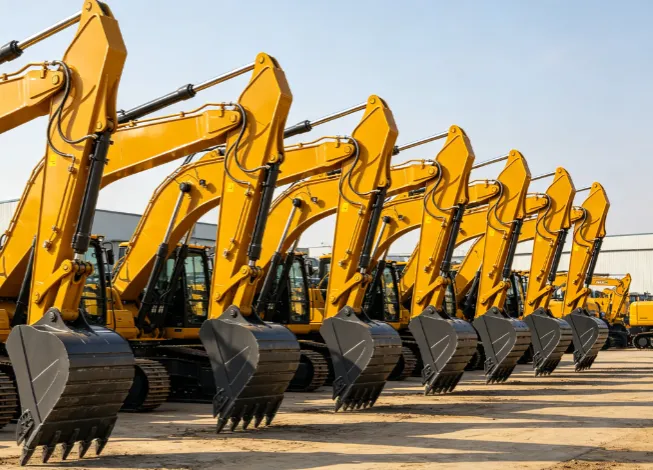
What Counts as “Heavy Machinery” in International Shipping?
“Heavy machinery” in logistics is defined by dimensions, weight, and mobility. Four terms are essential:
- OOG (Out of Gauge) Cargo: Freight exceeding standard container internal dimensions — width > 2.33 m or height > 2.59 m. Requires specialized equipment like flat racks or open-top containers.
- Breakbulk Shipping: Cargo that cannot be containerized at all, loaded piece-by-piece onto the vessel using heavy-lift cranes.
- Heavy-Lift Cargo: Single pieces exceeding 30 metric tons, requiring specialized lifting gear.
- Project Cargo: Complex, multi-component shipments requiring engineered logistics plans and route surveys.
| Category | Examples | Typical Weight | Common Challenge |
|---|---|---|---|
| Construction Equipment | Excavators, bulldozers, wheel loaders, mobile cranes | 8–45 tons | Over-width tracks; self-propelled = RORO candidate |
| Industrial Manufacturing | Injection molding machines, CNC centers, hydraulic presses | 5–30 tons | Sensitive electronics; moisture protection critical |
| Power Generation | Diesel generators, transformers, turbine components | 3–80+ tons | Heavy single-piece units; may require breakbulk |
| Agricultural Machinery | Combine harvesters, tractors, irrigation systems | 5–25 tons | Seasonal deadlines; wide dimensions |
The fundamental challenge: a 40-foot container has an internal width of roughly 2.35 meters and a door opening of 2.34 meters. If your equipment exceeds those dimensions, you need purpose-built equipment, ports with adequate crane capacity, multi-axle trailers, and a freight forwarder who understands the engineering — not just the paperwork.
6 Shipping Methods for Heavy Machinery: Which One Fits Your Equipment?
| Method | Best For | Max Weight | Max Width | Cost | Transit (China→US West Coast) | Damage Risk |
|---|---|---|---|---|---|---|
| FCL (20GP/40GP/40HQ) | Machinery fitting container dimensions | ~28 tons (20GP) | 2.35 m | $ | 12–18 days | Low |
| Flat Rack Container (20FR/40FR) | Over-width machinery (transformers, wheel loaders) | ~35–40 tons | ~4 m | $$ | 15–22 days | Medium |
| Open Top Container (20OT/40OT) | Over-height machinery fitting standard width | ~28 tons | 2.35 m | $$ | 15–22 days | Medium |
| RORO (Roll-On/Roll-Off) | Self-propelled wheeled equipment (excavators, tractors) | Vessel-dependent | Ramp-dependent | $$ | 18–28 days | Very Low |
| Breakbulk / LOLO | Non-containerizable massive cargo | 200–800 tons | Unlimited | $$$ | Varies | Medium-High |
| Heavy-Lift / MPP Vessel | Single pieces > 150 MT (turbines, TBMs) | 400+ tons | Unlimited | $$$$ | Varies | Medium |
FCL: Cheapest and simplest if your machinery fits. For more on this, see our guide to Containers shipping from China to USA for standard container options. The container door opening is your bottleneck — measure the machine at its widest point, add crate thickness, and confirm the total clears the doors.
Flat Rack: The workhorse for over-width cargo. End walls must both be up or both down — never one each way. Expect a “lost slots” surcharge because protruding cargo prevents adjacent container stacking.
Open Top: Best for over-height cargo within standard width. Crane-loaded from above with removable tarpaulin cover. Verify tarpaulin tension before departure — a loose tarp shreds within hours in heavy seas.
RORO: In our experience, the safest method for wheeled equipment. Excavators, loaders, and tractors are simply driven onto the vessel — no cranes, no lifting, minimal damage risk. We have shipped hundreds of excavators this way and have never seen a crane-related damage claim on a RORO shipment. Fixed schedules unlike breakbulk. Must be operational enough to drive on/off.
Breakbulk: For cargo too large for any container. No dimensional limits, but no fixed schedule either (tramp service). Economical at 5+ units or when no alternative exists.
Quick Decision Guide: (1) Fits in a container? → FCL. (2) Self-propelled with wheels? → RORO. (3) Over-width only? → Flat Rack. Over-height only? → Open Top. (4) Exceeds 40 tons or 4 m? → Breakbulk or Heavy-Lift.
The Complete Step-by-Step Process: Factory to Final Delivery
Here is the 10-step journey that a professional freight forwarder manages from start to finish:
- Pre-Shipment Assessment: Measure exact dimensions and weight at outermost points. Obtain CAD drawings with center of gravity (COG) coordinates. Commission a physical pre-shipment survey, not just manufacturer spec sheets.
- Incoterm Selection: Agree on Incoterms 2020 terms — EXW, FOB, CIF, or DDP — before finalizing the purchase. This determines who pays for each transport leg (see Section 7 for the full comparison). In our experience, changing the Incoterm after the supplier has quoted is one of the most common and costly mistakes first-time importers make.
- Export Packaging: Anti-corrosion treatment (VCI film, rust-preventive oil), custom hardwood/marine-plywood crating, ISPM 15 fumigation and IPPC stamp for all wood packaging, Shockwatch and Tiltwatch indicators.
- Inland Trucking in China: Multi-axle lowboy trailers (8–18 axles). Cargo exceeding 3 m width or 4.5 m height requires a Special Transport Permit applied 15+ days in advance.
- Chinese Export Clearance: Commercial Invoice, Packing List, Certificate of Origin, export licenses. AEO-certified forwarders clear ~40% faster with ~60% fewer inspections.
- Port Loading: Staged in OOG yard. Marine surveyor verifies lifting plan, rigging, and documents everything with time-stamped photographs.
- Ocean Transit: Stowage plan and lashing quality determine safety. The Bill of Lading (B/L) is your document of title. GPS/AIS tracking available throughout the voyage.
- Destination Customs: Licensed customs broker files the entry and classifies your machinery under the correct HS Code — according to US Customs and Border Protection (CBP) , misclassification is the #1 cause of entry delays and penalties on industrial imports. We always recommend having a broker pre-classify your machinery before it leaves China.
- Duty & Tax Payment: Base duty rate + any Section 301 tariffs (US), MPF (0.3464%), and HMF (0.125%, ocean only). Duties must be paid before cargo release.
- Final-Mile Delivery: Heavy-haul trucking to your facility. Inspect machinery and packaging thoroughly before signing the delivery receipt — this becomes the basis for any insurance claim.
What Shipping Heavy Machinery from China Actually Costs
A freight quote is only 40–60% of your total landed cost — and in our experience, the importers who get burned are almost always the ones who budgeted for the freight quote alone and never saw the destination charges coming. Below is a real-world breakdown for a representative shipment, so you know exactly what to expect with no surprises.
Scenario: One 22-ton injection molding machine, 40-foot Flat Rack, FOB Shenzhen → Door Los Angeles, mid-2026 rates. For standard container cost comparisons, see our Cost of Shipping a 40ft Container from China to USA breakdown, and for broader ocean freight options, our guide to Sea Freight from China to USA covers FCL and LCL pricing.
| Cost Component | Estimate (USD) | Notes |
|---|---|---|
| Inland Trucking (Factory → Shenzhen Port) | $600 – $1,200 | Multi-axle trailer + road permits |
| Export Customs Clearance | $150 – $300 | China-side broker fee |
| Origin THC (Terminal Handling) | $400 – $650 | OOG flat rack handling |
| Ocean Freight (Shenzhen → LA, 40FR) | $3,500 – $4,800 | Base ocean rate |
| OOG / Flat Rack Surcharge | $800 – $1,500 | Lost slots compensation |
| BAF (Bunker Adjustment Factor) | $200 – $500 | Fuel surcharge, quarterly adjustment |
| Cargo Insurance (All Risks, 110% CIF) | $250 – $400 | ~0.35% of insured value |
| Destination THC (Port of LA) | $450 – $750 | OOG terminal handling |
| US Customs Brokerage Fee | $150 – $350 | Licensed broker entry |
| Single Entry Bond | $300 – $800 | Based on entered value |
| Destination Trucking (Port → Warehouse) | $800 – $2,000 | Heavy-haul carrier |
| Total Landed Cost (excl. duties & tariffs) | ~$7,600 – $14,200 | |
| US Customs Duty (HTS 8477.10) | 0% – 3.7% | Often duty-free for this category |
| Section 301 Tariff (if applicable) | 25% of entered value | Check USTR exclusion lists |
| MPF + HMF | ~$200 – $700 | Capped fees |
Cost Comparison by Destination (40FR)
| Destination | Ocean Freight | Transit | Total (excl. duties) |
|---|---|---|---|
| USA — West Coast (LA/LB) | $3,500 – $4,800 | 12–18 days | $7,600 – $14,200 |
| USA — East Coast (NY/NJ) | $5,500 – $7,500 | 28–35 days | $10,000 – $17,000 |
| Canada — West (Vancouver) | $3,800 – $5,200 | 14–20 days | $8,000 – $15,000 |
| Mexico — Pacific (Manzanillo) | $3,200 – $4,500 | 18–25 days | $7,000 – $13,000 |
| Brazil — Santos | $5,000 – $7,000 | 30–40 days | $10,000 – $18,000 |
5 Ways to Reduce Costs
- Book during off-peak (Q2 or early Q4) — rates spike 20–40% during Q3 peak season and pre-CNY.
- Compare FCL vs. Breakbulk at volume — breakbulk per-ton economics flip at 5+ units.
- Use multi-port allocation — routing to Houston instead of all through LA can cut inland trucking 15–25%.
- Negotiate annual volume contracts for regular machinery imports.
- Bundle purchases into consolidated shipments — two machines on one breakbulk sailing cost less than two separate flat racks.
Customs Clearance & Import Duties: USA, Canada & Mexico
United States
HS Code Classification is the most important step. Most non-electrical machinery falls under HTS Chapter 84; electrical under Chapter 85; self-propelled vehicles under Chapter 87. Common codes:
| HTS Code | Product | Duty Rate |
|---|---|---|
| 8429.51 | Loaders, bulldozers, excavators | 0% |
| 8457.10 | CNC machining centers | 4.2% |
| 8458.11 | CNC horizontal lathes | 4.4% |
| 8462.10 | Forging/die-stamping machines | 4.4% |
| 8474.20 | Crushing/grinding machines | 0% |
| 8477.10 | Injection molding machines | 0% |
| 8479.89 | Other mechanical appliances | 2.5% |
| 8502.11/12 | Diesel generator sets | 2.5% |
| 8704.10 | Dumpers (off-highway) | 0% |
Section 301 Tariffs: As of 2026, rates of 7.5%–25% still apply to many Chinese-origin goods. For a deeper analysis of how these trade policies are evolving, see our guide on How U.S.-China Trade Tariffs Are Evolving in 2025: What Importers Need to Know. Check the USTR exclusion list for your specific HTS code — do not assume. Required documents: CBP Form 7501, Commercial Invoice, Packing List, B/L, Certificate of Origin, and ISF filed 24+ hours before vessel loading. EPA may require emissions declarations for diesel engines.
Canada
Processed via CBSA. Use the Canada Tariff Finder for duty rates. GST (5%) applies to all imports, plus provincial sales tax. For a complete walkthrough, see our guide on Shipping from China to Canada. For used agricultural machinery, the CFIA enforces strict cleanliness requirements — steam-cleaning certificate required.
Mexico
Aduana (SAT) requires a pedimento from a licensed Mexican broker. Many machinery categories need NOM compliance (NOM-001 for electrical safety, NOM-016 for energy efficiency). IVA (16%) applies to CIF + duty. For a full overview of your shipping options, read our guide on Shipping from China to Mexico. Partner with a forwarder that has established Mexican brokerage relationships.
Used Machinery Rules
The US EPA restricts used non-road diesel engines not meeting emissions standards. Most countries require pre-shipment inspection certificates and steam-cleaning documentation. Budget 2–3 extra weeks of lead time for used equipment.
Incoterms for Heavy Machinery: Which One Protects You?
Incoterms matter more for heavy machinery — cargo values are $10,000–$500,000+, damage risk is elevated, and OOG coordination complexity means the wrong term can leave you liable for costs you never anticipated.
| Incoterm | Who Arranges Freight? | Who Handles Import Clearance? | Best For |
|---|---|---|---|
| EXW (Ex Works) | Buyer | Buyer | Experienced importers with China logistics team |
| FOB (Free on Board) | Buyer | Buyer | Cost-control seekers with trusted destination broker |
| CIF (Cost, Insurance, Freight) | Seller (freight + insurance) | Buyer | High-value machinery; verify insurance coverage before sailing |
| DDP (Delivered Duty Paid) | Seller (everything) | Seller | First-time importers; complex destinations (Brazil, Mexico). Not to be confused with DDU (Delivered Duty Unpaid), where the seller handles freight but the buyer pays import duties. |
Scenario Guide: First-time importing a wheel loader? → DDP eliminates 90% of the headache. Have a trusted US broker for cost transparency? → FOB + freight forwarder service. Shipping a $250,000 CNC center? → CIF with verified All Risks at 110% value. Buying used equipment from multiple suppliers? → EXW with a forwarder’s consolidation service.
The Trap: A lower EXW price often costs more than FOB once you add local Chinese trucking, port charges, and export clearance. Always compare on the same terms. For a detailed breakdown of how these two terms compare, read our guide on EXW vs FOB Explained: Cost, Risk, and Responsibility Comparison. If you are deciding between CIF and FOB for your machinery import, our analysis of CIF vs FOB: Which is better for US importers walks through real cost scenarios.
Packing, Lashing & Insurance: Protecting Your Investment
Export Packaging Standards
- Anti-corrosion: VCI film, rust-preventive oil on exposed metal, desiccant packs in sealed wrapping
- Crating: Kiln-dried hardwood or marine plywood; steel-reinforced bases for machines > 10 tons; bolt the machine down, do not gravity-rest
- ISPM 15: All solid wood must be heat-treated (56°C core, 30+ min) or fumigated and stamped with the IPPC mark
- Shock & Tilt Indicators: Affix on at least two crate faces; photograph before departure
Lashing Best Practices
- COG: Must be marked on cargo; CAD drawings essential for equipment > 5 tons
- Lashing Strength: Combined breaking strength ≥ 1.8× cargo weight
- Dunnage: High-quality hardwood only (Kerto-Q/LVL); max 2,500 lbs/linear foot on flat racks
- Flat Rack Rules: Both end walls up or both down — never asymmetric; 4 corner castings unobstructed; cross-tension lashing pattern
- Wire Rope Lashing: ≥ 12 mm diameter for units > 5 tons; rated turnbuckles and shackles
Cargo Insurance
- All Risks (Institute Cargo Clauses A): Broadest coverage — recommended for all heavy machinery
- WPA (Clauses B): Named perils only; excludes many water damage and rough handling scenarios
- FPA (Clauses C): Total loss only — the cheapest, and usually wrong for machinery
- Coverage: 110% of CIF value. Premium: ~0.3–0.5% of insured value.
- Claims: Notify within 24 hours → surveyor inspection → documentation → settlement in 30–60 days
7 Common Mistakes When Shipping Heavy Machinery from China
- Declaring Incorrect Dimensions: 5 cm off = cargo does not fit. Get a professional pre-shipment survey with physical measurement.
- Skipping COG Documentation: Without CAD drawings, the crane operator is guessing with a 30-ton load.
- Choosing Method by Freight Quote Alone: Breakbulk looks cheaper until you add port storage ($500/day), higher THC, and special destination crane rental. Compare full-door cost.
- Under-Insuring or Skipping Insurance: At 0.3–0.5% of cargo value, one total loss equals 200–300 shipments’ worth of premiums.
- Missing Road Permit Deadlines: Special Transport Permit needs 15+ days in China. Miss the window, miss the vessel.
- Assuming All HS Codes Are the Same: A machining center (8457.10, 4.2%) and a lathe (8458.11, 4.4%) have different duty rates and tariff status. Have a broker classify before the shipment sails.
- Using Standard Lashing for OOG Cargo: Polyester straps will not hold a 15-ton excavator in 6-meter swells. Use wire rope ≥ 12 mm with engineered lashing plans.
Door-to-Door vs. Port-to-Port: Which Service Scope Fits You?
Door-to-door shipping covers everything — supplier pickup through final delivery. One contact, one invoice, no coordinating between separate trucking, shipping, and customs providers. Ideal for first-time importers, SMEs without logistics teams, and buyers in complex customs destinations.
Port-to-port suits experienced importers with established brokers and trucking relationships who want to manage destination logistics themselves.
Important: DDP (an Incoterm where the seller bears all risk/cost to your door) and door-to-door (a service scope) are not the same thing. DDP is always door-to-door, but door-to-door is not always DDP. Clarify both before signing.
Heavy Machinery Shipping Routes: China to the Americas
| Destination | Primary Ports | Ocean Transit | Cost |
|---|---|---|---|
| USA — West Coast | Los Angeles, Long Beach, Oakland, Seattle | 12–18 days | $$ |
| USA — East Coast | New York/Newark, Savannah, Charleston | 28–35 days | $$$ |
| USA — Gulf Coast | Houston, New Orleans | 25–32 days | $$$ |
| Canada — West | Vancouver, Prince Rupert | 14–20 days | $$ |
| Canada — East | Montreal, Halifax | 28–35 days | $$$ |
| Mexico — Pacific | Manzanillo, Lázaro Cárdenas | 18–25 days | $$ |
| Mexico — Gulf | Veracruz, Altamira | 22–30 days | $$$ |
| Brazil | Santos, Itajaí, Rio de Janeiro | 30–40 days | $$$ |
Route tips: West Coast is cheapest for ocean freight but inland trucking to the Midwest can erase savings. For a complete breakdown of transit times and port options, see our Shipping from China to USA landing page and our Shipping Routes from China to Brazil guide for South American importers. The rail-bridge (LA → Chicago/NY) is often 10–15% cheaper than all-water East Coast and 7–10 days faster. Mexico’s Pacific ports are viable USMCA gateways if Section 301 tariffs are a concern.
Why Choose Dantful for Heavy Machinery Shipping from China
Dantful.US International Logistics specializes in heavy machinery shipping from China to the Americas. With 15+ years of experience, FIATA and IATA certification — internationally recognized standards administered by the International Federation of Freight Forwarders Associations and the International Air Transport Association — and direct carrier contracts on Americas trade lanes, we deliver what generalist forwarders cannot.
- True Door-to-Door: Factory pickup to your warehouse — one contact, one invoice, end-to-end accountability
- Americas Specialization: Deep expertise on China → USA, Canada, Mexico, and Brazil routes
- Transparent Pricing: Every cost disclosed upfront — the landed cost breakdown you see in Section 5 is exactly how we quote, with no hidden fees
- Engineered Packaging & Lashing: Custom crating, cradle designs, and lashing plans backed by CAD analysis — not guesswork
- Dedicated Account Manager: One person who knows your cargo and route, with 24/7 direct communication
Ready to ship? Contact our heavy machinery team for a free consultation and landed cost estimate — a preliminary logistics plan delivered within 24 hours.
FAQs
How long does it take to ship heavy machinery from China to the USA?
West Coast: 12–18 days ocean + 3–5 days port/customs + trucking = 20–30 days door-to-door. East Coast: 35–45 days total. For a full transit time breakdown, see our guide: How Long does it Take to Ship from China to USA.
What is the cheapest shipping method?
FCL (if the machinery fits), followed by flat rack for OOG cargo. Breakbulk becomes economical at 5+ units. RORO is best value for self-propelled equipment.
Do I need a special permit?
Yes — Chinese road permits for cargo > 3 m width or > 4.5 m height. Apply 15+ days before pickup. Your forwarder should handle this.
How much does it cost?
$7,600–$14,200 for a 40FR from Shenzhen to LA (excl. duties/tariffs). See the full cost breakdown table above.
Can I ship used heavy machinery?
Yes, with additional documents: pre-shipment inspection, steam-cleaning certificate, and country-specific compliance. Allow 2–3 extra weeks’ lead time.
Conclusion
Shipping heavy machinery from China is not one-size-fits-all. Five takeaways:
- Your freight quote is only 40–60% of your landed cost. Budget for origin charges, destination charges, duties, tariffs, insurance, and final-mile trucking.
- Customs clearance is where most imports go wrong. Correct HS Code classification prevents the majority of delays and penalties.
- Proper packing and lashing is the cheapest insurance. Lashing ≥ 1.8× cargo weight, ISPM 15 compliance, and hardwood dunnage are non-negotiable minimums.
- Compare total landed cost, not ocean freight rates. The method that looks cheapest on freight often costs the most at your door.
- Your freight forwarder is the single biggest factor. Choose one with proven heavy machinery expertise, Americas route specialization, and true door-to-door capability.
Don’t leave your heavy machinery shipment to chance. Dantful.US International Logistics — 15+ years of heavy cargo expertise, FIATA/IATA certified, dedicated to getting your equipment from China to the Americas safely, on time, and on budget. For specialized heavy equipment logistics, visit our Shipping Machinery from China to USA page or contact us today for a free landed cost estimate and tailored shipping plan.
Leave a reply