

Are you a US importer deciding between CIF (Cost, Insurance, and Freight) and FOB (Free on Board) for your shipments from Asia? While CIF might seem like the easier option because the supplier handles the shipping, many importers are hit with unexpected destination charges once the cargo arrives at the Port of Los Angeles or the Port of New York/New Jersey.
Drawing from over a decade of hands-on experience managing Transpacific freight, we have seen countless first-time importers lose their profit margins to “cheap” CIF quotes. Understanding the true cost breakdown, risk transfer points, and customs responsibilities is critical for controlling costs and ensuring supply chain safety. In this guide, we break down CIF vs FOB specifically for the Americas dedicated line, helping you choose the most cost-effective and secure Incoterm for your business.
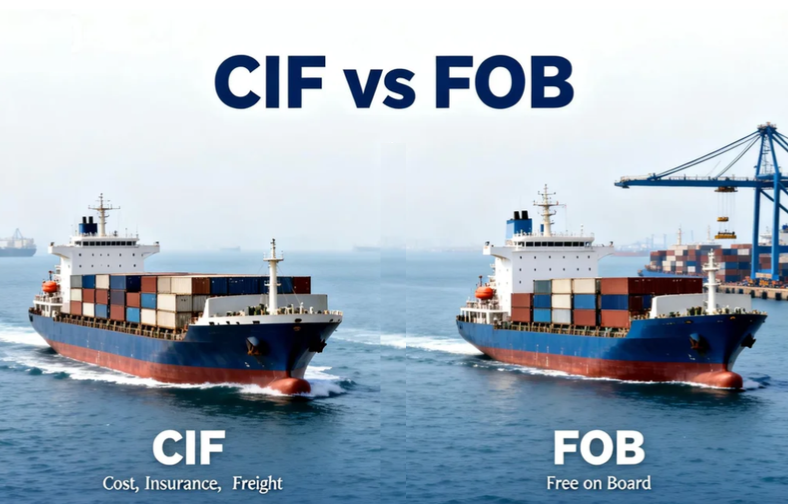
What Are CIF and FOB in International Shipping?
Both CIF and FOB are standard Incoterms (International Commercial Terms) that define who pays for what, and when the risk of loss or damage transfers from the exporter to the importer.
FOB (Free on Board)
Under FOB, the exporter is responsible for all costs and risks up to the point the goods are loaded onto the vessel at the origin port (e.g., Shanghai Port, Shenzhen Port).
- Risk Transfer: Once the goods cross the ship’s rail at origin.
- Buyer’s Role: The US importer controls the Sea Freight or Air Freight, chooses the freight forwarder, and buys the insurance.
CIF (Cost, Insurance, and Freight)
Under CIF, the exporter pays for the main carriage and minimum insurance to bring the goods to the named destination port in the United States.
- Risk Transfer: Same as FOB—once the goods are loaded onto the vessel at origin. (Many mistakenly believe risk transfers at the destination).
- Buyer’s Role: The US importer is responsible for all unloading, destination handling, and customs clearance upon arrival.
The Hidden Costs: Why CIF Can Be a Trap for US Importers
For many first-time buyers sourcing from China or Vietnam, CIF looks attractive. The supplier quotes a landed price at the US port. However, CIF often leads to loss of control and inflated destination charges.
When a supplier ships CIF, they often use a forwarder who offers them a very low origin freight rate but compensates by charging exorbitant destination fees to the US consignee.
Real-World Pitfall Scenario: Recently, an Amazon FBA seller imported a 20’GP container of electronics from Shenzhen to the Port of Los Angeles under CIF terms. The supplier’s freight quote seemed $300 cheaper than market average. However, upon arrival, the US importer was hit with:
- Inflated THC (Terminal Handling Charges): Billed at $800 instead of the standard $400.
- Unjustified Document & Handover Fees: $250.
- Because the supplier’s forwarder was slow to release the Delivery Order (D/O), the container sat at the terminal, incurring Demurrage fees of $150/day for 4 days.
- Total unexpected loss: $1,250.
Under CIF, you have zero leverage to negotiate these local fees because the contract is between the supplier and their forwarder.
Common Hidden CIF Fees at US Ports Include:
- Inflated THC (Terminal Handling Charges)
- PierPass / Traffic Mitigation Fees (TMF) and Clean Truck Fees (CTF) (often marked up by third-party agents)
- High Demurrage and Detention rates if customs clearance is delayed
With FOB, you negotiate directly with a US-based forwarder like Dantful.US International Logistics. The costs are transparent, and you have a dedicated agent handling your Customs Clearance and Door to Door delivery.
Cost & Risk Comparison: CIF vs FOB (China to USA)
Note: Freight rates and transit times fluctuate based on peak seasons, General Rate Increases (GRIs), and port congestion. The following is a comparative estimate for a 20’GP container from Shenzhen to Los Angeles.
| Feature / Cost Component | FOB (Importer Controls Freight) | CIF (Supplier Controls Freight) |
|---|---|---|
| Origin Charges & Export Customs | Paid by Supplier | Paid by Supplier |
| Ocean Freight (e.g., $1,200 – $1,800) | Paid by Importer (Transparent) | Paid by Supplier (Often marked up) |
| Marine Insurance | Arranged by Importer (Usually comprehensive Clause A) | Arranged by Supplier (Minimum Clause C – covers total loss, ignores partial damage) |
| Risk Transfer Point | On board vessel at origin (Incoterms® 2020) | On board vessel at origin (Incoterms® 2020) |
| Destination THC & Port Fees | Paid by Importer (Pre-negotiated) | Paid by Importer (Often inflated) |
| Import Customs Clearance | Arranged by Importer | Arranged by Importer |
| Overall Cost Control | High – You know every fee | Low – Prone to surprise surcharges |
Decision Framework: When to Choose Which?
Choosing the right term depends on your volume, experience, and need for control.
Choose FOB if:
- You import regularly and want to optimize Sea Freight or Air Freight costs.
- You want transparent pricing without hidden destination fees.
- You want control over the transit time and carrier selection (crucial for Amazon FBA inventory).
- You want to ensure comprehensive insurance coverage for high-value goods.
Choose CIF if:
- You are a new importer making a one-off, very small shipment (though DDP or DAP might be better for true door-to-door simplicity).
- You do not have a reliable US customs broker or freight forwarder yet. (Warning: Even for small shipments, be prepared for unpredictable local port charges).
Related reading: Find out how Shipping Container from China to USA can impact your overall import strategy under both CIF and FOB terms.
Customs Clearance & Compliance Risks
Regardless of whether you choose CIF or FOB, the US importer is always the “Importer of Record” (IOR) and is responsible for import customs clearance.
Critical Compliance Steps for US Importers:
- ISF (Importer Security Filing) 10+2: Under CBP regulation (19 CFR § 149), the ISF must be filed at least 24 hours before the cargo is loaded onto the vessel at the foreign port. Failure to file on time can result in liquidated damages of up to $5,000 per violation. Under CIF, relying on the supplier’s overseas forwarder to provide timely ISF data is a major compliance risk. Under FOB, your own US-based forwarder manages this seamlessly.
- Customs Bond: You must have a single-entry or continuous customs bond on file with CBP to import commercial goods into the United States.
- Duties and Taxes: You are responsible for paying all applicable tariffs based on the product’s Harmonized System (HS) code, as well as the Merchandise Processing Fee (MPF) and Harbor Maintenance Fee (HMF).
Interested in the specifics of FOB shipping from China to USA? This guide covers costs, timelines, and considerations for US-bound shipments.
Why Choose Dantful.US International Logistics?
As a highly professional, cost-effective one-stop international logistics service provider with over 10 years of experience in the US route, Dantful.US International Logistics solves the pain points of opaque information and uncontrollable costs.
Whether you are shipping under FOB or need a complete Door to Door solution, we provide:
- Transparent, itemized quotes with no hidden fees.
- Guaranteed space and optimized transit times for Sea Freight and Air Freight.
- In-house Customs Clearance to ensure CBP compliance and avoid delays.
- Seamless integration with Amazon FBA warehouses.
Ready to optimize your shipping strategy? Contact Dantful.US International Logistics today for a free quote and let our experts design the perfect Door to Door or FOB scheme for your Americas dedicated line.
7. FAQs
Q1: Is CIF always more expensive than FOB for US importers?
Often, yes. While the initial invoice price might look lower, CIF frequently involves hidden destination surcharges and inflated terminal handling fees at US ports, making the total landed cost higher than a well-negotiated FOB shipment.
Q2: Under CIF, who pays for US customs clearance?
The importer (buyer) is always responsible for US customs clearance, including duties, taxes, and customs broker fees, regardless of whether the term is CIF or FOB.
Q3: Can I use my own customs broker under CIF?
Yes, as the US importer, you have the right to nominate your own customs broker (like Dantful.US International Logistics) to handle the clearance, even if the supplier arranged the ocean freight.
Q4: Does CIF insurance cover my goods all the way to my warehouse?
No. CIF insurance typically only covers the goods until they arrive at the destination port. Furthermore, it is usually minimum coverage (Clause C). You bear the risk from the origin port onwards, so if damage occurs, you must file the claim with the supplier’s overseas insurance company, which can be difficult.
Q5: What is the best alternative to CIF if I want a hands-off experience?
If you want a truly hassle-free experience, ask for a Door to Door service like DAP (Delivered at Place) or DDP (Delivered Duty Paid) through a reliable US-based forwarder, rather than relying on CIF.
Leave a reply