

Are you looking for a hassle-free way to import goods with all duties and taxes prepaid? DDP shipping from China to Brazil might be the perfect solution for your business. In this comprehensive guide, we’ll explore what Delivered Duty Paid (DDP) means, how it compares to other Incoterms, and why so many importers and exporters rely on DDP for seamless international logistics. Get ready to discover the step-by-step process, cost breakdowns, and expert tips for choosing a reliable DDP freight forwarder.
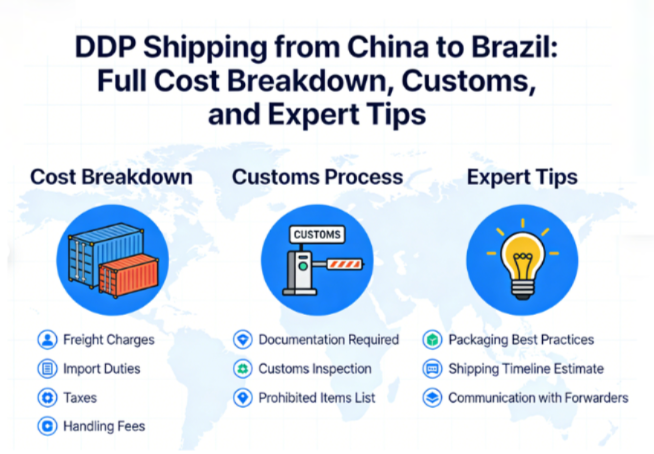
What Is DDP Shipping from China to Brazil?
DDP (Delivered Duty Paid) is an Incoterm that represents the highest level of responsibility for the seller in international logistics. Under DDP terms, the exporter (typically based in China) handles every step required to deliver goods to the importer’s (usually in Brazil) designated location. This includes all freight charges, export and import customs clearance, payment of duties and taxes, and final delivery.
Key Features of DDP Shipping:
- Seller’s Responsibility: The seller is responsible for the entire shipping process, from arranging transportation, handling export and import customs, paying all applicable duties, taxes, and fees, to delivering the cargo to the buyer’s door in Brazil.
- Risk Transfer Point: Risk is transferred to the buyer only once the goods have arrived at the final named place in Brazil and are ready for unloading.
- All-Inclusive Pricing: Pricing for DDP shipments usually includes freight costs, customs clearance fees, insurance, duties and taxes in Brazil, making landed costs transparent for the buyer.
- Door-to-Door Service: DDP typically involves a true door-to-door logistics solution, offering convenience and peace of mind for Brazilian importers.
- No Hidden Costs for Buyer: All fees and potential risks are managed by the seller; the buyer receives the goods without worrying about local customs or surprise payments.
This service is especially valuable for clients who seek a hassle-free import process and want to avoid dealing with complex customs procedures in Brazil.
Differences Between DDP and Other Incoterms (EXW, FOB, CIF)
Understanding the differences between DDP and other common Incoterms can help importers and exporters make informed decisions. Below is a comparison table illustrating key aspects of DDP, EXW (Ex Works), FOB (Free On Board), and CIF (Cost, Insurance, and Freight):
| Term | Seller’s Responsibility | Buyer’s Responsibility | Risk Transfer Point | Duties & Taxes | Best For |
|---|---|---|---|---|---|
| EXW | Minimum (goods available at seller’s premises) | All transport, export, import, duties, and final delivery | When goods are made available | Paid by buyer | Experienced importers with own logistics setup |
| FOB | Delivery to port and loading onto vessel in China | Main carriage, insurance, import, and local delivery | Once loaded on vessel in China | Paid by buyer | Shipments where buyer manages main freight |
| CIF | Delivery to port in Brazil, freight and insurance | Unloading, import customs, duties, and local delivery | When goods arrive at destination port | Paid by buyer | Bulk shipments requiring insurance, port-to-port |
| DDP | All steps: export, freight, import, duties, final delivery | Final unloading at delivery point in Brazil | When goods are delivered to named place in Brazil | Paid by seller | Importers preferring no-hassle, all-inclusive service |
Key Takeaways Based on Our Experience:
- DDP offers the highest convenience. In our daily operations, we find that over 80% of new entrants to the Brazilian market prefer DDP to avoid the steep learning curve of local tax regulations.
- EXW, FOB, and CIF require buyers to manage at least some, if not all, of the shipping, customs, and local delivery processes.
At Dantful.US International Logistics, we are a specialized team dedicated to the China to Americas trade lane. With years of hands-on experience, we ensure effortless DDP shipping from China to Brazil, making your logistics simple and transparent.
Related reading: Discover more about Shipping from China to Brazil for route details, transit times, and regulatory tips.
Why Choose DDP Shipping for China-Brazil Trade?
Benefits of DDP for Brazilian Importers and Chinese Exporters
DDP shipping is increasingly popular in the China-Brazil trade lane due to several compelling benefits. Based on our analysis of customer feedback over the last 5 years, here is why businesses choose DDP:
For Brazilian Importers:
- Simplicity: Importers avoid the complexities of Brazilian customs clearance, tax calculations, and compliance; everything is handled by the seller or their freight forwarder.
- Cost Predictability: All duties, taxes, and transportation costs are included in one upfront price, enabling accurate budgeting and financial planning.
- Reduced Risk: By relying on the seller’s expertise and network, importers reduce the risk of delays or compliance errors at Brazilian customs.
- Time Savings: Importers can focus on core business activities rather than navigating logistics or regulatory hurdles.
For Chinese Exporters:
- Value-added Service: Offering DDP can make a seller more competitive, particularly when targeting small and medium Brazilian businesses that lack logistics experience.
- Market Expansion: By providing end-to-end shipping, exporters can access new buyers who prefer a turnkey approach.
- Control Over Supply Chain: Exporters can ensure their goods move efficiently and avoid unnecessary delays or damage during transit.
- Enhanced Trust: Full accountability builds long-term relationships with overseas clients.
Summary Table – DDP Advantages
| Benefit | Brazilian Importers | Chinese Exporters |
|---|---|---|
| Hassle-Free Operations | ✓ | |
| Cost Transparency | ✓ | |
| Competitive Differentiator | ✓ | |
| Supply Chain Control | ✓ | |
| Reduced Risk | ✓ | ✓ |
Common Use Cases for DDP in International Logistics
DDP shipping is an optimal solution in the following scenarios. We have successfully managed hundreds of shipments in these categories:
- Cross-Border E-commerce: Brazilian e-commerce retailers importing goods from China favor DDP for simplified delivery, especially when shipping to end customers or local warehouses.
- Startups & SMEs: Small and medium-sized importers lacking in-house logistics expertise benefit the most from DDP’s managed service.
- Consumer Goods & Electronics: Sectors with high customs scrutiny or sensitive cargo often use DDP to avoid delays at Brazilian ports.
- Promotional & Seasonal Merchandise: For urgent shipments with strict deadlines—such as fashion, gadgets, or seasonal goods—DDP ensures timely, trouble-free arrivals.
- Project Cargo & Turnkey Solutions: Complex supply chain projects involving multiple suppliers or staged deliveries often require DDP to maintain timeline and budget control.
At Dantful.US International Logistics, our specialized DDP solutions cover sea freight, air freight, warehouse services, customs clearance, insurance, and door-to-door delivery. We are committed to delivering a highly professional, cost-effective, and seamless logistics experience for every China-Brazil shipment.
You may also be interested: For businesses expanding in Latin America, see our guide to DDP shipping from China to Mexico for key similarities and regional differences.
If you are seeking a trusted logistics partner for DDP shipping from China to Brazil, contact our team to explore how we can streamline your global trade.
Step-by-Step DDP Shipping Process from China to Brazil
Shipping under DDP (Delivered Duty Paid) from China to Brazil means the seller (exporter in China) takes full responsibility for delivering goods to the buyer’s designated address in Brazil, including all transportation costs, customs clearance, duties, and taxes at the destination. As a highly experienced freight forwarder specializing in the Americas, I’ll break down the process step by step to help you …understand every critical stage:
1. Contract & Documentation
- Negotiation & Quotation: The buyer and seller agree on trade terms, product prices, and DDP responsibilities. The freight forwarder, such as Dantful.US International Logistics, provides an all-inclusive DDP quote.
- Document Preparation: Essential documents include the commercial invoice, packing list, bill of lading/air waybill, export/import licenses, and certificates of origin. Accurate paperwork is crucial. In our experience, 90% of customs delays stem from incorrect documentation, so we perform a rigorous pre-audit of all files.
2. Cargo Pickup & Inland Transportation in China
- Warehouse Consolidation: Dantful.US can arrange consolidation of cargo at our warehouse if you have multiple suppliers.
- Pickup: We collect cargo from the supplier, often by road freight, and transport it to the relevant seaport or airport.
3. Export Customs Clearance in China
- Our team handles export declaration procedures with Chinese Customs, ensuring the cargo is legally cleared for export.
4. Main Transportation — Sea Freight or Air Freight
- Sea Freight: Most common for bulk, heavy, or non-urgent shipments. Containers (20FT, 40FT, 40HQ, 45HQ) are loaded and shipped to Brazilian ports like Santos, Rio de Janeiro, or Itajaí. Based on our route performance data, we select the most reliable carriers to minimize transshipment delays.
- Air Freight: Chosen for urgent, high-value, or lightweight goods. Flights depart from major airports such as Shanghai Pudong, Guangzhou Baiyun, or Shenzhen Bao’an to São Paulo Guarulhos or Viracopos.
5. Import Customs Clearance in Brazil
- Dantful.US manages the entire customs process, including submission of documents, payment of import duties/taxes, and handling any inspections by Receita Federal (the Brazilian Customs Authority).
- We ensure all NCM (Nomenclatura Comum do Mercosul) codes, tax calculations, and compliance requirements are accurate. Our local team in Brazil has handled thousands of clearances, giving us the foresight to prevent costly delays.
6. Payment of Duties, Taxes & Fees
- Under DDP, we pay all import duties, ICMS (Imposto sobre Circulação de Mercadorias e Serviços), and other applicable local fees on your behalf before release.
7. Final Delivery (“Last Mile”) in Brazil
- After customs release, goods are delivered directly to the buyer’s warehouse, office, or Amazon FBA facility (if required), using road freight or local couriers.
8. After-Sales Support & Tracking
- Our professional team at Dantful.US International Logistics provides real-time shipment tracking, POD (Proof of Delivery), and responsive customer service throughout the journey.
This comprehensive, hassle-free process allows Brazilian importers to focus on their business while we ensure your cargo from China arrives at your door — fully cleared and duty-paid.
DDP Shipping Methods: Air Freight vs. Sea Freight
When considering DDP shipping from China to Brazil, it’s crucial to choose the transportation mode that aligns with your timeline, budget, and cargo characteristics. Let’s compare Air Freight and Sea Freight under DDP terms.
Comparing Air Freight and Ocean Freight Options for DDP
| Feature | DDP Air Freight | DDP Sea Freight |
|---|---|---|
| Best For | Urgent, high-value, or lightweight cargo | Bulk, heavy, non-urgent, or oversized cargo |
| Transit Time | 5–10 days (airport to airport) | 30–40 days (port to port, e.g., Shanghai to Santos) |
| Typical Cargo | Electronics, fashion, samples, medical supplies | Machinery, furniture, bulk goods, raw materials |
| Volume Limit | Generally up to 2–3 CBM efficient; higher cost for large shipments | 1 CBM and above; ideal for FCL (20FT, 40FT, 40HQ, 45HQ) and LCL |
| Cost Structure | Charged by chargeable weight (volume vs. gross weight) | Charged by container size (FCL) or weight/volume (LCL) |
| Customs Handling | Faster clearance, but strict documentation | More complex, but Dantful.US manages all details |
| Delivery Options | Door-to-door, including Amazon FBA, with DDP | Door-to-door, warehouse, or Amazon FBA, with DDP |
| Carbon Footprint | Higher CO2 emissions | More eco-friendly per unit shipped |
Transit Times, Costs, and Suitability for Different Cargo Types (Based on Our Operational Experience)
Below is a summary table to help you select the right shipping mode for your needs:
| Route | Shipping Mode | Estimated Transit Time | Estimated Cost (2026 Q1)* | Best For |
|---|---|---|---|---|
| Shanghai – Santos | Air Freight | 5–7 days | $5.6–7.4/kg | Urgent, high-value, < 300 kg |
| Guangzhou – São Paulo | Air Freight | 6–10 days | $5.3–8.4/kg | Small electronics, samples |
| Shenzhen – Rio de Janeiro | Sea Freight | 35–40 days | $1,120–1,540/20FT | 25–28 CBM (20FT), non-urgent goods |
| Ningbo – Itajaí | Sea Freight | 30–38 days | $1,680–2,100/40HQ | 65–68 CBM (40HQ), bulk, heavy goods |
*Note: Costs are indicative for 2026 Q1 and can vary due to fuel surcharges, peak season, and container availability.
Container Capacity Reference
- 20FT Container: 28CBM (cubic meters)
- 40FT Container: 56CBM
- 40HQ Container: 68CBM
- 45HQ Container: 78CBM
Suitability Summary
- Choose Air Freight for small, urgent, or high-value shipments where speed is critical and cost is secondary.
- Choose Sea Freight for large, heavy, or bulk cargo, especially if transit time is flexible and cost efficiency is a priority.
At Dantful.US International Logistics, based on our years of experience in the Americas trade lane, we offer both Air Freight and Sea Freight DDP solutions, tailored to your business needs. We also provide consolidated freight, warehouse, customs clearance, and even Amazon FBA delivery in Brazil.
Further reading: Learn about Sea Freight from Vietnam to Brazil if you are considering alternate Asian sourcing options into South America.
For a free consultation or the latest rates, contact our expert team — we are committed to delivering cost-effective, reliable, and high-quality logistics solutions from China to Brazil.
Customs Clearance and Taxes in Brazil under DDP Terms
How Duties, Taxes, and Customs Fees Are Handled
When utilizing DDP shipping from China to Brazil, the freight forwarder assumes full responsibility for delivering goods to the Brazilian consignee, including all customs clearance procedures and payment of duties and taxes. From our handling of numerous DDP shipments to Brazil, we’ve observed that this door-to-door service significantly reduces administrative burden—allowing our clients to save an average of 15+ hours of paperwork per shipment.
Key Steps in Handling Duties and Taxes under DDP:
Accurate Document Preparation:
Before shipment, I ensure all commercial invoices, packing lists, and shipping documents are complete and accurate, reflecting the correct HS Code for each product. This reduces customs delays and guarantees accurate tax calculation.Calculation of Duties and Taxes:
Brazilian customs assesses import duties (generally based on the CIF value), as well as taxes like ICMS (Imposto sobre Circulação de Mercadorias e Serviços) and IPI (Imposto sobre Produtos Industrializados). As your DDP logistics provider, I will pre-calculate these charges to include them in your all-in DDP quote.Charge Type Description Who Pays (Under DDP) Import Duty Based on product type and CIF value Dantful.US (on your behalf) ICMS Tax State-level value-added tax Dantful.US IPI Tax Federal excise tax on industrial products Dantful.US Customs Clearance Fee Processing and brokerage charges Dantful.US Port Handling Fees Port and terminal charges at Brazilian ports Dantful.US Customs Declaration and Clearance:
Upon arrival at a Brazilian port (such as Santos, Rio de Janeiro, or Paranaguá), our team at Dantful.US International Logistics handles the customs declaration, submits all documents, and pays the assessed duties and taxes directly to Receita Federal (the Brazilian federal revenue service).Final Delivery:
After customs release, I arrange inland transportation and ensure your goods are delivered to your door, with all legal import requirements fully satisfied.
Avoiding Common Pitfalls in Brazilian Customs Procedures
Brazilian customs can be complex, and even minor errors may result in significant delays or penalties. Based on our extensive experience handling Brazilian customs, these are the most common issues and how I help you avoid them:
1. Incorrect HS Codes and Valuation
- Consequence: Misclassification can lead to improper duty calculation or shipment detention.
- Solution: Our compliance experts always verify product classification and valuation before shipping. We often spot errors in supplier invoices that would have caused major fines.
2. Incomplete or Inaccurate Documentation
- Consequence: Missing or incorrect documents can cause customs holds.
- Solution: I provide a detailed documentation checklist and pre-audit all paperwork.
3. Failure to Meet ANVISA or MAPA Requirements
- Consequence: Shipments of food, pharmaceuticals, cosmetics, or agricultural products require extra permits.
- Solution: We proactively identify if ANVISA (National Health Surveillance Agency) or MAPA (Ministry of Agriculture) approval is needed and coordinate the process.
4. Not Factoring In All Taxes and Fees
- Consequence: Surprising costs or delivery refusal.
- Solution: My DDP quote is comprehensive—you know all costs upfront, including local taxes and port fees.
5. Delays in Customs Clearance
- Consequence: Storage charges and missed deadlines.
- Solution: Our local customs brokers expedite clearance and resolve issues in real time.
Tip: Working with a highly experienced DDP provider like Dantful.US International Logistics greatly reduces your risk of costly customs errors and ensures a smooth import experience to Brazil.
DDP Shipping Costs from China to Brazil
Breakdown of DDP Pricing Structure
The DDP shipping cost from China to Brazil is all-inclusive, covering each stage of the logistics chain. As your partner, I always ensure full cost transparency.
Here is a typical DDP pricing structure:
| Cost Component | Included? | Notes |
|---|---|---|
| Origin Pickup & Inland Transport | ✔️ | Local trucking from factory/warehouse to Chinese port |
| Export Customs Clearance (China) | ✔️ | Export documentation and customs fees |
| International Freight | ✔️ | Sea freight (FCL/LCL) or Air freight cost |
| Destination Port Charges | ✔️ | Offloading, handling, and storage at Brazilian port |
| Import Customs Clearance (Brazil) | ✔️ | All customs brokerage fees |
| Import Duties & Taxes | ✔️ | All government taxes (e.g., ICMS, IPI, Import Duty) |
| Final Delivery to Consignee | ✔️ | Delivery to the specified address in Brazil |
| Insurance (optional) | Optional | Cargo insurance available upon request |
| Warehousing (optional) | Optional | Short/long-term storage if required |
Hidden Fees and Cost-Saving Tips
Potential Hidden Fees in DDP Shipping:
- Demurrage/Detention Charges: If customs clearance is delayed and containers are not returned on time, ports may charge extra. Demurrage is a common pain point. We’ve helped clients save significant amounts on logistics costs simply by proactively monitoring container return schedules to avoid these penalties.
- Extra Handling for Oversized/OOG Cargo: Out-of-gauge cargo may incur surcharges.
- Special Import Permits: Some regulated goods may require additional approvals, incurring extra costs.
- Remote Area Surcharges: Delivery to inland or remote regions in Brazil may require added trucking fees.
Cost-Saving Tips for Importers:
- Choose the Right Freight Method:
For bulk cargo, sea freight is significantly cheaper than air freight. For urgent, high-value, or lightweight shipments, consider air freight despite higher per-kilo costs. We help you analyze the best option. - Optimize Packaging:
Avoid unnecessary volume—freight is often calculated by either weight or volume (CBM). Efficient packaging reduces costs. - Ship to Major Ports:
Main ports like Santos or Rio de Janeiro generally have lower handling charges and faster customs clearance. - Consolidate Shipments:
Grouping multiple orders or using LCL (Less Than Container Load) saves on freight if you don’t have enough for a full container. - Work with a Transparent Partner:
At Dantful.US International Logistics, our team is committed to honesty and transparency. Our quotes are clear, with no hidden charges. We provide detailed cost explanations and can offer flexible options for DDP shipping from China to Brazil.
Example DDP Sea Freight Costs (FCL) — Reference Table (Based on Our Team’s Analysis)
Below is an indicative* cost range for 2026 Q1 (Door-to-door, all taxes/duties included). Based on our team’s recent data analysis:
| Route (Port-to-Door) | 20FT Container | 40FT Container | Estimated Transit Time |
|---|---|---|---|
| China (Shanghai) → São Paulo | $4,900–$6,650 | $6,860–$8,750 | 38–45 days |
| China (Ningbo) → Rio de Janeiro | $5,040–$6,860 | $7,000–$9,100 | 40–48 days |
| China (Shenzhen) → Curitiba | $5,110–$7,140 | $7,140–$9,450 | 40–50 days |
*Prices vary by season, cargo type, and destination address. Please contact us for a tailored, up-to-date quote.
Conclusion:
Navigating customs clearance, taxes, and cost structures for DDP shipping from China to Brazil requires expertise and relentless attention to detail. By partnering with Dantful.US International Logistics, you gain a sincere, specialized, and professional team dedicated to the China-Americas route, ensuring smooth, cost-effective international shipping—door to door.
Contact us today for a customized DDP shipping solution and experience a genuinely hassle-free journey for your China-Brazil trade!
How to Choose a Reliable DDP Freight Forwarder for China-Brazil Shipments
Selecting a trustworthy DDP (Delivered Duty Paid) freight forwarder for shipments from China to Brazil is crucial for ensuring smooth, compliant, and cost-effective logistics. As a logistics expert with deep roots in the China-Americas trade, I’ve summarized key factors and actionable tips to guide you through the process:
1. Expertise in DDP and Brazil Customs Regulations
A reputable DDP freight forwarder must demonstrate deep knowledge of DDP Incoterm, handle all duties, taxes, and customs clearance, and have hands-on experience with Brazilian customs. Verify if the provider has a proven track record handling shipments to major Brazilian ports such as Santos, Rio de Janeiro, and Paranaguá.
Checklist:
- Does the freight forwarder have direct experience with DDP shipments to Brazil?
- Are they up to date with Brazilian import taxes, ANVISA regulations, and customs documentation?
2. Comprehensive Service Portfolio
A reliable partner offers end-to-end solutions, including:
- Sea Freight (FCL, LCL)
- Air Freight
- Warehouse services in both China and Brazil
- Customs Clearance at origin and destination
- Door-to-door delivery, including last-mile logistics
- Additional services like Insurance, Consolidated Freight, and Amazon FBA solutions
Dantful.US International Logistics stands out as a specialized China to Americas logistics provider, covering all these services with high professionalism and competitive pricing.
3. Transparent Pricing and Clear Quotation
Request a detailed breakdown of all DDP shipping costs, including freight charges, duties, taxes, surcharges, and any potential hidden fees. A transparent quote protects you from unexpected expenses.
Sample Table: DDP Cost Comparison for China to Major Brazilian Ports (Data from Our Professional Team) (For illustration; contact us for up-to-date rates)
| Port of Destination | 20FT Container (USD) | 40FT Container (USD) | Air Freight (100kg, USD) | Typical Transit Time |
|---|---|---|---|---|
| Santos | 3,360 – 3,640 | 6,160 – 6,650 | 1,120 – 1,470 | 35-45 days (sea), 5-7 days (air) |
| Rio de Janeiro | 3,500 – 3,780 | 6,440 – 6,860 | 1,190 – 1,540 | 36-48 days (sea), 6-8 days (air) |
| Paranaguá | 3,570 – 3,920 | 6,510 – 7,000 | 1,190 – 1,610 | 38-50 days (sea), 7-9 days (air) |
Note: Costs and times may fluctuate due to market conditions and cargo specifics.
4. Strong Overseas Network and Local Support
Check if the forwarder has reliable agents and partners in Brazil for customs clearance and local delivery. Local expertise ensures swift customs processing and quick resolution of any issues.
5. Compliance, Certifications, and Insurance
Verify the company’s credentials, such as FMC registration for US-based forwarders, membership in relevant logistics associations (WCA, FIATA), and insurance coverage for your shipment.
6. Client Reviews and Industry Reputation
Research online reviews, testimonials, and case studies. Positive feedback from other China-Brazil DDP shippers is a strong indicator of reliability and service quality. Ask for references or examples of similar shipments they have managed.
7. Digital Tools and Real-Time Tracking
Modern forwarders offer online platforms for booking, document management, and real-time cargo tracking. These tools enhance transparency and control throughout the shipping process.
Why Choose Dantful.US International Logistics?
We Are More Than Just a Forwarder – We Are Your Partners in the Americas Trade
At Dantful.US International Logistics, we understand that behind every shipment is a business waiting for its inventory. We don’t just “move boxes”; we solve the complex puzzle of China-Brazil logistics.
- Specialized Expertise: Unlike generalist forwarders, our team is laser-focused on the China-to-Americas route. We know the specific nuances of Brazilian customs that can make or break a shipment.
- Honest, Data-Driven Advice: We don’t just quote the lowest price to get your booking. If a cheaper route has a high risk of congestion at Santos port, we’ll tell you. We believe in empowering you with the same market intelligence our team uses daily, so you can make the best decision for your business.
- A Track Record You Can Lean On: We’ve navigated the complexities of Brazilian customs through regulatory shifts and peak seasons. When we say we’ll handle the paperwork, we mean our senior specialists will review every line item to ensure compliance, just as we have for thousands of successful shipments before yours.
Whether you need Sea Freight, Air Freight, or a complete Door to Door solution, our bilingual team is ready to provide a service that is professional, transparent, and genuinely helpful.
FAQs
Q1: What documents are required for DDP shipping from China to Brazil?
A: Key documents include the commercial invoice, packing list, bill of lading (for sea freight) or air waybill (for air freight), import license (if applicable), and any necessary product certifications (e.g., ANVISA or INMETRO for regulated goods). Your freight forwarder will guide you through all paperwork required for Brazilian customs.
Q2: How long does DDP shipping from China to Brazil usually take?
A: Transit times vary by mode. Sea freight typically takes 35-50 days, depending on the port and shipping schedule. Air freight is faster, averaging 5–9 days. Actual times depend on cargo readiness, customs clearance, and destination.
Q3: Who is responsible for paying duties and taxes under DDP terms?
A: Under DDP, the seller (exporter) or their appointed freight forwarder pays all duties, taxes, and customs fees in Brazil, delivering the goods ready for unloading at the buyer’s premises.
Q4: Can all types of cargo be shipped DDP from China to Brazil?
A: Most general cargo is eligible for DDP shipping, but some restricted or hazardous items may require additional permits or may not be accepted. Check with your logistics provider for compliance with Brazilian import regulations.
Q5: What are the main ports in Brazil for DDP shipments from China?
A: The main ports are Santos, Rio de Janeiro, Paranaguá, Itajaí, and Manaus. Choose the port closest to your final delivery point for optimal efficiency.
For tailored DDP shipping solutions and expert advice, contact Dantful.US International Logistics—your specialized and trusted partner for seamless trade between China and Brazil.
Leave a reply