

Why Logistics Risk Is Now a Board-Level Issue?
For many exporters, logistics risk used to be synonymous with delays, port congestion, or fluctuating freight rates. These risks were operational in nature and largely manageable through experience and contingency buffers.
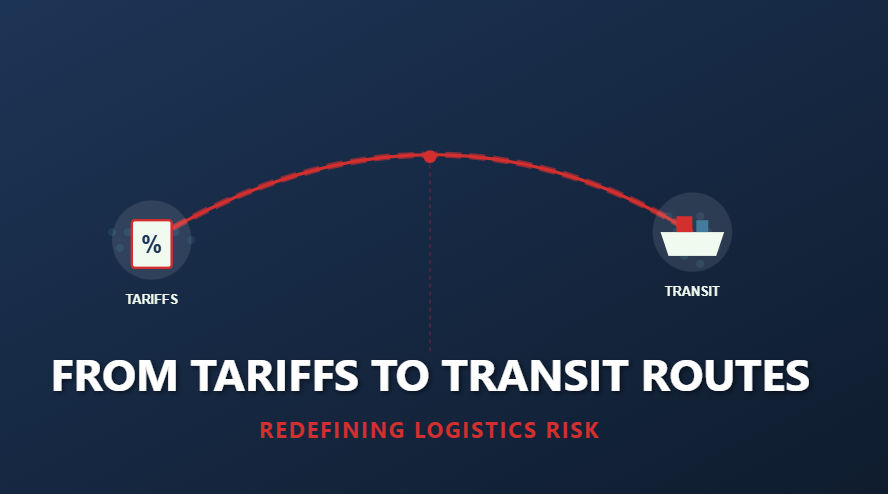
That definition is no longer sufficient.
Between late 2025 and 2026, exporters shipping from China to the United States and broader Americas region have entered a new environment where trade policy, regulatory enforcement, and routing decisions intersect directly with logistics execution.
Tariff investigations, origin scrutiny, and evolving shipping routes are no longer abstract policy discussions. They now influence:
- Which routes are viable
- How cargo should be classified and documented
- Whether shipments clear customs smoothly or face costly delays
In this context, logistics risk has evolved from an operational concern into a strategic and financial issue — one that senior management can no longer afford to overlook.
The New Risk Landscape: When Policy and Logistics Collide
Trade Investigations as a Structural Reality
U.S. trade enforcement actions — including Section 301 tariffs, anti-dumping investigations, and enhanced customs scrutiny — have become a persistent feature of the trade environment rather than a temporary measure.
Unlike sudden tariff hikes in earlier trade cycles, recent actions are characterized by:
- Longer enforcement horizons
- Broader product coverage
- Increased scrutiny of documentation and origin claims
For exporters, this means that compliance risk is no longer limited to a specific product category or time period. It has become embedded in daily shipping operations.
Logistics Decisions Now Influence Regulatory Exposure
One of the most significant changes exporters face is that logistics decisions themselves can increase or reduce policy-related risk.
Examples include:
- Route selection affecting perceived origin risk
- Transshipment patterns triggering additional customs checks
- Inconsistent documentation across shipments raising red flags
As a result, logistics is no longer policy-neutral. Every routing and documentation choice carries potential compliance implications.
Tariffs Are Only the Visible Cost: Understanding the Hidden Risks
Beyond Duty Rates
When exporters assess tariff impact, the focus is often on headline duty percentages. While important, tariffs represent only the most visible cost layer.
Less visible — but often more disruptive — are:
- Cargo inspections and holds
- Requests for additional documentation
- Post-clearance audits
- Shipment delays cascading through inventory planning
These indirect consequences can erode margins far more quickly than a known tariff rate.
The Compounding Effect on Supply Chains
A single delayed shipment does not exist in isolation. It can trigger:
- Missed delivery commitments
- Production line disruptions
- Inventory imbalances
- Lost customer confidence
In highly competitive markets, reliability often matters as much as price. Logistics risk therefore becomes a competitive factor, not just a cost issue.
Routing Strategy as Risk Management
Direct vs. Indirect Routes: A Risk-Based Perspective
With the expansion of direct shipping routes between China and the Americas, exporters are presented with more options — but also more responsibility.
From a risk perspective:
- Direct routes reduce handling points but concentrate exposure
- Indirect routes increase flexibility but introduce complexity
Neither option is inherently safer. The appropriate choice depends on:
- Cargo type and value
- Delivery timelines
- Regulatory sensitivity
- Destination market characteristics
A risk-aware logistics strategy—the kind Dantful.US develops for high-volume exporters—evaluates routes not only on speed and cost, but also on resilience under regulatory pressure.
The Importance of Contingency Planning
In a tightening policy environment, contingency planning is no longer optional.
Key questions exporters should ask include:
- What happens if a shipment is held for inspection?
- Are alternative routes or ports pre-approved?
- How quickly can documentation be adjusted if requirements change?
Freight forwarders play a critical role in designing these fallback scenarios before disruptions occur.
Documentation and Classification: The Most Underestimated Risk Factor
Why Errors Are Increasingly Costly
As enforcement intensity rises, customs authorities rely heavily on data consistency. Even minor discrepancies between:
- Commercial invoices
- Packing lists
- Bills of lading
- HS codes
can trigger inspections or audits.
In many cases, exporters assume documentation accuracy is a purely administrative task. At Dantful.US, we treat it as a critical risk control mechanism.
The Forwarder’s Role in Documentation Governance
A professional freight forwarder does more than transmit documents. Responsibilities increasingly include:
- Reviewing classification logic
- Ensuring consistency across shipments
- Flagging potential risk areas based on destination rules
This governance function becomes especially important for exporters shipping multiple SKUs across different markets.
Why Low-Cost Logistics Can Increase Risk
The Illusion of Savings
In periods of cost pressure, exporters often gravitate toward the lowest-priced logistics options. However, aggressive pricing strategies may involve:
- Complex routing structures
- Marginal compliance practices
- Limited transparency
While such approaches may reduce upfront freight costs, they can significantly increase downstream risk exposure.
Risk-Adjusted Cost Thinking
A more sustainable approach is to evaluate logistics decisions on a risk-adjusted cost basis, considering:
- Probability of delay
- Financial impact of disruption
- Compliance exposure
When assessed holistically, the “cheapest” option is not always the most economical.
Freight Forwarders as Risk Managers, Not Just Operators
A Shift in Expectations
As logistics risk grows, expectations placed on freight forwarders are evolving.
Exporters increasingly look for partners who can:
- Interpret regulatory trends
- Anticipate enforcement focus areas
- Integrate compliance considerations into routing decisions
This represents a shift from transactional service to advisory partnership.
Building Long-Term Resilience
Risk-aware logistics planning emphasizes:
- Transparency over short-term savings
- Flexibility over rigid optimization
- Communication over reactive problem-solving
Forwarders who adopt this mindset—like the dedicated experts at Dantful.US—become an extension of the exporter’s supply chain team.
Conclusion:
Logistics Risk Is No Longer Optional to Manage
The convergence of trade policy enforcement, routing complexity, and supply chain volatility has fundamentally changed the role of logistics in China–Americas trade.
Exporters who continue to view logistics purely as an execution function risk unexpected costs, delays, and compliance challenges. Those who integrate logistics into strategic planning gain control, predictability, and resilience.
In this environment, freight forwarding is no longer about moving cargo from origin to destination. It is about managing uncertainty in a complex global trade system.
The question exporters now face is not whether logistics risk exists — but whether they have the right partners to manage it.
Secure Your Supply Chain with Dantful.US
Don’t let logistics volatility disrupt your business. Whether you are shipping via Sea Freight from Shenzhen or Air Freight to Chicago, Dantful.US provides the strategic oversight and operational excellence you need.
Contact us today for a free, risk-adjusted freight quote.
Leave a reply