

Are you wondering how FOB shipping from China to Mexico works and how it can benefit your import or export business? Understanding FOB (Free On Board) terms is crucial for navigating international trade efficiently and cost-effectively. In this comprehensive guide, based on our team’s extensive experience in the China-Americas trade lane, we’ll break down the FOB shipping process, highlight key ports and shipping routes, explain essential documents, and share expert tips to optimize your China-Mexico freight forwarding. Unlock the secrets to smooth, successful shipments between China and Mexico!
What is FOB Shipping? A Complete Guide for China to Mexico Trade
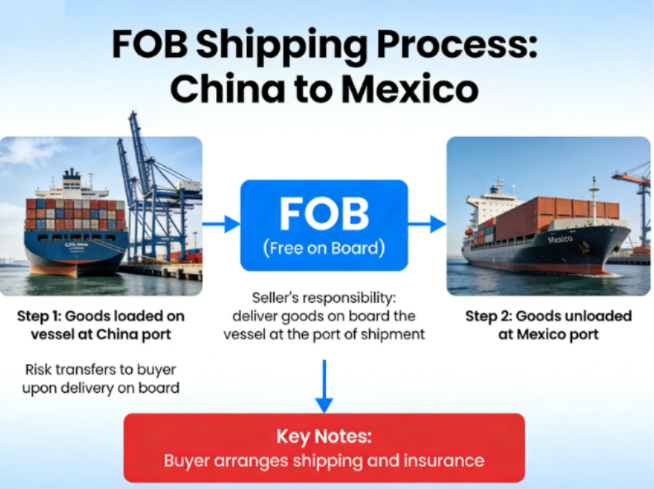
FOB (Free On Board) is one of the most widely used international trade terms (Incoterms) for shipments from China to Mexico. Under FOB, the seller is responsible for delivering the goods to the specified port of shipment (for example, Shanghai, Shenzhen, or Ningbo in China) and loading them onto the vessel nominated by the buyer. Once the cargo passes the ship’s rail at the port, responsibility transfers from the seller to the buyer.
Key features of FOB include:
- The seller handles export customs clearance, inland transportation to the port, and port handling charges in China.
- The buyer assumes all risks and costs after the cargo is loaded, including ocean freight, insurance, import customs clearance in Mexico, and inland transport to the final destination.
- The agreed FOB port is crucial, as it determines the transfer point of risk and cost.
This structure makes FOB a balanced term that clearly defines responsibilities, helping both parties avoid misunderstandings.
How FOB Terms Affect Importers and Exporters
Under FOB, both importers and exporters must understand their responsibilities to prevent issues during the shipping process:
| Party | Responsibilities under FOB |
|---|---|
| Exporter (China) | Packaging, inland transport to port, export customs clearance, port handling, loading onto vessel |
| Importer (Mexico) | Booking the vessel, paying ocean freight, insurance, import customs clearance, inland delivery |
For exporters, FOB terms mean they must ensure timely customs clearance and proper cargo handling at the origin port. For importers, FOB allows control over main carriage (the international shipping leg), often enabling better negotiation of freight rates and easier consolidation with other shipments.
Advantages of Using FOB for China-Mexico Shipments
Choosing FOB for your China to Mexico shipments offers several advantages:
- Cost Control: Importers can select their own freight forwarder, potentially securing more competitive shipping rates and tailored logistics services.
- Transparency: All charges at the port of loading are clear, so importers aren’t caught off guard by unexpected local fees from the seller’s agent.
- Flexibility: Importers can better coordinate shipments, bundle cargo, and choose sailing schedules that match their needs.
- Risk Management: FOB terms clearly define the transfer of risk—once goods are loaded, the buyer is responsible. This clarity helps in arranging insurance and planning logistics.
- Smooth Customs Procedures: Sellers accustomed to export procedures in China ensure that shipments comply with local regulations, minimizing delays.
At Dantful.US International Logistics, our dedicated team specializes in China to Americas logistics. We help customers navigate FOB shipments from China to Mexico with the expertise gained from years of focused service on this route. For more detailed insights on pricing, see our guide on How much to ship a container from China to Mexico.
Step-by-Step FOB Shipping Process from China to Mexico
Booking Freight and Selecting Reliable Suppliers
The shipping journey begins with choosing both your product supplier and an experienced freight forwarder like Dantful.US International Logistics, a specialist in the China-to-Americas trade lane. It’s essential to work with a supplier familiar with FOB terms and a forwarder who understands the unique requirements of the China-Mexico route.
Key steps:
- Confirm that your supplier can deliver under FOB conditions.
- Request detailed quotes from freight forwarders, paying attention to sailing schedules, transit times, and available services (e.g., sea freight, air freight, warehouse, insurance, door-to-door).
- Ensure the forwarder can handle customs clearance and has a track record in handling shipments to Mexico.
If you are also interested in logistics to other key North American markets, you might find our resource on Shipping from China to USA helpful for comparison.
Cargo Preparation, Packaging, and Inland Transport
Proper preparation is key for a safe and efficient journey:
- Cargo Preparation: Ensure products are ready according to contract terms and export standards.
- Packaging: Use export-grade packaging to protect cargo during transport and comply with regulations for both China and Mexico.
- Inland Transport: Arrange trucking or rail from the supplier’s factory to the Chinese export port (e.g., Shanghai, Ningbo, Shenzhen). The seller is responsible for this step under FOB.
Tip: For cost efficiency, consolidate shipments or use appropriate container sizes:
| Container Type | Capacity (CBM) | Typical Use |
|---|---|---|
| 20FT | 28 | Small to medium shipments |
| 40FT | 56 | Standard large shipments |
| 40HQ | 68 | High-volume cargo |
| 45HQ | 78 | Oversized/high-volume |
Export Customs Clearance in China
Before goods can leave China, they must clear export customs. This involves:
- Submitting the commercial invoice, packing list, and other required documents to Chinese customs.
- Ensuring HS codes, product descriptions, and values are accurate.
- The freight forwarder or supplier handles communication with customs authorities and pays any applicable export duties or fees.
At Dantful.US International Logistics, based on our extensive experience handling thousands of shipments, we offer seamless customs clearance services, ensuring strict compliance and minimizing delays for your FOB shipments.
Ocean Freight from Major Chinese Ports to Mexico
Once cleared, cargo is loaded onto the vessel at the chosen Chinese port. The importer (buyer) now bears all risk and cost. Major shipping ports for Mexico-bound freight include Shanghai, Ningbo, Shenzhen, and Qingdao.
Transit time and cost overview:
| Origin Port | Main Destination Port in Mexico | Typical Transit Time (Days) |
|---|---|---|
| Shanghai | Manzanillo | 25-28 |
| Shenzhen | Lázaro Cárdenas | 22-26 |
| Ningbo | Veracruz | 28-32 |
| Qingdao | Altamira | 30-35 |
Transit time depends on route, line, and any transshipment. Please check with your forwarder for current schedules.
Dantful.US International Logistics‘s dedicated Americas team provides real-time tracking, customized sailing schedules, and full support throughout the ocean shipping process. For readers shipping consolidated (LCL) loads, our guide on LCL Shipping from China to Mexico gives further details.
Import Customs Clearance and Final Delivery in Mexico
Upon arrival at the Mexican port, the importer must:
- Arrange for import customs clearance, including submitting the correct documentation (commercial invoice, packing list, bill of lading, and any specific certificates required by Mexican authorities).
- Pay any applicable import duties, taxes, and port handling charges.
- Organize inland transportation from the port to the final destination, such as a warehouse, distribution center, or retail location.
With our deep understanding of Mexican customs regulations, Dantful.US International Logistics can coordinate door-to-door delivery, customs clearance, and even warehouse services in Mexico, providing a true one-stop logistics solution. If you require integrated logistics, including Door to Door Shipping from China to Mexico, our experienced team can assist.
By choosing FOB shipping from China to Mexico, you gain flexibility, control, and transparency. Working with a professional partner specializing in the China-Americas trade lane like Dantful.US International Logistics ensures your goods move safely, efficiently, and in full compliance with international laws and best practices. If you need expert support or a customized shipping solution, our team is ready to assist at every step of your supply chain journey.
Key Ports and Shipping Routes from China to Mexico
Shipping under FOB (Free On Board) terms from China to Mexico involves navigating a network of strategic ports and established ocean routes. Understanding these key points in the supply chain is essential for optimizing shipping times, reducing costs, and ensuring smooth customs clearance. Our analysis of recent shipping data provides a detailed, up-to-date breakdown of the main ports, routes, and timelines relevant for all stakeholders—importers, exporters, procurement managers, and logistics professionals.
Major Chinese Export Ports for Mexico-bound Freight
China is home to some of the world’s busiest and most advanced container ports. For shipments to Mexico, the following ports are most frequently used, thanks to their high efficiency, global connectivity, and access to major manufacturing hubs:
| Chinese Port | Location | Strengths | Typical Cargo for Mexico |
|---|---|---|---|
| Shanghai | East China | Largest container port globally, advanced facilities | Electronics, machinery, apparel |
| Shenzhen | South China | Proximity to tech/manufacturing clusters | Electronics, consumer goods |
| Ningbo-Zhoushan | East China | High throughput, efficient customs | Machinery, textiles, chemicals |
| Guangzhou (Nansha) | South China | Fast-growing, excellent inland connections | Furniture, auto parts, appliances |
| Qingdao | North China | Key link for northern exporters | Industrial goods, steel, chemicals |
| Xiamen | Southeast China | Flexible, growing demand for Latin America | Shoes, garments, home goods |
| Tianjin | North China | Serves Beijing and northern industry zones | Heavy machinery, metals |
When arranging your FOB shipment, your supplier’s location in China typically determines the most suitable port. Efficient inland transport and strong port infrastructure help streamline the export process.
Main Mexican Ports for Receiving Chinese Imports
Mexico features several well-equipped seaports, primarily on its Pacific coast, to handle large volumes of containerized cargo from China. The following ports are key entry points for Chinese goods:
| Mexican Port | Location | Primary Advantages | Main Cargo Received |
|---|---|---|---|
| Manzanillo | Colima (West Coast) | Largest container port in Mexico, top infrastructure | Electronics, auto parts, general goods |
| Lázaro Cárdenas | Michoacán | Deep-water port, accommodates mega-vessels | Bulk cargo, machinery, consumer goods |
| Ensenada | Baja California | Close to US border, strategic for northern Mexico | Electronics, perishables, textiles |
| Veracruz | Gulf Coast | Main gateway to eastern/central Mexico | Machinery, chemicals, agricultural |
For most China-Mexico trade, Manzanillo and Lázaro Cárdenas are the preferred ports due to their size, efficiency, and seamless connections to Mexico’s road and rail networks.
Popular Sea Freight Routes and Transit Times
The primary shipping route from China to Mexico crosses the Pacific Ocean. Most vessels take a direct or transshipment route, often stopping at U.S. West Coast ports, especially for consolidated (LCL) cargo. Here is an overview of estimated transit times for major port pairs:
| Origin Port | Destination Port | Typical Route | Estimated Transit Time (Days) |
|---|---|---|---|
| Shanghai | Manzanillo | Direct/transshipment via U.S. West Coast | 22–28 |
| Shenzhen | Manzanillo | Direct/transshipment via Los Angeles/Long Beach | 20–26 |
| Ningbo | Lázaro Cárdenas | Direct/transshipment via Panama Canal or U.S. | 24–30 |
| Qingdao | Manzanillo | Transshipment | 26–32 |
| Guangzhou | Veracruz | Via Pacific, Panama Canal | 28–35 |
Note: Sea freight transit times may fluctuate due to port congestion, weather, customs checks, and vessel schedules. For the most accurate schedule, consult our specialized team at Dantful.US International Logistics.
FOB Shipping Costs: What Influences Your Total Expenses?
FOB shipping from China to Mexico involves multiple cost elements. Understanding each charge allows for accurate budgeting and effective supplier negotiations. Based on our team’s latest cost analysis for 2026, we break down the typical expenses, key factors influencing freight rates, and strategies for obtaining reliable shipping quotes.
Breakdown of Typical FOB Charges
When using the FOB Incoterm, the seller covers costs up to loading the goods onto the vessel at the port of origin. The buyer takes over from there. Here’s a detailed breakdown:
| Cost Item | Paid By | Description |
|---|---|---|
| Manufacturing Costs | Seller | Production and local handling |
| Inland Transport (Origin) | Seller | Truck/rail from factory to port |
| Export Customs Clearance | Seller | China export documentation and duties (if any) |
| Origin Port Charges | Seller | Terminal handling, loading onto vessel |
| Ocean Freight | Buyer | Main carriage from China to Mexico |
| Insurance | Buyer | Optional but highly recommended |
| Import Customs Clearance | Buyer | Mexican import duties, taxes, customs fees |
| Destination Port Charges | Buyer | Unloading, terminal handling at Mexican port |
| Inland Transport (Destination) | Buyer | Truck/rail delivery to final destination |
Tip: For the most transparent and cost-effective shipping, collaborate with a specialized China-to-Americas logistics provider like Dantful.US International Logistics, who can provide bundled services and expert guidance on every fee.
Factors Affecting Freight Rates
Several dynamic factors impact your overall shipping costs from China to Mexico:
- Cargo Volume & Weight: Full Container Load (FCL, e.g., 20FT/40FT/40HQ/45HQ) is more economical per unit than Less than Container Load (LCL) for larger shipments. Standard container capacities are: 20FT = 28CBM, 40FT = 56CBM, 40HQ = 68CBM, 45HQ = 78CBM.
- Route & Port Pair: Direct routes are faster but may be pricier. Choice of origin and destination ports also affects total cost due to varying port charges.
- Seasonality: Peak seasons (pre-holiday, Chinese New Year, back-to-school) drive up rates due to high demand.
- Fuel Prices & Surcharges: Bunker Adjustment Factor (BAF), Emergency Risk Surcharges (ERS), and other variables can affect ocean freight rates.
- Container Type: Special cargo (e.g., Out-of-Gauge, Refrigerated) costs more than standard dry containers.
- Value-added Services: Insurance, customs brokerage, warehousing, and last-mile delivery add to total expenditure.
- Market Fluctuations: Global trade policies, port congestion, and shipping line capacity also play a role.
How to Get Accurate FOB Shipping Quotes
Obtaining a precise quote involves providing detailed shipping information. Here are the steps to ensure transparency and cost control:
- Specify Cargo Details: Indicate HS code, dimensions, weight, packaging type, and whether cargo is regular, hazardous, or temperature-sensitive.
- Declare Shipping Terms: Clearly state you require an FOB quote, specifying both the origin and destination ports.
- Request Inclusive Quotes: Ask for breakdowns covering ocean freight, destination charges, customs clearance, insurance, and inland delivery if needed.
- Evaluate Transit Time and Reliability: Don’t choose solely on price; reliable transit and professional service reduce risks and hidden costs.
- Partner with a Reputable Freight Forwarder: Dantful.US International Logistics offers highly professional, cost-effective, and high-quality one-stop shipping solutions—including Sea Freight, Air Freight, Amazon FBA, Customs Clearance, Insurance, Warehouse, and more—for businesses trading between China and the Americas. Our team provides transparent quotes, expert support, and tailored logistics strategies for each customer.
If you’re also interested in cost comparisons for shipping to nearby countries, our post on Shipping from China to Brazil provides a useful benchmark for Latin American routes.
Sample FOB Shipping Cost Table (2026 Q1 Estimates):
| Container Type | Shanghai to Manzanillo | Shenzhen to Manzanillo | Ningbo to Lázaro Cárdenas |
|---|---|---|---|
| 20FT | $1,750–$2,250 | $1,680–$2,170 | $1,820–$2,380 |
| 40FT | $2,940–$3,780 | $2,800–$3,640 | $3,010–$3,920 |
| 40HQ | $3,080–$4,000 | $2,940–$3,780 | $3,150–$4,060 |
The prices above are estimates as of 2026 Q1 and subject to change based on market conditions, carrier availability, and specific cargo requirements.
In summary: Understanding the main ports, popular shipping routes, transit times, and the full spectrum of FOB shipping costs will help you make informed logistics decisions. For end-to-end support, transparent pricing, and custom solutions for your China–Mexico supply chain, I recommend working with Dantful.US International Logistics—your trusted partner for China-Americas freight forwarding.
Essential Documents for FOB Shipping from China to Mexico
When using FOB (Free On Board) terms for shipping from China to Mexico, proper documentation is essential. It ensures seamless customs clearance, reduces risks, and helps avoid costly delays. From our experience handling thousands of customs entries, we have compiled a comprehensive overview of the key documents you’ll need, regulatory considerations, and common pitfalls to avoid.
Commercial Invoice, Packing List, and Bill of Lading
1. Commercial Invoice
A Commercial Invoice is the primary document that details the transaction between buyer and seller. It outlines the goods’ value, description, quantity, HS codes, and payment terms. Mexican customs uses this document to assess import duties and taxes. Make sure all information is accurate and consistent with other documents.
2. Packing List
The Packing List provides a detailed breakdown of each package in your shipment, including weight, dimensions, contents, and packaging type. It helps both the customs authorities and logistics providers (like our specialized team at Dantful.US International Logistics) to verify cargo, plan handling, and ensure smooth delivery.
3. Bill of Lading (B/L)
The Bill of Lading is a critical shipping document issued by the carrier or freight forwarder. It serves as:
- A receipt of goods
- Evidence of contract of carriage
- A document of title (important for releasing cargo at destination)
There are two common types for FOB shipments:
- Original Bill of Lading: Required to claim goods at Mexican ports
- Telex/Express Release: Used for faster processing and paperless transfer
| Document | Issuer | Purpose | Importance in FOB Shipping |
|---|---|---|---|
| Commercial Invoice | Exporter/Supplier | Declares value and details of goods | Customs clearance, tax assessment |
| Packing List | Exporter/Supplier | Itemizes packages, weight, measurements | Cargo verification, logistics |
| Bill of Lading | Carrier/Freight Forwarder | Evidence of shipment, contract of carriage | Cargo release, proof of ownership |
Certificates, Permits, and Regulatory Requirements
Depending on your goods, Mexico may require extra certificates and permits. Common examples include:
- Certificate of Origin: Proves the manufacturing country, often needed for preferential tariff treatment under free trade agreements.
- Product-Specific Certificates: Such as phytosanitary certificates for agricultural products, or quality certificates for electronics and machinery.
- Import Permits: Certain goods (pharmaceuticals, chemicals, foodstuffs) require government permits.
- Compliance Certificates: For products subject to safety or quality standards, such as NOM (Norma Oficial Mexicana) certification in Mexico.
Tip: Work closely with your freight forwarder to determine all necessary documents for your cargo type.
Common Mistakes to Avoid with Shipping Documentation
- Inconsistent Information: Discrepancies among documents (values, product descriptions, weight) can trigger customs inspections or delays.
- Missing Signatures/Stamps: Always ensure documents are properly signed, stamped, and, if needed, legalized.
- Incorrect HS Codes: Wrong tariff codes can lead to miscalculated duties or seizure of goods.
- Outdated Templates: Use the latest versions of commercial documents to reflect current regulations.
- Incomplete Certificates: Missing or expired certificates (such as Certificate of Origin) will prevent customs clearance.
Best Practice: Partnering with an experienced China-Mexico specialist like Dantful.US International Logistics greatly reduces risk, as our team provides document preparation guidance and pre-shipment checks to eliminate costly errors.
Tips to Optimize Your China-Mexico FOB Freight Forwarding
Shipping between China and Mexico can be complex, but with the right strategy, you can minimize costs, avoid delays, and ensure cargo safety. Here are proven tips for optimizing your FOB logistics.
Choosing the Best Freight Forwarder for Your Business
Selecting a reliable freight forwarder is critical. Consider the following criteria:
- Industry Experience: Choose a partner with proven experience in the China-Mexico trade lane.
- Service Range: Ensure they offer comprehensive solutions—Sea Freight, Air Freight, Rail Freight, Road Freight, Customs Clearance, Insurance, Door-to-Door, Warehouse, Amazon FBA, OOG Freight, Consolidated Freight, Breakbulk Freight.
- Network Strength: A forwarder with established partnerships at both Chinese and Mexican ports can resolve issues quickly.
- Customer Support: 24/7 support, transparent communication, and digital tracking are must-haves.
- Reputation and Certifications: Look for positive reviews, industry certifications, and compliance with local/international standards.
Why Dantful.US International Logistics?
- We are a highly professional, cost-effective, and high-quality, one-stop international logistics service provider for China-Americas trade.
- Our dedicated Americas team guides you through each shipping stage, ensuring smooth customs clearance, cost savings, and risk reduction.
Negotiating Favorable Terms and Avoiding Hidden Fees
- Clarify FOB Responsibilities: Know exactly where your cost and risk begin—typically when goods cross the ship’s rail at the Chinese port.
- Get All-Inclusive Quotes: Always request detailed quotations covering all charges—origin fees, freight, destination handling, customs, and last-mile delivery.
- Check for Surcharges: Look out for seasonal or port congestion surcharges, documentation fees, and cargo inspection charges.
- Negotiate Payment Terms: Leverage your shipping volume and frequency for better rates and payment flexibility.
- Benchmark Costs: Use industry data or multiple quotes to compare and avoid inflated pricing.
Insurance, Tracking, and Risk Management Strategies
Cargo insurance is a must for international shipments, especially on the China-Mexico route, where risks like damage, loss, or delays can occur.
- Arrange Adequate Insurance: Cover at least the full value of goods, plus freight and a percentage for potential profit or additional costs.
- Choose the Right Policy: Options include All-Risk, Total Loss, and Free of Particular Average (FPA). Consult your forwarder for advice.
- Use Digital Tracking: Opt for a logistics partner offering online tracking, real-time notifications, and supply chain visibility.
- Emergency Support: Ensure your forwarder can provide fast response for incidents like customs holds, port strikes, or natural disasters.
Dantful.US International Logistics leverages deep local knowledge to offer advanced cargo tracking, tailored insurance packages, and proactive risk management—giving you peace of mind from origin to destination.
FAQs
Q1: What are the main documents required for FOB shipping from China to Mexico?
A: You need a Commercial Invoice, Packing List, and Bill of Lading as basic documents. Depending on your product, extra certificates (e.g., Certificate of Origin, NOM certification) or permits may be needed.
Q2: Who is responsible for export customs clearance under FOB terms?
A: The seller in China handles export customs clearance. The buyer arranges and pays for ocean freight, insurance, and import customs clearance in Mexico.
Q3: How can I get an accurate FOB shipping quote from China to Mexico?
A: Provide detailed information to your freight forwarder: cargo description, weight, dimensions, volume (CBM), origin and destination ports, and required services (e.g., door-to-door, insurance).
Q4: How long does sea freight from China to Mexico take?
A: Typically, transit times range from 18 to 30 days, depending on the chosen ports and shipping route. Contact our Americas logistics experts at Dantful.US International Logistics for a tailored schedule.
Q5: What are the estimated shipping rates for 20ft and 40ft containers in 2026?
A: According to our 2026 Q1 data, a 20ft container from China to Mexico typically costs between $1,750 and $2,250, while a 40ft container ranges from $2,940 to $3,780. Rates depend on the specific port pair and market conditions.
Q6: How do peak seasons impact shipping costs and transit times?
A: During peak seasons (like pre-Chinese New Year or Q4 holiday rush), freight rates can increase significantly, and transit times may extend due to port congestion. We recommend booking 3-4 weeks in advance during these periods to secure space and better rates.
For personalized advice and a free quote, contact the Dantful.US International Logistics team today. Your success in the Americas market starts here!
Leave a reply