

Are you a US importer wondering whether FOB (Free On Board) or CIF (Cost, Insurance, and Freight) will save your business more money? The short answer: FOB generally saves US importers 10% to 20% on total landed costs by eliminating hidden destination fees and supplier markups.
Understanding these crucial international shipping terms dictates who controls the freight, where the risk transfers, and how much you ultimately pay to get your goods through US Customs. In this comprehensive guide, we will break down the true costs, expose the common “CIF Trap,” and provide a decision framework to help you choose the most cost-effective shipping solution.
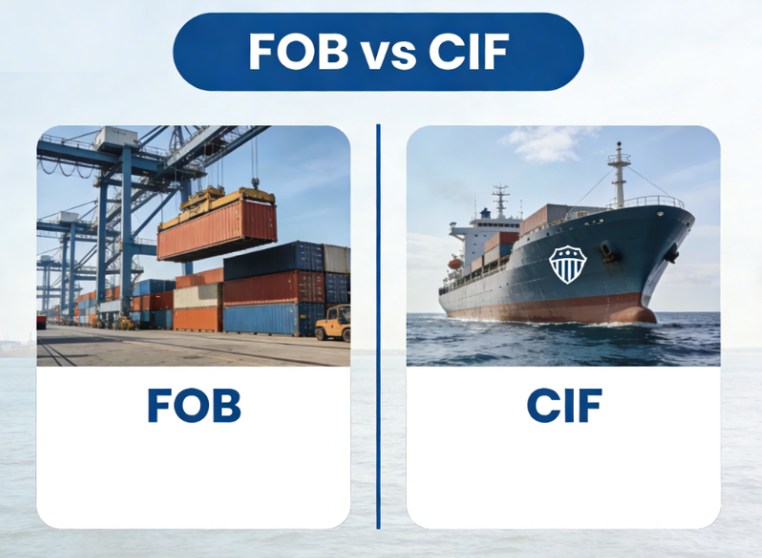
Core Differences: FOB vs CIF
When importing goods into the United States from countries like China, Vietnam, or Taiwan (China), Incoterms define the responsibilities of the buyer and seller.
FOB (Free On Board)
Under FOB, the seller is responsible for all costs and risks up to the point the goods are loaded onto the vessel at the origin port (e.g., Shanghai Port or Shenzhen Port).
- Your Role: You, the US importer, hire your own international freight forwarder specializing in the Americas dedicated line (like Dantful.US International Logistics) to handle the Sea Freight or Air Freight, insurance, and destination delivery. You control the costs.
CIF (Cost, Insurance, and Freight)
Under CIF, the seller pays the main freight and basic insurance to get the goods to the destination port (e.g., Los Angeles Port or New York Port).
- Your Role: Risk transfers to you once goods are loaded at origin, but you rely on the seller’s logistics choices. You must handle customs clearance and pay all local destination charges upon arrival.
Quick Comparison Table
| Feature | FOB (Free On Board) | CIF (Cost, Insurance, and Freight) |
|---|---|---|
| Freight Negotiator | Buyer (You control the rate) | Seller (Often includes a markup) |
| Risk Transfer Point | When loaded on vessel at origin | When loaded on vessel at origin |
| Insurance Quality | Buyer chooses comprehensive coverage | Seller provides minimum (Clause C) coverage |
| Hidden Fees Risk | Low (Transparent forwarder quote) | High (Unexpected destination charges) |
| Customs Control | High (Your broker handles ISF & Entry) | Low (Handled by supplier’s destination agent) |
The “CIF Trap”: Why Suppliers Push CIF
Many new US importers choose CIF because it seems easier—the supplier handles the shipping. However, this often leads to what the logistics industry calls the “CIF Trap.”
Why do overseas suppliers prefer CIF? Because they often receive kickbacks or heavily discounted rates from their local forwarders, while inflating the freight cost on your commercial invoice.
Where US Importers Lose Money on CIF:
- Inflated Destination Charges: When the CIF cargo arrives in the US, the supplier’s destination agent controls the release of the goods. They often charge exorbitant fees (Delivery Order fees, inflated THC, handover fees) that you must pay to get your cargo.
- Poor Insurance Coverage: CIF only requires basic insurance. If your cargo is damaged by water or rough handling, the minimum policy rarely covers the full commercial value.
- ISF Penalties: For US imports, the Importer Security Filing (ISF) must be filed 24 hours before loading. Under CIF, communication delays between the supplier’s agent and your US broker often result in late filings, triggering CBP fines of up to $5,000.
Real-Life Cost Breakdown: FOB vs CIF
To illustrate the true landed cost, let’s compare a standard 20′ GP Container shipped from Shenzhen to Los Angeles.
Assumptions: Cargo value $20,000. Ocean freight market rate is approx $1,500.
| Cost Component | FOB Option (Using Dantful.US) | CIF Option (Supplier Arranged) |
|---|---|---|
| Supplier Invoice (Goods + Origin) | $20,000 | $22,000 (Includes inflated freight) |
| Ocean Freight | $1,500 (Transparent quote) | Included in above |
| Marine Insurance | $60 (Comprehensive All-Risk) | Included (Minimum coverage only) |
| Destination THC | $350 | $600 (Inflated by agent) |
| Delivery Order / Doc Fees | $85 | $250 (Inflated by agent) |
| Customs Clearance | $125 | $125 |
| Total Landed Cost | $22,120 | $23,025 |
Conclusion: Even if the CIF invoice looks appealing initially, the hidden destination fees and freight markups made the CIF shipment nearly $900 more expensive. By choosing FOB, the importer retained full control and visibility.
Customs & Compliance: The FOB Advantage
Smooth Customs Clearance is critical for US importers. Delays at the port result in expensive demurrage and storage fees.
By shipping FOB and using an international freight forwarder specializing in the Americas dedicated line like Dantful.US, you integrate your shipping and customs processes:
- Proactive ISF Filing: We ensure your ISF is filed accurately and on time, avoiding penalties.
- Direct Communication: If CBP flags your shipment for a customs exam (e.g., X-ray or intensive exam), your forwarder can immediately arrange drayage to the exam site, minimizing delays.
- Amazon FBA Readiness: If goods are bound for FBA, an FOB forwarder can seamlessly arrange port pickup, palletizing, and final delivery without relying on disconnected third parties.
Compliance Statement: Customs policies, tariffs, and regulations are subject to change. The information provided is for logistical planning and does not constitute legal or tax advice. Always refer to official U.S. Customs and Border Protection (CBP) guidelines for the most current compliance standards.
Decision Framework: When to Choose Which?
Use these rules to decide which term is best for your current logistics setup:
Choose FOB if:
- You are importing commercial goods regularly (FCL or large LCL).
- You want the lowest total landed cost and no hidden fees.
- You want control over transit times and carrier selection.
- You are shipping to Amazon FBA and need seamless Door to Door integration.
Choose CIF if:
- You are importing a very small, one-off sample shipment where freight cost is negligible.
- You have zero logistics experience and are willing to pay a premium for convenience (though be prepared for destination agent fees).
Why Choose Dantful.US International Logistics?
Navigating the complexities of cross-border trade requires expertise. As a leading international freight forwarder specializing in the Americas dedicated line, Dantful.US provides one-stop, cost-effective logistics solutions for US importers.
- 10+ Years Experience: Deep expertise in the US route, avoiding common pitfalls.
- Transparent Pricing: No hidden fees. Our Door to Door quotes are comprehensive.
- Full-Spectrum Services: From Sea Freight and Air Freight to Customs Clearance, Insurance, and Consolidated Freight.
Contact Dantful.US International Logistics now to streamline your supply chain and protect your profit margins. Let us handle the logistics so you can focus on growing your business!
FAQs
Q: Does CIF mean I don’t pay any shipping fees? A: No. CIF only covers the main ocean/air freight to the destination port. You are still responsible for all US port charges, terminal handling, customs duties, and inland delivery to your warehouse.
Q: Can I change from CIF to FOB with my supplier? A: Yes. Simply ask your supplier to quote the product price based on FOB terms (e.g., “FOB Shanghai”). Then, contact a US freight forwarder to quote the freight.
Q: Who pays the origin customs clearance under FOB? A: Under FOB, the seller is legally responsible for clearing the goods for export and paying all associated origin fees (like origin THC, export documentation, and loading fees).
Leave a reply